I’ve just finished recording a concert’s worth of live looping performances. I’ll be posting these a day at a time, starting later today and continuing through Thanksgiving, 2018. (And there’s a daunting round-number birthday in there somewhere.) I’ve covered my looping setup before, but it’s changed a lot since the last time I wrote about it.
MainStage users, you can download my looping template here. It includes no user patches or third-party plug-ins — it’s just a raw template. But if I’d had this when I started out, it would have saved me a day or two!
Man, I’ve been wanting to do this experiment for ages — and largely because it’s been a black hole off ignorance for me. As mentioned in the video, I used to think they were the same pickup. But as you can hear, they’re quite distinct, and the differences are far from subtle.
Polly’s Firebird is a 1960s original.
Until now I’ve never owned a guitar with either pickup type. My chief experience with mini-humbuckers was when I demoed a set in this sane Strat for my Strat replacement pickups comparison. I liked them there as well, though I was using a set of Seymour Duncans, while these are Lollars. (I’d be cautious about making tone comparisons, since the two videos were recorded using very different tone chains.)
Annie Clark designed her own signature guitar.
I once played Polly Harvey’s original reverse Firebird on a gig, and I wasn’t that blown away at the time. (Though there were many other variables at play.) But I adored the way the Firebird pickups in Annie Clark’s Musicman St. Vincent model sounded, and I gave the instrument a rave review for Premier Guitar. I was struck then, as now, by their extraordinary dynamic response. Small variations in touch yield big tonal contrasts. My hope was that they’d sound like Fender pickups on steroids in a Strat, and to my ear, they do. (By “steroids,” I don’t mean high output — I generally recoil from extra-hot Strat pickups. Tones are simply fatter without neutering the high end as super-hot single coils tend to do.
I liked both pickups sets a great deal, but the Firebirds are a better match for my fingerstyle playing. What do you think?
I was polishing up my solo solo version of this lesser-known Mancini tune, and I was reminded once again of the late composer’s genius. Sure, we all know he was a great tunesmith and brilliant orchestrator. But the deeper you dig into his compositions, the more remarkable things you uncover.
Even though Mancini worked exclusively in pop idioms, I rank Hank as one of the 20th century’s greatest composers. Everything he composed seems to have some remarkable and unlikely compositional twist, even the best-known tunes we take for granted. Consider the slippery chromaticism and crunchy minor-3rd modulations of the Pink Panther theme. Or the familiar “Baby Elephant Walk” melody — if you take a step back, you realize how bizarre it is, rocketing up as an arpeggio before leaping down to a dissonant note. It’s also easy to forget how shocking the Peter Gunn theme was, with those violent dissonant accents, not to mention its unprecedented fusion of brainy Stan Kenton harmonies and greasy guitar rock. (Jobim is the only parallel I can draw in terms of writing wildly original chromatic themes that somehow become universally beloved pop melodies.)
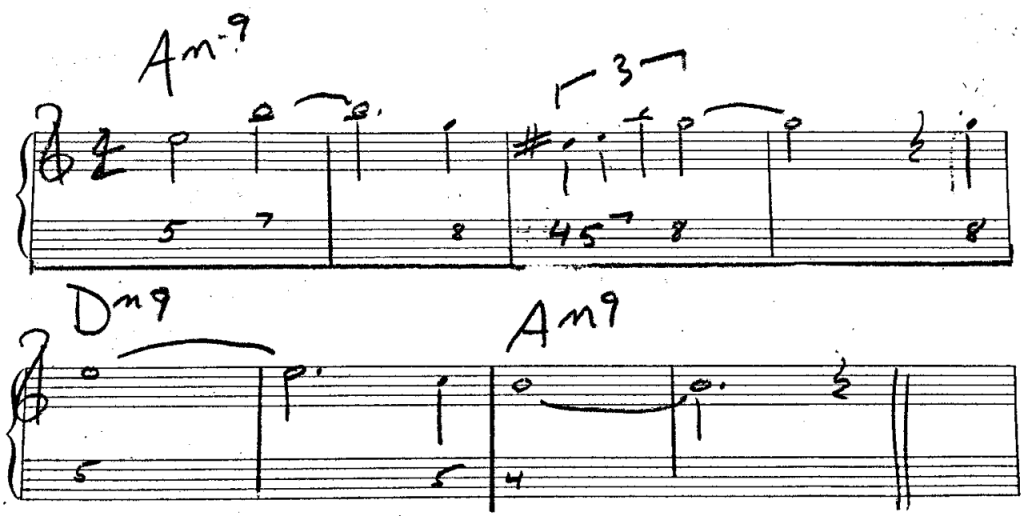
This song is Mancini’s take on the exotica style created by the likes of Martin Denny and Les Baxter. (Mancini was far too tasteful to include exotica’s signature big-call effects, but I lack such restraint.) But check out the cool melody and the way is straddles the underlying harmonies:
We’re in A minor, but no A notes appear in the main melody. Instead, the tune lingers on the 9th, emphasizing B over the Am7 chord and E over the Dm7. Eventually an A does appear — but not till the downbeat of the B second, by which point we’ve embarked on a long, twisted trail of chromatic modulation.
My Mancini obsession goes way back. In the ’90s, I was privileged to play in Oranj Symphonette, a jazz group lead by cellist Mat Brubeck (yeah, Dave’s son) that also included peerless keyboardist Robbie Burger, mad multi-instrumentalist Ralph Carney, and drum titan Scott Amendola (later replaced by the equally awesome Pat Campbell). Sadly, our two Rykodisc albums are out of print, but there’s buttloads of our stuff on YouTube.
I just started a Tonefiend Instagram feed, ’cause I know there’s not enough junk in your inbox. If you’re an Instagram user, feel free to follow. (Or just friend me on Facebook, where all the Instagram images also appear. I’m not picky—I’ll friend anyone, at least till they start posting links to $19 Prada handbag knockoffs.)
Often I don’t post here at tonefiend.com till I’ve cobbled together a relatively substantial item, which means the site can fester for weeks without an update. But for better or worse, I plan to post a steady stream of square cell phone pics compelling images and trivial pithy thoughts on Instagram/FB/Twitter.
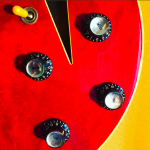
On Instagram, I’m starting out with two weekly posts. Both are pretty silly, but each has inspired some surprisingly cool conversations. The first series is “Name That Gear,” which is simply a close-up shot of some music gizmo, but with some telling detail that reveals its identity. Not much too it, but it can be fun.
Page vs. Wagner: Who’d Win in a Fight?
The other recurring item is “Who’d Win in a Fight?” These are deliberately absurdist: The first post matched Jimmy “Hammer of the Gods” Page against Richard “Twilight of the Gods” Wagner. But amazingly, it inspired a long, fascinating, and drop-dead funny Facebook conversation. (Thanks for my wife for suggesting both ideas.)
Naturally, I’ll also be using those feeds to shamelessly flog my music and gear. I’m going to be showing the first five Joe Gore Pedals stompboxes at the LA Amp Show in Van Nuys, California on October 3rd and 4th—just a couple of weeks from now! The product announcements aren’t quite ready yet, but trust me—I bombarding you with them very soon. 🙂
The rule requires that each U.S. carrier subject to this regulation allow a passenger to carry into the cabin and stow a small musical instrument, such as a violin or a guitar, in a suitable baggage compartment, such as the overhead bin or a closet, or under the seats, in accordance with FAA safety regulations and the carrier’s FAA-approved carry-on baggage program.
Carriers must allow passengers to stow their small musical instruments in an approved stowage area in the cabin if at the time the passenger boards the aircraft such stowage space is available. Under the rule, musical instruments as carry-on items are treated no differently from other carry-on items and the stowage space should be made available for all carry-on items on a “first come, first served” basis. Carriers are not required to give musical instruments priority over other carry-on baggage, therefore passengers traveling with musical instruments may want to buy the pre-boarding option offered by many carriers to ensure that space will be available for them to safely stow their instruments in the cabin.
Maybe we should do like my pal Shelley Doty recommends and carry a copy of this every time we check in for a flight.
I had a lot of fun putting together an article for Premier Guitar on using non-tube distortion. It features a smorgasbord of digital tones guaranteed to horrify tube purists. (It’s certainly horrifying a few commentators on PG‘s Facebook page.)
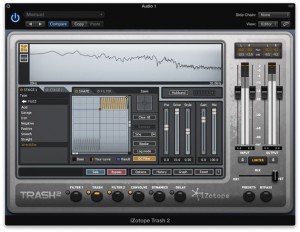
iZotope’s Trash 2 — like version 1, only trashier!
It was also a chance for me to explore iZotope’s Trash 2, on the recombination of my ol’ pal Jeff Cross, who is one of the most super-genius of the super-genius audio guys I’ve worked with at Apple. I was a fan of the first version of Trash, though I didn’t have the opportunity to use it a lot. This generation is even cooler, and seems to focus less energy on conventional amp modeling than on being a wild and open-ended distortion-designing tool. I’ll definitely be spending some more time with this! I also enjoyed playing with FXpansion’s Maul, which covers much similar territory.
Have any of you guys played with some of these digital distortion-designer tools? Any observations?
It’s that time of year when we stop practicing, turn off the soldering irons, and pretend to relate to spend precious time with our loved ones. I’m off to Santa Fe for a visit with my wife’s family (it’s okay — they’re mostly musicians), and I’m especially looking forward to hanging out with my super-cool nephews. So please pardon this zero-effort post.
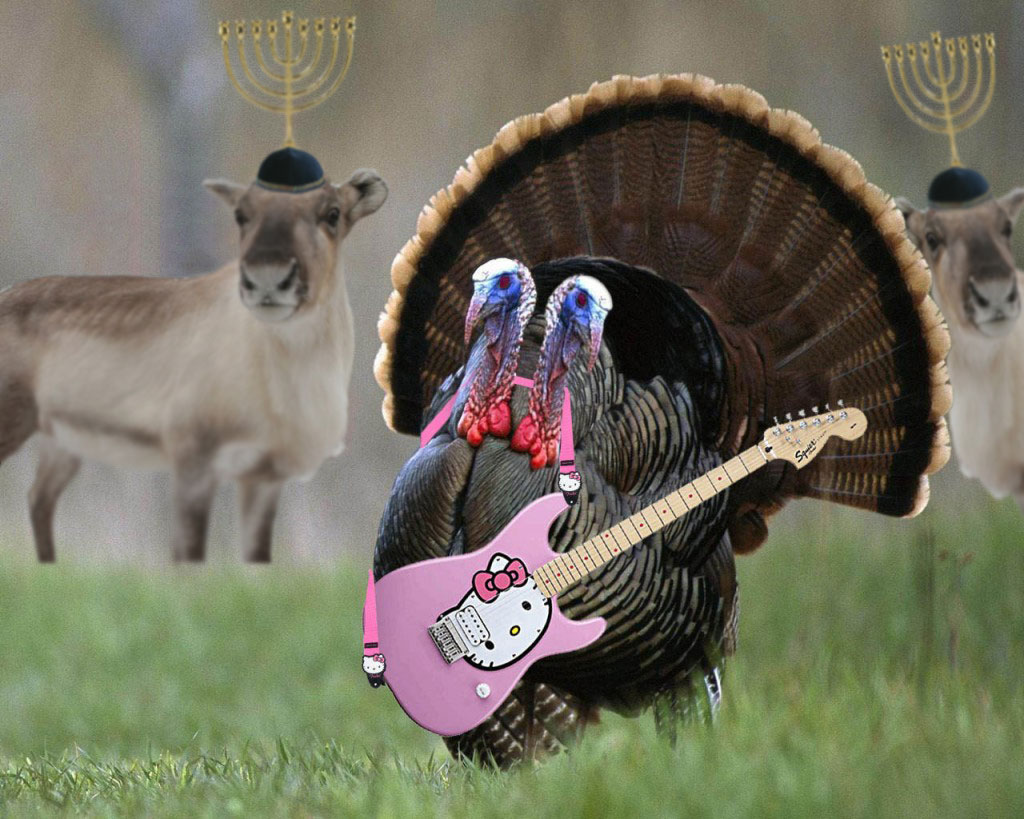
Reflexive snark aside, I’d like to thank all of you who have contributed your time, effort, musicality, and ingenuity to tonefiend since the last time I posted a poorly Photoshopped turkey image. If it weren’t for you, this site would be nothing more than a bunch of self-important pontification, instead of what it is: a bunch of self-important pontification leavened by your wit and wisdom.
Thanks, too, to you lurkers — I know you’re there! Truth be told, I’m a habitual lurker who rarely contributes to his favorite blogs, so I get where you’re coming from and invite you to lurk to your hearts’ content. (Though if you ever do feel like introducing yourself, I promise you a friendly welcome.)
I’ve got lots of interesting stuff coming up after the holiday. Your responses and suggestions to the Let’s Design a DIY Amp post have helped focus that notion, and I’m speaking with some smart people about creating a project/kit. I’ll also be reporting on some of the new digital gizmos and soundware I’ve been exploring in preparation for a performance at Strung Out!, a monthly San Francisco solo guitar event I’m launching with friend/acoustic virtuoso Teja Gerken.
And frankly, I’m glad to be powering down the soldering iron for a few days, because I just completed all the tech work for a massive pickup review I’m preparing for Premier Guitar, which includes recordings of eight rival humbucker-sized P-90 pickup sets, all tested in the same guitar/signal chain. The results are fascinating, and I managed to perform a couple of dozen pickup changes with only one second-degree burn and two small puncture wounds. (Yep — you heard it here first: The next big thing in humbuckers is hum!) I’ll link to the story when it goes live in a few weeks.
I’m thankful for having so many of you to thank. Have a lovely holiday, everyone!