Categories
Effects

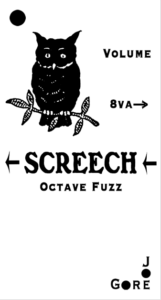
Introducing the Screech!

Yay! The first 100 Screech pedals just got into stock at Vintage King. Again, the very first production model went to Blake Mills. He immediately started doing thing I didn’t even know it could do. Damn.

Here’s the info from the product page at gorepedals.com. Pardon then obnoxious use of the third-person.

OVERTONE OVERDOSE
The Joe Gore Screech is descended from vintage octave fuzzes like the Ampeg Scrambler and Dan Armstrong Green Ringer, but it’s not a clone. It provides much clearer octave overtones, and you don’t need an extra booster for great results.

Most octave fuzzes work best when you play near the 12th fret using the neck pickup. But Screech provides potent octaves regardless of neck position or pickup setting. It also does fine non-octave fuzz. A common mod for octave fuzzes is to add a switch that switches of the diodes, removing the octave effect. The problem is, the resulting sound is dull as dirt. Here, though, though non-octave fuzz is sufficiently fiery and dynamic to stand on its own.

Unlike most things Joe Gore makes, Screech is not especially dynamic. It needs consistently heavy gain for its powerful octave effects. But as on many vintage octave fuzzes, you get freaky harmonics and other interesting noises when you lower your guitar’s volume control.

Screech runs on standard 9-volt batteries or power supplies. It was created in San Francisco by Joe Gore and is built in Michigan by skilled craftspeople paid a fair wage. It comes with a lifetime warranty.

TO USE: The single knob is a master volume. (There’s no gain control because this circuit demands high gain to generate such strong octaves.) When you hit the DIST footswitch without the octave (OCT) engaged, the LED glows red. With the octave on, the light is yellow. (You can’t use the octave section without DIST activated.)

When Screech is bypassed, you can specify whether the octave will be engaged when you activate the pedal. If the LED glows green, the octave will be engaged when you hit DIST. If the LED isn’t glowing, you’ll get non-octave fuzz when you step on DIST.

BACKGROUND INFO FOR PEDAL GEEKS: Here’s an article and video I put together a few years ago, demonstrating all the classic octave fuzz circuits. Toward the end I show an early prototype of the circuit that would become Screech. It’s evolved since then, so don’t consider this a proper demo. It’s just some amusing pedal geekery. 🙂
Categories
Effects

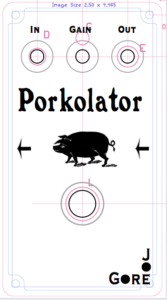
Oink You Very Much: Meet the Porkolator!

It was a longer and harder process than I’d ever imagined, but the first of my four new pedals is finally released and in stock now at Vintage King.

Here’s my product demo:

And here’s a just-posted “First Look” video from John Bohlinger at Premier Guitar:

Man, it’s always such a trip when you tinker with an effect and play it in isolation for years, and then hear it being played by someone else. But I couldn’t be luckier: The first person who ever played one beside me was the stupefyingly talented Blake Mills. (He dug it, and he got the very first production model). And now, another performance by another of my favorite players. Pinch me!

There’s lots more info about Porkolator on the Joe Gore Pedals product page. As I explain, this is a highly mutated version of a circuit that was pretty bizarre to begin with: the Interfax Harmonic Percolator. There is so much bad info about the original pedal floating around. Everyone seems use a couple of phrases over and over: “tube-like” and “even-order harmonics.” Wrong and wrong! Everyone’s just copying something (incorrect) they read somewhere else.

A few years ago, I did a story on the Harmonic Percolator and its boutique DIY spinoffs. Even if you don’t especially dig the pedal, it’s an interesting study in how an effect gets tweaked and modernized. Here’s the accompanying video.

At the end I demonstrate an early version or Porkolator, though it’s changed so much that you can’t really compare. I gave this original to famous drummer and not-as-famous guitar player Matt Chamberlin during a film score session. Like many of my hand-built prototypes, it promptly broke. Fortunately, the new ones are built by the talented professional at Cusack Music. I just designed the damn things.

Categories
Effects

Gore Pedals in Guitar Player Magazine

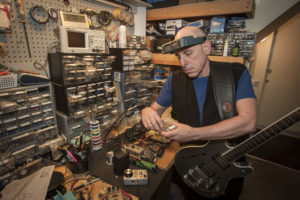
Well, this is an honor! Guitar Player magazine’s Mike Molenda profiled me and my Gore Pedals line in the magazine’s May 2018 issue. (It’s their annual pedals extravaganza, with good ol’ Adrian Belew on the cover.)

You can read the piece here.

I owe Mike a big thanks, and not only for this story and other kind things he and his colleagues have written about my work. (Just last month Mike singled out my upcoming Cult Germanium Channel and Purr Vibrato pedals as NAMM 2018 highlights.) Mike and his GP colleagues were one of the first audiences for my DIY pedals when I first picked up the soldering iron a decade ago, long before I’d gone commercial. Their initial enthusiasm was a much-needed shot in the arm for a nervous neophyte. Mike was one of the first players to add some of my sketchy gizmos to his gigging pedalboard.

Thanks, too, to staff photographer Paul Haggard, who somehow managed to make it look like I know what I’m doing at the bench. When Paul came by for the shoot, we reminisced about how he was my very first connection to the magazine. I knew Paul’s brother, brilliant guitarist Mark “Mirv” Haggard, from the 1980’s San Francisco punk-funk scene, where he played with the Limbomaniacs and M.I.R.V. Pushing 30 and desperate for work, I contacted Mirv’s brother, Paul, who worked for one of GP‘s sister publications. He connected me to the late Tom Wheeler, who eventually hired and mentored me. (Thanks yet again, Paul!)

It’s been a long time since I contributed to Guitar Player, yet the magazine has always been an important part of my life for 30 years. Today, both the print and music industries are shadows of their former selves, and it’s far harder to sustain a guitar mag than it was when I was on staff. Ad revenue is lower and corporate support is weaker. We had it so easy in comparison! Yet Mike, Paul, and Art Thompson have done heroic work in this often hostile environment, putting out quality issues month after month. I’m so proud to be part of their latest effort.

Categories
Digital Effects guitar

My New Live Looping Rig: Total “Faylor”

I haven’t posted any new video in months and months. It’s not just laziness or business, though I suffer from both. I’ve just been locked away in my studio, trying to create a new live looping system.

I still haven’t nailed it down, so I’m not going to get into a complete run-down yet. But here are the basic ideas.

I’ve moved from a hardware looper to software looping. When I started this godforsaken looping project years ago, I’d just finished a lot of work on Apple’s then-new MainStage software. At the time, the program’s looper simply wasn’t reliable enough for live performance. Also, my intense signal processing was pushing my MacBook Pro to its limits. But since then, the program has gone through many upgrades. Meanwhile, after years of relative stagnation, Apple finally issued a major MacBook Pro upgrade in 2017. Between the more powerful computer and the refined software, I could finally shift looping and signal processing to the computer. Yeah, there are a couple of disadvantages. For one thing, MainStage’s looper lacks a “copy” function, something I’ve come to rely on a great deal in my arrangements. But it sure is nice not having to run the entire mix through the relatively cheap hardware looper convertors — just the snazzy ones in my Apollo interface. (Of course, now that I’ve transitioned, Electro-Harmonix has just announced a compelling-looking 6-track looper. I’ll have to check that out…)

I’ve put aside for now the Fishman TriplePlay MIDI pickup. I have no complaints about TriplePlay, which is far and away the best MIDI pickup ever created, and a product I recommend without reservation. But I wanted to be free from the hardware setup. This way, I can plug in any guitar, any time. (I’ve been experimenting with acoustic looping — more on that soon.) I’m still using MIDI sounds, but again, it’s all in software via Jam Origin’s brilliant MIDI Guitar plugin. It works incredibly well without a MIDI pickup, but it’s not nearly as fast as TriplePlay. It’s fine for doubling, or for melodic and textural stuff, but it’s just not speedy enough to play MIDI drums at even moderate tempos. Which bring me to the other big departure …

I confess: I’m playing to a drum machine. I’m triggering and changing patterns using a KMI !2 Step foot controller. I really wrestled with this decision. I loved the idea of using no machine tempos — it all came from the hands. But at some point I realized that the main reason I was committed to that approach was for bragging rights: “No prerecorded tracks, and no machine rhythms” I could boast. But who cares except geeks like me? Anyway, I still have misgivings about the change, but I’m going with it for now. I think that means, though, that I’ll create more arrangements without percussion, just so I’m not locked to the machine for an entire set.

Meanwhile working with a tempo clock lets me do fun stuff with synchronized effects. I’m especially besotted with Sugar Bytes’s Effectrix, a mind-bending multi-effector that lets you activate and edit effects on a note-by-note basis. You hear it a lot in the “solo” in this video.

I’ve played a few shows with the new setup. The first one was flawed but promising. The second was an unmitigated disaster. Then I doubled up on practicing and (not kidding) started meditating again, which helped a lot. Last time I tried this live, it went really well! We’ll see how it goes at my gig this week.

Anyway, it’s still a work in progress. I’ll keep the curious updated.

I played this cover tune with no irony whatsoever. I love the original.

Categories
Effects

Gore Pedals Demo from Premier Guitar

NAMM was fun, though I’m paying a price with this dreaded flu I came home with. (“NAMMthrax,” they call it.) A highlight was getting interviewed on camera by my friend and frequent editor, Shawn Hammond.

Admittedly, there are some cringeworthy moments, especially when my entire Porkolator demo crashes and burns thanks to a funky cable. (I’ve played Shawn’s role at other tradeshows, and trust me, those guys sprint from booth to booth at speeds you wouldn’t believe — definitely no time for do-overs!) But you’ll get a decent idea of the other three. Soon I’ll have proper demos of the new releases, and I’ll share them here.

I was showing my stuff in the brand-new pro audio hall, miles away from most of the guitar stuff. That’s because my distributors, Vintage King/M1, work mainly in the high-end studio/audio realm. (I was set up right next to those magnificent Shadow Hills compressors.)

Still, I managed to see a few old friends and make some new ones. One reunion was with producer Matt Wallace (Faith No More, Maroon 5, Replacements, etc.) who I hadn’t seen in over 35 years, when I was his frickin’ “Intro to Music Appreciation” TA at UC Berkeley. Another was a middle-school friend with no connection to the music industry — his daughter just got a gig at Fender.

And when I wasn’t demoing, schmoozing, or contracting diseases, I was watching the nearby Mix With The Masters stage. That company sells online recording/mixing lessons featuring famed producers and engineers, many of whom gave live presentations in which they walked the audience through their productions. I saw my old pals Joe Chicarelli and Jacquire King, and I got to meet several others whose work I’ve long admired: longtime Nick Cave & the Bad Seeds accomplice Mick Launay, mastering legend Howie Weinberg, and Sylvia Massy. In addition to recording everyone from Tool to Johnny Cash to System of a Down to Julio Iglesias, Sylvia authrored the coolest book ever on creative recording.)

Totally off-topic: While driving from SF, I finally finished the audio book version of Alan Moore’s 1,255-page magnum opus, Jerusalem. Fuck me — the most amazing book I’ve encountered since David Mitchell’s Cloud Atlas over a decade ago.

Okay — back to my flu meds!

Categories
Effects

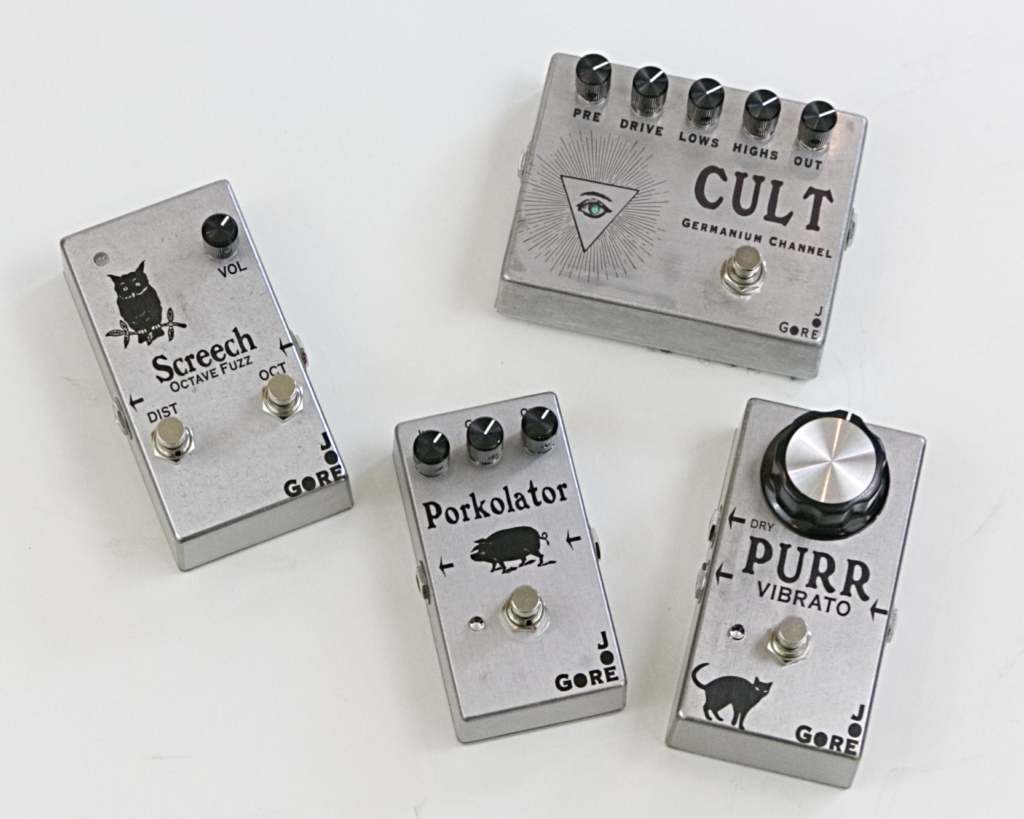
Four New Joe Gore Pedals at NAMM 2018

Happy new year, all. Sorry I’ve been so scarce — mostly, I’ve been practicing guitar! I’m trying out lots of challenging new things (for me, anyway) and I’ll share some of them as videos very soon. I’ve also been finalizing the four new Joe Gore pedals I’m debuting at NAMM 2018. Lookit!

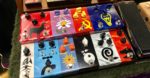
[L-R]: Screech Octave Fuzz, Porkolator Distortion, Cult Germanium Channel, Purr Vibrato

They’ve already gone into the production, and they’ll be available via Vintage King very soon. I have yet to make demo videos and detailed spec sheets, and we still haven’t finalized the prices. (It depends how much the damn germanium transistors in Cult Germanium Channel and Porkolator wind up costing.)

In the meantime, here’s the info sheet I’m distributing at NAMM. Also, Premier Guitar is scheduled to record a demo video at the show and post it on their site. (I’ll share the details when that happens.) I hope I sound less like a squirrel on meth than I did for last year’s show-floor video.

If you’re attending the show in Anaheim, please visit me at booth #15517. (It’s a huge booth run by my distributors, M1. I’ll be crammed behind a tabletop somewhere within.) I’d love to say hi.

Categories
Effects

Guns N’ Roses N’ Germanium


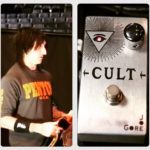
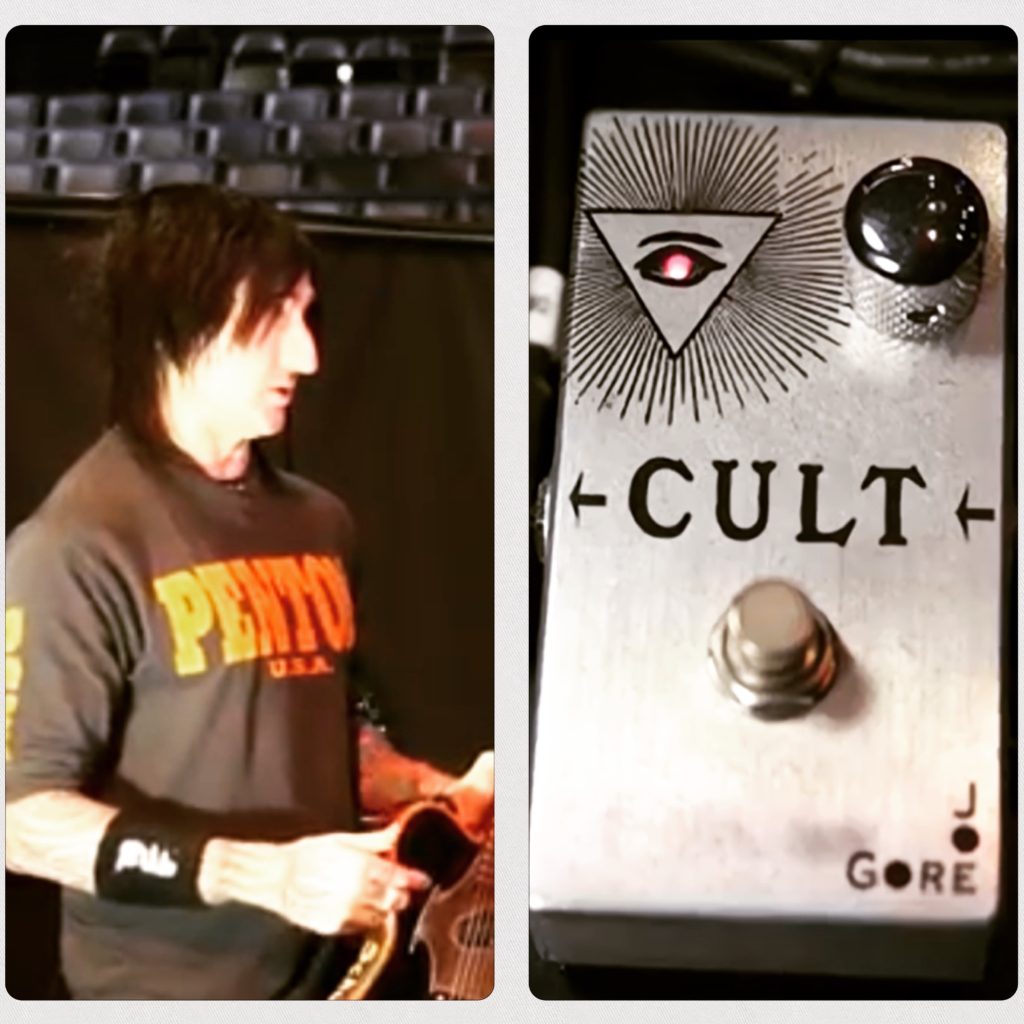
Woohoo! In this just posted Rig Rundown from Premier Guitar, Guns N’ Roses guitarist Richard Fortus shows off his fascinating stage rig, which happens to include my Cult pedal. It appears a 55:05. But gear geeks should watch the entire video, even if they’re not GNR fans. It’s full of interesting stuff—and lots of surprises.

Richard is the coolest. I’ve known him since the ’90s, when his then-band, Love Spit Love, played a show with PJ Harvey back when I was in the group. Besides being a great player, he’s the nicest guy ever, and he still has the enthusiasm of a kid discovering guitar for the first time. Plus, I’m jealous of how my PG pal John Bohlinger makes this sort of on-camera, impromptu interview look easy. (Trust me—it’s not.)

This part is especially flattering, and it’s not in the video: Like many primitive germanium effects, Cult doesn’t like buffers, so it should usually be used at or near the front of an effect chain. But of course, Richard performs using a buffered wireless system. He had someone build an “unbuffering” box that makes the pedal “see” pickup-style capacitance. I didn’t even know you could do that till Richard told me about it (though I’ve heard about other similar strategies since then).

Gotta say: It’s a special sort of thrill when something you concocted on a filthy little workbench winds up in the hands of a fine musician. Thanks, Richard and John!

Categories
Effects guitar

The One Weird Thing About Gold Foil Pickups

Okay, the funky gold foil pickups found in cheapo Japanese and American gutiars in the 1950s and ’60s are popular again. And trend slut that I am, I’m smitten with them. But they do this one really weird thing ….

It has to do with the capacitive relationship between the guitar volume knob, pickups, and downstream pedals and amps. If you don’t use your guitar’s volume knob as an expressive device, this behavior probably doesn’t matter. But if you do, this is potentially a big deal, one worth considering before purchasing a pair of gold foils.

I first realized this as I was preparing my Gore Pedals demo for the NAMM show. Many of my pedal designs depend on the ability to alter tones from the guitar — it’s how I get away with using relatively few knobs. It’s the quality you hear in the first minute of my Cult pedal demo:

You just can’t do that with gold foils. Apparently, the rubber magnets in gold foil have a different capacitive relationship with downstream gear, relative to conventional alnico- and ceramic-magnet pickups. Some of the peaky, high-resonance sound you get when rolling back the volume knob on a guitar with gold foils are pretty cool, and I can certainly imagine using them. But I definitely have to modify my technique when using gold foils.

I recently reviewed one of the bitchin’ new Supro guitars for Premier Guitar. Their pickups are based on a different historic gold foil model, but they exhibit the exact behavior demoed in my first video above. After writing that review I spoke with Ken Calvet of Roadhouse Pickups, who created the excellent-sounding Valco-style gold foils for Supro. He acknowledged the unusual volume knob behavior and attributed it to the rubber magnets used in historically accurate gold foils.

My first video above demonstrates this property using a capacitance-dependent vintage-style Fuzz Face. Not only do you encounter the same thing with many non-buffered (i.e., cool) fuzzes and boosters, but also when plugging directly into an overdriven amp. You can’t summon clean sounds from a dirty amp via the guitar volume knob the way you can with most conventional passive pickups.

But despite all of that, I’m still crazy for the Lollar Gold Foils in my DIY Resistocaster:

Has anyone else noticed this quirky characteristic?

Categories
DIY Effects guitar

The Prettiest Pedalboard! (Plus: A New DIY Lipstick Tube Guitar)

You know what sucks about attending NAMM as a manufacturer rather than a gear writer? I was epoxied to my booth all day, and I barely saw anything other than my guitar pedals. But on one rare break, I got to hang out with Jannis Anastasakis and his crew from JAM Pedals of Athens, Greece. (I highlighted some of their beautiful work in my pathetically skimpy “NAMM report.”)

Happily, there’s more to celebrate here than great visuals. JAM builds lovely versions of many classic analog effects. Their sounds and production quality are stellar, and JAM often adds modern updates such as realtime expression control, extra knobs, and internal trim pots for customizing tones. It’s quality stuff, used by many a guitar star.

And guess what? Jannis loaned me one of his magnificent Custom Shop analog pedalboards. Γαμώτο!

Sadly, I must now pack up and return this pretty pedalboard. But I’ll be getting my own JAM Delay Llama Supreme, an expanded version of the analog delay heard here, with tap tempo, a cool modulation section, and the almighty infinite-hold switch. (I reviewed it for Premier Guitar a few months ago.)

In the meantime, this experience makes me want to try my own DIY pedalboards. Not as an item for sale — just as a way to group related effects in a single enclosure for stage use. Gears are spinning ….

Categories
Effects

Gore Pedals: New for 2017

Oh man — my friends at Premier Guitar just posted a video of me demoing four of my new pedal prototypes at NAMM. I didn’t even think I’d have these ready by showtime, but I powered out at the last minute. (Maybe ’cause I needed something to take my mind of the inauguration.)

It’s been a busy month since we filmed this. We’ve settled on names, graphics, and specs, and everything is in development. (Though they’re still a few months away from shipping.) I’ve included the first-draft enclosure graphics as well.

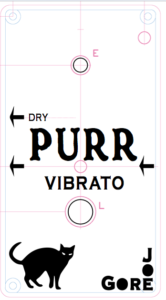
Purr is a minimal one-knob optical vibrato. Yep — one knob, which means no independent rate and depth controls. Sound crazy? I agree. But it just sort of works! (I explain my questionable reasoning in the video.)

It’s not a deep, wobbly pitch-shift effect — more like cross between a really warm, pretty tremolo and a subtle optical vibrato. It’ll have the same large knob as my Duh pedal, so you can make adjustments with your foot, assuming you’re not as clumsy as I am.

It’s my fave modulation circuit, one I’ve used on a number of my YouTube videos. Here it’s on throughout at a very subtle setting.

In this video it’s set more strongly, though I toggle it on and off as I loop additional layers.

Screech, a mutant spinoff of the Octavia and Green Ringer octave fuzzes, is an outgrowth of the experiments I did did a few years ago, when I built models of every major octave fuzz design, and then attempted a variation of my own. (It’s not too far removed from the final pedal in this video, which appears at the 10-minute mark.)

It’s got the most extreme octave effect I’ve ever heard from an analog octave fuzz, and unlike on an Octavia or Green Ringer, the effect works in all neck positions and at all pickup settings. You can also bypass the octave portion of the circuit for a straight distortion sound. (That’s not a new idea—it’s a popular Octavia mod. But that non-octave Octavia sound is dull as dirt, whereas this, I think, has a bit more character and impact.)

Porkolator also springs from a video demo/experiment of a few years back. It’s my oddball spin on the Interfax Harmonic Percolator, which is already pretty odd to begin with. It uses the same weird combination of negative- and positive-ground transistors for that sort of gravelly, decidedly non-tube-like distortion that Steve Albini loves so much. But all the part values differ, and the gain stages work very differently. There’s also an independent boost stage that can generate tons of extra level if desired. Again, it’s not that far removed from the final example in my octave fuzz video. (It appears starting at 5:55.)

Unlike the other three pedals, Cult Germanium Channel is pretty much finished. (We were originally going to include it among the 2016 releases, but decided that three new products were enough.) Its heart is the same primitive germanium overdrive circuit as in my Cult pedal, but with lots of added doodads: a tone-shaping pre-gain control, great-sounding active 2-band tone control, and an output trim. You can read more about Cult Germanium Channel here.

The NAMM video also features a demo of Kitty Boy, my imaginary vision of a germanium fuzz that should have existed in the 1960s. It’s sort of a cross between a Maestro Fuzz Tone and a Tone Bender Mk. I, which can go from lightly overdriven “Satisfaction” tones to hyper-saturated Ziggy Stardust glory. (It’s inspired by a conversation with Lyle Workman, so thanks, Lyle!)

I hope folks dig these. I’ll keep you posted about release dates and final prices.

Thanks, Jason Shadrick and Perry Bean, for doing such a nice job with the video and squeezing me into a brutal production schedule at the last minute.

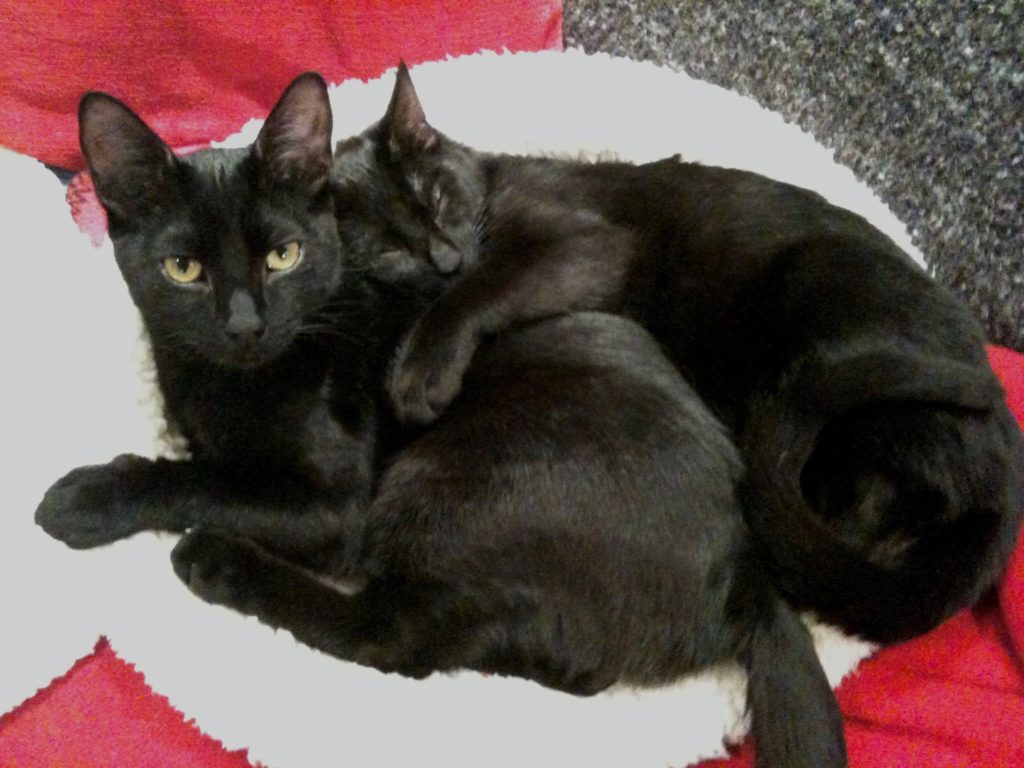
Jet and Kaiju say: “When Joe plugs in those horrible fuzz pedals, we hide in the closet. But that new Purr pedal with the black cat on it isn’t so bad.”