
Category: guitar

  • That Classic Electric 12-String Sound (and How to Avoid It)

    That Classic Electric 12-String Sound
    (and How to Avoid It)

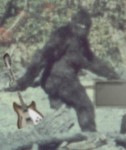
    Digitally enhanced versions of the 1967 Patterson-Gimlin footage prove that Bigfoot used flatwounds.

    Want to get a great ’60s-style Beatles/Byrds electric 12-string sound? Use flatwound strings. It’s almost guaranteed to up your jangle quotient.

    This advice is admittedly counter-intuitive—why should relatively dull-sounding flatwounds improve a guitar’s treble response? My best explanation is that when the lower-octave strings emit fewer highs, there’s less phase cancellation against the higher-octave strings. The round wound sound is pretty in its way, but the flat wounds sound tighter and more defined, and are definitely easier to situate in a mix. The strings simply sound more in focus.

    Don’t believe me? Hear for yourself.I’ve recorded the same lick with both types of strings—and you dang well better appreciate it! Do you have any idea what a pain it is to restring a 12-string twice within an hour?

    (FYI, the guitar is a ’90s Japanese-made Fender Squier with Duncan pickups.)

    Electric 12-string roundwound

    Electric 12-string flatwound

    One problem with this approach: Not many companies make flatwound 12-string sets, and they tend to be expensive. I’ve used both Pyramids and La Bellas with excellent results. The latter are far cheaper in the States.

    And what’s the best amp? Bright Fender? Chiming Vox? Well, “Mr. Tambourine Man” was recorded direct into the board with no amp whatsoever, but tons of LA-2A compression.

    Try this recipe: Plug straight into your warmest-sounding preamp. Boost the crap out of everything above 2kHz or so. Scoop a narrow  band of low mids around 160Hz. Set the compression between 4:1 and 8:1, but with a slow-ish attack. A touch of plate-style reverb lubricates the proceedings.

    On the other hand, maybe you want to liberate yourself from the conceptual prison on jingle-jangle 12-string. There’s no law that says you have to automatically start playing “Ticket to Ride” or “Turn Turn Turn” each time you heft one of these beasts. In that spirit, I offer a mismatched bouquet of alternative 12-string tones:

    Spacehead 12-String

    Sick Rezo 12-String

    Filter Stab 12-String

    Titicaca 12-String

    Fartflange 12-String

    And that’s not even touching on the trouble you can into if you tune each each string in the octave pair to different notes . . .


  • Mutant Beauty Pageant: The Photo Gallery

    Mutant Beauty Pageant: The Photo Gallery

    Well, um, the entires in our Mutant Beauty Contest are certainly . . . something. Click the MORE button to open the slideshow. New beauties added daily!

    Post your images to comments via a photo-sharing site, or email them to me. I’ll add each new mutant to the slideshow so the entire Internet can laugh at your abysmal taste admire your collecting and building skills.

    You can review the “rules” here. The prize is still TBD, but I guarantee it’ll be every bit as . . . something as the beauties displayed here.

    (more…)

  • Mutant Beauty Pageant: Enter and “Win!”

    Mutant Beauty Pageant: Enter and “Win!”

    It’s time for another contest!

    I hereby announce the first Tonefiend Mutant Beauty Pageant.

    I know many deadbeats with too much time on their hands musicians, and most of them have a thing for weird gear. I’m talking real freak-show stuff, the items that make anyone who walks into your music room shriek, “What the hell is that thing?”

    Here’s the idea: You post your oddities, and the coolest/weirdest item wins. They can be anything music-related: guitars, basses, amps, effects, CDs or vinyl, music industry swag, some crazy DIY project—anything goes! The winner will receive—well, let’s just say something as weird and cool as the stuff being posted. (more…)

  • How to Mic an AmpPart 1: The Basics

    How to Mic an Amp
    Part 1: The Basics

    Don't fear the mic! (Illustration: Elise Malmberg)

    Recording be be brutal. Tracking vocals is tough. Capturing pianos or acoustic guitars is painstaking work. But recording electric guitars is easy, easy, easy—once you learn a few basics.

    The post focuses on the simplest way to record a guitar amp: sticking a single mic in front of a speaker. In future posts we’ll tackle the tricky stuff: multiple mics, unorthodox mic positions, amps in shower stalls or aluminum trash cans. Those techniques are great—but you don’t need any arcane tricks to record great electric sounds. You don’t even have to have a fancy mic—countless great guitar tracks have been recorded with the humble Shure SM-57.

    In fact, if the guitar, amp, and performance sound good, it’s actually pretty difficult to screw things up. Basically, you’ve got two things to consider: Which mic to use, and where to stick it. We’ll tackle those topics in reverse order.

    (more…)

  • Changing Three Pickups in Five Minutes (and What It Sounds Like)

    Changing Three Pickups in Five Minutes
    (and What It Sounds Like)

    This is my kind of pickup change: the easy kind!

    I got my hands on the new Seymour Duncan Everything Axe pickguard, which comes with three pre-installed Strat-format humbuckers (JB Jr., Duckbucker, and Little ’59). I’ve always avoided humbuckerized Strats because they remind of really bad ’80s bands. But I love the JB and ’59, so I figured, why not confront my prejudices?

    I slapped the pickguard onto your basic Mexican Strat, and voilà! Instant coolness.

    Here’s a little demo featuring all five pickup combinations. As the product name implies, this particular pickup trio yields many high-contrast colors. But I’m struck most by how much Strat flavor remains—there’s certainly no lack of shimmer and twang. I favored clean tones in the demo, just to deep-six my outdated stereotypes about harsh, compressed, over-distorted Strat humbucker sounds.

    And it really did take about five minutes.

  • Let’s Talk Looping!

    Let’s Talk Looping!

    Here’s a little video I made yesterday using the looping setup I’ve been using live.

    Any other looping geeks out there? I didn’t set out to be one—I just wanted to do a duo band with percussionist extraordinaire Dawn Richardson. Looping seemed, well, kind of ten years ago, but I got sucked in, and it turned out to be a cool format for a lot of the sound design I was doing in Apple’s MainStage software. So there.

    As always in looping, it’s easy to build big textures, but difficult to break them down. That’s where I always choke.

    FYI, Dawn and I made an album this way, and are working on a second. More info here.

  • Can Cool Pickups Save a Crappy Guitar?

    Can Cool Pickups Save a Crappy Guitar?

    My cat is skeptical.

    Multiple readers have asked some variation of that question since I launched this blog last month. I’ve been wondering myself as I prowled the local music emporia, searching for a fun, but seriously funky guitar to experiment on.

    (more…)

  • Practice Without an Instrument [VIDEO]

    Practice Without an Instrument [VIDEO]

    For players who have a little bit too much of a life: five fretting-hand exercises you can practice when you’re away from your guitar or bass. Make sure to run through them in public places so bystanders can alert the mental health authorities admire your prowess.

  • Vibrato: Do You Shake It Like Ethel?

    Vibrato: Do You Shake It Like Ethel?

    Can you shake it like Ethel? And more important, SHOULD you?

    Almost all of us are guilty of it: repetitive, auto-pilot vibrato.

    Can you blame us? Between choosing the right notes, and trying to play them in tune and in time, we don’t always have surplus brain cells to shape each note individually. So much simpler to stamp each one with the same prefab wiggle!

    One of the wickedest observations about shred guitar came from one of the greatest shred guitarists, Paul Gilbert. In a conversation many years ago when he was a youngster, he noted that a lot of players seem to have pilfered their vibrato technique from Ethel Merman. (more…)

  • Humbucker + P-90 = ?

    Humbucker + P-90 = ?

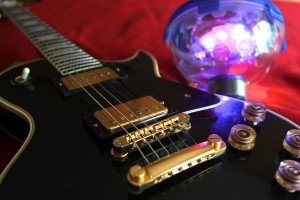
    It's not like these pickups NEED a hot tub disco light to be exciting, but hey, a little mood lighting never hurts.

    I recently upgraded a beat-up old Les Paul with a pair of Seth Lover humbuckers, a journey detailed here and here.

    While I was in a makeover frame of mind, I figured, what not try something I’d always been curious about: installing a P-90 and a humbucker on the same guitar. So I swapped the neck pickup for a Seymour Duncan Phat Cat, a vintage-sounding P-90 is a humbucker-sized housing. (more…)