
Categories
Acoustic Amps Bass Digital DIY Effects Gigs guitar Music Pickups Recording Technique The Secret Room Tonefiend DIY Club

The Secret Room: Not So Secret Anymore

Now with more secrets — and less secrecy.

Last winter I tried an odd experiment: a website where players were encouraged to post their best tone secrets — the kinds of tricks and techniques that are almost too good to share. But in order to get, you had to give: The site was password-protected, and the password was only sent to those who contributed secrets.

Musicians responded, no doubt encouraged by the cool prizes awarded to the top secrets, as judged by user ratings. I also asked some cool musician friends to contribute the first round of secrets, yielding tips from the likes of composer/virtuoso Lyle Workman, metallurgist-turned jazzbo Alex Skolnick, original Chili Peppers guitarist Jack Sherman, boy genius Blake Mills, and other great players.

Once the contest ended, traffic slowed, but the site has slowly but surely grown. And now, as an experiment, I’ve removed the password protection. Now anyone can visit the Secret Room, AKA tonesecret.com, even if they haven’t coughed up a secret. So please do!

It’s a fascinating document. Naturally, the quality of secrets varies, as does the level of expertise needed to make the most of them. I exerted a light editorial hand — only silly or flat-out-wrong tips were vetoed, and I didn’t do much in the way of spelling and grammar repair. Sometimes the contents are a little repetitious — but trust me, there is much wisdom and originality throughout.

I hope you find something helpful — and I hope you’re moved to contribute some secrets yourself using the site’s submission form. And who knows? There may be more tawdry bribes fabulous prizes lurking around the corner…
Categories
Bass guitar Recording Technique

Those Times When It’s Good to NOT Play Like Yourself…

Can we all agree that it’s a good thing when guitarists and bassists cultivate their own style? Even a jaded old cuss experienced music journalist like me still gets a thrill upon discovering a new player with a startlingly original voice.

I am not any of these people —but I pretended to be them.

But there are times when it’s worth pursuing the opposite approach. (And not just for pragmatic reasons, such as the likelihood that you’ll get canned from your cover band gig if you mix it up too much, or the fact that the jingle client can’t afford to license that Black Keys song, but will happily pay you to record something “similar.”) Sometimes disconnecting your ego and completely immersing yourself in another player’s point of view can make you a better, and paradoxically, more original player. (I’m reminded of a Marc Ribot interview I once edited where the brilliant guitarist talked about learning Chuck Berry songs, clams and all — the “bad” notes, he suggested, were as much a part of Berry style as the “good” ones.)

I had a chance to take this idea to an extreme a few years go when writer/composer Elise Malmberg and I collaborated on a massive internet hoax: a bogus website alleging to be the 50-year history of a “legendary” indie record label. Clubbo Records is easily the most obsessive-compulsive project I’ve undertaken. The site features hundreds of pages of music, bios, photos, and memorabilia memorializing dozens of fictitious artists. Even many external links are fake — we just made a lot of little mini-hoax websites.

(Example: We licensed a photo of a beautiful ’60s blonde in a leopard-skin coat, which inspired a story about Ava & the Avalanches, the best known group of the Swiss Invasion. We wrote a story about how wearing the coat for the photo shoot horrified her, and launched her on a life path of animal activism. Where would she be now, we wondered? Running a big cat rescue charity, of course! Which inspired more than a few queries from journalists, including one from the BBC, asking to put us in touch with the non-existent Ava. And Ava’s signature “hit,” “Ski Baby Ski” has been licensed over and over, most recently for the silly Jonah Hill comedy The Babysitter.)

Categories
Acoustic guitar Recording

How Nashville High-Stringing Works

You don’t have to be high in Nashville to enjoy Nashville high-strung.

Nashville high-strung tuning is one of the guitar’s great magic tricks. It has a delicious, “secrets of the Guild” quality — you feel like an insider just knowing what it is.

Not that I did know what it is until embarrassingly late in life. For the sake of my fellow late-bloomers, I’ll explain: You replace your guitar’s lowest four strings with thinner strings tuned an octave higher than normal.

You can think of it as using the higher-pitched of a each pair in a 12-string string set. (Or the top two strings of a normal set, and the top four strings from another normal set, with the first string as the third string, the second string as the fourth, etc.)

I love how this tuning can work subliminal magic, or step front and center for marquee riffs. Nashville session players conceived it as a way to add stereo shimmer to doubled acoustic guitar tracks. But rock players have used it to great effect as a foreground sound, as heard on the Stones’ “Wild Horses,” Floyd’s “Hey You,” Kansas’s “Dust in the Wind,” and Tracy Chapman’s “The Promise.”

Here’s a quick little demonstration, both solo and in a mix:

Categories
Effects Recording

A History of Reverb

Hi there. We changed musical history!

Tonefiend reader Scott S. hipped me to a fabulous little article that just appeared in the online edition of The Atlantic: a history of artificial reverb that’s both technically savvy and fun to read. Author William Weir covers all the right gizmos: echo chambers, plates, springs, tape echo, custom convolution reverbs (which I wrote about here), and Duane Eddy’s 2,000-gallon water tank. Plus there’s lots of of fascinating historical speculation: Did Stonehenge draw some of its ritualistic power from its unique acoustic properties? Did the long reverb times of medieval cathedrals hasten the birth of polyphony?

Quick! Can you name the first hit to feature fake reverb? You will after you read this fine piece!

Categories
Digital guitar Recording

Adventures in Direct Recording

Hey man — what happened to your amps?

No question about it: Amps are awesome, and guitarists will be plugging into them for a long time to come. But as threatened in this post from last week, I’ve been experimenting with direct- recorded guitar sounds. I’m not talking amp simulators, but the sound of electric guitar recorded straight into a mixing board with no attempt to replicate the tone of an amp. After all, some of the most iconic guitar riffs of all time — including Zep’s “Black Dog,” the Byrds “Mister Tambourine Man,” Chic’s “Le Freak,” and most ’60s Motown hits — were tracked not through amps, but through great old analog preamps, compressors, and mixing boards.

Not that I own any great old ’60s and ’70s analog recording gear. But I wanted to see how close I could get using modern preamps and compressors, plus plug-ins that simulate vintage gear.

And how close did I get? Um…kinda close, and I could have gotten closer if I had an attention span longer than five minutes dedicated sufficient time to the pursuit.

Wanna hear what I came up with?

Categories
guitar Music Recording

No Stinkin’ Amps (or Amp Simulators)

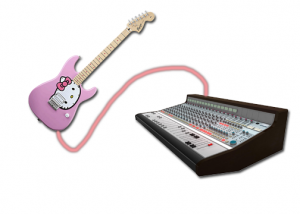
An advanced technical diagram.

No videos or audio examples today — I’m in the midst of “reconfiguring” my studio. (That’s the technical term for pulling stuff out of racks, tangling all your cables, making an ungodly mess, and dissolving into a puddle of bitter, frustrated tears.)

But the good news is, I got some cool new stuff. I’m switching over a pair of large Pro Tools and Apogee systems to a minimalist Universal Audio Apollo setup, an audio interface that doubles as a plug-in host. UA makes killer plug-ins, but I’ve never owned any, since they’ve always run off of proprietary PCI cards, and the card slots in my computers have always been filled to capacity. Now that I have the UA stuff in my grubby mitts, I’m obsessing on the idea of exploring non-amped guitar tones, especially distorted ones. And I’m not talking amp simulators, but the distortion you get from overdriving a recording console’s preamps.

Categories
Digital guitar Music Recording

A Loop-Oriented Laptop Guitar Rig

I haz a band.

My ol’ pals at Guitar Player magazine interviewed me for an instructional article on looping for next month’s issue. It was especially flattering to be invited, because the interviewer was Barry Cleveland, a fine guitarist and a leading figure in the looping community.

I put together this little video to demo the digital rig I use onstage with my duo band, Mental 99, and I’ve cross-posted it here. It covers software, hardware loopers, looping techniques, and the like. Have a listen.

Categories
DIY guitar Pickups Recording

The Pagey Project, Phase 2:
An INSANELY Versatile Les Paul

Just how many colors can you coax from one guitar?

This post is about a guitar wiring scheme that only geeks and tweakers could love.

I think you’ll dig it. :satansmoking:

In Phase 1 of this project, I recreated the original Page wiring scheme using an ’82 Paul, a pair of Duncan ’59 model pickups, and four push-pull pots. The result was a great-sounding, almost absurdly versatile guitar, though the sheer number of options was downright bewildering.

So naturally, the only way forward was to make the instrument even more bewildering by adding additional sonic options. This version offers all the sound of the Phase 1 model, and a buttload more. Several buttloads, actually — and I’m not talking about those skimpy metric buttloads!

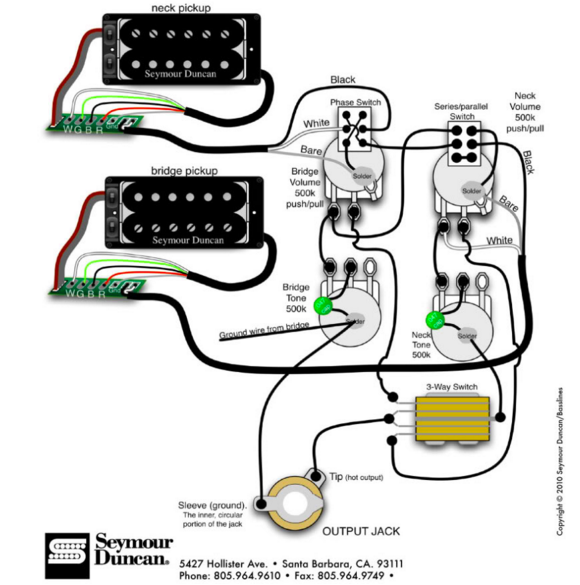
I gutted all the Phase 1 electronics. (Man, that hurt!) Next, using the same pickups, I added a pair of Duncan Triple Shot Mounting Rings. These provide four settings per pickup: humbucker, inner coil split, outer coil split, and both coils in parallel. (The Phase 1 plan offers only one split-coil setting per pickups. While you can configure the two pickups in parallel, you can’t do so with the individual coils in each pickup like you can here in Phase 2.) Here’s the wiring diagram I worked from, which for some reason is no longer posted on the Duncan site.

Since the Triple Shots add four new switches, the Phase 2 wiring requires only two push/pull pots. I wan’t about to let that real estate go unused! I installed a homemade germanium overdrive circuit (similar to the one we made in DIY Club) inside the guitar. My third push/pull pot activates it, and the fourth selects between two input caps, so I get a choice between a fat, Sabbath-style drive and a brighter, thinner Bluesbreakers-type tone.

Check out the demo video:

Categories
Bass guitar Recording

Credit Where It’s Due — Please!

Move along — there's nothing to see here.

Ordinarily I wouldn’t publicize “causes” on this site, but this one has special relevance for musicians and music fans.

My pal Count, a producer/mixer who’s done work for Radiohead, DJ Shadow, New Order, the Stones, No Doubt, and many other artists, is launching an online campaign to get musicians, producers, engineers, and other contributors credited on iTunes, Pandora, and other digital music services.

Consider the absurdity of the current situation: Why, in the digital age, are we granted only a fraction of the info available in the analog age? Why should fans be denied the details of their favorite recordings? And for underpaid musicians and technicians, the credit is often the only meaningful payment for services, a possible path to future work. The current state of affairs is just plain wrong!

If you agree that this is worthy goal, check out the page for Count’s Credit Is Due Facebook campaign.

Categories
Acoustic Bass guitar Recording

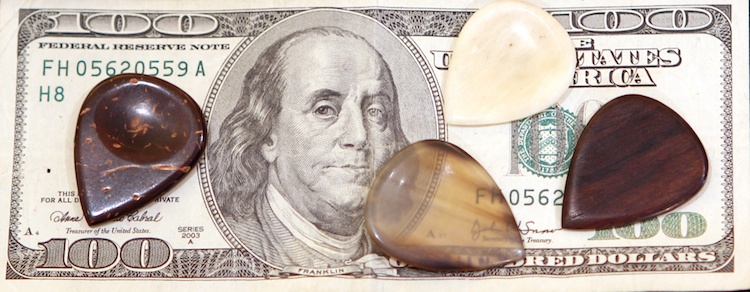
About Those Expensive Picks . . .

UPDATE: I’m proud to announce that the first part of my report on high-end picks has been selected to appear in the debut issue of Pure Guitar, a new digital guitar mag whose editorial staff includes my two music journo mentors : Tom Wheeler and Jas Obrecht. Also on board: jazz ace Wayne Goins, session superhero Tim Pierce,  Nashville’s leading guitar tech, Joe Glaser, and other preeminent axe experts.

You’ll find my article here — but frankly, I recommend starting at the homepage of issue #1 and reading all the way through!

Congrats, guys, on the new mag. I’m psyched to be part of it.  :beer: