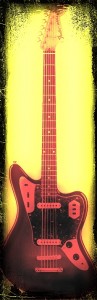
Don’t you love when someone revisits a weird idea from the past — and makes it even weirder?
I got a new bass last week, right before I left for the NAMM show. I finally had a chance to try it out yesterday. I think I’m in love. View the incriminating evidence in this brief video: (more…)
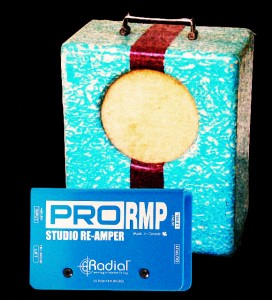
The latest version of the ReAmp, the Radial PRO RMP Studio Re-Amper, lists for a recession-friendly US$115, which means you can probably snag one for under a C-note.
Teisco amp not included. Pity.
The device, created by engineer John Cuniberti (best known as Joe Satriani’s studio wiz), is a recording direct box in reverse: It lets you play recorded tracks through guitar stompboxes and amps by stepping the signal down from line level to instrument level. Applications include:
• recording guitars direct or through amp simulators, and then choosing the perfect analog amp sound after other crucial tracks are in place
• running non-guitar tracks through guitar effects and amps
• making objective comparisons between amps, effects, and DIY project options by running identical signals through multiple pieces of gear.
If you’ve been following this blog, you’ve heard a lot of ReAmp. I recommend them to all studio provocateurs — especially now that the price is right!
Location, location, location: IR reverbs can make your guitar sound like it was recorded ANYWHERE!
Impulse response reverbs are one of the handiest tools in the digital-audio junk drawer. If you’re new to the concept, prepare to be amazed. (And if you’re familiar with the technology, jump to the end of this post to score some cool free reverb sounds.)
Impulse response reverbs, also known as IR or convolution reverbs, fake the sounds of genuine acoustic spaces. Say you want to be make your tracks sound as if they were recorded in a 12th-century dungeon: Just visit your nearest medieval castle and set up a small PA system in the dungeon. Next, play a test signal (usually a sine-wave sweep or a starter-pistol shot) and make a recording of it echoing in the space. Back at your studio, your IR software compares the new recording to the original test tone, and creates a reverb preset that you can apply to any audio source. Just slap it on a guitar track, say, and voilà — you’re rocking out in the dungeon, minus rats, mildew, and torture implements.
But wait, there’s more! You can use the same technology to mimic hardware effects and speakers. Just run the test signal through an amp or effect, and you’ll have a digital clone of the physical device. Here’s a brief video demonstrating the idea:
We got into a discussion about buzzing single-coil pickups over in the lipstick tube thread. Reader Matthew Seniff chimed in with some well-informed observations and remedies. I’ve moved them here so more folks will see.
Another reader had written: “Every time my kids turn on my kitchen light my amp starts buzzing. It’s due to the rheostat that controls it. It’s old but I’m too lazy to change it.” To which Matthew replied: (more…)
Any baritone guitar fans in the house? Let’s talk LOW!
I’ve been obsessed with baritone and other low-tuned guitars for decades, but I’ve never really found a perfect method for setting up a lower-than-standard guitar, so I’m interested to hear about other players’ experiences.
My main issue is pretty straightforward: I can get great tones by simply lowering the pitch on a standard-scale guitar, but the intonation is a nightmare, especially on the fifth and sixth strings. And when I use a longer-scale instrument, I get huge bass tones and solid intonation, but the middle and upper registers feel too thin stiff and stiff — I have difficulty making them sing.
With standard-scale guitars, it seems to help if there’s a length of straight string-pull — like on a Telecaster — between the nut and the tuners. I used a standard Tele tuned down to BEADF#B (like standard tuning, but a fourth lower) on the Tom Waits albums I worked on in the ’90s. Fortunately, the sketchy intonation were a plus in that clangorous context. (His song “Goin’ Out West” is a pretty good example of a cool, but screamingly out of tune, guitar tone. It was played on an old Tele dropped down to B.) (more…)
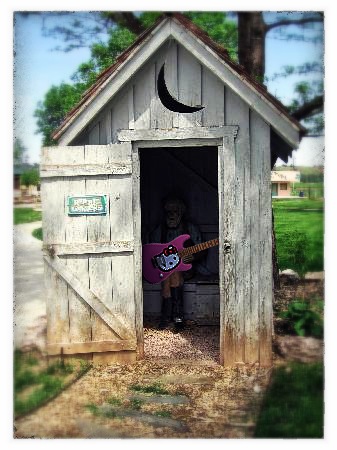
Digitally enhanced versions of the 1967 Patterson-Gimlin footage prove that Bigfoot used flatwounds.
Want to get a great ’60s-style Beatles/Byrds electric 12-string sound? Use flatwound strings. It’s almost guaranteed to up your jangle quotient.
This advice is admittedly counter-intuitive—why should relatively dull-sounding flatwounds improve a guitar’s treble response? My best explanation is that when the lower-octave strings emit fewer highs, there’s less phase cancellation against the higher-octave strings. The round wound sound is pretty in its way, but the flat wounds sound tighter and more defined, and are definitely easier to situate in a mix. The strings simply sound more in focus.
Don’t believe me? Hear for yourself.I’ve recorded the same lick with both types of strings—and you dang well better appreciate it! Do you have any idea what a pain it is to restring a 12-string twice within an hour?
(FYI, the guitar is a ’90s Japanese-made Fender Squier with Duncan pickups.)
One problem with this approach: Not many companies make flatwound 12-string sets, and they tend to be expensive. I’ve used both Pyramids and La Bellas with excellent results. The latter are far cheaper in the States.
And what’s the best amp? Bright Fender? Chiming Vox? Well, “Mr. Tambourine Man” was recorded direct into the board with no amp whatsoever, but tons of LA-2A compression.
Try this recipe: Plug straight into your warmest-sounding preamp. Boost the crap out of everything above 2kHz or so. Scoop a narrow band of low mids around 160Hz. Set the compression between 4:1 and 8:1, but with a slow-ish attack. A touch of plate-style reverb lubricates the proceedings.
On the other hand, maybe you want to liberate yourself from the conceptual prison on jingle-jangle 12-string. There’s no law that says you have to automatically start playing “Ticket to Ride” or “Turn Turn Turn” each time you heft one of these beasts. In that spirit, I offer a mismatched bouquet of alternative 12-string tones:
We all love tube amps. Yayy, tubes. Some of us love amp models. Yayy, models. And how about those cheap little solid-state amps?
[…crickets…]
Oh, come on! Am I really the only person who digs the barking attack and corrosive crunch of the subcompact tubeless combo? Will none step forward to sing the praises of those brave little badgers of the amp kingdom?
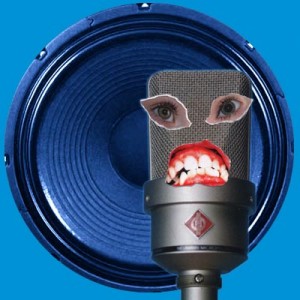
Don't fear the mic! (Illustration: Elise Malmberg)
Recording be be brutal. Tracking vocals is tough. Capturing pianos or acoustic guitars is painstaking work. But recording electric guitars is easy, easy, easy—once you learn a few basics.
The post focuses on the simplest way to record a guitar amp: sticking a single mic in front of a speaker. In future posts we’ll tackle the tricky stuff: multiple mics, unorthodox mic positions, amps in shower stalls or aluminum trash cans. Those techniques are great—but you don’t need any arcane tricks to record great electric sounds. You don’t even have to have a fancy mic—countless great guitar tracks have been recorded with the humble Shure SM-57.
In fact, if the guitar, amp, and performance sound good, it’s actually pretty difficult to screw things up. Basically, you’ve got two things to consider: Which mic to use, and where to stick it. We’ll tackle those topics in reverse order.
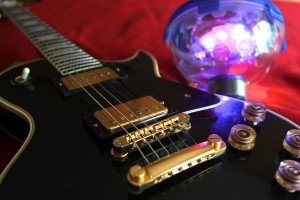
It's not like these pickups NEED a hot tub disco light to be exciting, but hey, a little mood lighting never hurts.
I recently upgraded a beat-up old Les Paul with a pair of Seth Lover humbuckers, a journey detailed here and here.
While I was in a makeover frame of mind, I figured, what not try something I’d always been curious about: installing a P-90 and a humbucker on the same guitar. So I swapped the neck pickup for a Seymour Duncan Phat Cat, a vintage-sounding P-90 is a humbucker-sized housing. (more…)
Chicarrelli on Jack White: "He has an attack unlike anyone else. The concussion of his playing is just unbelievable."
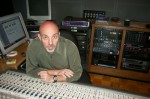
Joe Chiccarelli is one of music’s most respected producers and engineers—and one of the most versatile. After making his mark as Frank Zappa’s studio right-hand, he went on to work with such artists as U2, Elton John, Beck, Tori Amos, Morrissey, Dwight Yoakam, Rufus Wainwright, and Jason Mraz. He’s particularly admired for his recent work with guitar-heavy rock bands such as the White Stripes, the Raconteurs, the Strokes, My Morning Jacket, the Shins, and the Killers.
Joe started out as a bass player in his native Boston. He only plays a bit of guitar, but he knows more about getting great guitar sounds that almost anyone I know. I’ve been lucky to enough to record several albums under his supervision, and each time I’ve been floored by his superb taste, vast tech knowledge, superhuman work ethic, and mind-boggling attention to detail. He can be a real taskmaster! But he’s also one of the most patient, considerate, and just plain sweet guys I’ve ever worked with.
Joe is the polar opposite of those technicians who jealously guard their “secrets.” He’s always generous with his knowledge, and was kind enough to take a break from a recent session to let me fire a few questions at him. (more…)