I recently reviewed the gorgeous little Veillette Avante Gryphon for Premier Guitar and liked it so much that I bought one. This was my first opportunity to record it in my studio.
The Avante Gryphon is a relatively low-cost version of Woodstock luthier Joe Veillette’s Gryphon, an 18.5″-scale 12-string designed to be tuned a minor seventh (an octave minus two frets) above standard. But while 12-string guitars feature octave-tuned string pairs, here all six courses are unisons, as on a mandolin. In fact, the Avante Gryphon sounds a lot like a mandolin, but with a wider range and guitar-like tuning. And unlike the couple of janky plywood mandolins I own, it plays gloriously in tune. It’s made (very nicely!) by Korean CNC robots and sells for $1,400, as opposed to $4K+ for Veillette’s hand-built models.
For years I’ve been looking for the right upscale mandolin, but now I’m happy I found this instead. My original motivation was a high-tuned soprano instrument for multi-guitar arrangements, or for magic-fairy-dust studio overdubs. But the thing is so fun — and sounds so darn pretty — that I can’t stop playing it solo. This Bach prelude, for example:
I won’t recap my review here—check it out if you’re curious. Instead, let’s yak about Johann Sebastian!
Listening to and playing Bach can be tonic during depressing times. His industrious rhythms and clockwork counterpoint can dupe you into believing there’s some rational order to the universe. This piece is the opening movement from the G major cello suite — the best-known segment of Bach’s six suites for the instrument. I worked from a violin transcription downloaded from IMSLP, an amazing free resource for public domain scores. (It’s like a musical equivalent to Project Gutenberg, with its vast trove of public domain books.) Here’s the version I snagged.
The cello original makes extensive use of open strings. The violin version transposes the suite to D to make use of the corresponding strings on that instrument. Playing it as fingered on the Avante Gryphon puts the piece in C, an octave and a fourth above the original. This alters its character, big-time — the original sonorous baritone is replaced by high-pitched twinkling. But the piece’s soaring lines and deftly implied counterpoint sound awesome in any register.
Note the use of the word “implied.” Unlike the heavily contrapuntal solo music that Bach wrote for harpsichord, organ, and lute, his pieces for violin, cello, and wind instruments must often create the illusion of polyphony by jumping between registers, as if the composer were playing two simultaneous chess games. (Cello has some polyphony — players can bow two strings at once, or arc the bow quickly across thee or four string.) In tackling the piece, I had to decide whether to mimic a bowed-instrument sound by not letting notes ring into each other too much, or to make the most of the guitar’s greater chordal ability. After some experimenting, I committed to the latter approach, and let notes ring out naturally. It sounds great that way too, and to my ear, the rich sustain compensates for the instrument’s higher range and smaller tone.
(Playing like a guitar is actually “a thing” in non-guitar Baroque music. Composers such as J.S.B., François Couperin, and Domenico Scarlatti often wrote passages where notes would bleed into each other like the open strings of a lute or guitar, and the words al liuto — “lute- style” — often appear in the era’s scores.)
There so much astonishing writing in this one brief piece! Here are a few things I found particularly fascinating while preparing this:
- Much like some shred guitar solos, the piece consists almost entirely of uninterrupted 16th notes. But unlike those solos, it’s never rhythmically dull. Bach generates rhythmic interest in other ways, such as varying the harmonic rhythm (the rate of the “chord changes,” to use pop terminology) and phrase lengths.
- Dig the chromaticism! Not just the daring chromatic passages themselves (like the literal chromatic climb at the piece’s climax), but the way they’re interspersed with easygoing diatonic sections. Tension rises and falls, like water in canal locks.
- Note how Bach exploits the instrument’s range for structural and dramatic effect. When a previously unheard high or low note appears, it’a a big deal. When that high C (fingered as D, and G in the cello original) appears at the end, you know he’s bringin’ it home!
Ah — this is just like being a youngster again, writing music school term papers. Except here I don’t get marked down for using non-academic language. I can even use naughty words if I want. Fuck fuckity fuck!
I made a point not to listen to Yo-Yo Ma’s iconic rendition of this piece while working on it, just to keep a fresh perspective. You may find it interesting to compare his sublime performance with my little squeaks. (Spoiler alert: He’s way the fuck better than me, and his version is superior by a factor of approximately 17 billion. Squared.) Note how he varies the rhythm to accommodate the big bowing leaps between melodies on the high strings and pedal notes on the low ones. Obviously, he could play it in stricter time if he desired, but the slight hesitations provide the time needed for those sonorous low notes to bloom, and they’re true to his instrument’s magisterial spirit. I tried emulating the effect in my version, but it sounded fake. My instrument is light and plinky, and so is my interpretation.
Other J.S. Bach developments: Hey, did you see that 3D image of Bach’s face, extrapolated by Scottish anthropologists from Bach’s actual skull? (I tell you, man—someday people will look back on our musical era and ask, “Why didn’t they keep the skulls?!”) Our visual image of Bach had been based entirely on a single portrait from life by E.G. Haussmann. But chances are, the reconstruction is more accurate. And doesn’t the steely-haired dude look more like a Lutheran workaholic with 20 kids than the guy in the powdered wig?
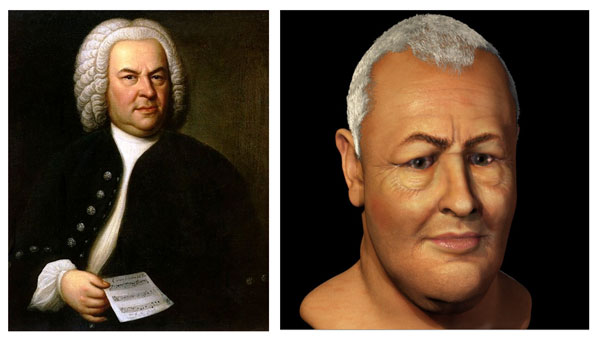
Oh, and one more thing, in case you missed it: There’s some evidence that J.S. Bach was a punk.


Leave a Reply