Archived Posts

  • Another ’60s Rock Mystery…

    Another ’60s Rock Mystery…

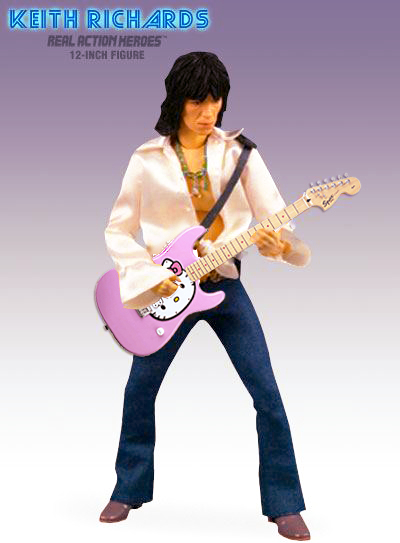
    This action figure not available in stores!

    It’s hard to discuss the Beatles without summoning their shadow: the Stones. Since posting last week about Randy Bachman solving the mystery of the “Hard Day’s Night” chord, I can’t stop thinking about another 1960s conundrum: Who played the solo on “Sympathy for the Devil?”

    There’s one key reason why so many listeners suspect that it wasn’t Keith Richards: It simply doesn’t sound like anything else he ever recorded, and certainly nothing like his solos on the  many live versions of the song.

    A couple of years ago a wrote a short piece on the solo for a “100 greatest guitar solos” anthology. Sadly, the project remains unpublished for legal reasons — a pity, since it boasted contributions from many great guitar-centric music writers. But I’m rather relieved my piece never appeared, since I argued that Keith did in fact play the solo. Now I suspect the opposite. Here’s what I wrote:
    (more…)

  • A Very EBow Christmas!

    A Very EBow Christmas!

    Sustain that seasonal spirit!

    WARNING: THIS POST CONTAINS HOLIDAY MATERIAL. THOSE WITH SEASONAL MUSIC ALLERGIES SHOULD CONSULT THEIR THERAPISTS BEFORE PROCEEDING.

    Nothing says “Christmas morning” like an ugly piece of molded plastic with a battery inside! But unlike so many cheap plastic toys, the EBow is a treasure that can delight you for decades.

    While racking my brain for a holiday post without too much bad attitude, it occurred to me that “Silent Night” makes a perfect little EBow exercise. If you play it in G, starting on the the 7th fret of the third string, the melody spans almost the entire range of the string. And it includes lots of those melodic leaps that are so tough to play smoothly on EBow. In other words, this simple, familiar tune is a serious workout! (more…)

  • Baritone Guitar, Anyone?

    Baritone Guitar, Anyone?

    Any baritone guitar fans in the house? Let’s talk LOW!

    I’ve been obsessed with baritone and other low-tuned guitars for decades, but I’ve never really found a perfect method for setting up a lower-than-standard guitar, so I’m interested to hear about other players’ experiences.

    My main issue is pretty straightforward: I can get great tones by simply lowering the pitch on a standard-scale guitar, but the intonation is a nightmare, especially on the fifth and sixth strings. And when I use a longer-scale instrument, I get huge bass tones and solid intonation, but the middle and upper registers feel too thin stiff and stiff — I have difficulty making them sing.

    With standard-scale guitars, it seems to help if there’s a length of straight string-pull — like on a Telecaster — between the nut and the tuners. I used a standard Tele tuned down to BEADF#B (like standard tuning, but a fourth lower) on the Tom Waits albums I worked on in the ’90s. Fortunately, the sketchy intonation were a plus in that clangorous context. (His song “Goin’ Out West” is a pretty good example of a cool, but screamingly out of tune, guitar tone. It was played on an old Tele dropped down to B.) (more…)

  • Lithuanian Mutants

    Lithuanian Mutants

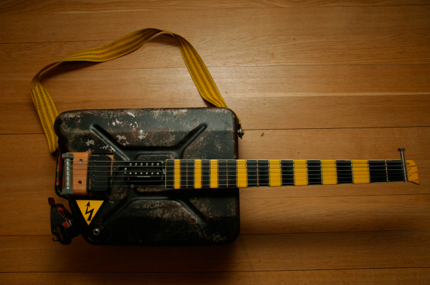
    Sadly, the Mutant Beauty Pageant ended weeks ago. But I suspect you’ll enjoy the pics I received from Lithuanian reader Dmitrij Timofejev. Dmitrij, what does that sideways humbucker sound like? BTW, the is the less radical of Dmitrij’s two guitars.

    (more…)

  • Bait for Beatle Bots!

    Bait for Beatle Bots!

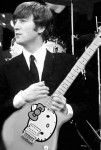
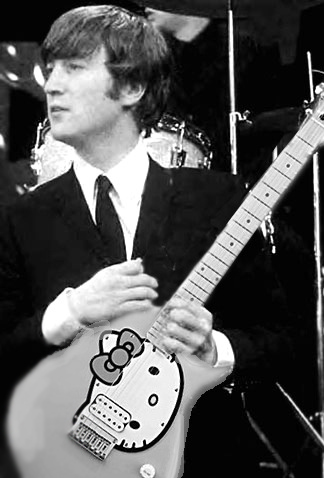
    Authentic and un-retouched historic photo.

    Okay, I’ve received this link in the last 24 hours from pretty much everyone I know who’s every held a guitar pick.

    Guess Who guitarist Randy Bachman claims to have cracked the half-century mystery of the polychord that jump-starts the Beatles’ “Hard Day’s Night.” And I believe he’s nailed it. Enjoy, Beatle bee-yotches!

    My favorite Beatle chord is the psychedelic feedback fest that launches “It’s All Too Much.” My fave solo is the screamer on “Taxman,” played by . . .  Paul.

    Hey, just for fun: Here, hastily scrawled on a bar napkin, is a one-guitar, no-bass approximation of the “Hard Day’s Night” chord that manages to cram in most of the pitches. No one in the group actually plays it, but it sounds pretty cool when you whack it hard. If your fans scream loudly enough, they’ll never notice the difference! Check it out: (more…)

  • Fun with Onboard Boosters!

    Fun with Onboard Boosters!

    Put more ELECTRIC in your guitar!

    Lately I’ve been obsessed with mounting boosters inside my electric guitars.

    Why bother? Especially when you can just get a clean-boost stompbox and use it on all your guitars? Because:

      a) certain guitars just seem to sound best with a particular boost circuit;
      b) you can “play” the booster by riding the gain setting, and;
      c) why leave well enough alone when there’s an exciting opportunity to screw things up?

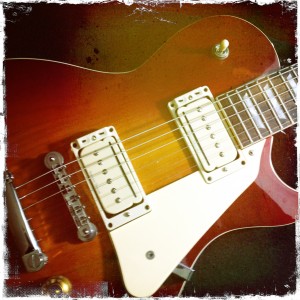
    Two examples: a squeaky-clean boost inside a lipstick tube Strat (which I previously wrote about here), and a dirty little germanium overdrive inside an old Les Paul (a guitar I previously wrote about here).

    Listen to the results! (more…)

  • Cheap Guitar Makeover!

    Cheap Guitar Makeover!

    A while back a couple of readers brought up Jimmy Page’s Les Paul wiring scheme, which made me want to set up a dual-humbucker guitar with lots of those tricky series, parallel, and split-coil tricks. Meanwhile, I wanted to do a sequel to my last cheap guitar makeover, but this time with a solidbody instead of a semi-acoustic. Also, I’d been meaning to try a pickup combo recommended by the mavens at Seymour Duncan: a pair of P-Rails combined with Triple Shot Mounting Rings.

    So I slaughtered all three birds with a single stone: I picked up a late-’80s Aria Pro II for $200 and retrofitted it with that absurdly versatile pickup scheme. Have a listen! (more…)

  • Three Useful, Easy & Cheap DIY Tools

    Three Useful, Easy & Cheap DIY Tools

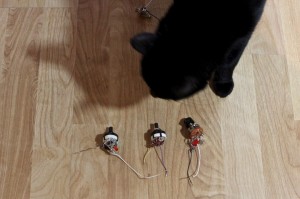
    My cat hates when I play distortion pedals. I don't think he especially appreciates my non-distorted playing either.

    Reader Derick just posted a comment on the DIY Project #1 page about his experiences with using different diodes for the Bad-Ass Distortion Pedal project. He’s inspired me to share a few cool tools you can use to make your DIY work easier and more creative. If you’ve worked through some of projects, or think you might, you should think about adding some of these to your workbench. (more…)

  • Lust for Lipstick Tubes

    Lust for Lipstick Tubes

    Nothing says “low budget cool” like a lipstick tube pickup.

    Maybe it’s their humble but sweet sound. Maybe it’s the quirky housing. Or maybe just the fact that, for countless Baby Boomers, the lipstick tube pickups of the ’60s provided the formative electric guitar experience.

    Whatever the reasons, it’s been a loooooong time since lipstick tube pickups were only appreciated by budget-bound beginners. Just consider the stupendous list of celebrity users.

    Anyone who’s ever played a lipstick tube knows they have a unique sound. Several sounds, actually. Despite the extreme simplicity of the design — no pole pieces, no bobbin, just a wire wrap around a bar magnet, stuffed into a metal tube — the old ones really do sound different than most of the modern, Asian-made ones, at least to my ears. The old ones seem more open and sparkly, while the new ones sound thicker and more midrangy, with less of that defining “hollow” quality. Popping replacement lipstick tubes into a new lipstick-tube guitar is usually a significant sonic upgrade.

    Check out this revealing lipstick tube demo:

    (more…)

  • Hubert Sumlin, 1931-2011

    Longtime Howlin’ Wolf sideman Hubert Sumlin died this week at age 80. He played with Wolf on and off from 1953 until the singer’s death in 1976. (The YouTube clip features the two performing one of their greatest tunes live in Europe in 1964, accompanied by pianist Sunnyland Slim, drummer Clifton James, and the great songwriter and bassist Willie Dixon.)

    I never met Sumlin, though everyone I know who did described him as a mellow, sweet guy. But “mellow” and “sweet” are the last words you’d use to describe his frantic, abrasive sound. I can’t think of another player who better encapsulates a) what I love about great mid-20th-century blues, and b) what I hate about much blues from subsequent generations.  (more…)