Archived Posts

  • Tonefiend DIY Club: Join and or Die!

    Tonefiend DIY Club:
    Join and or Die!

    I hereby call to order the first meeting of the Tonefiend DIY Club!

    Our mission: To attain tonal mastery over our guitars, amps, and effects with the least possible damage to our gear, bodies, homes, and pets. When the smoke has cleared (and all the smoke alarms have been reset) you’ll be able to install pickups, customize your guitar’s electronics, mod and build stompboxes, repair cables, and brag about your technical prowess while waiting in line to file your insurance claims.
    Take it from one of the laziest and clumsiest people ever to brandish a soldering iron: Anyone can learn these skills. They’re fun and creative, and they’re one of the best ways to “own you tone,” if I may borrow the Seymour Duncan motto.

    As promised, this material will be suitable for absolute beginners. (Though I hope more experienced guitar hackers join in, because we’ll really need your help!)

    Read on for lists of what you’ll need to build our first three projects, plus recommended reading while waiting for your stuff to arrive.
    (more…)
  • Pretty, Pretty Pickup

    Pretty, Pretty Pickup

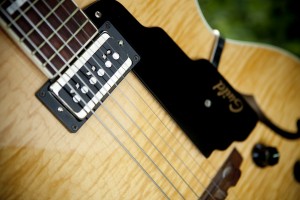
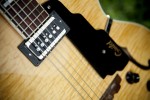
    The Dynasonic: one pretty pickup!

    Take my advice: When MJ says she has something cool to show you, drop everything and investigate.

    MJ, of course, is Maricela Juarez, the longtime manager of the Seymour Duncan Custom Shop. And the item in question was a clone of the DeArmond 200 pickup, also known as the Gretsch Dynasonic®. Predating the Gretsch Filter’Tron, the Dynasonic provided one of the key sounds of classic rockabilly, and was used at times by Cliff Gallup, Eddie Cochrane, and Duane Eddy. It’s also just about the prettiest-looking pickup I’ve ever seen. (more…)

  • Cruel Finger Exercises [Part 2]

    Cruel Finger Exercises [Part 2]

    In Part 1 of this series, I introduced 24 fingering patterns that can be jumping-off points to any number of warmup and dexterity-development exercises. As threatened, this installment introduces additional technical hurdles guaranteed to challenge even advanced players. Try these out—but only after you can play the everything in Part 1 comfortably and consistently (“like identical pearls on a string”).

    (more…)

  • Acoustic EBow: Insane, or Merely Crazy?

    Acoustic EBow: Insane, or Merely Crazy?

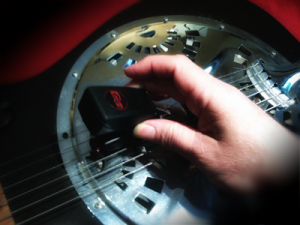
    EBow on a Dobro? Oh, yeah!

    If you’ve screwed around much with an EBow—you know, that battery-powered plastic thingie that you slide against your guitar strings to magnetically invoke infinite sustain—you may have also noticed that it works on steel-string acoustic guitar, especially on the unwound first and second strings. It’s hardly an earth-shaking tone— just a thin whine, really— though you can sometimes use it to good effect, compressed and processed within a mix.

    But when I got my first Dobro last year (okay, I was a little slow getting around to it) the technique really came alive for me, and I’ve been using it on tons of tracks ever since. (more…)

  • A Question for YOU, Dear Readers . . .

    A Question for YOU, Dear Readers . . .


    UPDATE, Friday, September 23th: Attend the first Tonefiend DIY Club meeting here.

    ____________

    Can if  I make like a zombie and eat pick your collective brain?

    One of my key goals for this blog is to promote do-it-yourself experimentation. It’s a topic I approach with the passion of a recent convert, largely due to the influence of the Maker Faire,  the unspeakably cool DIY event that has sparked a worldwide movement. (Witness this video I shot at a 2011 Maker Faire, in which hundreds of little kids learn to solder.)

    My question: Would anyone be interested in joining a guitar electronics “makers club” suitable for absolute beginners? I’m sure that many of you already have more workbench skills than I will acquire in several lifetimes, but I have a hunch there are at least as many who are curious about making and modding, but just haven’t taken the leap of faith. Am I right? (more…)

  • In Search of Primitive Bass

    In Search of Primitive Bass

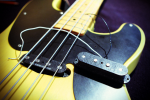
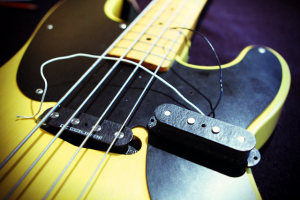
    Compare the honkin' magnets on the installed Quarter Pound to those of the factory pickup.

    The original P-Bass is a fascinating instrument. It’s wasn’t the first electric bass guitar—inventor and owner Paul Tutmarc claimed that title with the instruments he created and sold through his Seattle, Washington, music shop in the 1930s and ’40s. But the P-Bass, released in 1951, was the first electric bass that really mattered—the one that made the instrument a fixture of our musical landscape.

    The P-Bass has evolved much over the course of its 60 years. In fact, its creators instigated the first big makeover back in 1957, when Fender abandoned the original Telecaster-inspired styling and single-coil pickup in favor of a sleeker, Strat-type look and a split-coil pickup wired in humbucking mode. (The earlier P-Bass style resurfaced in the late ’60s as the Telecaster Bass, and in Fender’s  ’51 P-Bass reissues.)

    (more…)

  • Welcome…

    . . . to a blog about all the things you can do with — or to — a guitar. Topics: DIY, instruments, amps, effects, recording, software, technique, music history, music heresy.

  • UPDATE: Amps vs. Models Contest

    UPDATE: Amps vs. Models Contest

    UPDATE, Friday Sept. 23: The contest is now closed! Read the results here.

    Yet another thing you could be doing instead of practicing.

    I knew it would be hard, but I didn’t think it would be that hard!

    The Amps vs. Models Contest is still very much in progress. Yes, yes, yes—you still have a chance to win fabulous prizes and even more fabulous bragging rights.

    One of two things must occur to conclude this thing: Either a) three contestants need to get perfect scores to claim the three instant prizes, which hasn’t happened yet, or b) we wait another six weeks till Halloween, when the prizes simply go to the three best scores.

    No one wants to wait six weeks to wrap this up—least of all me. I’m dying to spill the beans, and I’m so tempted to blab when people write asking for details. But dropping hints  wouldn’t be fair to the plucky contestants who dove right in with no hints whatsoever. But I will make one seemingly obvious suggestion: Consider a bit of research about what the amps are supposed to sound like. You Tube clips may help here. 🙂

  • The Forbidden Guitar Mic!

    The Forbidden Guitar Mic!

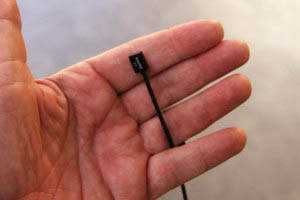
    Lavalier mics: Not just for talking heads!

    UPDATE: You’ll find a reworked version of my article on the “forbidden” guitar mic here at the online guitar magazine Pure Guitar — along with a ton of other great stuff. It’s still free! :beer:

  • Theft—or Musicology?

    Theft—or Musicology?

    Excuse me, Mr. Beatle, but Scotland Yard would like to speak with you about your illicit treble content.

    DISCLAIMER: I am not encouraging any illegal activity. Just sharing some observations.

    Over the last few years, just about every musician I know has been spellbound by a series of illicitly leaked recordings. These files, sometimes lumped under the name “Multitrack Masters,” feature dozens of classic rock recordings, broken out into individual tracks. You hear isolated Beatles vocals, Queen guitar stems, Bob Marley rhythm tracks, Stevie Wonder keyboards, and much, much more.I don’t know how they came to be leaked in this form, though I’m guessing one or more sneaky remixers did the deed.
    (more…)