I've had this cool Kala U-Bass for a few years. (I did a video on it back when I got it.) I've used it on a few things, especially when I want a sort of Latin-flavored Ampeg Baby Bass sound. (That solidbody upright from the 1960s is largely forgotten, except in Latin dance bands, where it's considered the classic bass.)
But I've recently started rehearsing with a new band featuring my pals Jane Wiedlin, Pietro Straccia, and Dawn Richardson. And for perversity's sake, I decided to try using this little uke bass as the sole bass in band. (And Dawn hits those drums pretty hard!)
The above video demos some sounds I concocted using Fractal's AX8, the "light" pedalboard version of Axe-FX II, the company's flagship amp/effect modeler. I'm quite encouraged by the results! AX8 has no power amp, so I've been plugging into one or both of the Fishman LoudBoxes I use for my solo looping gigs. And if we play somewhere with good monitoring, I can just bring the uke bass and a small shoulder bag. Total lazy old guy gig!
The sonic missions were pretty simple: Amp up the lows. Nix as much of the ugly piezo pickup quack as possible. Concoct enough patches to make a nice, interesting palette for a set. There's still more to do, especially in terms of modifying my technique for the instrument. I'm still not quite comfy to the super-short scale. Also, I'm too accustomed to resting my picking hand on the body or bridge, and the piezo loves to amplify those thumping and scraping sounds.
But overall, I'm encouraged. Plus it's just sick fun. :)
I almost always play small combo amps of 20 watts or less. But I wanted something with a bit more clean headroom for a possible upcoming project — and to demo my stompboxes. I’ve always enjoyed playing JTM-45s when I’ve reviewed them for guitar mags, so I ordered Monotone’s British 45 kit.
I’d previously had a great experience building Mojotone’s Marshall 18 watt clone kit when I reviewed it for Premier Guitar a couple of years ago. It turned out great, and I use it regularly.
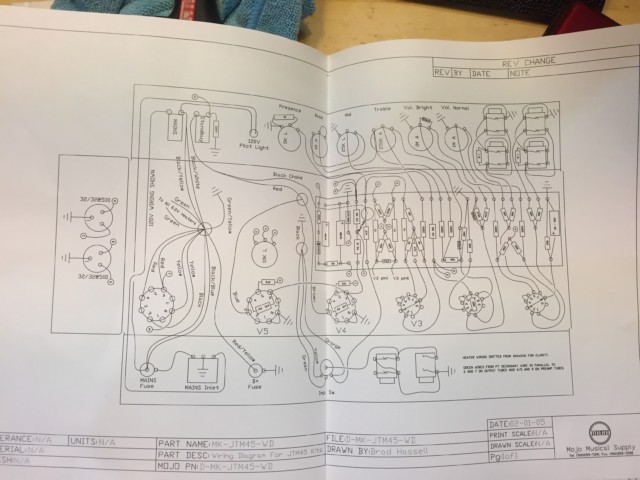
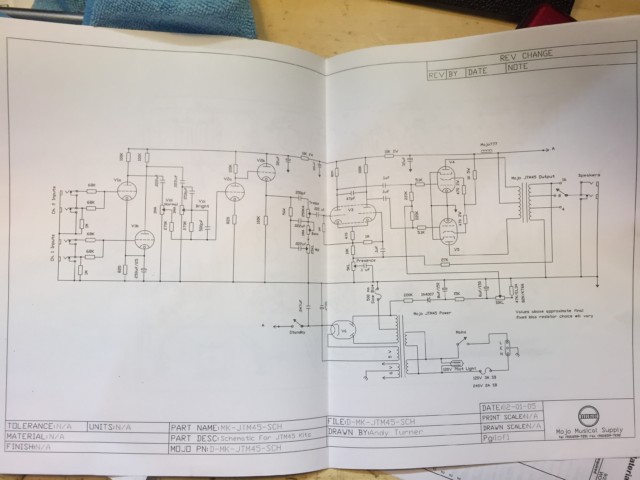
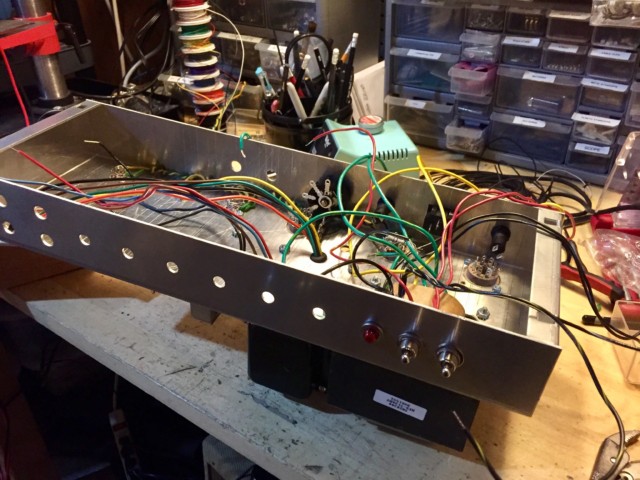
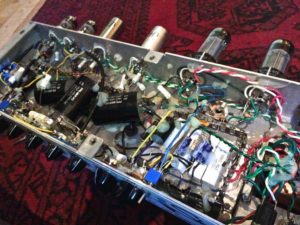
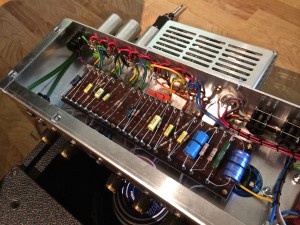
Mojotone provides high quality parts, nearly labelled and organized in plastic compartmented boxes. But beware: The company provides no build instructions — just a layout diagram and a schematic. You need amp building experience or help from an expert. Click play for a slideshow about he build:
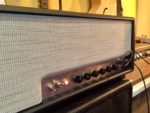
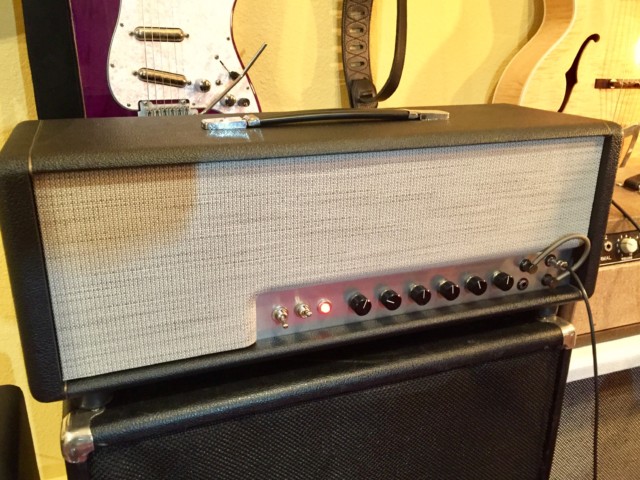
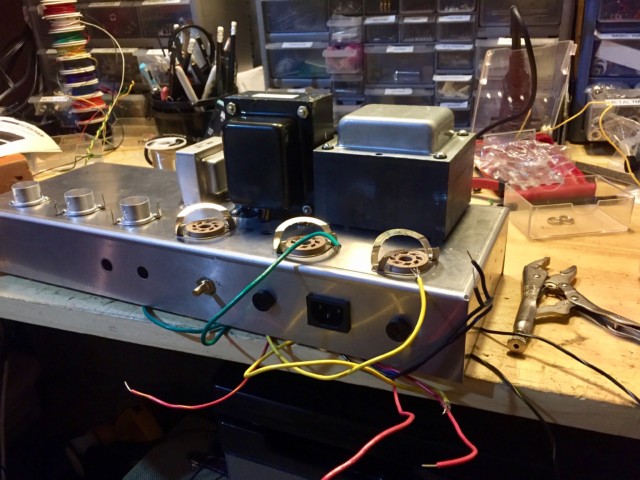
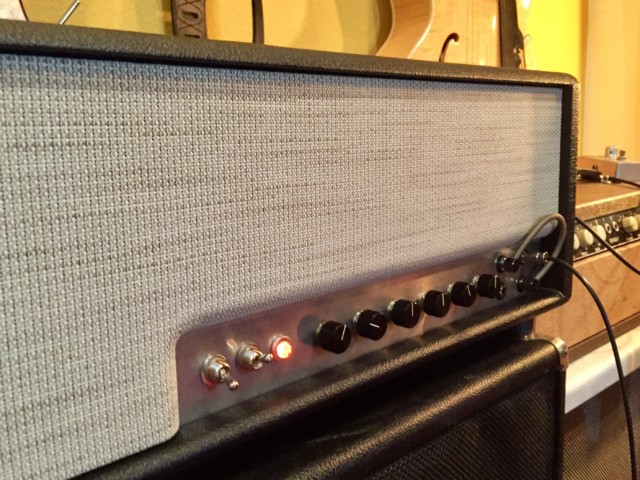
This is Mojotone's new offset head cabinet. (The amp chassis first in other Mojotone cabinets as well.)
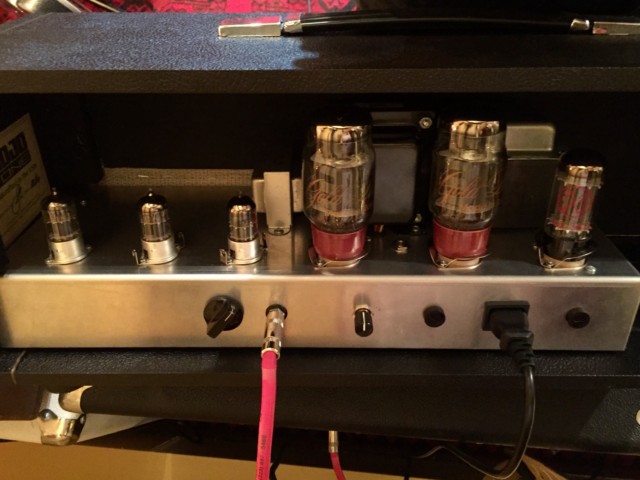
The two power tubes can be either EL-34s or KT-66s. (I chose the latter, just for a new experience.)
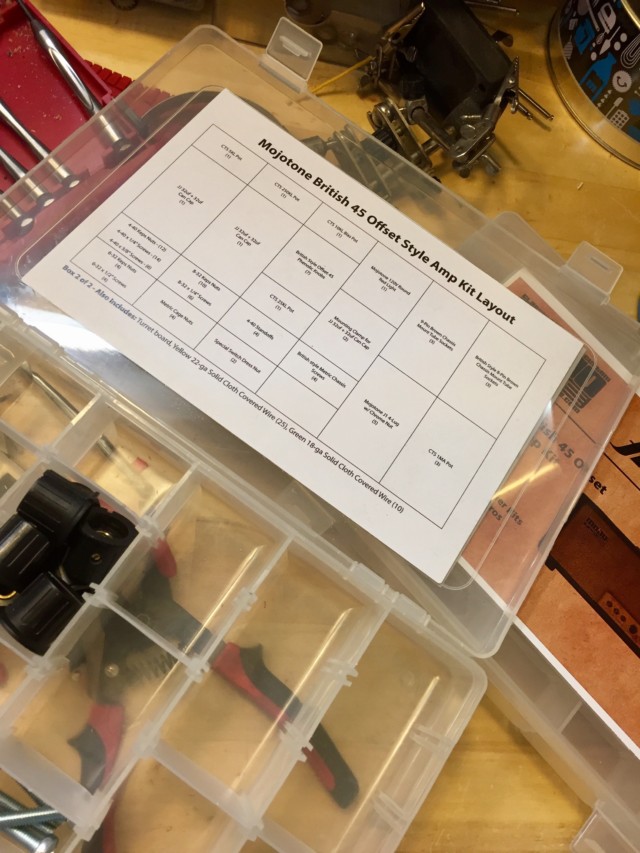
The parts come neatly labeled and organized in plastic bins — a BIG help!
Warning: the kit includes no build instructions — just this layout diagram and a schematic.
I ALMOST managed to assemble it, but I needed a rescue at the end. (Thanks to Bruce Clement of BC Audio, a brilliant boutique builder here in San Francisco.)
Mojotone supplies their own branded transformers (which sound fab).
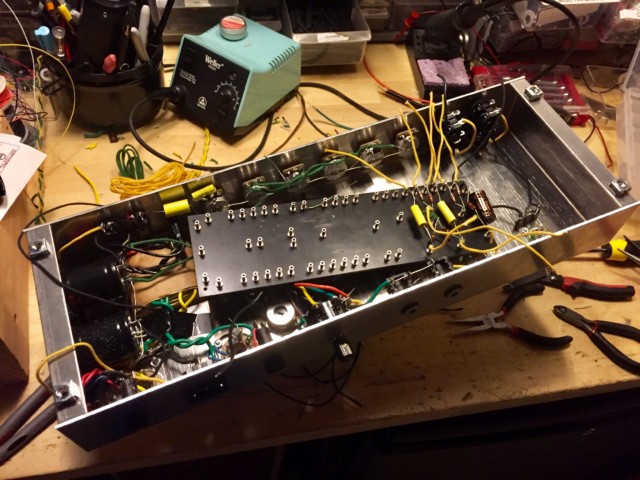
It's a turret board build. (The board and turrets are pre-made, as opposed to some kits, which require you to insert the turrets yourself.)
This is probably not a good first build — maybe start with a nice little tweed Champ kit?
The a plexi faceplate, which I left omitted. I also substituted my own knobs.
I nearly made it through myself. (Translation: I soldered everything together and it didn’t work.) So I had to hire Bruce Clement of BC Audio here in San Francisco to rescue me. (Bonus: Bruce loaned me one of his JTX50 heads. Man, it’s one of the best-sounding Marshall derivatives I’ve ever heard. It’s among his Octal-Plex series amps, which use octal preamp tubes in Marshall-inspired designs.) (more…)
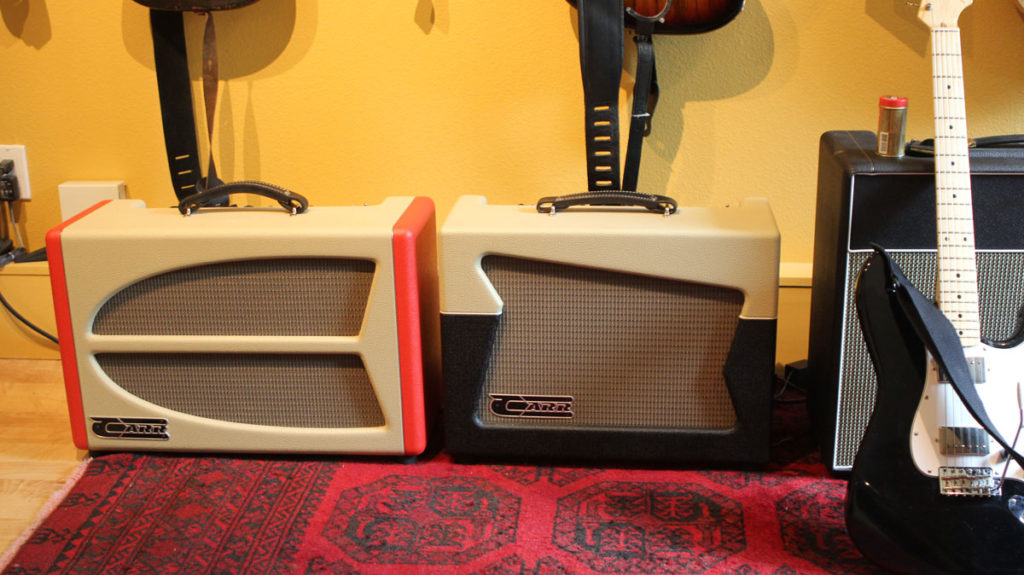
I’ve been using my Carr Skylark amp incessantly for the last 18 months or so. I’d originally reviewed it for Premier Guitar magazine, and then I bought one for myself. I dig the fact that, while Skylark is inspired by 1960s Fender amps, builder Steve Carr made numerous departures from the Fullerton template. To my ear Skylark sounds better than my ’60s originals. That’s especially true of its re-voiced tone stack, where the ranges are smaller and subtler than on vintage Fenders, with more of a Matchless-style “no bad settings” sensibility.
For better or worse, history repeated itself earlier this year when I reviewed Carr’s Lincoln in PG. Lincoln is to Vox what Carr is to Fender — not a clone, but vintage-inspired model with its own character and unique twists. Its dual EL-84 architecture makes it a cousin of the AC-15. But I think of it more as a “fantasia on a theme by Vox.” It’s captures the Vox qualities I dig, minus the ones that can make dealing with vintage Voxes a major drag.
Skylark features true point-to-point wiring, with no circuit or turret board. (Lincoln, however, uses bits of circuit board for non-audio functions such as channel-switching.)
If you’ve listened to many of my videos and demo clips from the last year or so, you’ve heard these amps, so I figured I’d focus on them. For tech details, see the reviews. This video is more about how the amps inspire me musically.
From their flawless cabinetry to their ravishing tones, these amps are simply stunning. Cheap, they ain’t, but I felt like I was (RATIONALIZATION ALERT!) investing in musical art. Or maybe I’m making up for not buying a Trainwreck amp back in the ’90s when they were affordable.
I especially love how these Carr amps sound with my flatwound-strung guitars, and I used them on most of the demos for my pedals because they’re so very flattering. Ironically, I thought I’d given up buying new amps, because I was having so much fun building from kits. But trust me — both these instruments sound way better than any of my kit amps. Have a listen!
How come my DIY amps never look this pretty inside?
A couple of weeks ago I posted here about a Premier Guitar project in which I built two Marshall 18-watt clone kits. Meanwhile, the magazine received a review model of Marshall’s latest iteration of the 18-watt, a high-end, hand-wired version that sells for $2,700. My new review is online at PG, if you’re curious to hear a proper Marshall as well as the clones.
My take: It’s a beautifully built, hand-wired amp that sounds as least as good as either clone. Unlike the kits with their single 12″ speakers, the Marshall has a pair of 10s, which I think I prefer in this circuit. At $2,700, though, it’s pretty darn expensive, even for a beautiful, hand-made instrument. But I’ll be sad when I send the review model back to Bletchley.
I had a blast building and testing two Marshall 18-watt kits for a Premier Guitar story — and I emerged with new respect for this cool 1965 design.
These mini-Marshalls were neglected in their day, but are now treasured. The oft-heard claim that they provide plexi tones at reasonable volumes is only partially true — these are open-backed combos powered by a Vox-like pair of EL-84s tubes. But while they have roughy the same horsepower as the era’s Fender Deluxe and Vox AC15, their tone is undeniably ’60s Marshall. In the studio, they sound far larger than their actual size. And out of the studio, they’re still pretty darn loud.
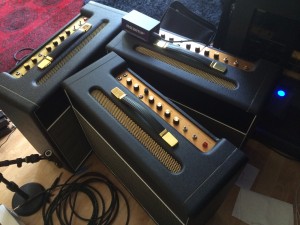
I’ve never seen three 18-watts in the same place before.
Even though the Mojotone and Tube Depot kits I built share the same schematic (and identical cabinets, both made by Mojotone), the build experiences and final results differed greatly.
And just when I thought I’d scaled the Everest of 18-watt ecstasy, I get a real Marshall 18-watt reissue for an upcoming Premier Guitar review. Stay tuned.
Are any of you guys 18-watt fans? Any observations to share?
May I take this opportunity to pimp my new monthly recording column in Premier Guitar? The first installment covers basic electric guitar miking technique. It’s ground that’s been covered often enough before, though I hope the article’s many audio files (recorded via ReAmp, moving the mic between “takes”) shed some new light on the topic.
Meanwhile, I’m breathlessly stoked about my new “Partsmaster.” It’s a Korina “Split Jazzmaster” body from Warmoth with Fralin P-92s and some new tricks I’ve been wanting to try with wiring and onboard overdrive, plus several other ill-considered, stab-in-the-dark adventurous experiments. It’s like some wacky Firebird/Jazzmaster hybrid (“Birdmaster?”) I hope to post some video later this week, but right now, the guitar is awaiting the plek treatment at Gary Brawer’s shop. Gary is also prettying up some of my clever but sloppy wiring, and remedying the fact that, when I brought the beast in, the strings were about a half-inch from the fretboard.
I just tried an interesting tone comparison, one I’ve never seen attempted. It concerns the search for loud amp sounds at low volumes.
Have any of you ever experimented with speaker attenuators — the passive load boxes that reside between your amp output and speaker input, which let you crank the amp while maintaining a low level from the speaker?
I’ve worked with one model before, a borrowed THD Hot Plate, and thought it performed well. I decided to purchase my own attenuator after several Premier Guitar reviews of large amps. As a small amp fan (not to mention an aging player with fragile ears), I wanted to minimize the aural assault of evaluating loud-ass amps.
But first, I wanted to determine whether it’s legit to evaluate amps at attenuated levels. Does attenuation inevitably alter the tone? And if so, can you compensate for via recording software?
Online opinions about attenuators range from “works like a charm!” to “totally killed my tone!” So I picked up a Swart Night Light and started recording and measuring. (I didn’t compare rival products. I just went with the Swart for its reasonable price, solid online reviews, and dual outputs for driving two cabs. I didn’t A/B it with a Hot Plate, though the results seem roughly similar.)
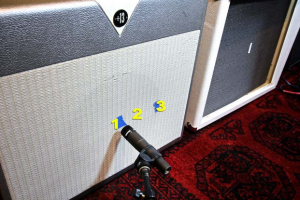
I direct-recorded a brief guitar phrase using my black Les Paul with Bigsby and PAFs, and then ran it through a ReAmp to my early ’60s Tremoverb, a 35-watt Fender with two 6L6 power tubes. I dimed the volume and left the EQ flat. Tt was insanely loud in my small studio. After recording that, I tracked the same clip again using the attenuator at each of its three settings. The lowest attenuation setting reduced the sound from insanely loud to very loud. Medium attenuation reduced to somewhat loud. Strong attenuation produced a sound quiet enough to speak over. I recorded the results through Royer R-121 ribbon mic. I added a touch of plate reverb, but no compression or EQ. (Though I did normalize the files so they played back at similar levels.) In other words, you hear the same clip four times through a head whose settings never vary.
So did the tone change? Have a listen:
Do you hear what I hear?
IMHO, none of the clips sound particularly great. (Most amps, including this one, don’t sound their best at 10.) But the unattenuated loud sound has some qualities the others examples lack. The attenuated clips have a little less low-mid impact, and the higher-register single notes that sound a bit thin and prickly even on the original sound even thinner and pricklier post-attenuation.
Why, since the amp settings don’t change, and the performance are identical? Mics can respond differently at different sound pressure levels, and the relatively restrained speaker movement alters the result as well. Conclusion: the timbres of the attenuated signals are fairly faithful to the original, but there are slight spectral differences and a bit less body/fatness, especially on single notes.
Then I introduced some additional wrinkles: (more…)
Let’s not just talk about one-knob gear — let’s design some! Any interest in conspiring to create a minimalist DIY amp?
Frankly, the intensity of the reaction to my recent One Knob Manifesto startled me. I had a general sense there was a growing interest in minimalist gear, but I was no idea the sentiment was so intense. (Though I’d hesitate to draw too many conclusions based on a focus group of the obsessive geeks who hang out here.)
Now, don’t get your hopes up — we probably won’t create anything QUITE this awesome.
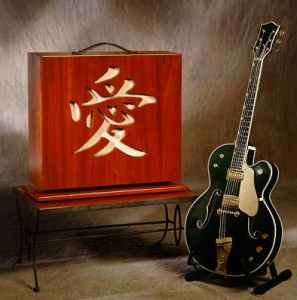
The limited edition Love amp fascinates me. Not its ornate furnishings, but the minimal controls: no tone stack, not even a volume control. It’s pretty much exactly what I was talking about when I expressed an interest in an amp with nothing but an on/off switch. That desire became even more focused last week when I reviewed a fabulous amp from a new Colorado Springs company called Toneville. (I’ll link to the Premier Guitar review when it goes live in a couple of weeks.) The Toneville Beale Street model I reviewed features a full compliment of blackface-style controls, but the tone controls are voiced so that the tone stack can largely be removed from the circuit, and there’s also a pot to remove the negative feedback loop for a more tactile/primitive response. As with some other ultra-high-end amps I’ve written about recently (like the Little Walter 50/22 covered here), the tone controls sound great wide-open, and it matters surprisingly little where you set the volume — you just drive it hard enough to warm things up, and then shape the tone from the guitar. With a nicely voiced and biased amp, you need far fewer controls than you might think. And the more crap you omit, more livelier the reponse and the more immediate the tone
The no-controls Mill Hill Love amp.
So why don’t we collectively create something in this vein? A simple but great-sounding tube amp with nothing but an on/off switch? I’ve never designed anything such thing and have little relevant expertise beyond the knowledge that, unlike 9v stompboxes, AC-powered amps can kill you. But I’ve built enough kit amps to know that a one-knob head can be easy, potentially inexpensive (though you could invest in ultra-premium tranformers, vintage tubes, NOS parts, and so on), and it should sound stunning. If we come up with a plan, we can source the parts, create step-by-step instructions, and probably get a vendor to put together a kit for us. (I’m thinking out loud here, so bear with me.)
I’m not firm on many details other than these:
head-only design (at least initially)
low-wattage for home/studio use — something you can crank without self-evicting
should sound big and bad-ass (not a cheap, practice-amp sensibility)
Any interest, folks? And more important, any ideas? And more important, any ideas? What would make this fun, useful, and bitchin’?
It’s almost always a bad idea to label something a manifesto. It’s pretentious, and it makes you sound like a crank, especially if you were born between 1890 and 1990. But it is dramatic. And would anyone pay attention if I gave this post a more accurate title, like “Please Participate in My Stompbox User Interface Focus Group?”
Anyway, I’ve been having this recurring workbench experience. (No, not the solder burns.) Every time I breadboard a stompbox project, I poke through the circuit, looking for places where I might add a switch or knob to unlock cool sounds. I usually find nice variations and build accordingly. But as soon as I plug in the pedal, I always seem to like one setting a lot more the others. Then I rebuild, hard-wiring the preferred value and ditching the switch or pot. Eventually almost everything I build winds up with only one or two knobs. (Unless I’m making it for personal use, in which case it often has no knobs.) It’s not a love of minimalism, and it’s certainly not an assumption that users are too stupid for anything more complex. It’s just that time and again, the simplest solutions sound best to me.
Meanwhile, I just had an interesting experience reviewing a (gulp) $5,000 amp for Premier Guitar, which crystallized some of my thoughts. The amp in question is a Little Walter 50/22 (which is actually two independent amps in a single housing), and I’ll link to the review when it goes live in a few days. But suffice it to say that Little Walter amps draw their inspiration from the earliest Fender tweeds, and have minimal controls to match: one volume knob and one tone knob. Furthermore, builder Phil Bradbury all but advises against using the tone control, pointing out that vintage-stye tube amp tone controls are strictly subtractive, and that you get maximum impact and richness with the tone circuit wide-open. And Bradbury is right. As on many great vintage amps, the Little Walter controls are practically superfluous. If you locate the right sweet spot, you can park the controls there and make any needed gain or tone adjustments the old-fashioned way: by playing them. Dig in harder for more distortion. Back of the volume to clean up. Use your angle of attack as a tone control. Like that.
But you don’t encounter many new-production amps that adhere to the philosophy. I get the sense that a lot of designers would like to create minimalist amps such as these, but they fear that the public wouldn’t get it. How could the one-knob amp possibly sound as good as the one with 11 knobs? But I suspect that the more experience you have with amps, the likelier you are to believe that simple sounds better. Now I want to build a great-sounding tube amp with only an on/off switch.
Three knobs?! What, do I look like Einstein to you?
I’m finding the same to be true with distortion/fuzz/overdrive stompboxes. For many players, the minimum complement of controls is gain, tone, and master volume. But almost every circuit I’ve explored sounds better without a tone control, and it’s hard to make a gain control sound great throughout its entire range. So more and more I find myself fine-tuning circuits to what I feel are the best gain and tone settings, hard-wiring them there, and then just slapping on a master volume for level-matching. (And if the pedal doesn’t add a great deal of volume, I often skip the master as well.) If you “tune” the distortion, you can control the gain perfectly well via your hands and guitar.
“But,” I hear the inquiring player ask, “don’t you need a tone control so you can use the same pedal with different guitars?” (Sadly, I sometimes believe I’m hearing the voices of inquiring players when I’ve neglected my meds.) Increasingly, I think not. In almost all cases, there’s a sweet spot where a circuit sounds good on everything from a bright Tele bridge pickup to a tubby neck humbucker. Those extremes don’t sound the same, of course. But if you’re playing distorted on a Tele, can’t we assume that you want a bright edge? (And vice-versa with the neck humbucker.) And if you do want to modify the tone, isn’t doing so with via fingers, amp, or mixing board a better solution than using a tone-sucking stompbox tone circuit?
Another example: I spent countless hours pursuing a stompbox vibrato circuit. (I mean true pitch-shift vibrato, not tremolo.) I’d obtained great tones, but I couldn’t get the effect to sound good at all rates and depths, because the perceived depth changes along with the rate. Finally, it occurred to me to go the one-knob route, using only a rate control, and letting that determine the depth. That may sound like a half-assed non-solution, but I’ll be danged if I didn’t suddenly have the most gratifying vibrato pedal I’ve ever played. Like the minimal controls on ’50s amps, the arrangement just worked.
Other factors influence my one-knob attitude: Since I’ve spent much of the last few years in the digital guitar realm, analog guitar has become a refuge from that sometimes math-based approach. When I switch on the analog rig, my goal isn’t maximum user options, but a primal experience. Also, there’s probably an element of advanced-player snob appeal. I don’t know much about cars, bicycles, motorcycles, or sporting goods, but there’s probably a parallel between minimalist musical tools that demand a fair amount of technical finesse, and vehicles and sports gear with stripped-down, featherweight, only-for-pros features. Not every bicycle needs a kick-stand, and not every fuzz pedal needs a gain control. (Or something like that.) Additionally, I hope to bring my pedal designs to market, and what a crowded market it is! Sure, it’s mainly crowded by clones, but many brilliant builders are creating complex mad scientist boxes. Maybe there’s a niche for one-knob mad-scientist boxes…
I’m not sure it’s kosher to conclude a manifesto with questionnaire. But I’m eager to hear your replies to these queries—or anything else you feel inspired to add. Thanks!
Do you tend to change tone settings on amps and pedals when you switch guitars?
How often do you fiddle with stompbox knobs mid-performance?
Do you use your guitars’ tone knobs much? If so, how and why?
Does anyone out there actually use their guitar volume knobs to veer from clean to dirty sounds? Or is just the wishful thinking of pompous guitar “journalists?”
Would you consider using a no-knob stompbox that pretty much requires you to use your guitar’s knobs?
This first installment of my 2013 NAMM report focuses on products for the digital guitarist. In the coming days I’ll be doing posts on analog amps, guitar, stompboxes, and accessories. (But maybe not as quickly as I’d like, because I’ve also got to cover MacWorld in San Francisco this weekend.) This is cross-posted from Create Digital Music, one of the few music sites I visit every frickin’ day.
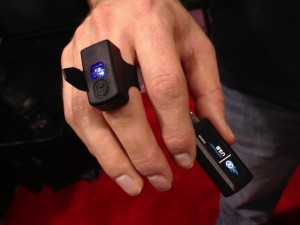
Source Audio’s Hot Hand USB wireless controller.
We guitarists tend to be a technologically conservative bunch, yet there was no shortage of forward-looking products at NAMM 2013.
Not that everyone was looking in the same direction. Guitar processors are getting smarter, but they’re doing so in different ways. Are we entering an era when every guitar, amp, and pedal in our effect chain will boast powerful processors and a dedicated editing environment? Or will we just simply centralize everything in some future i-device? (I suspect that latter, and tend to think that smart pedals and smart amps represent an evolutionary cul-de-sac. But that cul-de-sac might be a real nice place to hang out for a couple of years.)
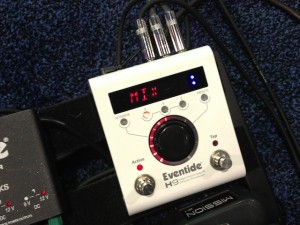
Eventide’s H9 can play all the sounds from the company’s software-intensive stompboxes, and you can edit and control them wirelessly.
One release I found particularly telling was Eventide’s H9, the latest addition to the company’s software-intensive stompbox line. The H9 has few new sounds, but can run all the DSP algorithms from Eventide’s other guitar stompboxes. The $499 box will ship late this quarter, preloaded with 9 of Eventide’s 43 current algorithms. Players hungry for more will be able to purchase them а la carte from an online store. (Eventide hasn’t yet finalized the add-on pricing.) The H9 also includes a handsome and full-featured iOS app for editing and managing patches via Bluetooth. There are no current plans to release an editor for OSX or Windows. (more…)