Categories
Pickups

Mini-Humbuckers vs. Firebird Pickups: A Head-to-Head Comparison

Man, I’ve been wanting to do this experiment for ages — and largely because it’s been a black hole off ignorance for me. As mentioned in the video, I used to think they were the same pickup. But as you can hear, they’re quite distinct, and the differences are far from subtle.

Polly’s Firebird is a 1960s original.

Until now I’ve never owned a guitar with either pickup type. My chief experience with mini-humbuckers was when I demoed a set in this sane Strat for my Strat replacement pickups comparison. I liked them there as well, though I was using a set of Seymour Duncans, while these are Lollars. (I’d be cautious about making tone comparisons, since the two videos were recorded using very different tone chains.)

Annie Clark designed her own signature guitar.

I once played Polly Harvey’s original reverse Firebird on a gig, and I wasn’t that blown away at the time. (Though there were many other variables at play.) But I adored the way the Firebird pickups in Annie Clark’s Musicman St. Vincent model sounded, and I gave the instrument a rave review for Premier Guitar. I was struck then, as now, by their extraordinary dynamic response. Small variations in touch yield big tonal contrasts. My hope was that they’d sound like Fender pickups on steroids in a Strat, and to my ear, they do. (By “steroids,” I don’t mean high output — I generally recoil from extra-hot Strat pickups. Tones are simply fatter without neutering the high end as super-hot single coils tend to do.

I liked both pickups sets a great deal, but the Firebirds are a better match for my fingerstyle playing. What do you think?
Categories
Effects

Introducing the Screech!

Yay! The first 100 Screech pedals just got into stock at Vintage King. Again, the very first production model went to Blake Mills. He immediately started doing thing I didn’t even know it could do. Damn.

Here’s the info from the product page at gorepedals.com. Pardon then obnoxious use of the third-person.

OVERTONE OVERDOSE
The Joe Gore Screech is descended from vintage octave fuzzes like the Ampeg Scrambler and Dan Armstrong Green Ringer, but it’s not a clone. It provides much clearer octave overtones, and you don’t need an extra booster for great results.

Most octave fuzzes work best when you play near the 12th fret using the neck pickup. But Screech provides potent octaves regardless of neck position or pickup setting. It also does fine non-octave fuzz. A common mod for octave fuzzes is to add a switch that switches of the diodes, removing the octave effect. The problem is, the resulting sound is dull as dirt. Here, though, though non-octave fuzz is sufficiently fiery and dynamic to stand on its own.

Unlike most things Joe Gore makes, Screech is not especially dynamic. It needs consistently heavy gain for its powerful octave effects. But as on many vintage octave fuzzes, you get freaky harmonics and other interesting noises when you lower your guitar’s volume control.

Screech runs on standard 9-volt batteries or power supplies. It was created in San Francisco by Joe Gore and is built in Michigan by skilled craftspeople paid a fair wage. It comes with a lifetime warranty.

TO USE: The single knob is a master volume. (There’s no gain control because this circuit demands high gain to generate such strong octaves.) When you hit the DIST footswitch without the octave (OCT) engaged, the LED glows red. With the octave on, the light is yellow. (You can’t use the octave section without DIST activated.)

When Screech is bypassed, you can specify whether the octave will be engaged when you activate the pedal. If the LED glows green, the octave will be engaged when you hit DIST. If the LED isn’t glowing, you’ll get non-octave fuzz when you step on DIST.

BACKGROUND INFO FOR PEDAL GEEKS: Here’s an article and video I put together a few years ago, demonstrating all the classic octave fuzz circuits. Toward the end I show an early prototype of the circuit that would become Screech. It’s evolved since then, so don’t consider this a proper demo. It’s just some amusing pedal geekery. 🙂

Categories
DIY guitar

Telecaster Deluxe Variations: Six Pickups and Some Weird Wiring

Fender’s Telecaster Deluxe has had an interesting and checkered history. Once regarded as yet another mediocre product from the company’s era of CBS ownership, these turn-of-the-seventies instruments now fetch huge prices on the collector’s market. I’ve never owned own. But when singer/songwriter Greer Sinclair loaned me one of Fender’s 2010 reissues, it was time for research — and experimentation.

The made-in-Mexico 1972 Deluxe reissue is a cool guitar. It replicates many details of the original: the oversized headstock, the Strat-like belly cut and fixed Strat-style bridge, and the big-ass pickguard. But its pickups are definitely a departure. In lieu of the original’s large-format “Wide Range” pickups, it employs a P-94R (a humbucker-sized P-90 spinoff) at the neck, and a conventional Gibson-style humbucker at the bridge.

The Wide Range pickup was a unique beast. Fender had commissioned Seth Lover, the man who invented the Gibson humbucker, to create a Fender humbucker in hopes of cashing in on the growing popularity of hard rock. With DC resistance in the 10k range, the new Wide Range pickup was a bit hotter than a vintage Gibson humbucker. Wide Range pickups appeared in several of the era’s models, including the Tele Thinline, Tele Custom, and semi-hollowbody Starcaster.

Gibson humbuckers have a bar magnet within, but the pole pieces are not magnetic. But on Wide Range pickups, the pole pieces are magnetic, as on Fender’s single-coil pickups. Situating individual magnets closer to the strings yield a brighter sound with greater note defition and string-to-string separation — characteristics we associate with vintage Fender pickups. So the Wide Range pickup lent a uniquely “Fender” twist to the Gibson design.

Wide Range pickups are slightly larger than conventional humbuckers. Most of Fender’s circa-1970 Tele reissues substitute generic humbuckers of the standard size. Standard humbuckers can sound superb in a Tele, but they’re horses of different colors. Fender has also created some reissues with the larger-sized pickups, but these are also garden-variety humbuckers — the larger format is purely cosmetic. The pole pieces of the factory humbucker on Greer’s guitar don’t align with Fender’s wider string spacing. (But one thing I’ve leaned from my various Fender/Gibson hybrid experiments is that sonically, this can matter very little.)

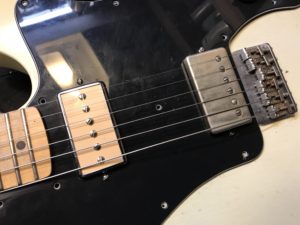
The P-94R’s cream-colored top looks wicked against the guitar’s finish. It’s a warm, full-sounding pickup from the mellower side of the P-90 spectrum. Actually, it doesn’t sound all the different from a traditional Telecaster neck pickup. (Like that pickup, it works quite well for jazz.) Note, though, that its dimensions differs substantially from those of a Gibson P-90, as you can the in the photo where it sits alongside a historically accurate Lollar P-90. When you change the size of a pickup’s components, you inevitably alter the sound. The tones can be for better or worse — but they will be different.

Categories
DIY Effects guitar

Museum of Lost Effects:
Interfax Harmonic Percolator

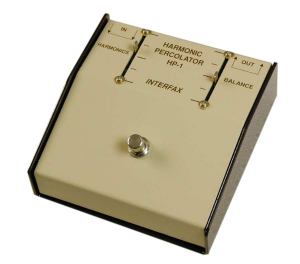
Few guitar pedals can rival the cult cachet of the Harmonic Percolator, a singularly ugly distortion stompbox produced in minuscule numbers in the early ’70s by Interfax, a small company based in Milwaukee, Wisconsin. And guess what? They sound ugly too, though they’re ugly in a cool and useful way.

They don't get much rarer — or uglier.
They don’t get much rarer — or uglier. (This is a cosmetically faithful reproduction from Theremaniacs.)

I’ve been wanting to write about these for years, but was hindered by the fact that I don’t have access to one. No one does! Well, except the pedal’s best-known user, producer/guitarist Steve Albini. (Steve has posted several popular YouTube videos in which he sings the praises of the original and evaluates it against modern clones.)

But I revisited the idea recently when Christian Magee, who runs Tube Depot, sent me a couple of old 2N404A transistors from a stash he recently acquired. This rare PNP germanium transistor appeared in the original, along with an NPN 2N3565 (also rare, but not as ridiculously rare as the 2N404A). Yes—this pedal uses both a positive-ground germanium transistor and a negative-ground silicon transistor in the same circuit. (Another Fuzz Face/Tone Bender clone, this ain’t!)

I whipped up several variants:

    • a clone using the original parts


    • a near-clone using more readily available alternatives


    • a Harmonic Jerkulator, an all-silicon/no-diodes variation created by DIY stompbox titan Tim Escobedo


    • an experimental version with extra controls

Survey the wreckage:

Post-mortem after the jump.

Categories
Effects guitar

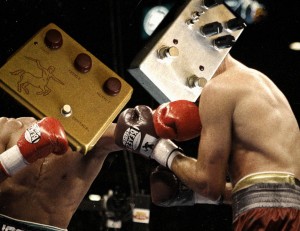
NEW CONTEST: Klon vs. Screamer
Identify the Audio Clips and Win!

Left: Klon Centaur #309, worth over $2,000.Right: BYOC Overdrive 2, a $95 Tube Screamer clone.
Left: Klon Centaur #309, worth over $2,000.
Right: BYOC Overdrive 2, a $95 Tube Screamer clone.

It’s hardly a new idea: YouTube is full of Klon vs. Screamer comparison videos.

But this one is different.

Using the same “reasonably scientific” techniques deployed in my recent germanium fuzz survey, I’ve created a blind listening test that removes as many variables as possible from the equation.

The video details the testing procedures. But basically, the A/B recordings are identical save for the use of one pedal or the other. The rival pedals are Klon Centaur #309 (the unit reviewed in Guitar Player back in the ’90s) and a new BYOC Overdrive 2, a DIY Tube Screamer clone kit with extra knobs and pots to provide the most popular boutique mods.

This Klon would fetch north of $2,000 on EBay. You can order the Overdrive 2 online for $95.

Now, these two pedals are NOT identical circuits. (The key differences are covered in the video.) But they share the same topology and sonic character. It’s not an apples and oranges comparison — more like two apples of distinct but related varieties.

For the video I dialed in five different sounds from across the Klon’s range, and then tried to duplicate them with the BYOC Screamer clone. You’ll hear the same material ten times, like so:

Example 1: medium gain, medium tone

Pedal A =
Pedal B =

Example 2: high gain, medium tone

Pedal A =
Pedal B =

Example 3: low gain, medium tone

Pedal A =
Pedal B =

Example 4: medium gain, bright tone

Pedal A =
Pedal B =

Example 5: medium gain, dark tone

Pedal A =
Pedal B =

To compete, just fill in the blanks and copy your answers into the comments thread below.

The pedals might not appear in the same order for each pair of audio clips. Other than that, there are no sneaky tricks. (For example, you really do hear two different pedals for every example.)


The first three contestants to submit perfect scores before Tuesday, July 23rd, 2013, will each win fabulous prizes one of my hand-built stompboxes. On that date I’ll post the answers and announce the winners here, assuming there are some. You can still test your ears after that by watching this video and not peeking at the answers — but sorry, no more prizes.

Only one entry per person. Anyone caught circumventing this rule via multiple identities may be subject to global ridicule.

I’ll hold off on any sonic observations till I post the correct answers next week.

Good luck, and may the best ears win some gnarly stompbox.

Categories
DIY Effects

Next Week on Fuzz Detective!

UPDATE: Based on cool info supplied by YOU, dear readers, I’m expanding the scope of this piece. I’m furiously wiring up clones of some very rare models, and I can promise many cool and interesting surprises. Thanks, guys! :beer:

Okay, now that we’ve all gotten that silly “reading” stuff out of our systems with Book Week, it’s time to get back to the real focus of this blog: nasty, filthy fuzz pedals.

Last time we were on the subject, we looked at the original version of Dallas-Arbiter Fuzz Face, and included Mitchell “super-freq” Hudson’s beautiful DIY instructions.

Those posts generated many interesting comments — plus some misinformation on my part. For example, I said that the original Fuzz Face circuit is a close cousin to the Tone Bender Mk I, which would mean, for example, that known Mk 1 user Mick Ronson was essentially using a Fuzz Face between his Les Paul and his Marshall. But subsequent listening and reading makes me believe I was wrong. So I figured it was time to play fuzz detective and sort the facts from the other stuff.

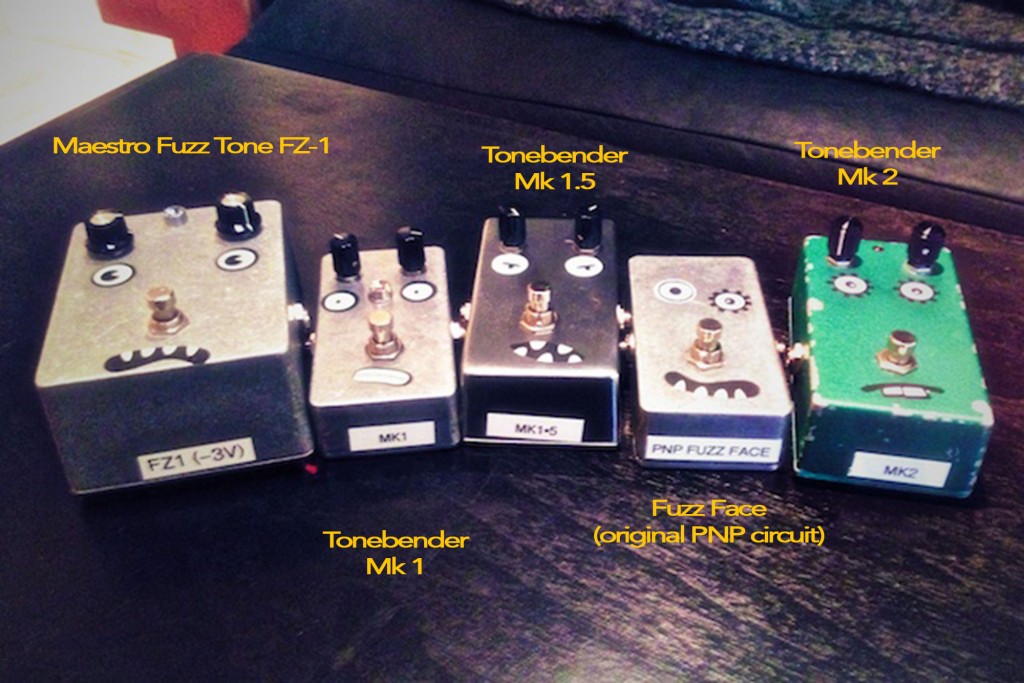
First, I made clones of all the early commercial fuzzes. I’ll be posting a compare-and-contrast video in the coming days. (The audio forensics will be quite incriminating.) Here’s the lineup:

The usual suspects. (Incriminating audio/video evidence to be posted soon!)

I’ve also re-read the experts, and man, even my most trusted sources contradict each other right and left, especially when it comes to those darn Tone Benders. While I have absolutely no inside dope on what actually transpired, I think David from D*A*M Stompboxes offers the most convincing Tone Bender chronology, which you can read here.

Anyway, here’s my best guess about how the early fuzz years unfolded:

Categories
guitar Music

The Best Music Notation Software for Guitarists?

Since New Year resolutions expire at midnight, January 7th, I’m racing to realize my goal of finally becoming fluent with music notation software before the sands run out.

A new way to feign productivity in cafes!

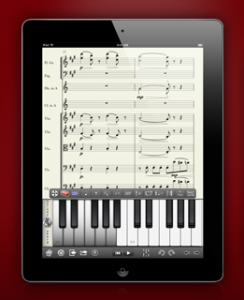
I’d like to share some initial impressions about Notion. This isn’t a full-fledged product review — just a few thoughts about a half-dozen features I dig. (Most also apply to Notion’s sister app, Progression, which compiles all of Notion’s fretted-instrument tools, but omits the orchestral stuff. If you only plan to notate for guitar, the lower-priced Progression is probably all you need.)

1. Appropriate complexity. Two programs, Sibelius and Finale, dominate the music notation field. Both are powerful, deep programs. Most notation pros use them because they’re packed with features essential to “music engraving” (the archaic and pretentious term for the process of preparing music for publication).

Categories
Amps

The Class A vs. Class A/B Slugfest!

Which kick more ass? Class A or Class AB?

The recent experience making a DIY Class A Champ  reignites for me the eternal debate between the merits of Class A and Class A/B amps. (I link once more to Dave Hunter’s excellent short article on the topic, since he explains the distinction so much better than I can.)

Like most American players of a certain age, I grew up without access to great Class A amps. (I’m going to take the lazy way out here, and lump Voxes and their kin into the Class A category, despite the distinctions that Dave H. explains so well.) My initial exposure to various ’90s Vox reissues and other “Voxoids” of the era was enough to spark my interest. (And is “spark” the perfect verb for great Class A amps, or what?) But it wasn’t till I encountered Matchless amps and real vintage Voxes that I totally got it.

But still, I go back and forth constantly. And whenever I switch between categories, I think, “Ah! There’s what I was missing,” though I tend not to miss it when I’m playing an amp of the opposite type. So at least I’m usually happy.

Overall I’ve probably favored Vox-type amps over Fender- and Marshall-flavored ones, though I’m the sort of player who’s rarely interested in macho rock and metal distortion. (If that weren’t so, I’d be an A/B purist!) But having said that, my fave amp these days is the decidedly A/B brownface Tremolux I use in the lion’s share of my videos. So put me down as perennially undecided.

How about you? Do you pledge your allegiance to the explosive harmonic energy of Class A or the focused impact of Class A/B? And has anyone explored switchable schemes, as found on some Mesas and modded Marshalls?

Categories
Effects guitar

Museum of Lost Effects: Klon Centaur

Overdrive from Heaven? Or hype from Hell?

Has any stompbox ever been as steeped in myth and legend as the Klon Centaur? Doubt it. Original Centaurs are extremely collectible, currently fetching around $1,500 on EBay. But for every player who drools over the prospect of obtaining this rare creature, there’s another who’s foaming at the mouth about idiots who’d pay four figures for a “glorified Tube Screamer.” When you Google “Klon Centaur,” one of the first items to appear is this memorable rant from the always entertaining Zachary of Zachary Guitars:

Here is a guitar pedal which has been around for about 10 years and stands for total Bull Shit in my opinion. The website, the presentation, the marketing, the hype, the price. Everything about it is why I hate the music business and the shockingly stupid guitar consumers. Its a mediocre and common pedal. Its your typical mild Tube Screamer- type of effect and sound. It really does not do much and is not very versatile. I found it stuffy and midrange sounding.In comparison to the great touch sensitivity, clarity, transparency and the wonderful independent Clean Boost section of the Zachary Pedal, well…there is absolutely no comparison.

Yow.

For a bit of perspective, how about we just listen to the thing? Here a little video demo, followed by a few observations.