Here’s the info from the product page at gorepedals.com. Pardon then obnoxious use of the third-person.
OVERTONE OVERDOSE
The Joe Gore Screech is descended from vintage octave fuzzes like the Ampeg Scrambler and Dan Armstrong Green Ringer, but it’s not a clone. It provides much clearer octave overtones, and you don’t need an extra booster for great results.
Most octave fuzzes work best when you play near the 12th fret using the neck pickup. But Screech provides potent octaves regardless of neck position or pickup setting. It also does fine non-octave fuzz. A common mod for octave fuzzes is to add a switch that switches of the diodes, removing the octave effect. The problem is, the resulting sound is dull as dirt. Here, though, though non-octave fuzz is sufficiently fiery and dynamic to stand on its own.
Unlike most things Joe Gore makes, Screech is not especially dynamic. It needs consistently heavy gain for its powerful octave effects. But as on many vintage octave fuzzes, you get freaky harmonics and other interesting noises when you lower your guitar’s volume control.
Screech runs on standard 9-volt batteries or power supplies. It was created in San Francisco by Joe Gore and is built in Michigan by skilled craftspeople paid a fair wage. It comes with a lifetime warranty.
TO USE: The single knob is a master volume. (There’s no gain control because this circuit demands high gain to generate such strong octaves.) When you hit the DIST footswitch without the octave (OCT) engaged, the LED glows red. With the octave on, the light is yellow. (You can’t use the octave section without DIST activated.)
When Screech is bypassed, you can specify whether the octave will be engaged when you activate the pedal. If the LED glows green, the octave will be engaged when you hit DIST. If the LED isn’t glowing, you’ll get non-octave fuzz when you step on DIST.
BACKGROUND INFO FOR PEDAL GEEKS: Here’s an article and video I put together a few years ago, demonstrating all the classic octave fuzz circuits. Toward the end I show an early prototype of the circuit that would become Screech. It’s evolved since then, so don’t consider this a proper demo. It’s just some amusing pedal geekery. 🙂
You know what sucks about attending NAMM as a manufacturer rather than a gear writer? I was epoxied to my booth all day, and I barely saw anything other than my guitar pedals. But on one rare break, I got to hang out with Jannis Anastasakis and his crew from JAM Pedals of Athens, Greece. (I highlighted some of their beautiful work in my pathetically skimpy “NAMM report.”)
Happily, there’s more to celebrate here than great visuals. JAM builds lovely versions of many classic analog effects. Their sounds and production quality are stellar, and JAM often adds modern updates such as realtime expression control, extra knobs, and internal trim pots for customizing tones. It’s quality stuff, used by many a guitar star.
And guess what? Jannis loaned me one of his magnificent Custom Shop analog pedalboards. Γαμώτο!
Sadly, I must now pack up and return this pretty pedalboard. But I’ll be getting my own JAM Delay Llama Supreme, an expanded version of the analog delay heard here, with tap tempo, a cool modulation section, and the almighty infinite-hold switch. (I reviewed it for Premier Guitar a few months ago.)
In the meantime, this experience makes me want to try my own DIY pedalboards. Not as an item for sale — just as a way to group related effects in a single enclosure for stage use. Gears are spinning ….
Oh man — my friends at Premier Guitar just posted a video of me demoing four of my new pedal prototypes at NAMM. I didn’t even think I’d have these ready by showtime, but I powered out at the last minute. (Maybe ’cause I needed something to take my mind of the inauguration.)
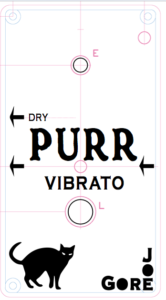
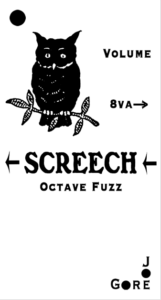
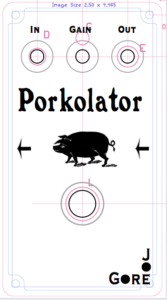
It’s been a busy month since we filmed this. We’ve settled on names, graphics, and specs, and everything is in development. (Though they’re still a few months away from shipping.) I’ve included the first-draft enclosure graphics as well.
Purr is a minimal one-knob optical vibrato. Yep — one knob, which means no independent rate and depth controls. Sound crazy? I agree. But it just sort of works! (I explain my questionable reasoning in the video.)
It’s not a deep, wobbly pitch-shift effect — more like cross between a really warm, pretty tremolo and a subtle optical vibrato. It’ll have the same large knob as my Duh pedal, so you can make adjustments with your foot, assuming you’re not as clumsy as I am.
It’s my fave modulation circuit, one I’ve used on a number of my YouTube videos. Here it’s on throughout at a very subtle setting.
In this video it’s set more strongly, though I toggle it on and off as I loop additional layers.
Screech, a mutant spinoff of the Octavia and Green Ringer octave fuzzes, is an outgrowth of the experiments I did did a few years ago, when I built models of every major octave fuzz design, and then attempted a variation of my own. (It’s not too far removed from the final pedal in this video, which appears at the 10-minute mark.)
It’s got the most extreme octave effect I’ve ever heard from an analog octave fuzz, and unlike on an Octavia or Green Ringer, the effect works in all neck positions and at all pickup settings. You can also bypass the octave portion of the circuit for a straight distortion sound. (That’s not a new idea—it’s a popular Octavia mod. But that non-octave Octavia sound is dull as dirt, whereas this, I think, has a bit more character and impact.)
Porkolator also springs from a video demo/experiment of a few years back. It’s my oddball spin on the Interfax Harmonic Percolator, which is already pretty odd to begin with. It uses the same weird combination of negative- and positive-ground transistors for that sort of gravelly, decidedly non-tube-like distortion that Steve Albini loves so much. But all the part values differ, and the gain stages work very differently. There’s also an independent boost stage that can generate tons of extra level if desired. Again, it’s not that far removed from the final example in my octave fuzz video. (It appears starting at 5:55.)
Unlike the other three pedals, Cult Germanium Channel is pretty much finished. (We were originally going to include it among the 2016 releases, but decided that three new products were enough.) Its heart is the same primitive germanium overdrive circuit as in my Cult pedal, but with lots of added doodads: a tone-shaping pre-gain control, great-sounding active 2-band tone control, and an output trim. You can read more about Cult Germanium Channel here.
The NAMM video also features a demo of Kitty Boy, my imaginary vision of a germanium fuzz that should have existed in the 1960s. It’s sort of a cross between a Maestro Fuzz Tone and a Tone Bender Mk. I, which can go from lightly overdriven “Satisfaction” tones to hyper-saturated Ziggy Stardust glory. (It’s inspired by a conversation with Lyle Workman, so thanks, Lyle!)
I hope folks dig these. I’ll keep you posted about release dates and final prices.
Thanks, Jason Shadrick and Perry Bean, for doing such a nice job with the video and squeezing me into a brutal production schedule at the last minute.
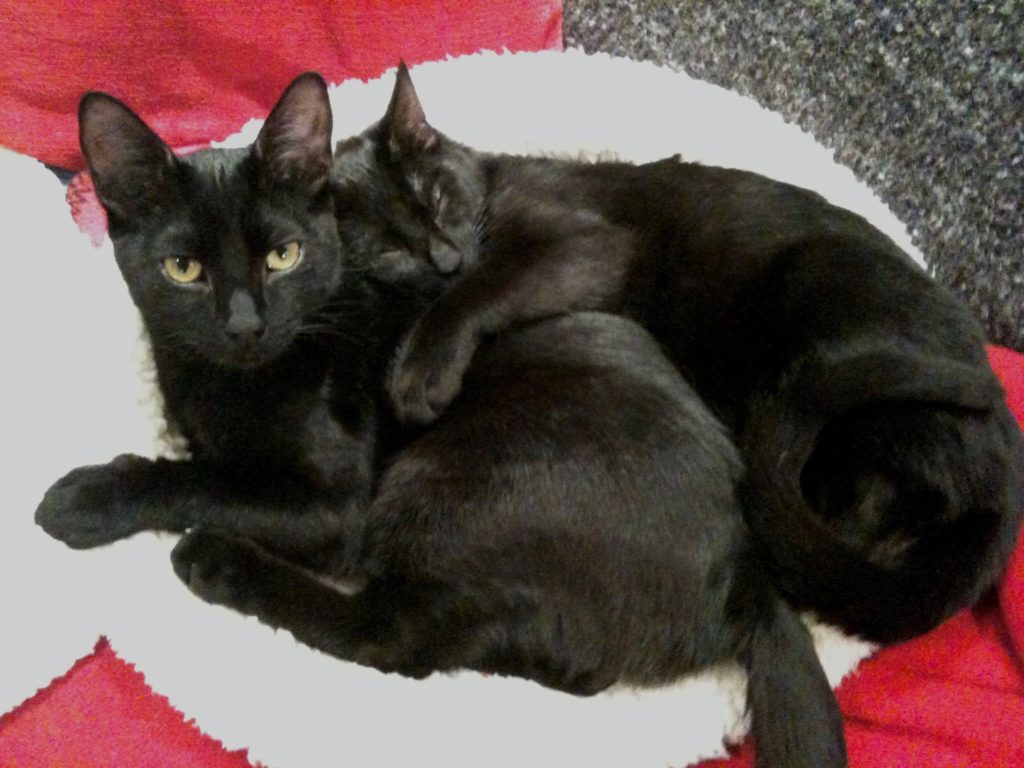
Jet and Kaiju say: “When Joe plugs in those horrible fuzz pedals, we hide in the closet. But that new Purr pedal with the black cat on it isn’t so bad.”
Sorry for even more solipsistic stompbox stuff, but I couldn’t resist. David Torn, one of the players I admire most on earth, just posted an unsolicited demo of my Filth Fuzz on Soundcloud. I love his post-apocalyptic soundscape.
For the uninitiated, David is one of those rare players who deploys staggering technical skill in a bold, unique style utterly unpolluted by cheesy guitar heroics. He’s recorded with Bowie, Tori Amos, John Legend, Madonna, and k.d. lang and created many brilliant solo albums. Last year’s Only Sky is particularly magnificent. It makes a great introduction to this singular guitarist/composer.
Lookit! My pals and colleagues at Premier Guitar just posted a video demo of my pedals shot at NAMM last month.
It was a trip being on the business end of that gear-review microphone! Shooting this clip was surprisingly nerve-racking. You have to make the gear sound good … try not to play too terribly … speak coherently … and not come off as a dick. It’s a tall order, at least for me.
Thanks to the gang at Voodoo Lab for letting me shoot this in their booth. (Which they did because they’re just plain cool.) Thanks also to Shabat Guitars for letting me borrow this pretty guitar, and to Fryette for letting me plug it into one of their spectacular Aether combo amps. Man, am I a freeloader, or what?
If you’d like to learn more about Gore Pedals, please visit my Gore Pedals page for studio-quality recordings with multiple guitars, more pedal settings, and lots of geeky tech info.
How to tell holiday season is officially over: It’s time for NAMM 2016! And this will be the first time I attend not as a music magazine writer, but as a guy trying to sell guitar pedals. Or as Ray Liotta put it in Goodfellas: “Just another schnook.”
Not like I can afford a proper booth or anything. I’ll just be wandering around with a sack of goods like some frickin’ crack dealer. I’ll have a pedalboard with new four new releases (plus a couple of surprises) on display at the Vintage King booth in Hall A. But sadly, it won’t be hooked up to anything — there just isn’t enough room for live pedal demos. However, my awesome friends at Voodoo Lab will have my new Filth Fuzz in the demo pedalboard at their booth. (No business connection there — they’re just doing me a favor ’cause they’re cool.) So you can stop by and try it out while sampling Voodoo Lab’s latest and greatest.
If you’re attending NAMM and would like to check out my stuff — or just meet and say hi — drop me a note. I’ll be at the show Thursday, Saturday, and Sunday. (Sorry, I can’t help obtain passes. I had to scuffle for my own like … a regular schnook.)
But I’m skipping the show on Friday. Friday night I’ve got a gig at Taix restaurant in Los Angeles, performing my solo looping material and sharing the bill with my longtime pals, Double Naught Spy Car. I haven’t played L.A. in several years, and this is the first time playing solo. I’ll be stoked if folks stop by.
And during the day, I’m teaching a master class at LACM, where my dear pal Adam Levy oversees the guitar department. The focus is modes — or rather, my irreverent crackpot theories about the most musically profitable ways to regard and use modes. I’ve been kicking around these notions for many years, and I’ll probably adopt them into a tonefiend post soon.
I hope to see some old friends and make some new ones. So don’t be a stranger!
My Filth Fuzz pedal is finally in production and will be shipping within a few weeks. It’s one of three new pedals I’ll be showing at this week’s NAMM show in Anaheim, California. I just finished the demo video, and I’m stoked about how it’s sounding.
I’ll also be debuting three other new pedals: Gross Distortion, Cult Germanium Overdrive, and Boring Boost & Buff. Filth, Gross, Cult, and are finalized and in production, and should be available from my partner, Vintage King, sometime in February. (Vintage King is also currently the sole vendor of my Duh Remedial Fuzz, released last year.) We’re still working out a minor bug in Boring, but it should arrive soon after.
Now, it’s not like I can afford a proper booth or anything, so when I say “I’ll be showing these at NAMM,” I mean I’ll be walking around with a bag of merchandise. I’ll have a pedalboard with all my products on display at the Vintage King booth in Hall A, but sadly, it won’t be set up for demoing — there just isn’t enough space. However, my super-cool friends at Voodoo Labs will have a Filth Fuzz on their demo pedalboard, so you can take it for a spin in their booth while checking out the new stuff from that ever-innovative company. (I have no business connection to Voodoo Labs — they’re just helping me out because they’re nice.)
If you’re going to the show and would like to meet up, contact me and we’ll work something out. 🙂
Here’s what I wrote about Filth on its product page. (If you’re allergic to marketing copy, skip ahead, where I share some interesting backstory on how we arrived at the interface design.)
Man, I love those mad scientist fuzzes with too many knobs! I’ve collected them for decades and used them on a zillion sessions. It got to the point were people were hiring me specifically to make those sort of farting, fried-circuit tones.
But the downside of those complex fuzzes is that they’re a little too wide-ranging, with many settings you’ll probably never use. It’s easy to spend 20 minutes dicking around with the dials without nailing the perfect tone. I’ve always wished for a wild, highly variable fuzz that was a bit more “curated,” with easier access to the tones you’re likeliest to use.
That’s what inspired the Filth Fuzz. It’s only got four controls, but it’s a cornucopia of cool, quirky, and usable fuzz flavors.
The drive and level controls do what you’d expect. But unlike many fuzz drive controls, this one sounds great throughout its range. Extreme settings are molten-lava thick. Lower settings are like…slightly cooled lava, maybe?
But the real action is in the two sliders. They’re tone controls of a sort, but not in the usual way. Most fuzz tone controls are tone-sucking passive circuits situated downstream from the fuzz effect. But here, the sliders alter the voltages at the transistors, radically changing not only the tone, but also the timbre, response, attack, sustain, and compression. In other words, the sliders radically alter the fuzz’s core character, as opposed to simply EQing a single core tone.
TO USE: Set desired gain and output levels. Move the sliders till it sounds awesome.
CAUTIONS: Filth sounds best before any buffered effects. It usually works best at or near the front of your effect chain.
Filth Fuzz was created in San Francisco and is built in Michigan by skilled craftspeople earning a fair wage.
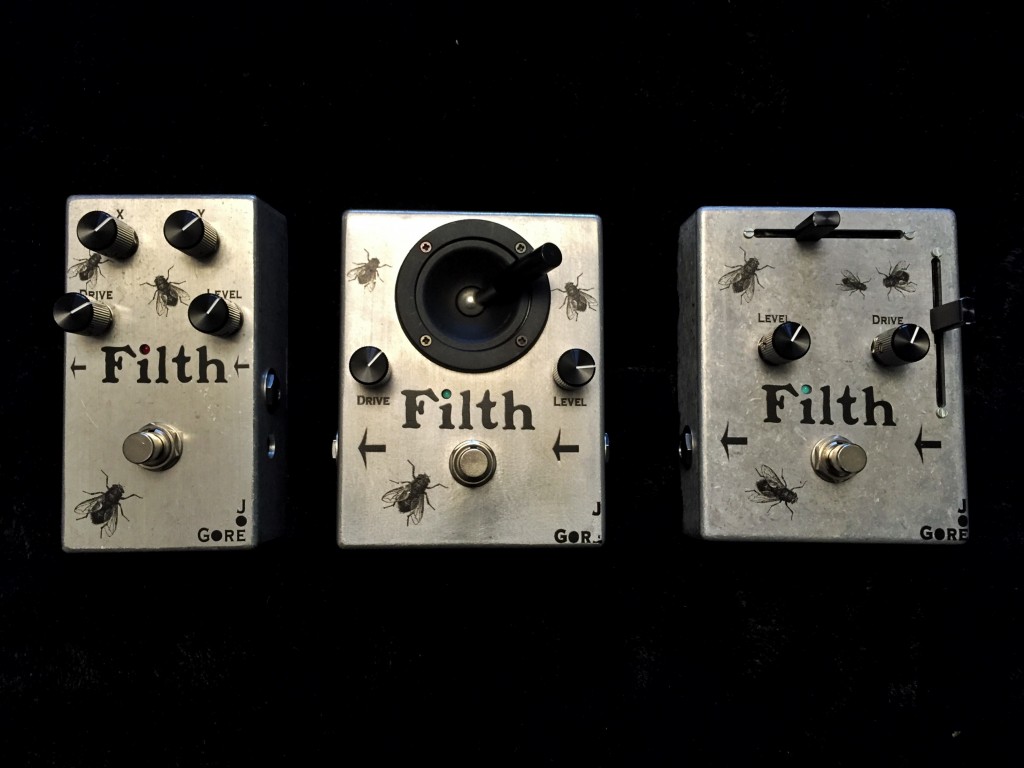
Filth’s sound hasn’t changed since I concocted the circuit on breadboard a few years ago. but the interface has gone through many iterations. It kept changing even after I sent schematics and prototypes to Tony Lott at Cusack Music (my manufacturer). Here’s a pic of three production prototypes:
Three incarnations of Filth Fuzz (in order of appearance).
To dial in tones on Filth, you adjust two highly interactive pots (let’s call them x and y), which tweak the voltages going in and out of the transistors, providing many tone variations. The original version used two standard pots for these x/y controls. It worked okay, but the ergonomics weren’t ideal. I’ve found that the fastest way to refine sounds is to move both pots at once over a sustained note or chord, and it was just a bit awkward having to take both hands off the guitar to turn the controls simultaneously.
So I decided to employ a joystick, which lets you adjust x and y with one hand (and it looks pretty bitchin’). The ergonomics were great, and I thought we’d finalized the format.
But then I showed a joystick prototype at the L.A. Amp Show in October, and for the first time I had a chance to sit back and watch other guitarists interact with the device. Players seemed to have a blast with it, but I kept noticing how often a heavy stompbox foot would land perilously close to the joystick’s none-too-sturdy shaft.
Meanwhile, we discovered that the the only compatible joystick option cost about $25 per unit — enough to jack the retail cost way up. Also, it was tricky to replicate exact setting via the joystick, which would suck if, say, you were trying to get identical tones night after night on tour. (I knew that when I first opted for the joystick, but I’d figured the fun factor would more than compensate.)
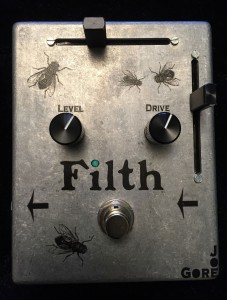
Then Miko Mader, a clever guitarist who works for my distributor, M1, came up with the perfect solution: Why not use two sliders instead of pots? Tony at Cusack sourced the perfect part, and we prototyped a third version.
Bingo!The ergonomics were great (check out the demo video to see how quickly you can change sounds with one hand). You can mark exact settings with tape if you need to, easily repeating specific sounds. The two sliders are a fraction of the cost of a single joystick, so we can sell the pedal for far less. (We’re still nailing down the retail price as I write.) There’s no fragile shaft to break. And while I miss the goofy fun of the joystick, the sliders are still pretty darn entertaining. (So thanks, Miko, for your brilliant idea.)
I’m really stoked about this pedal. I hope you enjoy it as well.
UPDATE: I just posted detailed pedal descriptions at gorepedals.com
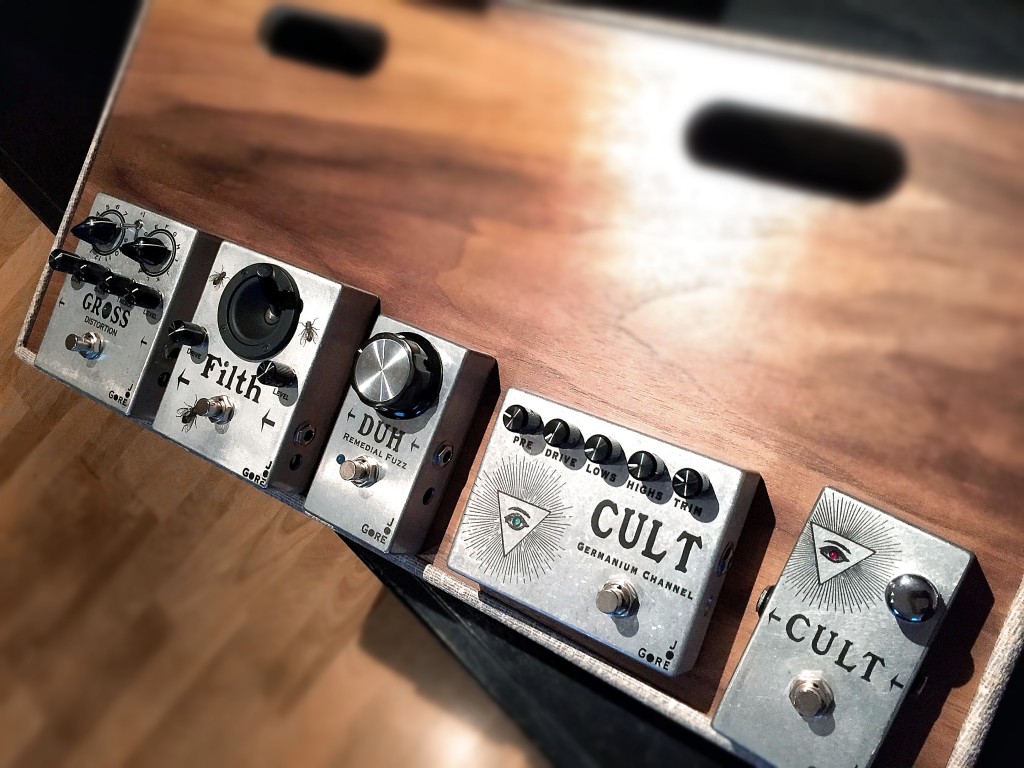
Anyone going to the big LA Amp Show this weekend? I’ve never been, though I’ve heard it’s a blast. (Literally: Unlike at NAMM, exhibitors set up in separate hotel suites, reportedly without noise restrictions.) I always like geeking out at musical instrument trade shows, but this one is special for me: It’s my pedal premiere, the public debut of my next four stompboxes. They’re not shipping quite yet (except Duh, available here), though they’ll be out in time for a crunchy-as-hell Kwanzaa.
The pedals pictured may look like my usual sketchy handmade stuff, but they’re actually slick factory-made versions, painstakingly styled to look like sketchy handmade stuff. (Michigan’s Cusack Effects is my manufacturer.) They sound like my handmade prototypes, but are less likely to break every 15 minutes.
I’ll be showing them off in the Vintage King suite. (They’re my production partners, and for now, my sole retailer, though the pedals will eventually make their way to hip guitar shops.) Magnatone, Jackson Ampworks, and Moog pedals will also share the VK suite, so my pedals will be in lofty company.
I’ve already written about Filth, Cult, and Cult Germanium Channel, though I haven’t yet finished their demo videos. (If you’ve spent any time on this site or my YouTube channel, you’ve heard them.) But I think this is the first time I’ve mentioned Gross Distortion, a twisted new take on a cool old crunch circuit. Here’s a demo I just made:
… and here’s how I describe it on the upcoming product page:
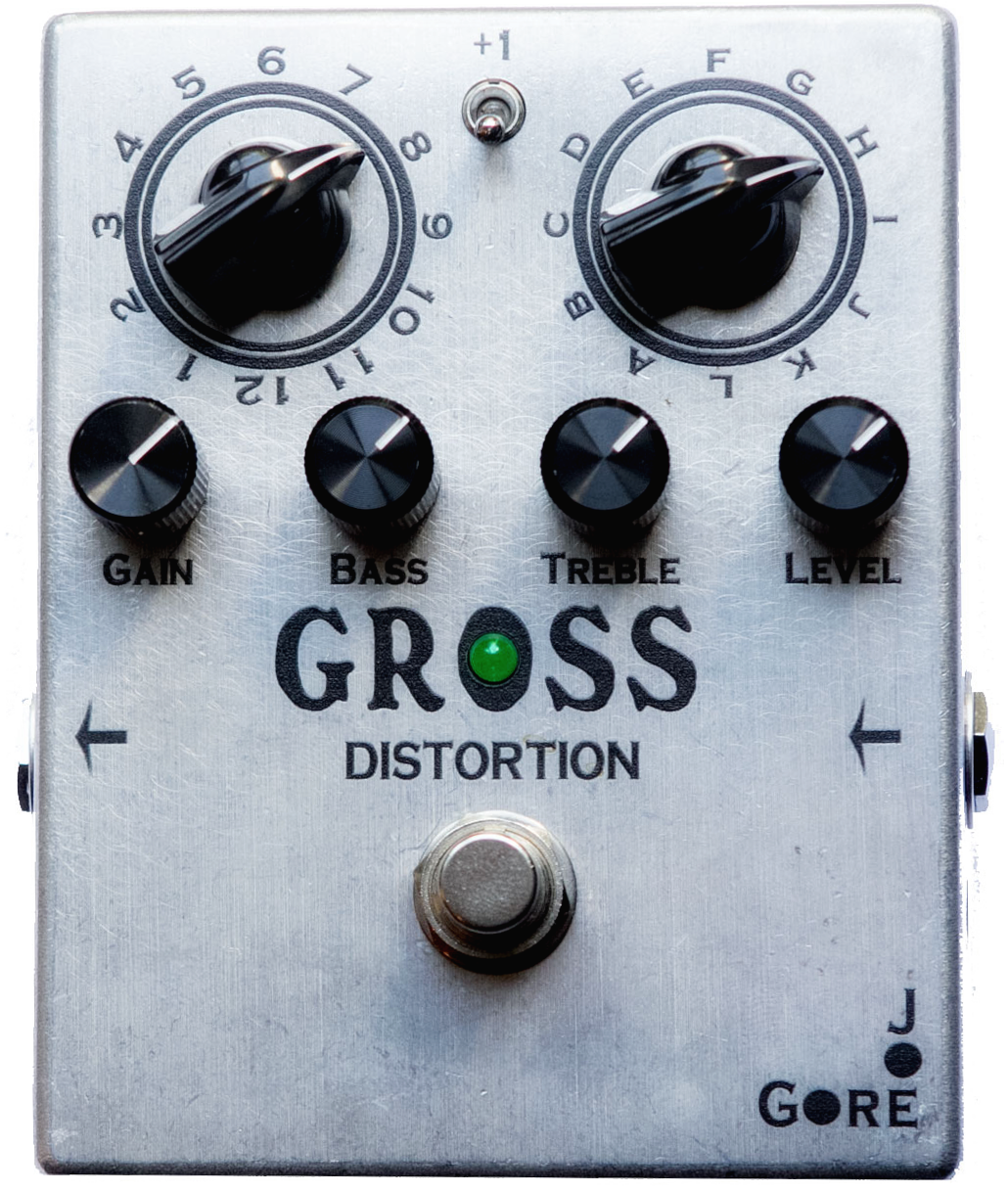
There’s never been a distortion pedal quite like Gross—so it needs an explanation.
At its heart, Gross is a simple, one-transistor distortion from the same family tree as the Electra circuit. This simple yet powerful effect was built into Electra guitars in the late ’70s, and was later adopted by many boutique stompbox builders. For good reason: It’s a lively, dynamically responsive circuit with less compression than most modern IC-based distortion pedals. The transistor boosts the level, and then the signal hits a pair of clipping diodes, which provide the signature distortion.
Every diode combination sounds slightly different. In fact, several boutique pedal companies have based their businesses on creating Electra derivatives with slightly varied diode choices. (Just Google “Electra distortion clone.”)
Gross isn’t an Electra clone. I’ve changed parts and values for a fatter sound and even greater dynamic response. I also added an active 2-band tone control—something seldom, if ever combined with primitive distortion like this. The distortion isn’t too “gainy.” It’s more about definition than sheer power—one reason it pairs well with other gain pedals. The character of your guitar and fingers always comes through.
The oddest feature is the diode section. Instead of a fixed diode pair, two 12-position rotary switches select from 24 diodes for 78 possible diode combinations! An additional switch adds a third diode for asymmetric distortion, which makes156 possible shades. My target number was 144—that’s why I called it Gross, though that may have happened the other way around.
Some combinations are as different as night and day. Others are only as different as noon and 12:05. But this network of germanium, silicon, and LED diodes provides many crunch colors.
With its labeled and detented selector knobs, you can call up favorite settings onstage. But for me, Gross’s forte is as a studio tool. It’s great for “texturizing” guitar overdubs—just spin the dials till you find a tone that sits perfectly in the track. It’s especially useful for doubling.
Gross Distortion was created in San Francisco and is built in Michigan by skilled craftspeople earning a fair wage. Available soon from Vintage King!
TO USE: Set the desired gain and level. Grab the big knobs and start spinning. Toggle the +1 switch frequently for asymmetric distortion—the changes can be dramatic! When you hear a cool tone, refine it with the bass and treble knobs. (Note: the higher the gain setting, the more dramatic the diode-tone contrast.)
 How to tell holiday season is officially over: It’s time for NAMM 2016! And this will be the first time I attend not as a music magazine writer, but as a guy trying to sell guitar pedals. Or as Ray Liotta put it in Goodfellas: “Just another schnook.”