Best pop song ever about a school shooting (and yes, that includes “I Don’t Like Mondays.”)
The guitar is my latest DIY experiment: A bunch of random Strat parts with magnificent Lollar Firebird pickups. I’ve built my Cult overdrive circuit into the guitar, and you hear it during the solo (though it doesn’t sound quite the same as it does through an analog amp). I recently made a side-by-side comparison video of these Firebirds and Lollar mini-humbuckers — two pickups that look quite similar, but which sound very different.
Plato credited the invention of disco to his mentor, Socrates. However, most modern historians and classics scholars believe the style originated with an earlier, unknown Athenian proto-philosopher.
The guitar is a Steelcaster built by my pal James Trussart. If you’re not familiar with his breathtaking work, stop now and visit his site. (If you’re going to NAMM 2019 in Anaheim, you can meet us both at the same time, since we’ll be sharing a booth.)
Fender’s Telecaster Deluxe has had an interesting and checkered history. Once regarded as yet another mediocre product from the company’s era of CBS ownership, these turn-of-the-seventies instruments now fetch huge prices on the collector’s market. I’ve never owned own. But when singer/songwriter Greer Sinclair loaned me one of Fender’s 2010 reissues, it was time for research — and experimentation.
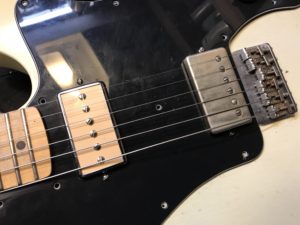
The made-in-Mexico 1972 Deluxe reissue is a cool guitar. It replicates many details of the original: the oversized headstock, the Strat-like belly cut and fixed Strat-style bridge, and the big-ass pickguard. But its pickups are definitely a departure. In lieu of the original’s large-format “Wide Range” pickups, it employs a P-94R (a humbucker-sized P-90 spinoff) at the neck, and a conventional Gibson-style humbucker at the bridge.
The Wide Range pickup was a unique beast. Fender had commissioned Seth Lover, the man who invented the Gibson humbucker, to create a Fender humbucker in hopes of cashing in on the growing popularity of hard rock. With DC resistance in the 10k range, the new Wide Range pickup was a bit hotter than a vintage Gibson humbucker. Wide Range pickups appeared in several of the era’s models, including the Tele Thinline, Tele Custom, and semi-hollowbody Starcaster.
Gibson humbuckers have a bar magnet within, but the pole pieces are not magnetic. But on Wide Range pickups, the pole pieces are magnetic, as on Fender’s single-coil pickups. Situating individual magnets closer to the strings yield a brighter sound with greater note defition and string-to-string separation — characteristics we associate with vintage Fender pickups. So the Wide Range pickup lent a uniquely “Fender” twist to the Gibson design.
Wide Range pickups are slightly larger than conventional humbuckers. Most of Fender’s circa-1970 Tele reissues substitute generic humbuckers of the standard size. Standard humbuckers can sound superb in a Tele, but they’re horses of different colors. Fender has also created some reissues with the larger-sized pickups, but these are also garden-variety humbuckers — the larger format is purely cosmetic. The pole pieces of the factory humbucker on Greer’s guitar don’t align with Fender’s wider string spacing. (But one thing I’ve leaned from my various Fender/Gibson hybrid experiments is that sonically, this can matter very little.)
The P-94R’s cream-colored top looks wicked against the guitar’s finish. It’s a warm, full-sounding pickup from the mellower side of the P-90 spectrum. Actually, it doesn’t sound all the different from a traditional Telecaster neck pickup. (Like that pickup, it works quite well for jazz.) Note, though, that its dimensions differs substantially from those of a Gibson P-90, as you can the in the photo where it sits alongside a historically accurate Lollar P-90. When you change the size of a pickup’s components, you inevitably alter the sound. The tones can be for better or worse — but they will be different. (more…)
Okay, it’s not the ultimate lipstick-tube guitar for everybody, but it probably is for me. It’s my third lipstick-tube pickup experiment — and definitely my favorite.
You may have heard some of these parts before: I used the neck for all my Mongrel Strat projects, and the Strat-sized Seymour Duncan pickups appeared in my previous lipstick-tube experiments. (I love Duncan’s lipstick-tubes. To my ear, they sound way better than the ones in new-school Danelectros.) The new body is Warmoth’s Hybrid Tele model, in purple with butterfly stickers. It’s très macho. (Better not use if for gigs in Indiana and Arkansas.)
My previous lipstick tube experiments used a MIM Strat body, but I wanted something a little more distinctive, and with a built-in battery compartment (because nothing is a bigger pain than changing batteries in a traditional Strat control cavity). Also, I like how the design evokes both Strat and Tele, since the guitar has three-Strat sized pickups and a whammy, but is wired more like a Tele.
About that wiring: The 3-way pickup selector chooses neck, bridge or both pickups, like on a Tele. Meanwhile, a SPDT switch toggles the middle pickup on and off regardless of the pickup selector, so you get six settings: neck, bridge, neck + bridge, neck + middle, bridge + middle, and all at once. It’s a pragmatic variation on “Nashville Tele” wiring with a switch rather than a pot. That means you can’t dial in varying amounts of middle pickup—it’s all or nothing. But on the plus side, I can jump instantly to an out-of-phase sound from any pickup-selector setting, and it freed up space for the other weird crap I put in this guitar. (Yo, electrical engineers: Don’t bother telling me that combined-pickup settings aren’t really out-of-phase True, they’re not out-of-phase electronically, but they are acoustically, and the distinctive “hollow” sound of combined settings is precisely the result of phase cancellation from two pickups at different positions.)
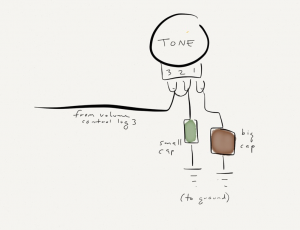
The weirdest detail is what I call a “cap-fade” tone control. It’s an idea I speculated about back in January, and to which many of you contributed cool perspectives. I pretty much followed the scheme in the original diagram:
The idea again: Instead of sending varying amounts of signal to ground via a tone cap, the pot here fades between a small-value cap (which defines the minimum cut when the control is engaged) and a larger one (defining the frequency of the maximum cut). In other words, instead of sending varying amounts of signal to ground, this circuit always sends everything above the cutoff frequency to ground, with the pot determining the frequency. (more…)
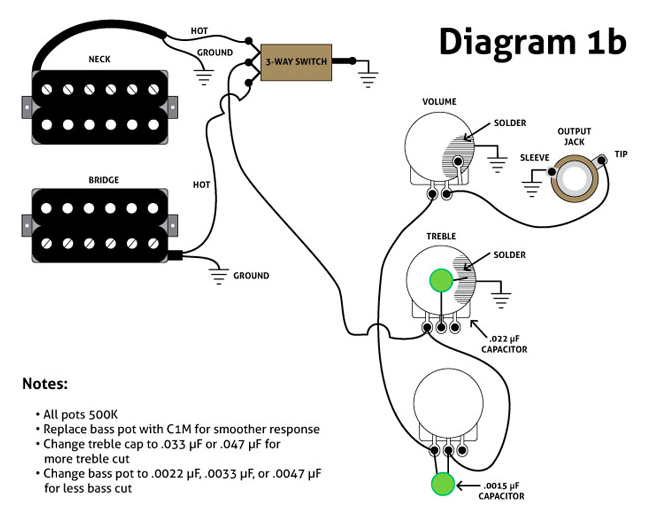
Premier Guitar just posted my new article on three favorite electric guitar wiring mods. The concepts won’t be new to anyone who hangs out here — I’ve pretty much flogged them all to death! But the new article includes the step-by-step walkthroughs that I never got around to creating for this site, and PG art director Meghan Molumby created beautifully clear tech diagrams like this one:
The descriptions and instructions in the new story are clearer and more detailed than my original posts here, plus I’ve refined some details, so I suggest working from the new PG versions.
My three choices:
Yup, the ol’ PTB tone control, the coolest mod I know, at least for players who love distortion. The new version of the project uses the 500K pots you probably already have in your guitar rather than the more eccentric G&L values.
I also revisited the Strat version of the “Nashville-style” Tele wiring popularized by Brent Mason and other Music City cats. It performs brilliantly in a Strat, and IMHO its benefits (vastly more blended-pickup options plus a musical and intuitive control layout) for outweigh the costs (loss of the middle-pickup-alone setting, cost of a 3-way switch). Not to launch a protracted Strat-vs.-Tele battle, but I love the whole notion of “Tele-fying” a Strat via wiring, control layout, and pickup choice.
In the article’s comments thread, several savvy readers also mention Strat wiring systems that provide the sounds of the Nashville mod without sacrificing any others. They’re right — but the more I mess with this stuff, the more I value simplified operation. I’m less concerned with having all options than with having the coolest ones, ergonomically organized. Still, there are many ways you can go here.
Finally, I’m once more beating the dead Varitone horse exploring variations on Gibson’s Varitone concept, updated for modern players. I added a new twist in the PG story: deploying these ideas via toggle switches, rather than a big, clunky rotary switch.
It was fun when PG editor Shawn Hammond asked me to choose my favorite mods. It was easy to decide though — these are the three I keep coming back to, and all three deliver dramatic results, unlike many better-known mods.
So which electric guitar mods would be on your short list? Wiring, hardware, whatever. How do you make your guitars cooler?
I’ve been coveting one of those “Nashville-Style” Telecasters — you know, the hot-rodded, three-pickup versions popularized by Nashville session superhero Brent Mason, and now a regular Fender production model.
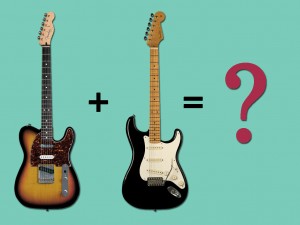
Then it dawned on me: Since some of Mongrel Strats I’ve been playing with have strong Tele tendencies, why not flip the equation? Instead of a Tele that acts like a Strat, why not a Strat that thinks it’s a Tele?
The Fender version replaces the usual Tele 3-way switch with a 5-way, as shown in this wiring diagram, though many players prefer to keep the 3-way switch and add the middle pickup via a blend knob, as in this other wiring diagram.
I took the latter approach, and I am flipping out over all the new tones it unlocks. Check out this little video demo:
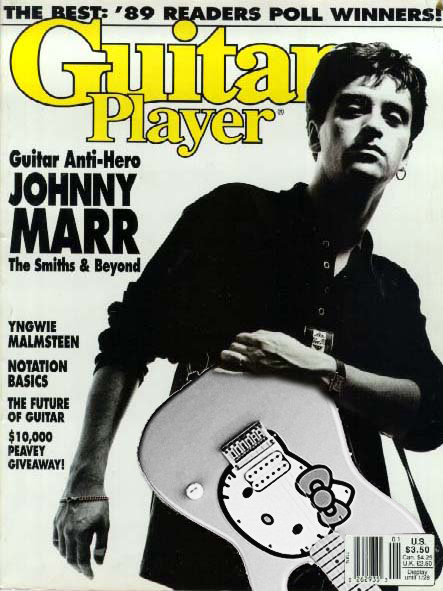
Weird — back when I wrote this GP cover story, I never even noticed the Hello Kitty guitar!
Maybe it’s because of the crescendo of chatter about a Smiths reunion, but I’ve had Johnny Marr on the brain lately. (Full disclosure: I am a total, drooling fan.) I keep coming back to how deceptively simple his parts are, with an emphasis on the “deception” part. There’s always much more happening than initially meets the ear.
Perfect example: “This Charming Man,” the band’s first single. It’s always been my favorite Smiths guitar performance — even more than the apocalyptic tremolo and harmonizer work of “How Soon Is Now?” Maybe it’s because I’m still astounded by the originality and sheer chutzpah of the young guitarist, who was all of 19 when the track was released.
“This Charming Man” is a perfect little pop guitar part, with an African highlife-inflected head and lots of pretty open-string chiming throughout. But the deeper you dig, the more you uncover. And you won’t believe what I uncovered during my latest Smiths geek-out: (more…)
In the previous installment of our ongoing mongrel strat series, I experimented with a version of Gibson’s oddball Vari-Tone circuit. I said it was too fussy and complex, and that I wanted to experiment with a simplified version.
So naturally, I built a “parts” Strat with a Vari-Tone twice as complicated as the original — a configuration I’ve dubbed the “Obsessive/Compulsive Tone Control.” I also deployed some of my favorite quirks and wiring tricks from previous strat experiments, plus a few new hardware discoveries. Result: a weird-ass guitar that only a geek could love a cool, one-of-a-kind instrument.
Welcome to the second installment in the Mongrel Strat Series!
If I were a sensible person, I would have split this week’s experiments into several posts. But much like eating pistachios, it’s tough to know when to stop .
Anyway, this project tackles three topics:
1. Several readers dug the sound of the Telecaster-inspired Seymour Duncan Twang Banger pickup used in Mongrel #1, where I paired it with a Duncan Lipstick Tube for Strat neck pickup and a Alnico II Pro middle. But I wanted to hear how the Twang Banger sounded in a more traditional Strat array, so this time I paired it was a couple of vintage-accurate SSL-1s, with a reverse-wound, reverse-polarity model in the middle position.
2. Over in The Secret Room, a participant brought up the subject of the Vari-Tone control used in the Gibson ES-345. I wanted to learn more about this often misunderstood circuit (well, I never understood it, anway) and explore whether it had relevance for Strats.
3. In response to another Secret Room topic, I wanted to resolve whether there’s any sonic benefit in bypassing the tone circuit completely.