
Categories
Music

Hey, Gates: Do You Know Your Dots?

“Yes, but can you read bass clef too?”

My incoherent headline is inspired by one of my favorite music quotes, from the 1947 film The Song of the Thin Man: Detective William Powell is pursuing a clue based on a classical music theme, and suspicion falls on a hipster jazz musician. Powell asks another jazz musician whether the suspect was the sort of player who would use classical themes in his solos.

Absolutely not, sniffs the musician: “Swingin’ the classics is strictly off the cob! A gate who knows his dots takes his Beethoven and Brahms straight.”

Vintage translation: “It’s corny to mix classical and jazz. A swinger who can read music tends to prefer classical music in its unadulterated form.”

Modern translation: “Fusion sucks. Gimme the pure shit.”

Do you know your dots? Do you care? I happen to be a dot geek, and I don’t regret it. But really, it’s not that big a deal. And if I rattle off my favorite non-classical musicians (especially guitarists), well, the vast majority ain’t readers. I wish I could play as well as any number of guitarists who wouldn’t recognize middle C if it poked them in the eye.

Categories
Bass guitar Music Technique

What’s Your “Basic Concept?”

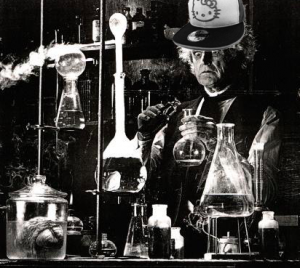
“They call me mad, but I’m actually a HAPPY scientist!”

There’s an interesting thread over on the Forum, started by reader Double D, who asked:

“Do you have a central core concept or inspiration that drives your playing? Are you squirrelled away with obscure harmony texts, or practising modes till your fingers bleed? Do you have go-to chord substitutions that define your sound? Do you have a creamy harmonic centre?”

Like most great questions, it’s really hard to answer (though some folks managed to reply in extremely articulate and compelling ways). I’ve been pondering it myself for the last few days, and the best answer I can come up with is something along the lines of what I hinted at in this recent post on chromaticism, namely a liquid sense of modality based on the notion that most of us Westerners really only perceive two modes — major and minor — but that there’s a vast amount if “wiggle room” when it comes to placing individual scale degrees.

To put it another way, most of what I play is based on simple tonic triads, major or minor, but the placement of all the other scale degrees is highly negotiable. For me, the advantage of viewing scales this way is that they remain grounded in harmony, and vice-versa. As opposed to the way many of us were taught modes: as purely mathematical sets of intervals divorced from their chordal implications — or just a bunch of diatonic scales that start on the “wrong” notes.

Hey, why is everyone nodding off, staring out the window, or checking their phones? Wake up and talk about the methods of your madness!

:cuckoo: