My friend John Bohlinger from Premier Guitar just shot a Rig Rundown video with one of my utmost guitar heroes, Andy Gill.
I’ve rhapsodized about Gill’s guitar voice more times than I can count. But the aspect of his playing that I love the most is the way he created such a definitive voice with zero reference to prior rock and blues. If I’d ever worked at Art Forum like my wife did, I could probably draw comparisons to Luigi Russolo’s futurism and Jean Dubuffet’s art brut, but really, I just dig Gill’s blunt, brutal badass-ness.
The big surprise for me in this interview: These days Gill plays through a laptop running Logic, and he’s using some of the stuff that I helped make while sound-designing guitar components for Apple. This news makes my year (though given the year we’ve all been through, walking to the corner store without breaking my ankle would probably also make my year).
Nice work, JB! And thanks, Andy, for the endless inspiration since 1979’s Entertainment!
I’ve been nursing the idea of arranging this most exquisite of Brian Wilson songs for multiple guitars for a long time. But two recent developments spurred me to finally do it.
Spirit of ’67 The first was my plan to record my first-ever solo album — a collection of heavily reinterpreted songs from 1967, tentatively titled Sixty-Seven Ghosts, marking the 50th anniversary of that memorable musical year. I was eight years old then, too young to play the music, but old enough that the music’s “ghosts crowded the young child’s fragile eggshell mind.” (I quote Jim Morrison, one of many crucial artists who debuted in that year.)
When I started playing music seriously a few years later, I had a sense that I’d missed the party, and that the music of ’67 was simply more meaningful than my early-’70s middle-school soundtrack. (I was wrong, of course. Subsequent decades have proven that if anything, the first years of the new decade produced at least as much great stuff. Yet 1967 had a mythic aura for me, and much of that year’s music has pursued me for a half-century.)
I wasn’t hip to “Surf’s Up” till those middle-school years, when the Beach Boys belatedly included the track on their 1971 album of the same title. The FM radio hits from that disc were “Long Promised Road” and “Feel Flows” — “Surf’s Up” was simply the record’s quirky coda. A few years later I discovered “Surf’s Up” lyricist Van Dyke Parks’ solo albums, with their similarly surreal lyrics and left-field song structures.
The Smile Mythos But I had no inkling of the song’s true provenance till some 20 years later, when pop fans began to grow obsessed with Pet Sounds and its “follow-up that never was,” Smile. Only then did I learn that “Surf’s Up” was originally from ’67, the intended centerpiece for that literally legendary album. By then we all knew the Brain Wilson crackup story, with its echoes of Greek tragedy. He’d held the music of the gods in the palm of his hand — so legend had it — only to have it ripped away by demons of self-doubt. Madness and self-destruction ensued.
My personal Smile mythology was heavily influenced by Lewis Shiner’s 1993 novel Glimpses (which I wrote about here). In it, a modern music fan realizes he can go back in time to the moments when great musical masterpieces were lost. (Sounds silly, but trust me — it’s not.) The highlight for me was the Wilson sequence, where our protagonist meets Brian at his peak moment of genius and fragility, right before everything went off the rails. The scene where Brian played the brilliant new songs for his hater bandmates haunted me: (more…)
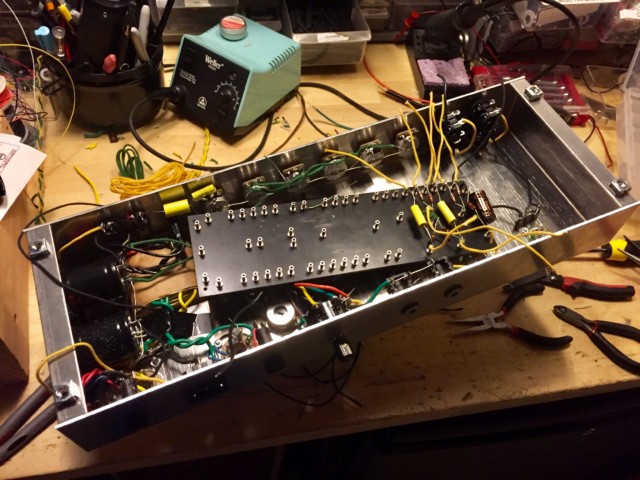
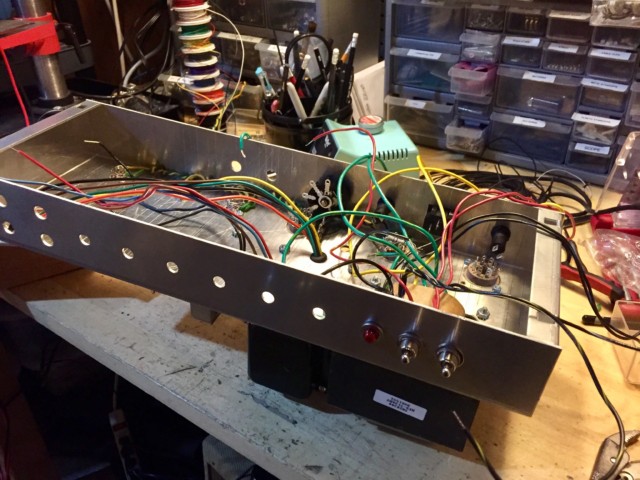
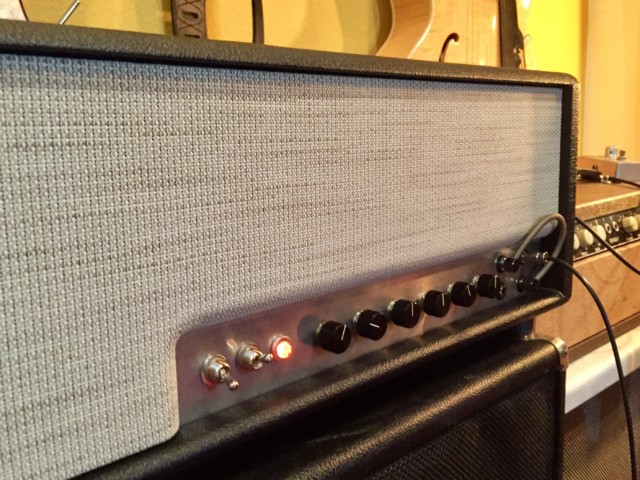
I almost always play small combo amps of 20 watts or less. But I wanted something with a bit more clean headroom for a possible upcoming project — and to demo my stompboxes. I’ve always enjoyed playing JTM-45s when I’ve reviewed them for guitar mags, so I ordered Monotone’s British 45 kit.
I’d previously had a great experience building Mojotone’s Marshall 18 watt clone kit when I reviewed it for Premier Guitar a couple of years ago. It turned out great, and I use it regularly.
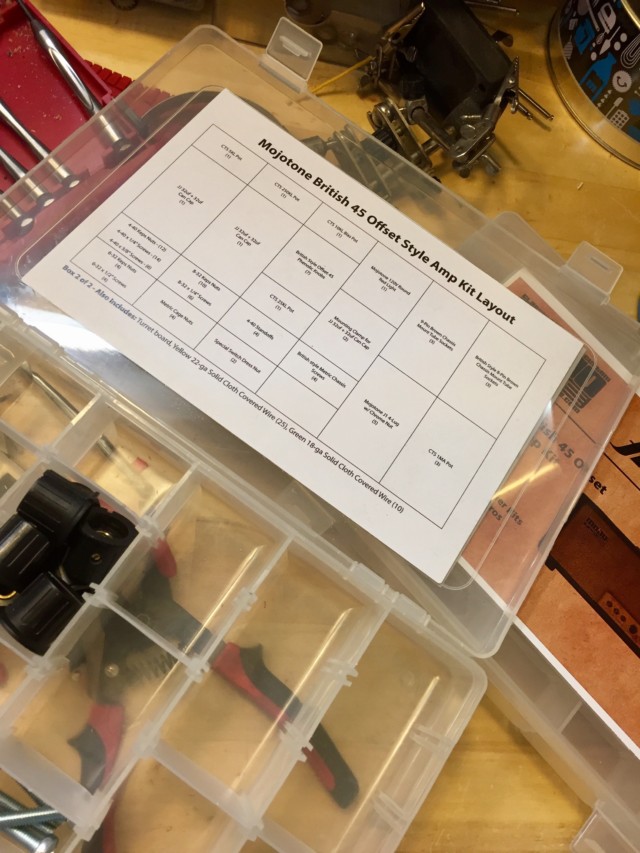
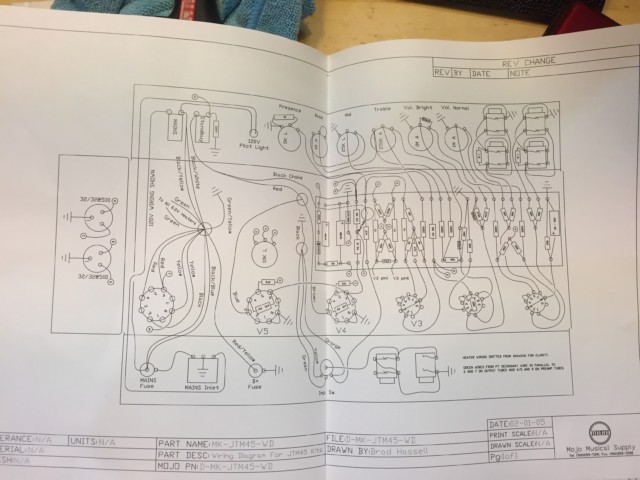
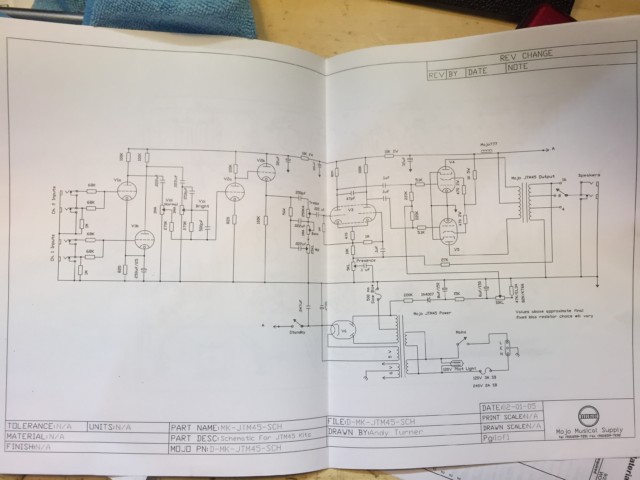
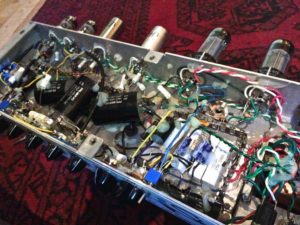
Mojotone provides high quality parts, nearly labelled and organized in plastic compartmented boxes. But beware: The company provides no build instructions — just a layout diagram and a schematic. You need amp building experience or help from an expert. Click play for a slideshow about he build:
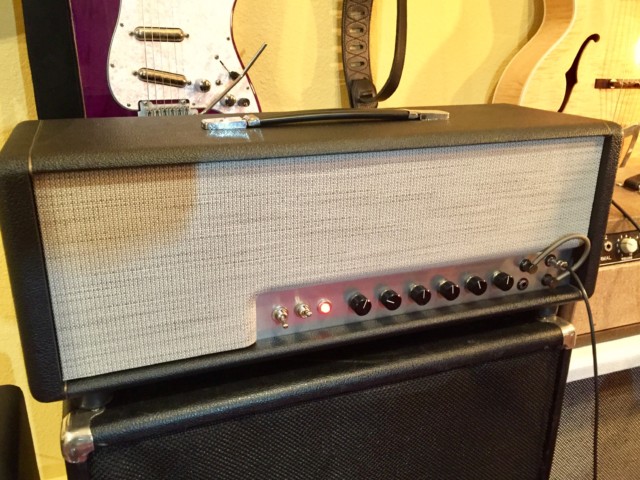
This is Mojotone’s new offset head cabinet. (The amp chassis first in other Mojotone cabinets as well.)
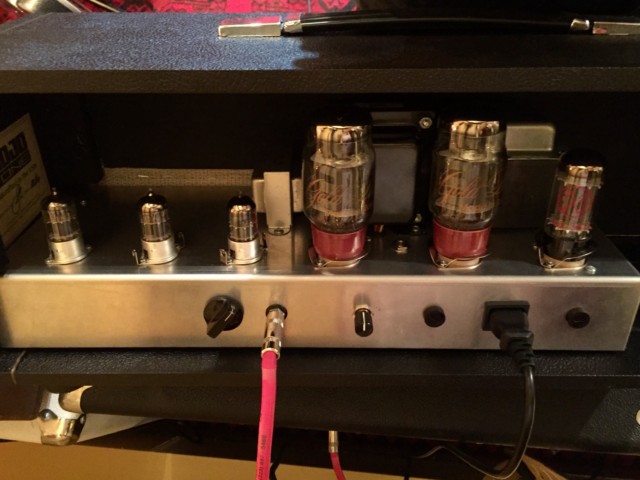
The two power tubes can be either EL-34s or KT-66s. (I chose the latter, just for a new experience.)
The parts come neatly labeled and organized in plastic bins — a BIG help!
Warning: the kit includes no build instructions — just this layout diagram and a schematic.
I ALMOST managed to assemble it, but I needed a rescue at the end. (Thanks to Bruce Clement of BC Audio, a brilliant boutique builder here in San Francisco.)
Mojotone supplies their own branded transformers (which sound fab).
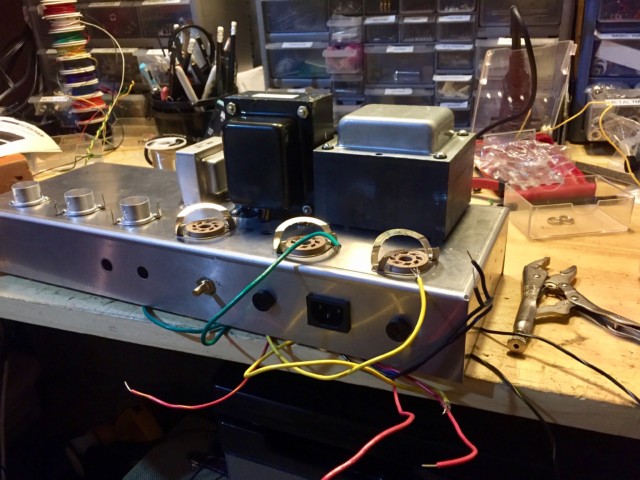
It’s a turret board build. (The board and turrets are pre-made, as opposed to some kits, which require you to insert the turrets yourself.)
This is probably not a good first build — maybe start with a nice little tweed Champ kit?
The a plexi faceplate, which I left omitted. I also substituted my own knobs.
I nearly made it through myself. (Translation: I soldered everything together and it didn’t work.) So I had to hire Bruce Clement of BC Audio here in San Francisco to rescue me. (Bonus: Bruce loaned me one of his JTX50 heads. Man, it’s one of the best-sounding Marshall derivatives I’ve ever heard. It’s among his Octal-Plex series amps, which use octal preamp tubes in Marshall-inspired designs.) (more…)
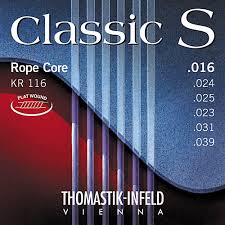
Ordinarily, these Thomastik-Infeld Classic S strings sound more like nylon strings than steel ones.
But their cores ARE steel — which means you can play through a magnetic pickup and mutilate the tone with amps and effects. I’m playing through effects designed for Apple’s MainStage software. (Some of them are in Logic Pro’s included sound library.)
I’m working on this version of Leonard Cohen’s “Suzanne” as part of album in progress: a collection of radically reinterpreted songs from 1967. I haven’t nailed down the final song list. (If you review the list of amazing songs from that year, you’ll understand why. And that link only cites the songs that charted, and doesn’t include classics like the first Velvet Underground album, some great Jobim tunes, random stuff like “Some Velvet Morning,” and lots more.) By hook or by crook, I hope to have the project done before year’s end in time to cynically capitalize on pay tribute to the 50th anniversary of that musically monumental year.
Some interesting tech notes: I’ve you followed this blog, you’re no doubt sick to death of my evangelizing for Thomastik-Infeld rope-core strings. But this is the first time I’ve put them on my Lowden S-25, my main acoustic guitar for nearly 20 years. Its default tone is super loud and bright. (Larry Fishman once referred to it as “a fucking cannon.”) But these days my ears are drawn to darker, softer tones. The Classic S transformed this laser-bright acoustic into an expressive crooner.
Meanwhile, I’ve become a bit alienated from traditional nylon strings over the years, but these, with their hybrid nylon/steel sound, hit just the right sweet spot for me. They’re extremely quiet (though they don’t sound like it when close-miked like this), but they have vast dynamic range and a smooth, sexy feel.
I’d previously written that this set is the same as the (cheaper in the U.S.) John Pearse Folk Series Fingerpicking strings, but I was mistaken. The story I hear was that the late Mr. Pearse, working with Thomastik-Infeld, devised this set for Brazilian guitar monster Bola Sete. But on the current Pearse set, the bass strings have nylon cores, while the Classic S bass strings have steel cores. That means you can use the TI set with a magnetic soundhole pickup, allowing you to plug into amps and effects. (I’ll be posting an example soon as a companion piece to this video.) But both sets sound lovely, and both allow you to bend strings as you would on an electric guitar — something you definitely can’t accomplish on conventional classical strings.
I don’t have a ton to add about the sublime Leonard Cohen. But “Suzanne” has always exerted a deep emotional spell on me — even, as here, minus the lyrics.
I haven’t been able to post much here at tonefiend.com recently because I’ve been overwhelmed by two big-ass projects that have occupied most waking hours, plus some sleeping hours as well. (I’ll share the details as soon as I’m allowed.)
Yet somehow, I’ve found time to post various things to Facebook. I know some of you are already pals with me there. But please — anyone with the patience for my pontification, send me a Facebook friend invite. (I’m not picky. I’ll be friends with anyone who doesn’t post spam, or racist/sexist/homophobic shit.)
If you’re not an FB type, believe me, I get it! I’ve got issues with the service myself, even if Mark Zuckerberg lives in my San Francisco neighborhood (in a much larger house, though I bet he doesn’t own a Hello Kitty! guitar, the loser). But if you ever hang out there, please befriend me. I’ve got lots of interesting music/guitar pals, many of whom know a hell of a lot more about this stuff than I do. We often have … um … lively conversations. Hope to see you!
Oh — if you type my name into the FB search field, you’ll see both my accounts. Pick the one with the Hello Kitty! guitar. The one with the green face is the account I use to hide from keep in touch with relatives and such.
BTW, I’m have no intention of abandoning this site! I just haven’t been able to put together the longer-form pieces I like to post, and probably won’t be able to for the next couple of months. (Meanwhile, I come here every day to respond to question/comments.)
As threatened, here’s a closer look at Strat with PAF humbuckers used for my recent “God Only Knows” cover. Most parts are from the long-suffering guitar used for all the Mongrel Strat Project experiments. And this one is especially mongrel-ific, with its blend of vintage Fender and Gibson.
Obviously, Gibson pickups is a Strat is far from a new idea. But usually, that arranged marriage is designed to spawn macho, high-gain solos minus the characteristic shrillness of vintage Strat bridge pickups. While many players I love have used humbucker-equipped Strats, I’ve always loathed playing them myself. But what, I wondered, if you didn’t use a hot humbucker, but an über-vintage PAF?
Like many players my age and younger, I was astonished when I first encountered a vintage-voiced humbucker. It was nothing like the dark, over-overdriven tones I associated with the word humbucker. A good PAF is sparkly, resonant, and perfectly capable of gloriously bright and clean tones. Here I used a Seymour Duncan Joe Bonamassa signature set, the same one heard in a more Gibson-like context here.
The results are … compelling. As expected, notes have far more mass than on a conventional Strat, and the bass response is vastly increased. There’s no shortage of top-end either, though the big lows can overwhelm the highs at times. So while I’m pretty much always obsessed with bass-cut controls (especially the high-pass section of the PTB circuit I’ve written about approximately 37 zillion times), it’s especially invaluable in this case. Since lows disproportionately drive distortion, even modest bass cuts clean up the tone and make highs speak more clearly.
I’ve also incorporated the dual-capacitor treble control I wrote about here. It creates a Vari-Tone/ToneStyler effect in a simplified way: Instead of using a clunky rotary switch to choose from a large set of treble-trimming capacitors, it fades between a large cap and a small cap, yielding the same resonant effect as the more complex options. I’ve incorporated this circuit in several guitars now, and it’s still working for me. It’s especially nice here, when paired with a Steinberger JackPot potentiometer, which lets you bypass the entire tone circuit for absolute maximum volume and brightness. I chose the small cap based on the minimum amount I’d ever want to remove from the signal, and the larger one based on the maximum cut I’d use.
I would have included a photo of the project in progress, but I didn’t because I’m embarrassed about how awful it looks inside. I needed to route out the pickup cavities to accommodate these larger pickups. But instead of taking it to a professional, or getting a proper router and learning how to use it, I chipped away with the tiny routing bit on an inexpensive Dremel tool. Do yourself a favor, kids, and don’t follow my lazy-ass example.
But hey, what’s a Strat pickguard for if not to conceal your shoddy workmanship? The guitar looks okay in the end, and I’m digging its sounds, even though it was far harder to get accustomed to than I’d anticipated. I had to recalibrate my right-hand dynamics to prevent treble notes from screeching. I was almost ready to chalk this up as a failed experiment, but after a few days of noodling around, I started to get the hang of it and enjoy the results. I think I’ll keep it this way for a while — or at least until the next Mongrel Strat concept wafts up from the bowels of Hell. 🙂
It probably wins my vote for prettiest pop-rock song of all time, and it’s a far-from-controversial opinion. “God Only Knows” and all the other great tracks from the Beach Boys’ incomparable Pet Sounds album are 50 years old. (The album was released on May 26th, 1966.)
I owe a big thanks to my pal Mark Goldenberg who inspired me to really learn the entire tune. Mark performs an exquisite solo version, far more lyrical and poetic than my relatively motoric reading. He and I are also preparing a duo version for an album project in the works.
I say “really learn” because you don’t appreciate the number of perverse composition tricks in the tune until you study it bar by bar. Example: the jarring leap into the bridge after the second verse. Or the way that chromatically snaking bridge seems to usher in a return to the chorus, but it’s only a three-bar tease (and in the “wrong” key at that) before a exquisite harmonic pirouette into the final verse. Or the fact that many, if not most, chords in the song don’t feature their root note in the bass. (Especially that verse! The voice leading simply makes no sense on paper, but it’s perfection in practice.) And while countless musicians have praised the outro’s beautiful choral polyphony, I haven’t got much to add, except to say that it’s frickin’ hard trying to cover all those parts! (I didn’t succeed — I only played as many as I could cram into my left hand.)
And oh, the guitar: It’s the latest installment in the ongoing Mongrel Strat Project.I’ve been hacking away at the same sad parts for years. Literally hacking, in this case: I had to route out the pickup cavity to accommodate a pair of über-retro PAFs (a Duncan Joe Bonamassa signature set). Yeah, a Strat with humbuckers isn’t a new idea. But the pickups used are almost always high-gain models designed for macho soloing. I wanted to try something low-gain and unpotted for relatively bright, resonant sounds not quite so far removed from traditional Strat tones. I’m finishing up a video about the project, and I’ll post it in the next few days.
Anyway: Happy birthday, beautiful. You wear your age well.:)
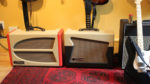
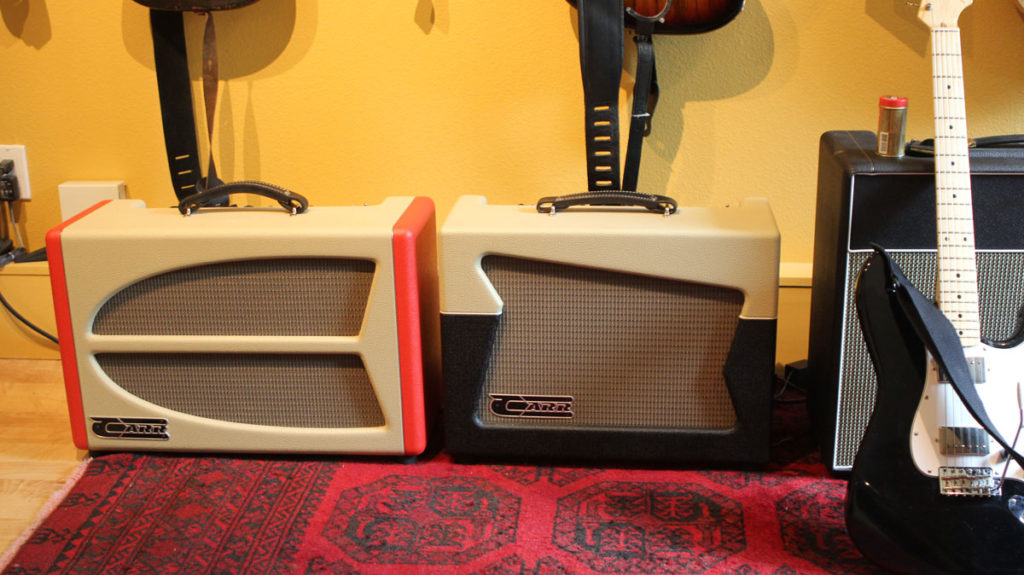
I’ve been using my Carr Skylark amp incessantly for the last 18 months or so. I’d originally reviewed it for Premier Guitar magazine, and then I bought one for myself. I dig the fact that, while Skylark is inspired by 1960s Fender amps, builder Steve Carr made numerous departures from the Fullerton template. To my ear Skylark sounds better than my ’60s originals. That’s especially true of its re-voiced tone stack, where the ranges are smaller and subtler than on vintage Fenders, with more of a Matchless-style “no bad settings” sensibility.
For better or worse, history repeated itself earlier this year when I reviewed Carr’s Lincoln in PG. Lincoln is to Vox what Carr is to Fender — not a clone, but vintage-inspired model with its own character and unique twists. Its dual EL-84 architecture makes it a cousin of the AC-15. But I think of it more as a “fantasia on a theme by Vox.” It’s captures the Vox qualities I dig, minus the ones that can make dealing with vintage Voxes a major drag.
Skylark features true point-to-point wiring, with no circuit or turret board. (Lincoln, however, uses bits of circuit board for non-audio functions such as channel-switching.)
If you’ve listened to many of my videos and demo clips from the last year or so, you’ve heard these amps, so I figured I’d focus on them. For tech details, see the reviews. This video is more about how the amps inspire me musically.
From their flawless cabinetry to their ravishing tones, these amps are simply stunning. Cheap, they ain’t, but I felt like I was (RATIONALIZATION ALERT!) investing in musical art. Or maybe I’m making up for not buying a Trainwreck amp back in the ’90s when they were affordable.
I especially love how these Carr amps sound with my flatwound-strung guitars, and I used them on most of the demos for my pedals because they’re so very flattering. Ironically, I thought I’d given up buying new amps, because I was having so much fun building from kits. But trust me — both these instruments sound way better than any of my kit amps. Have a listen!