Categories
Recording

Death by Doubling

Screen Shot 2014-05-19 at 3.40.19 PM
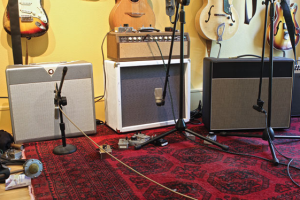
This photo was originally a line of 137 amps, but I had to crop it to fit this small space.

Premier Guitar has just posted a new installment in my Recording Guitarist column. The topic: doubling riffs for fatter sounds. Using a single guitar part (and a great drum performance swiped from Dawn Richardson), I tried every doubling trick in the book. plus some ones that wise editors expunged from the book. We’re talking amps, mics, panning, processing, analog vs. digital—real OCD stuff.

Is it interesting enough to justify  listening to the same part doubled 20 different ways? Depends how big a geek you are!

For the less geeky, here’s a concise executive summary:

Q. How many doubles do you need for maximum fatness?

A: Between zero and a lot.

Q: How many is too many?

A: Fewer than the 21 tracks in my last over-the-top example.

That, plus some helpful information, just to keep things lively. :smirk:

Categories
Recording

New Guitar Recording Column!

Screen Shot 2014-02-24 at 10.57.35 AM

May I take this opportunity to pimp my new monthly recording column in Premier Guitar? The first installment covers basic electric guitar miking technique. It’s ground that’s been covered often enough before, though I hope the article’s many audio files (recorded via ReAmp, moving the mic between “takes”) shed some new light on the topic.

Meanwhile, I’m breathlessly stoked about my new “Partsmaster.” It’s a Korina “Split Jazzmaster” body from Warmoth with Fralin P-92s and some new tricks I’ve been wanting to try with wiring and onboard overdrive, plus several other ill-considered, stab-in-the-dark adventurous experiments. It’s like some wacky Firebird/Jazzmaster hybrid (“Birdmaster?”) I hope to post some video later this week, but right now, the guitar is awaiting the plek treatment at Gary Brawer’s shop. Gary is also prettying up some of my clever but sloppy wiring, and remedying the fact that, when I brought the beast in, the strings were about a half-inch from the fretboard.

Can’t wait — this is an interesting one! 🙂

Categories
Effects guitar Recording

Logidy EPSi Review:
The First Customizable Convolution Reverb Pedal

One of the coolest gizmos from last weeks NAMM show is already in my grubby little hands: It’s the Logidy EPSi, the first customizable convolution reverb pedal. I ordered it the instant I heard about it, and it arrived right before I left for Anaheim.

Convolution (or impulse response) reverbs can mimic acoustic spaces and outboard gear with astonishing accuracy. (If this concept is new to you, check out this article by me. Or better yet, this one written by someone who knows what he’s talking about.) Nutshell: You create impulse response (IR) files by playing and recording a test tone in rooms or through gear. Once you load the file into an IR reverb device or plug-in, it can make anything sound as if it was recorded with the same ambience.You can also generate eerie, otherworldly sounds by loading unusual audio files.

Many software and hardware amp and effect modellers use IRs to mimic gear. Software convolution reverb plug-ins such as Audio Ease’s Altiverb, Logic Pro’s Space Designer, and Waves IR1 include reverb libraries, and also let you load your own IRs. But as far as I know, EPSi us the first device that lets you load your IRs into a stompbox and access them without playing through a computer.

I’m psyched to add IR reverbs to my (mostly) analog pedalboard, and EPSi makes it relatively easy to load the IR libraries I’ve compiled. The files require special treatment: They must be 44.1kHz WAVs, and the names must be formatted quite specifically, as detailed in Logidy’s documentation. The interface is extremely minimal: just a bypass footswitch and a knob/button pair to navigate the simple menus.

This unique reverb stompbox sounds great and offers limitless opportunities for creative sound design. You can load your own impulses, or add ones from from some of the fine freeware libraries online. (Thanks for the link, Scott!) On the downside, it’s difficult to load or edit sounds on the fly, so while it might be fun to spelunk for new sounds in the studio with EPSi, don’t plan on modifying sounds onstage. (The ability to recall several saved presets would vastly improve EPSi as a gigging tool.)

Categories
Amps guitar Recording

Attenuation Nation:
Loud Sounds at Low Volume?

skrinking-ray

I just tried an interesting tone comparison, one I’ve never seen attempted. It concerns the search for loud amp sounds at low volumes.

Have any of you ever experimented with speaker attenuators — the passive load boxes that reside between your amp output and speaker input, which let you crank the amp while maintaining a low level from the speaker?

I’ve worked with one model before, a borrowed THD Hot Plate, and thought it performed well. I decided to purchase my own attenuator after several Premier Guitar reviews of large amps. As a small amp fan (not to mention an aging player with fragile ears), I wanted to minimize the aural assault of evaluating loud-ass amps.

But first, I wanted to determine whether it’s legit to evaluate amps at attenuated levels. Does attenuation inevitably alter the tone? And if so, can you compensate for via recording software?

Online opinions about attenuators range from “works like a charm!” to “totally killed my tone!” So I picked up a Swart Night Light and started recording and measuring. (I didn’t compare rival products. I just went with the Swart for its reasonable price, solid online reviews, and dual outputs for driving two cabs. I didn’t A/B it with a Hot Plate, though the results seem roughly similar.)

I direct-recorded a brief guitar phrase using my black Les Paul with Bigsby and PAFs, and then ran it through a ReAmp to my early ’60s Tremoverb, a 35-watt Fender with two 6L6 power tubes. I dimed the volume and left the EQ flat. Tt was insanely loud in my small studio. After recording that, I tracked the same clip again using the attenuator at each of its three settings. The lowest attenuation setting reduced the sound from insanely loud to very loud. Medium attenuation reduced to somewhat loud. Strong attenuation produced a sound quiet enough to speak over. I recorded the results through Royer R-121 ribbon mic. I added a touch of plate reverb, but no compression or EQ. (Though I did normalize the files so they played back at similar levels.) In other words, you hear the same clip four times through a head whose settings never vary.

So did the tone change? Have a listen:

Do you hear what I hear?

IMHO, none of the clips sound particularly great. (Most amps, including this one, don’t sound their best at 10.) But the unattenuated loud sound has some qualities the others examples lack. The attenuated clips have a little less low-mid impact, and the higher-register single notes that sound a bit thin and prickly even on the original sound even thinner and pricklier post-attenuation.

Why, since the amp settings don’t change, and the performance are identical? Mics can respond differently at different sound pressure levels, and the relatively restrained speaker movement alters the result as well. Conclusion: the timbres of the attenuated signals are fairly faithful to the original, but there are slight spectral differences and a bit less body/fatness, especially on single notes.

Then I introduced some additional wrinkles:

Categories
Effects guitar Music Recording Technique

The WRONG Way to Use a Talk Box

Any talk box fans out there?

Whew. Didn’t think so. I mean, doesn’t everybody hate those godforsaken things? Wasn’t it all downhill after “Tell Me Something Good?”

But did you know that the “talking guitar” has a rather exalted history four decades pre-Frampton Comes Alive? Check out this performance by Alvino Rey, the steel guitar genius who pioneered the technique.

I am TOTALLY going to have nightmares about Stringy for the next 10 years!

Rey worked his magic in tandem with his vocalist wife. She supposedly stood behind a curtain with a mic attached to her throat, the output of which modulated the guitar signal. (That’s what online sources say, though it sounds a bit fishy to me.) A similar technique — or perhaps the same one — was known as the Solovox. In this case, a small loudspeaker attached to the singer’s throat, “playing” the music through the vocalist’s mouth. More amazing/horrifying evidence:

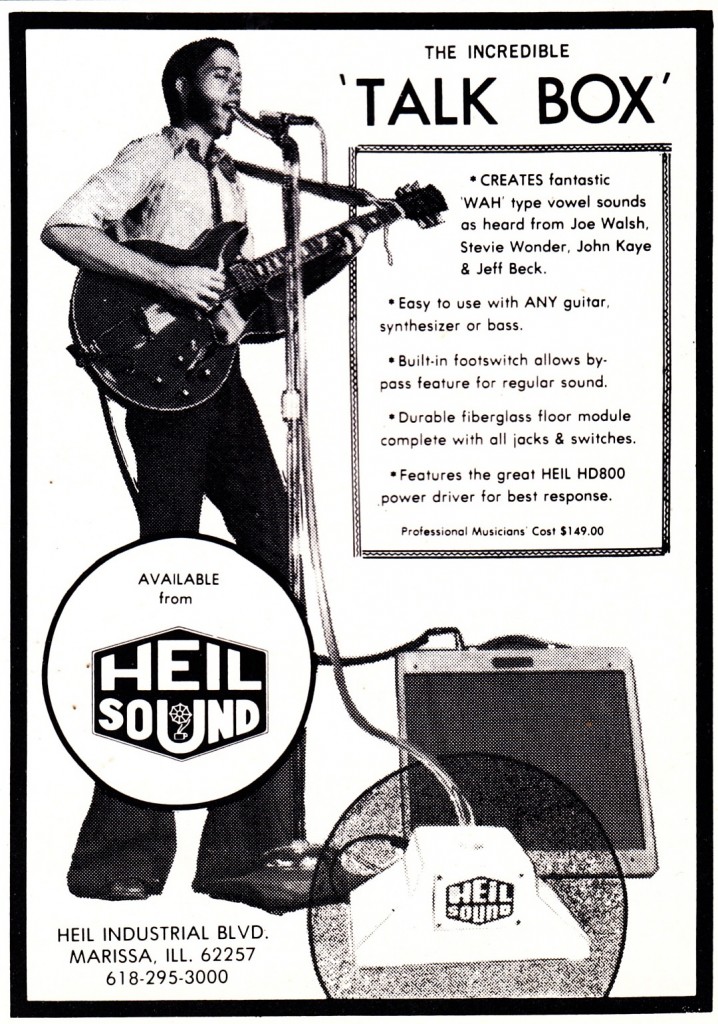
That’s the basic principle behind the rock-era talk boxes, though they rely on a plastic tube inserted into the mouth rather than a mic pressed to the neck. The first commercially available model was Kustom’s The Bag from 1969, “immortalized” on Steppenwolf Live. The Heil Talk Box — the version of the effect most of us know and loath — debuted in 1973. Dunlop is still making them.

But I have a perverse affection for the Rocktron Banshee. It’s incredibly loud. It’s actually a small amp, quite capable of driving a speaker cab, with a blunt-force distortion tone. That extra power is useful for my preferred way of using a Talk Box:

How about you guys? Anyone have anything good to say about the talk box?

Heil_TalkBox_1974

Categories
Digital Recording

Logic Pro X:
What’s New for Guitarists & Bassists?

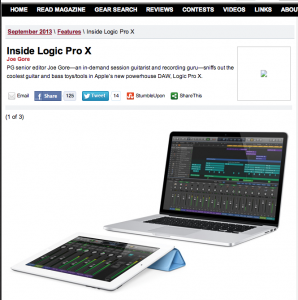
Inside Logic Pro XAs promised: an overview of Apple’s new Logic X Pro, with an emphasis on what’s new and cool for guitarists and bassists. Lots of movies and audio!

It’s here.

This is an exciting post for me, and not just because I get a desperately needed break from Klons and Screamers. I’m thrilled to bits about Logic Pro X and MainStage 3, though I’m still wrapping me head around them. (Yeah, I worked as a developer for both products, but I didn’t get a proper program-wide view until last week’s release.)

Also, it’s my first story for Premier Guitar, whose staff I’ve just joined as a senior editor. I’m stoked because it reunites me with PG editor Shawn Hammond and senior editor Andy Ellis, both of whom I remember fondly from my Guitar Player magazine days.

There’s much talent and coolness on the staff. I’m a happy little guitar nerd. Plus, the schedule is loose enough that I can still record, perform, and continue to work with audio/software clients.

What does the gig mean for this blog? Good things. I have no plans for a major course change — there are too many things I can only cover on a non-commercial site, including some of the topics closest to my heart. Meanwhile, working with PG will keep me more up-to-date on new music, new gear, and scurrilous guitar community gossip. In some cases, though, I may link to a PG article I’ve written rather than duplicate the work here. Today, for example. 🙂

Categories
Effects guitar Recording

Klon vs. Screamer Test:
The Results Are In!

As promised, the correct answers to the Klon vs. Screamer blind listening test posted exactly a week ago:

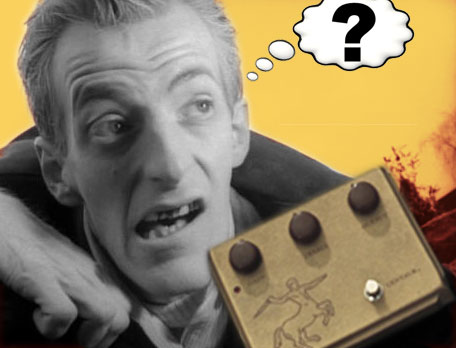
klon_zombie

Example 1: medium gain, medium tone

Pedal A = BYOC clone
Pedal B = Klon Centaur

Example 2: high gain, medium tone

Pedal A = BYOC clone
Pedal B = Klon Centaur

Example 3: low gain, medium tone

Pedal A = Klon Centaur
Pedal B = BYOC clone

Example 4: medium gain, bright tone

Pedal A = Klon Centaur
Pedal B = BYOC clone

Example 5: medium gain, dark tone

Pedal A = Klon Centaur
Pedal B =BYOC clone

And the winners are…

Categories
Bass Digital Effects guitar Recording

Logic X is Here!

Nnnggg...pedals.
Nnnggg…pedals.

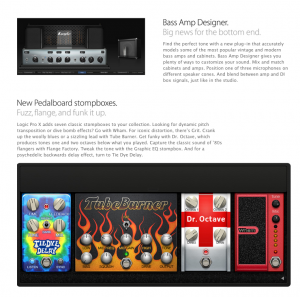
Apple released the long-awaited Logic X a few minutes ago. And it’s dripping with cool new guitar and bass stuff: a fabulous bass amp modeler. Lots of new virtual stompboxes. Vast new libraries of guitar tones, and newer, smarter ways of accessing them. More product info here.

FYI, I’m the furthest thing from an unbiased source: Apple is one of my clients, and I was a major indie developer for this product. But hey — the guitar features here are seriously bitchin’.

More details and examples in the coming days!

Categories
Acoustic Amps Bass Digital DIY Effects Gigs guitar Music Pickups Recording Technique

Tonefiend Book Week is Coming!

Tonefiend Book Week 2013

Next week at tonefiend we’ll be talking about our favorite guitar/music books. I’ll write about some of the titles I find especially useful, inspiring, or entertaining, and I hope you’ll chime in with some of your recommended reading.

Since there’s so much potential material here, I suggest we focus on a different book category each day. Here’s my proposed schedule:

Tonefiend Book Week is strictly an experiment, and a selfish one at that. If the past is any guide, the obsessive geeks experienced and sophisticated players who frequent this site will introduce us to lots of lively lutherie-linked literature. And I’ll do my best to keep up!

So scour your bookshelves, real and virtual. This shit is about to get real promises to be a most edifying conversation.

Categories
Acoustic Amps Bass Effects guitar Recording Uncategorized

The View from Here

IMG_6230

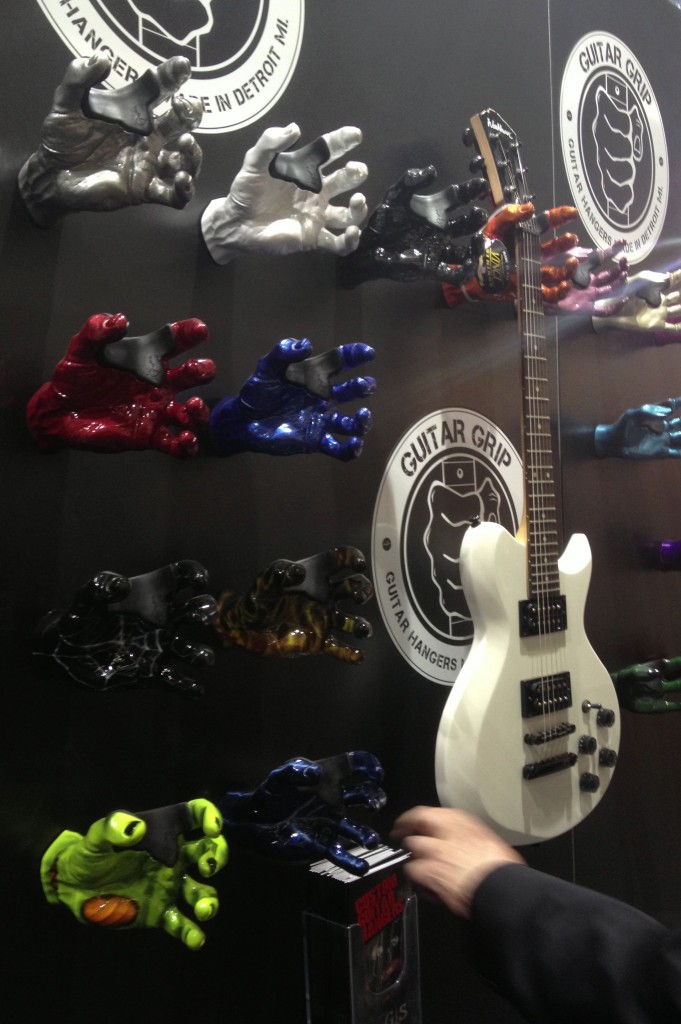
If you’ve been reading this blog for a while, you may have noticed a recurring pattern: I attend some interesting event and promise to report on it, only to get subverted by work, crowds, jabbering with old acquaintances, and jetlag. True to form, I’ve spend the first two days either demoing TriplePlay, or staggering to the coffee bar. Yesterday I spent hours staring at these Guitar Grip guitar hangers, which are mounted on the wall right next to the spot where I’m playing. They remind me of the human-hand candelabras from Jean Cocteau’s La belle et la bête.

It’s been fun playing for so many hours, though I’m still not very good at the MIDI guitar/drums thing. I was having a fairly disastrous moment when John McLaughlin came by. Isn’t that always how it is? You’re having an off day, and then you look up and see that frickin’ McLaughlin. Is it just me, or does everyone hate that? :shake:

This is my first time here, but the old hands tell me that the show is relatively dead, and that a lot of manufacturers have either already given up on Messe, or are planning to next year. We’ll see what transpires tomorrow afternoon and Saturday, when the show opens to the public. (So far, it’s industry-only.) And I really will try to scope out some gear!

IMG_6239
Stay classy, Marshall!
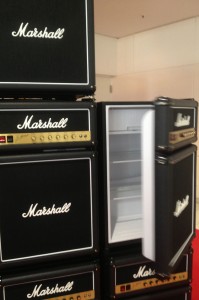
Now we're talking —  refrigerators!
Now we’re talking — refrigerators!