Month: January 2013

  • NAMM 2013: Digital Discoveries

    This first installment of my 2013 NAMM report focuses on products for the digital guitarist. In the coming days I’ll be doing posts on analog amps, guitar, stompboxes, and accessories. (But maybe not as quickly as I’d like, because I’ve also got to cover MacWorld in San Francisco this weekend.) This is cross-posted from Create Digital Music, one of the few music sites I visit every frickin’ day. 
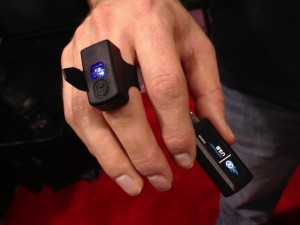
    Source Audio's Hot Hand USB wireless controller.
    Source Audio’s Hot Hand USB wireless controller.

    We guitarists tend to be a technologically conservative bunch, yet there was no shortage of forward-looking products at NAMM 2013.

    Not that everyone was looking in the same direction. Guitar processors are getting smarter, but they’re doing so in different ways. Are we entering an era when every guitar, amp, and pedal in our effect chain will boast powerful processors and a dedicated editing environment? Or will we just simply centralize everything in some future i-device? (I suspect that latter, and tend to think that smart pedals and smart amps represent an evolutionary cul-de-sac. But that cul-de-sac might be a real nice place to hang out for a couple of years.)
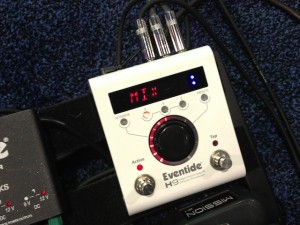
    Eventide's H9 can play all the sounds from the company's software-intensive stompboxes, and you can edit and control them wirelessly.
    Eventide’s H9 can play all the sounds from the company’s software-intensive stompboxes, and you can edit and control them wirelessly.

    One release I found particularly telling was Eventide’s H9, the latest addition to the company’s software-intensive stompbox line. The H9 has few new sounds, but can run all the DSP algorithms from Eventide’s other guitar stompboxes. The $499 box will ship late this quarter, preloaded with 9 of Eventide’s 43 current algorithms. Players hungry for more will be able to purchase them а la carte from an online store. (Eventide hasn’t yet finalized the add-on pricing.) The H9 also includes a handsome and full-featured iOS app for editing and managing patches via Bluetooth. There are no current plans to release an editor for OSX or Windows. (more…)


  • The Dog Ate My NAMM Report

    NAMM is loud.
    NAMM is loud.

    My idea was to scour NAMM’s five massive exhibition halls in a fast, efficient fashion, and then retire to a nearby cafe to pen witty yet informative summaries, which I’d post effortlessly via my cunning little i-devices.

    Instead I’ve been running around like a chicken with its head cut off and meth poured down its neck hole.

    So much for the twice-daily updates I’d envisioned. But I am seeing lots of interesting stuff. Even the boring stuff is kind of interesting, because it says a lot about the current state of music, musicians, and musical instruments. (more…)

  • NAMM I Am

    NAMM I Am

    It's that time again, folks.
    It’s that time again, folks.

    “It’s the most won-der-ful time of the year…”

    Oh wait — that was last month. Now it’s January. NAMM time!

    I’ll be there for the duration, partly to hang out with my Pure Guitar pals, and partly to meet with Fishman about the upcoming TriplePlay release. But mostly to gawp at the weird shit admire the musical instrument industry’s latest offerings. :oogle:

    I’ll be posting my findings here, and also doing a little write-up for my friends at Create Digital Music, one of my fave musician sites.

    Actually, I have this perverse fantasy of spending an entire show in Hall E: the Anaheim Convention Center’s low-rent basement/dungeon, a dark, inhospitable region where Fender and Gibson fear to tread. That’s where the industry leaders of tomorrow rub elbows with mad scientists and perennial laughingstocks (AKA “my peeps”).

    Any of you guys going? And if not, anything special you’re curious about?

  • Meet the REAL Spiders from Mars!
    Bartók on Electric Guitar

    Bartók: Smarter than math-rock — and way more violent.
    Bartók: Smarter than math-rock — and way more violent.

    My Bowie fandom is second to none. Yet I’ve always felt a vague sense of disappointment that the Spiders from Mars didn’t really sound much like spiders from Mars.

    On the other hand, the fourth movement from Béla Bartók‘s Fourth String Quartet really does sound like Martian spiders — assuming the critters in question had been force-fed a diet of chord clusters, mathematics, Hungarian folk music, and some of the most astonishing counterpoint this side of J.S. Bach.

    And dig it: This white-hot blast of dissonant modernism was composed in 1928!

    And how does this string quartet music sound on guitars? Awesome, IMHO — largely because the movement is played entirely pizzicato (plucked, not bowed). Very few modifications were needed to adopt it for four electric guitars.

    (more…)

  • Ring Modulation: The Effect from HELL!

    effect_from_hell
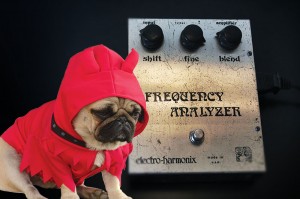
    Only very bad dogs like ring modulation!

    No disrespect to Chuck Berry, but I seriously doubt Johnny B. Goode played guitar just like a-ringin’ a bell unless he was using a ring modulator. That’s the only effect that can give you the complex, clangorous harmonics of a bell or a cymbal. Or make you sound like a ravenous horde of mutant robot ants.

    Theoretically, Johnny could have used one. By 1958, when Berry documented the guitarist in song, the effect was already being exploited extensively by avant-garde classical composers, notably the late Karlheinz Stockhausen, who used it to terrifying effect in his Gesang Der Jünglinge [1956].

    This post drips with perverse ring-mod love, including a demo of a rare vintage Electro-Harmonix Frequency Analyzer, and another featuring Roswell Ringer, a wicked ring mod plug-in.

    (more…)

  • The Best Music Notation Software for Guitarists?

    Since New Year resolutions expire at midnight, January 7th, I’m racing to realize my goal of finally becoming fluent with music notation software before the sands run out.

    A new way to feign productivity in cafes!

    I’d like to share some initial impressions about Notion. This isn’t a full-fledged product review — just a few thoughts about a half-dozen features I dig. (Most also apply to Notion’s sister app, Progression, which compiles all of Notion’s fretted-instrument tools, but omits the orchestral stuff. If you only plan to notate for guitar, the lower-priced Progression is probably all you need.)

    1. Appropriate complexity. Two programs, Sibelius and Finale, dominate the music notation field. Both are powerful, deep programs. Most notation pros use them because they’re packed with features essential to “music engraving” (the archaic and pretentious term for the process of preparing music for publication). (more…)