Archived Posts

  • My Flatwound Addiction

    flatwound
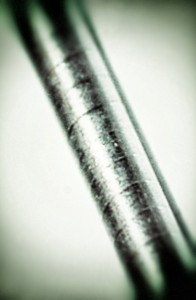
    So smooth. So sexy.
    So frickin’ expensive!

    Hi. I’m Joe, and I’m a flatwound addict.

    It took me a long time admit it. “What wrong with a little recrational flatwound use?” I used to ask. “I can quit anytime I want.”

    Sure, I’d sometimes put flatwound strings on my Guild archtop. And sometimes on a bass. And yeah, I did that post about how flatwounds are the key to nailing that ’60s electric 12-string sound. And that other post on how flatwounds brought my reissue Fender Bass VI to life. And yeah, I may have happened to blurt out that I like using flatwounds on a MIDI guitar.

    But I wouldn’t use them on, you know, one of my normal guitars.

    But then I recorded that Bartók piece, using the above-mentioned Guid and Bass VI alongside two standard-tuned guitars with roundwounds. The piece has a lot of counterpoint — all these motifs bouncing between the instruments. And the more I listened, the more I realized that I liked the tone of the two flatwound guitars far more than that of the two roundwound guitars.

    And then I bottomed out. I put flats on four more guitars. It wasn’t just musically risky — it was economically catastrophic! And that’s what brought me here tonight.

    Funny thing about flatwounds: Everytime I pick up a guitar with flats, I react negatively to the dullness of the wound strings. Where’s the shimmer? Where’s the zing?

    But the more I listen, the more I get sucked in. Parts layer over each other more readily. Chords speak more clearly. Fuzz and distortion yield sweeter overtones. It’s easier to get a consistent sound from melodies spanning wound and unwound strings. And the feel? Smooth, sleek and sensual.

    Sigh. Maybe I’ll try and kick the habit again tomorrow.
  • An Alternate-Tuning Capo

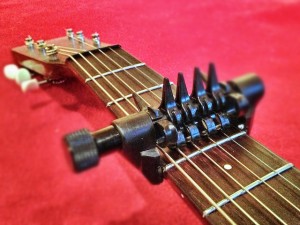
    Spider Capo

    UPDATE, 03.07.13: I should have mentioned a point that several readers noted in comments: The capo only alters the tuning of open strings. Which means that while you can play many harmonies normally available only in dropped tunings, any notes above the capo appear at their usual frets. For example, all barre chords are played exactly as in standard tuning.

    After all the digital guitar stuff I’ve been writing about lately, I really wanted to spend an afternoon without plugging in any frickin’ USB cables. So I finally got around to experimenting with the SpiderCapo I picked up last year on a whim.

    The SpiderCapo his six independently adjustable clamps, each of which can either stop the string or let it ring freely. That means you can dial in most dropped tunings without actually detuning any strings — instead, you transpose the entire voicing up. It’s a lot of fun to play, and seems like it could be a cool composing tool if you’re the sort of musician who gets inspired by unfamiliar tunings. Plus, it looks kind of wicked when you fret the unstopped strings behind the capo.

    Here’s a little video I made, noodling around in a few tunings I particularly liked:

    Anyone else tried one of these? Or any other “tricky” alternate-tuning capo? How about those gadgets that (unlike the SpiderCapo) can stop strings at differing frets?

  • My Friend Bill

    William Bennett, 1956-2013
    William Bennett, 1956-2013
    I lost one of my oldest and dearest friends yesterday — and one of the deepest musicians I’ve ever known.

    Bill Bennett, longtime oboist with the San Francisco Symphony, suffered a cerebral hemorrhage onstage last weekend while performing Richard Strauss’s Oboe Concerto at Davies Symphony Hall here in San Francisco. He passed away yesterday, surrounded by his family.

    Here’s a fine obituary written by our local classical music critic, a cool guy who also knew Bill well.

    I met Bill 30 years ago. I was a classical musician recently turned rocker, teaching guitar in San Francisco and hoping for a break. I received a call one day from a young-sounding dude who’d seen one of my ads.

    “Do you teach rock guitar?” he asked with a slight air of suspicion.

    “Of course I teach rock,” I sniffed.

    “I only want to study rock,” he said. “Not classical.” I assumed I was talking to some close-minded metal kid, and reassured him that I wouldn’t try to foist any classical stuff on him.

    You know the punchline: My “close-minded” student turned out to be one of the most celebrated classical musicians of his generation. (more…)

  • Demo: Fishman TriplePlay Wireless MIDI Guitar System

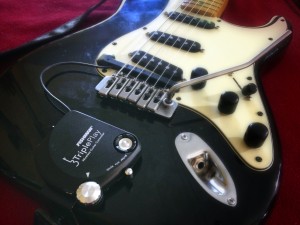
    I've installed TriplePlay on this homemade strat.
    I’ve installed TriplePlay on the homemade strat.

    For the last few months I’ve been working with Fishman on the documentation for TriplePlay, their long-awaited wireless MIDI guitar system, which will finally ship this quarter. I had a blast demoing TriplePlay at MacWorld a few weeks ago, and I’m looking forward to doing so again at Musikmesse in Frankfurt in April.

    But at times, it’s been frustrating. I power up TriplePlay to study some feature, get all excited, and then have to turn it off and write about it instead of going off and playing it for six hours. This little demo was my first real chance to just fool around with the thing. Thoughts and details after the video.

    (more…)

  • A Good Direction for Digital Guitar?

    Is this what your studio will look like in 2023?
    Is this what your studio will look like in 2023?

    The recent post on Auto-Tune for Guitar generated much interesting discussion, plus a few good Auto-Tune jokes. Thanks, guys!  :beer:

    The comments from smgear particularly impressed me, because he managed to assemble a wish list for a future digital guitar with more detail and clarity than I could have managed.

    It’s always a good idea for smart, articulate musicians to sound off about the musical tools they desire. But that’s especially true now, as manufacturers grapple with technological change with varying degrees of success. People really are listening!

    Anyway, smgear wrote:

    Basically, the problem is that the majority of the manufacturers seem locked into old paradigms. The bulk of their new designs are intended to mimic something else (Line 6), combine/integrate technologies (Roland) or make the ‘art’ less rigorous (Antares). Those are all fine pursuits and have resulted in some great tech, but they’re basically locking everyone into a pre-1980 palette of sounds, functions, and expression. Quite honestly, after my momentary enthusiasm has passed, I just pick up one of my no-name beater acoustics or electrics and dig in because every day I find a new sound, attack, approach, or whatever that allows me to express something in a new way. It’s true that I could do that playing through those tools, but I don’t need them and they are specifically designed to conform my sound to specific realms rather than to let me explore new spaces.

    So with regards to this batch of hex-based modeling tech, my general requirements are fairly simple. I want clean and discrete signals from each string (check), I want a serious multi-core processor AND a couple programmable on-board control knobs/switches (semi-check), and I want an easily accessible and intuitive interface that gives me full control over how each particular string or any group of strings is processed/routed (no check).

    (more…)

  • A Generic Stompbox Wiring Diagram

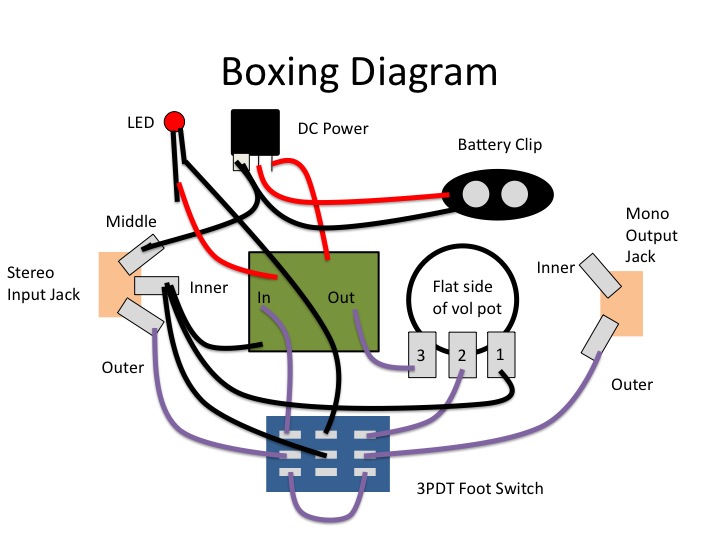
    I had to share this image sent by reader Gerald Good. (Thanks, man!)

    BoxingDiagram
    Gerald Good made this pretty picture. (Click to embiggen.)

    It’s a handy stompbox wiring diagram that’ll work with all the stompbox project on this site, and most other simple circuits. It’s not the only way to do it — there are other good options, especially for wiring that diabolical 3PDT footswitch. (You’ll find some of them here.)

    But I like the configuration Gerald chose to illustrate, because it’s the most idiot-proof. And everything I touch need serious idiot-proofing. I’m embarrassed to admit how many pedals I had to build before I had these basic connections committed to memory. The footswitch wiring alone nearly used to bring me to tears. I kept an ugly, hand-drawn diagram glued to a plank alongside my breadboard for ages.

    This is nicer. Print it out and post it at your workbench! :beer:

  • Auto-Tune for Guitar?

    Has anyone checked out this video for axes equipped with Antares’s Auto-Tune for Guitar?

    I haven’t tried one of these myself, though my pal Art Thompson at Guitar Player gave Peavey’s Auto-Tune-equipped AT-200 a glowing review.

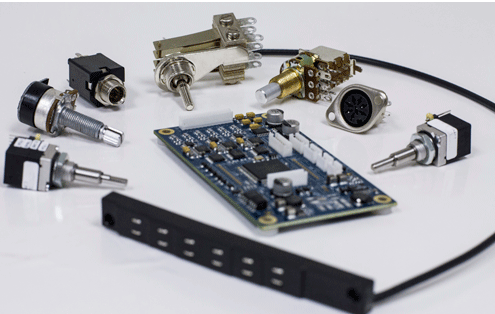
    I’d heard of the product, but must admit I hadn’t given it much thought, assuming it was chiefly a pitch-correction tool. But as Antares’s videos make clear, it also does many modeling tasks, and can no doubt be used in some very creative ways. According to the Antares site, the Peavey is the only currently available guitar pre-fitted with the system, though they hint at pending partnerships with other guitar companies. They’ve also announced the upcoming release of a Luthier Custom Kit, which means a) you’ll be able to install the system in a guitar of your choice, and b) there’s a product picture that reveals much about how the system works:

    Coming soon: the Auto-Tune for Guitar Luthier Custom Kit.
    Coming soon: the Auto-Tune for Guitar Luthier Custom Kit.

    (more…)

  • NAMM 2013: The Analog Edition

    NAMM

    UPDATE: My apologies if this page failed to load properly before. After a much screaming and crying some careful troubleshooting, it seems to be working correctly now.

    I put together a little slideshow of some of the interesting things I saw last week at the 2013 NAMM show in Anaheim.

    I covered some of the coolest new digital gear in this post. This time, the focus is analog guitars, amps, and effects. Plus: an ultra-rare sighting of a true California celebrity!

  • NAMM 2013: Digital Discoveries

    This first installment of my 2013 NAMM report focuses on products for the digital guitarist. In the coming days I’ll be doing posts on analog amps, guitar, stompboxes, and accessories. (But maybe not as quickly as I’d like, because I’ve also got to cover MacWorld in San Francisco this weekend.) This is cross-posted from Create Digital Music, one of the few music sites I visit every frickin’ day. 

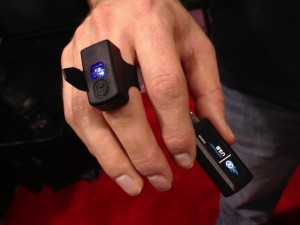
    Source Audio's Hot Hand USB wireless controller.
    Source Audio’s Hot Hand USB wireless controller.

    We guitarists tend to be a technologically conservative bunch, yet there was no shortage of forward-looking products at NAMM 2013.

    Not that everyone was looking in the same direction. Guitar processors are getting smarter, but they’re doing so in different ways. Are we entering an era when every guitar, amp, and pedal in our effect chain will boast powerful processors and a dedicated editing environment? Or will we just simply centralize everything in some future i-device? (I suspect that latter, and tend to think that smart pedals and smart amps represent an evolutionary cul-de-sac. But that cul-de-sac might be a real nice place to hang out for a couple of years.)

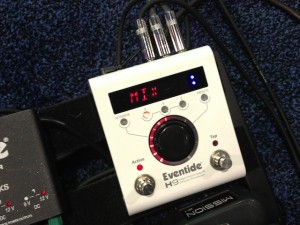
    Eventide's H9 can play all the sounds from the company's software-intensive stompboxes, and you can edit and control them wirelessly.
    Eventide’s H9 can play all the sounds from the company’s software-intensive stompboxes, and you can edit and control them wirelessly.

    One release I found particularly telling was Eventide’s H9, the latest addition to the company’s software-intensive stompbox line. The H9 has few new sounds, but can run all the DSP algorithms from Eventide’s other guitar stompboxes. The $499 box will ship late this quarter, preloaded with 9 of Eventide’s 43 current algorithms. Players hungry for more will be able to purchase them а la carte from an online store. (Eventide hasn’t yet finalized the add-on pricing.) The H9 also includes a handsome and full-featured iOS app for editing and managing patches via Bluetooth. There are no current plans to release an editor for OSX or Windows. (more…)

  • The Dog Ate My NAMM Report

    NAMM is loud.
    NAMM is loud.

    My idea was to scour NAMM’s five massive exhibition halls in a fast, efficient fashion, and then retire to a nearby cafe to pen witty yet informative summaries, which I’d post effortlessly via my cunning little i-devices.

    Instead I’ve been running around like a chicken with its head cut off and meth poured down its neck hole.

    So much for the twice-daily updates I’d envisioned. But I am seeing lots of interesting stuff. Even the boring stuff is kind of interesting, because it says a lot about the current state of music, musicians, and musical instruments. (more…)