Categories
DIY guitar Music

Tonefiend Book Week 2013: Epilogue

Monday: Theory and Technique
Tuesday: Gear
Wednesday: Repairs and DIY
Thursday: Biography
Friday: Fiction

Thanks to all my smart and cool readers who contributed to the first (maybe annual?) Tonefiend Book Week! I loved chatting about some old favorite books, and getting exposed to so many cool new ones.
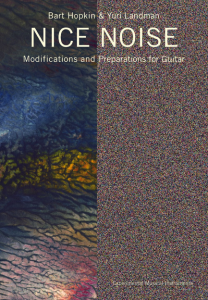
An encyclopedia of rad.
An encyclopedia of rad mods.

I have just two quick additions: the first concerns an exciting new acquaintance, and the other a sad departure.

In comments to Tuesday’s post on DIY and repair books, reader smgear mentioned Nice Noise, a book on prepared guitar by Bart Hopkin and Yuri Landman. I immediately ordered a copy, and received it the other day. I’m blown away. It’s a small-format book, a mere 72 pages, but it is a veritable encyclopedia of alternate guitar treatments.

Hopkin (he edited the journal Experimental Musical Instruments and wrote the fabulous alternate instrument books Gravikords, Whirlies & Pyrophones and Orbitones, Spoon Harps & Bellowphones) and Landman (he builds mutant guitars for Sonic Youth, Liars, Melt Banana, and other artists) discuss pretty much every avant-garde guitar mod I’ve ever heard of, and many besides. It’s not just a catalog — it’s a detailed how-to, meant to be consumed alongside the pair’s online audio library of musical examples. I’m sure you’ll be reading about it more here, because I’m definitely going inflict some of these rad alterations on some unwitting guitars.

One of the finest rock-and-roll novels.
A great rock-and-roll novel.

An a sadder note, the death of Scotland’s Iain Banks this weekend reminded me of a book that should have been inclued in Friday’s installment on musical fiction. Both funny and moving, his 1987 novel, Espedair Street, is simply one of the finest rock-and-roll novels ever. Its protagonist is a fabulously successful rock star (think Floyd or Fleetwood Mac in their prime) who must process his own past while grappling with the prospect of suicide.

Readers in the UK, where Banks is hugely popular, may be surprised to learn he’s strictly a cult figure in the States. While Espedair Street is his only work to focus on the music world, he wrote many fine novels marked by wry humor and vast empathy. (The Crow Road and Whit are two other favorites of mine.) He also wrote scads of science fiction under the name Iain M. Banks. Banks, 57, had only recently learned he was dying of cancer. In April he composed a final communique to his readers, writing:

I’ve asked my partner Adele if she will do me the honour of becoming my widow (sorry – but we find ghoulish humour helps). By the time this goes out we’ll be married and on a short honeymoon. We intend to spend however much quality time I have left seeing friends and relations and visiting places that have meant a lot to us.

Categories
Amps Effects guitar Music

Tonefiend Book Week 2013
Tuesday: Guitar Gear

Monday: Theory and Technique
Tuesday: Gear
Wednesday: Repairs and DIY
Thursday: Biography
Friday: Fiction

This week we’re talking about our favorite guitar/music books. The plan is simple: I discuss a few titles I’ve found particularly enlightening, useful, or entertaining, and then you jump in and do the same. I’ve organized the days of this week by subject matter. Today’s topic is guitar gear.

Guitar gear books seem to fall into three categories:

  1. Pornographic. Lavish publications featuring beautiful photos of rare instruments, often focusing on a single manufacturer or collector.
  2. Encyclopedic. Thick reference books covering wide swaths of guitar history.
  3. Pragmatic. Books that explain the inner workings of guitar technology, with an emphasis on how to turn this info to your musical advantage.

Even if I weren’t a jaded former guitar mag editor, I doubt I’d have much interest in coffee-table guitar porn books (and the occasional guitar porn magazine). Or at least, no more interest than I’d have in photos of, say, beautiful watches, speedboats, or nutcrackers. I’m not a guitar collector.

Not on <i>my</i> coffee table, you don't!
Not on my coffee table, you don’t!

Hey — stop laughing! Yeah, I own more than 20 guitars. (The exact number depends on whether I count guitars I’ve loaned out indefinitely and ones I’ve borrowed indefinitely.) I appreciate my instruments greatly, and I am very aware of how fortunate I am to have access to so many musical tools. But in the end, they are just tools to me, with little significance beyond their musical applications.

I realize this is a pretty weird attitude for a guitar dude, and one reason why I was probably never a perfect fit as a guitar mag editor. (I must be missing some crucial male gene, because I’m equally blasé about cars and sports. With rare exceptions.)

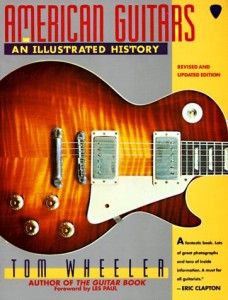
The classic reference book.

Reference books are a different story, especially the books of George Gruhn and Walter Carter, and those of Tom Wheeler. Sure, some of their weightier works have guitar porn aspects, but always paired with vast historical knowledge and the expertise of longtime industry insiders. Gruhn and Carter may know more about American guitars than anyone. But I always gravitate to Tom Wheeler’s books, and not just because he’s a longtime friend and mentor. Tom is a fine writer, an impeccable researcher (he’s been a journalism prof for the last 20 years), and he still conveys a teenager’s passion for the instrument. Tom is my hero.

(Bonus question: Has Wikipedia rendered the guitar reference book obsolete?)

But these days, the gear books that excite me most are the technically slanted, nuts-and-bolts titles. It’s one thing to ogle pretty instruments, and another to explain how they work, why they sound the way they do, and what that all means for the music we make today. And that’s why I love the books of Dave Hunter.