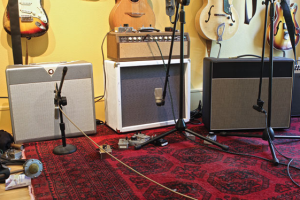
This photo was originally a line of 137 amps, but I had to crop it to fit this small space.
Premier Guitar has just posted a new installment in my Recording Guitarist column. The topic: doubling riffs for fatter sounds. Using a single guitar part (and a great drum performance swiped from Dawn Richardson), I tried every doubling trick in the book. plus some ones that wise editors expunged from the book. We’re talking amps, mics, panning, processing, analog vs. digital—real OCD stuff.
Is it interesting enough to justify listening to the same part doubled 20 different ways? Depends how big a geek you are!
For the less geeky, here’s a concise executive summary:
Q. How many doubles do you need for maximum fatness?
A: Between zero and a lot.
Q: How many is too many?
A: Fewer than the 21 tracks in my last over-the-top example.
That, plus some helpful information, just to keep things lively. :smirk:
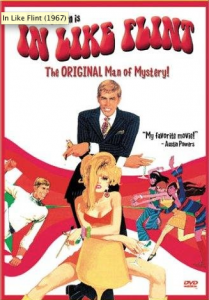
I just recorded a solo version of one of my fave film themes: Jerry Goldsmith’s main title to the 1967 spy spoof In Like Flint. I’ve adored the melody since childhood, and I blame it for instilling the love of chromaticism that made possible my extraordinarily uncommercial career.
I’d previously posted another version of this tune, performed upside-down on a friend’s lefty guitar. But that was all-analog — this time it’s digital. And I’ve used the video to highlight a favorite MIDI technique: doubling recognizable guitar sounds with non-guitar synths and samples.
I’ve been obsessed with this score since dinosaurs ruled the earth.
It’s funny — being able to trigger pretty much any sound from the guitar isn’t necessarily as liberating as you might think. Sure, when you first try it out, it’s thrilling to conjure an electric piano sound from the fretboard. But who wants to hear some schmo noodle aimlessly on electric piano when they could be noodling aimlessly on guitar?
For better or worse, I find myself using this technique repeatedly. When I double a part effectively, the result still seems like part of the guitar cosmos. It feels like expanding the palette, as opposed to vomiting on it. (Not that I’d be above vomiting on a palette if it helped create a cool painting.)
Did anyone else encounter this sort of childhood musical contamination? A melody, progression, or tone that infected you early on, and colored everything after? I’m not talking image, like falling in love with the Beatles on Ed Sullivan or Nickelback on the CBC because they were so frickin’ cool. I mean a primal sonic imprint. Anyone?