I almost always play small combo amps of 20 watts or less. But I wanted something with a bit more clean headroom for a possible upcoming project — and to demo my stompboxes. I’ve always enjoyed playing JTM-45s when I’ve reviewed them for guitar mags, so I ordered Monotone’s British 45 kit.
I’d previously had a great experience building Mojotone’s Marshall 18 watt clone kit when I reviewed it for Premier Guitar a couple of years ago. It turned out great, and I use it regularly.
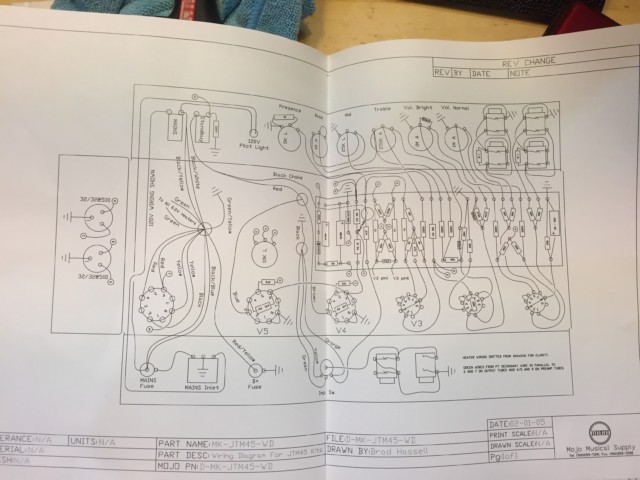
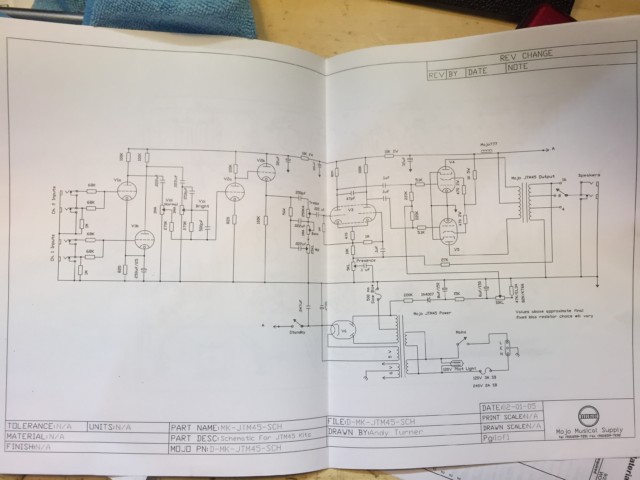
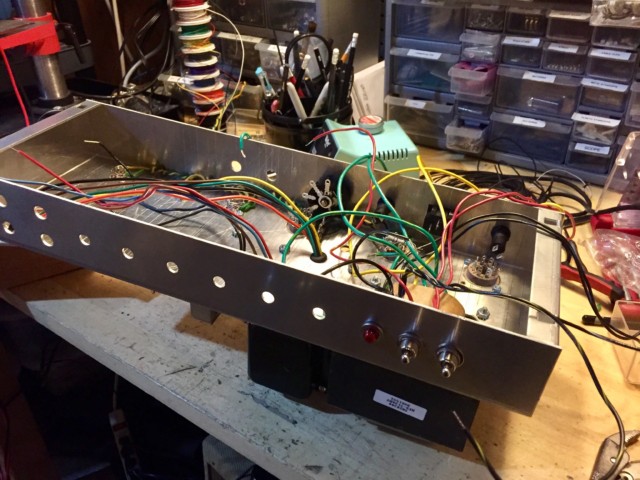
Mojotone provides high quality parts, nearly labelled and organized in plastic compartmented boxes. But beware: The company provides no build instructions — just a layout diagram and a schematic. You need amp building experience or help from an expert. Click play for a slideshow about he build:
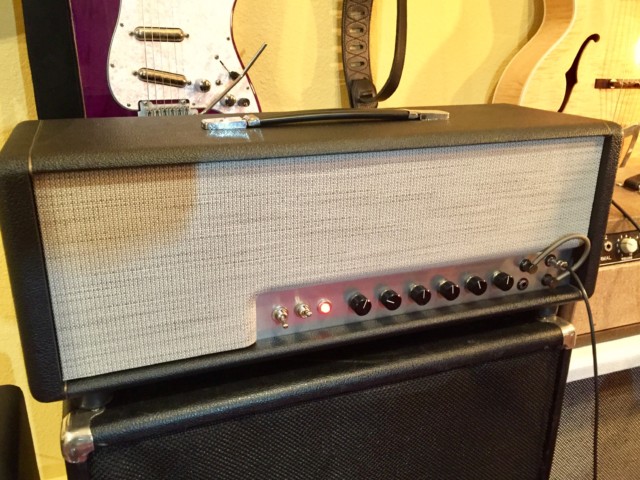
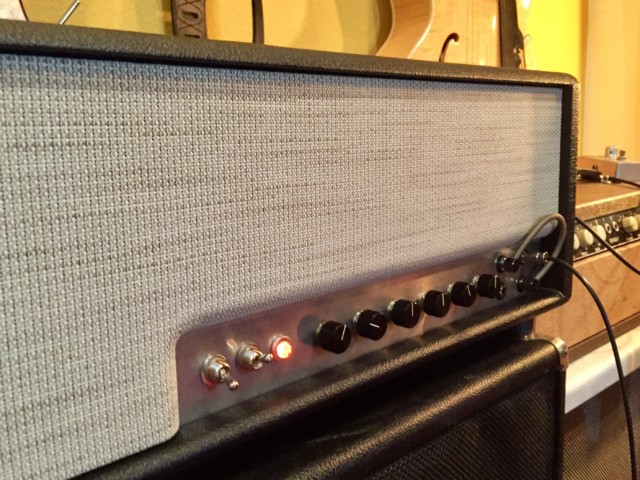
This is Mojotone’s new offset head cabinet. (The amp chassis first in other Mojotone cabinets as well.)
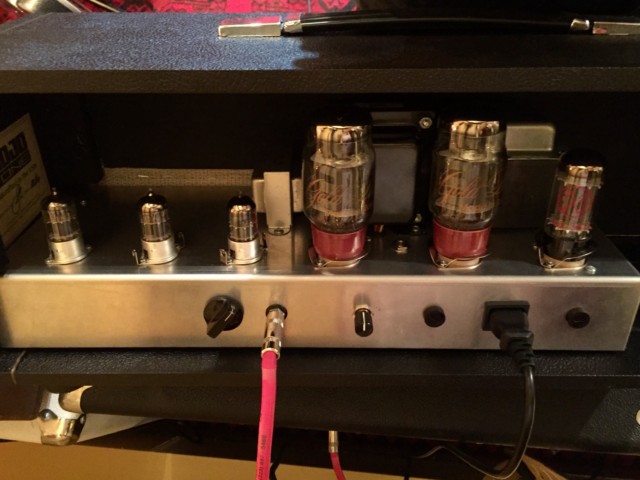
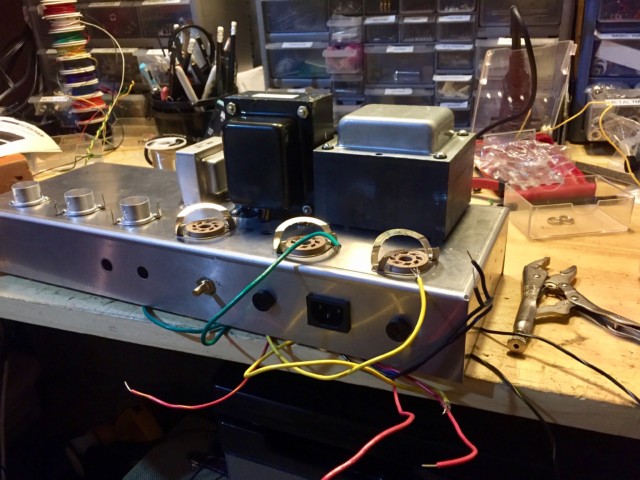
The two power tubes can be either EL-34s or KT-66s. (I chose the latter, just for a new experience.)
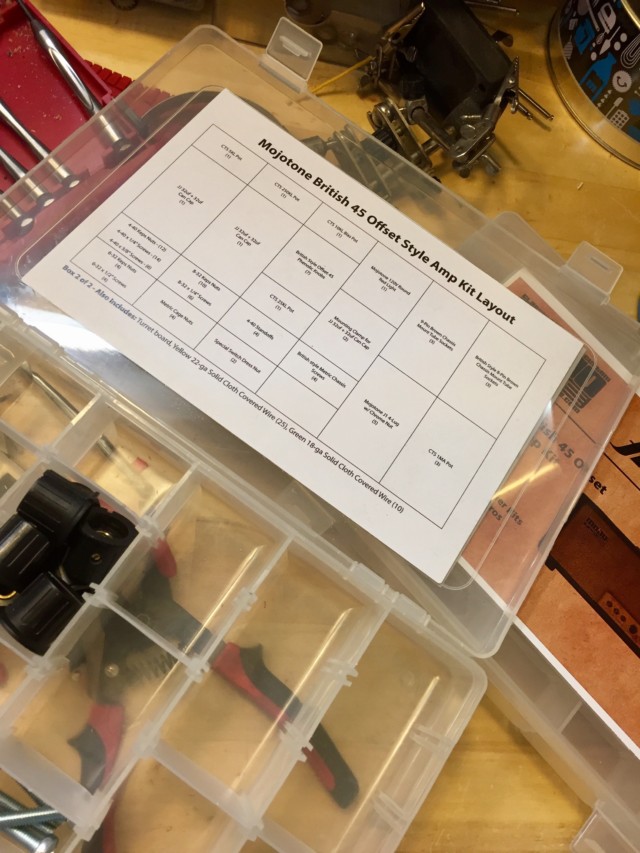
The parts come neatly labeled and organized in plastic bins — a BIG help!
Warning: the kit includes no build instructions — just this layout diagram and a schematic.
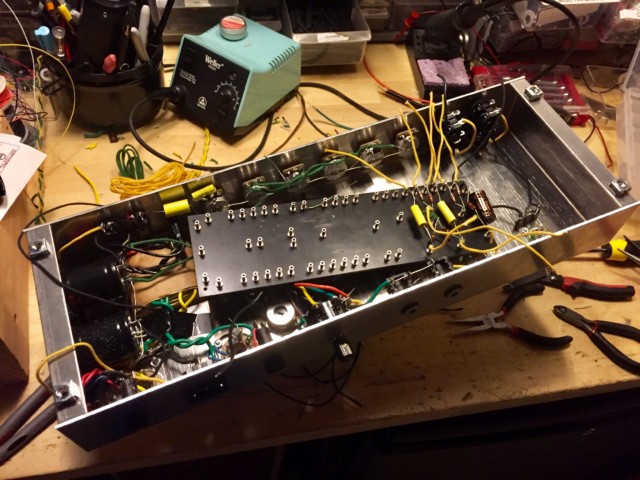
I ALMOST managed to assemble it, but I needed a rescue at the end. (Thanks to Bruce Clement of BC Audio, a brilliant boutique builder here in San Francisco.)
Mojotone supplies their own branded transformers (which sound fab).
It’s a turret board build. (The board and turrets are pre-made, as opposed to some kits, which require you to insert the turrets yourself.)
This is probably not a good first build — maybe start with a nice little tweed Champ kit?
The a plexi faceplate, which I left omitted. I also substituted my own knobs.
I nearly made it through myself. (Translation: I soldered everything together and it didn’t work.) So I had to hire Bruce Clement of BC Audio here in San Francisco to rescue me. (Bonus: Bruce loaned me one of his JTX50 heads. Man, it’s one of the best-sounding Marshall derivatives I’ve ever heard. It’s among his Octal-Plex series amps, which use octal preamp tubes in Marshall-inspired designs.) (more…)
As threatened, here’s a closer look at Strat with PAF humbuckers used for my recent “God Only Knows” cover. Most parts are from the long-suffering guitar used for all the Mongrel Strat Project experiments. And this one is especially mongrel-ific, with its blend of vintage Fender and Gibson.
Obviously, Gibson pickups is a Strat is far from a new idea. But usually, that arranged marriage is designed to spawn macho, high-gain solos minus the characteristic shrillness of vintage Strat bridge pickups. While many players I love have used humbucker-equipped Strats, I’ve always loathed playing them myself. But what, I wondered, if you didn’t use a hot humbucker, but an über-vintage PAF?
Like many players my age and younger, I was astonished when I first encountered a vintage-voiced humbucker. It was nothing like the dark, over-overdriven tones I associated with the word humbucker. A good PAF is sparkly, resonant, and perfectly capable of gloriously bright and clean tones. Here I used a Seymour Duncan Joe Bonamassa signature set, the same one heard in a more Gibson-like context here.
The results are … compelling. As expected, notes have far more mass than on a conventional Strat, and the bass response is vastly increased. There’s no shortage of top-end either, though the big lows can overwhelm the highs at times. So while I’m pretty much always obsessed with bass-cut controls (especially the high-pass section of the PTB circuit I’ve written about approximately 37 zillion times), it’s especially invaluable in this case. Since lows disproportionately drive distortion, even modest bass cuts clean up the tone and make highs speak more clearly.
I’ve also incorporated the dual-capacitor treble control I wrote about here. It creates a Vari-Tone/ToneStyler effect in a simplified way: Instead of using a clunky rotary switch to choose from a large set of treble-trimming capacitors, it fades between a large cap and a small cap, yielding the same resonant effect as the more complex options. I’ve incorporated this circuit in several guitars now, and it’s still working for me. It’s especially nice here, when paired with a Steinberger JackPot potentiometer, which lets you bypass the entire tone circuit for absolute maximum volume and brightness. I chose the small cap based on the minimum amount I’d ever want to remove from the signal, and the larger one based on the maximum cut I’d use.
I would have included a photo of the project in progress, but I didn’t because I’m embarrassed about how awful it looks inside. I needed to route out the pickup cavities to accommodate these larger pickups. But instead of taking it to a professional, or getting a proper router and learning how to use it, I chipped away with the tiny routing bit on an inexpensive Dremel tool. Do yourself a favor, kids, and don’t follow my lazy-ass example.
But hey, what’s a Strat pickguard for if not to conceal your shoddy workmanship? The guitar looks okay in the end, and I’m digging its sounds, even though it was far harder to get accustomed to than I’d anticipated. I had to recalibrate my right-hand dynamics to prevent treble notes from screeching. I was almost ready to chalk this up as a failed experiment, but after a few days of noodling around, I started to get the hang of it and enjoy the results. I think I’ll keep it this way for a while — or at least until the next Mongrel Strat concept wafts up from the bowels of Hell. 🙂
Happy 2016! I hope everyone’s holidays were epic, and that you got lots of good stuff.
There’s no better way to ring in the new year than to highlight the … um … peculiar culture that somehow got attached to our instrument. You can’t make this shit up.
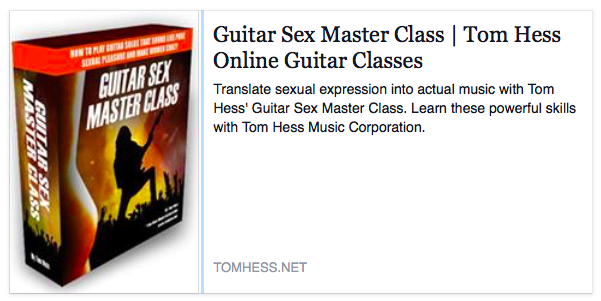
Hard to believe, but this mastur class is totally real — at least in the mind of its creator. From the master:
Only a master guitarist and master guitar teacher understand both mastery of these concepts and how to break down complex and advanced ideas into easy-to-understand lessons that you can begin to learn and use right away in your own guitar playing.
I’ve been asked to teach on this topic by students again and again over the years. So I decided to create a 4-part master class video series. In fact, people travelled from all over the world, with great anticipation, to be part of this master class while it was being filmed.
Does it really work? It sure does! 🙂 When I filmed the master class, I called up several volunteers (all students of mine) to come forward and try the concepts I shared with everyone. And, as you will see for yourself on these videos, whenever any of these students implemented these specialized concepts, every woman in the room was not only paying complete attention, but all were smiling constantly. We could all see the effect it was having directly on them!
But don’t worry, this is not a bunch of childish obscene gimmicks or noises that you make with your guitar. This is about REAL guitar playing mastery! In other words, you won’t get slapped in the face when you play this way for women… but they’ll definitely feel what you are expressing in a good way!
This, apparently, is the sort of music that does the trick.
I just started a Tonefiend Instagram feed, ’cause I know there’s not enough junk in your inbox. If you’re an Instagram user, feel free to follow. (Or just friend me on Facebook, where all the Instagram images also appear. I’m not picky—I’ll friend anyone, at least till they start posting links to $19 Prada handbag knockoffs.)
Often I don’t post here at tonefiend.com till I’ve cobbled together a relatively substantial item, which means the site can fester for weeks without an update. But for better or worse, I plan to post a steady stream of square cell phone pics compelling images and trivial pithy thoughts on Instagram/FB/Twitter.
On Instagram, I’m starting out with two weekly posts. Both are pretty silly, but each has inspired some surprisingly cool conversations. The first series is “Name That Gear,” which is simply a close-up shot of some music gizmo, but with some telling detail that reveals its identity. Not much too it, but it can be fun.
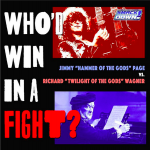
Page vs. Wagner: Who’d Win in a Fight?
The other recurring item is “Who’d Win in a Fight?” These are deliberately absurdist: The first post matched Jimmy “Hammer of the Gods” Page against Richard “Twilight of the Gods” Wagner. But amazingly, it inspired a long, fascinating, and drop-dead funny Facebook conversation. (Thanks for my wife for suggesting both ideas.)
Naturally, I’ll also be using those feeds to shamelessly flog my music and gear. I’m going to be showing the first five Joe Gore Pedals stompboxes at the LA Amp Show in Van Nuys, California on October 3rd and 4th—just a couple of weeks from now! The product announcements aren’t quite ready yet, but trust me—I bombarding you with them very soon. 🙂
Man, pontificating ain’t easy! KMI, who make the SoftStep controller I use almost every day, solicited a “Albums That Meant a Lot to You” list for their website, and I replied with “Ten Albums That Made My Head Explode,” which just went live on their site. And that made me want to hear your lists.
I don’t know why exercises like this can be so hard. First you can’t think of enough … and then too many … and then you worry you forgot an important one … and then you spend an hour reflecting on whether Joni Mitchell or Béla Bartók is more important … and then you read the whole thing through and realize how insufferably pretentious you sound. At some point, you just surrender and hit SEND. And that’s the moment you start second-guessing the whole thing.
For such a low-stakes effort, the pressure is high! And now I’m putting the pressure on you: I’d love to read your lists of mind-exploding music. Please post them to comments below, and add as much detail as you like. (And feel free to use the “runners up” dodge — I certainly did.)
I’m not sure if there’s much difference between “music that altered my mind” and “best music” lists. I guess it depends on how much importance you place on music that leaves brain specks all over your walls. For me, the brain-speck stuff usually is the best music.
I realized after the fact that only about half my picks have audible guitar parts. How about yours?
I just watched an amazing documentary on Netflix: The Source Family, the story the early-’70s cult led by James “Father Yod” Baker. Baker’s Sunset Strip restaurant, the Source, was a fixture of my LA youth — a popular hang for both hippies and music-industry types. (You’ve probably seen it as the backdrop for the breakup scene in Woody Allen’s Annie Hall.)
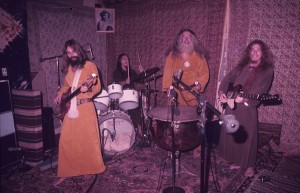
The hell with cowbell! We need more tympani! James “Father Yod” Baker (with mallets towards none) fronting Ya Ho Wa 13.
One of Baker’s less eccentric notions was to blow a fortune on music gear and a pro studio, where his self-styled “band,” Ya Ho Wa 13, reportedly recorded 65 albums’ worth of improvised music, much of which has been reissued in recent years. Prolific, chaotic, and fueled by a philosophy comprehensible only to its creator, the body of work is a bit reminiscent of Sun Ra’s, minus the talent.
Perhaps the best thing you can say about Baker is that he was no Manson. I don’t know that anyone died on his watch other than Baker himself (in an idiotic stunt I’ll refrain from sharing so as not to spoil the film’s stupefying denouement, though you can devour the details here if you like).
But he was a serial psycho-sexual abuser who acquired 14 very young wives while liberating hundreds of starry-eyed acolytes from their worldly possessions and cruising LA in a white Rolls Royce. Among the film’s most remarkable scenes are Ya Ho Wa 13’s recruiting concerts held at well-to-do West Side high schools and colleges, including my alma mater. Just … wow.
To its credit, though, the film isn’t moralistic in the slightest — directors Maria Demopoulos and Jodi Wille tell the story via the words of its witnesses, supplemented by film and photos of the cult’s own Isis Aquarian, Baker’s anointed archivist. (They report — you gawp in astonishment.) Many surviving members appear onscreen, as do such rock admirers as Billy Corgan and Don Bolles of the Germs.
Fictional mugshots of our fictional band’s fictional 1969 arrest, along with their fictional cult leader.
I knew the general outlines of the Source story, but not the hundreds of bizarre details that make it so compelling. Elise Malmberg and I drew from it a decade ago while creating Clubbo Records, our “music fiction” project. We concocted the Fold, a fictional hippie cult band, using bits pilfered from various spiritual scams of the era, including the Source and the equally fascinating Process Church. (A fictionalized Process Church also figures in Last Days, a darn good horror novel by Adam Nevill, though not quite as awesome as Nevill’s The Ritual, with its Scandinavian black metal underpinnings. It’s as scary/funny as actual black metal.)
Naturally, our fake story isn’t one-tenth as interesting as the shit that actually happened. But it did produce “Into the Fold,” one of our best bits of counterfeit music, featuring the brilliant Chuck Prophet singing the Morrison-esque role of Gary “Shep” Shepheard, who fronted the Fold’s rock band under the direction of cult leader Maestro Ludgang. (Elise wrote the song, and I played the music, except the drums, which are by Patrick Campbell. Other friends served as photo models.)
Meanwhile, I’ve been working on a new piece that has some sounds and phrases I like, but has steadfastly refused to take shape. I tried recording it the other night, but every soloistic element I added sounded stupid. When live-looping, I’m so self-conscious about excessive repetition that I use every trick I can muster to vary the sound and move things along. This time, though — under the spiritual influence of The Source Family, perhaps? — I just let the loops roll, visualized my ego dissolving into a pool of pearlescent light, and dug on the trance. Man.
It’s called “Unfolded,” after the Fold, of course.
But please, folks — if I start calling myself Maestro Ludgang Aquarian, do me a favor and stage an intervention.
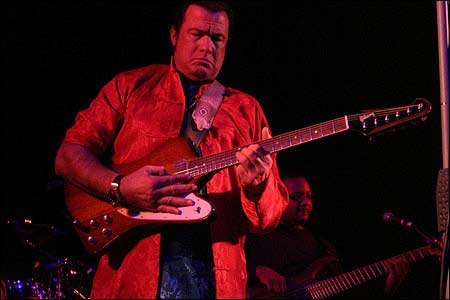
Actor Steven Seagal, who belongs to the homophobic (yet oddly homoerotic) Vladamir Putin cult, plays a reverse Firebird like the one that Ya Ho Wa 13 used. Coincidence?
UPDATE [06.16.14]: Okay, this is too great: I just shared this post with my pal/fellow Premier Guitar editor Charlie Saufely, who told me he played for a Ya Ho Wa 13 tribute band that performed in front of original band members when this film premiered at San Francisco’s Roxy Theater. Afterwards he got to jam with Djin, the guitarist. “It was a thrill,” Charlie says. “He was way more into skronking than blues jamming. We kinda went off on a Thurston-and-Lee, hail of sonic scree barrage. He had the Firebird … it was surreal. He reached over at one point and started scraping my strings with his fingernails. That was pretty sweet!”