Tag: overdrive

  • NEW CONTEST: Klon vs. Screamer
    Identify the Audio Clips and Win!

    Left: Klon Centaur #309, worth over $2,000.Right: BYOC Overdrive 2, a $95 Tube Screamer clone.
    Left: Klon Centaur #309, worth over $2,000.
    Right: BYOC Overdrive 2, a $95 Tube Screamer clone.

    It’s hardly a new idea: YouTube is full of Klon vs. Screamer comparison videos.

    But this one is different.

    Using the same “reasonably scientific” techniques deployed in my recent germanium fuzz survey, I’ve created a blind listening test that removes as many variables as possible from the equation.

    The video details the testing procedures. But basically, the A/B recordings are identical save for the use of one pedal or the other. The rival pedals are Klon Centaur #309 (the unit reviewed in Guitar Player back in the ’90s) and a new BYOC Overdrive 2, a DIY Tube Screamer clone kit with extra knobs and pots to provide the most popular boutique mods.

    This Klon would fetch north of $2,000 on EBay. You can order the Overdrive 2 online for $95.

    Now, these two pedals are NOT identical circuits. (The key differences are covered in the video.) But they share the same topology and sonic character. It’s not an apples and oranges comparison β€” more like two apples of distinct but related varieties.

    For the video I dialed in five different sounds from across the Klon’s range, and then tried to duplicate them with the BYOC Screamer clone. You’ll hear the same material ten times, like so:

    Example 1: medium gain, medium tone

    Pedal A =
    Pedal B =

    Example 2: high gain, medium tone

    Pedal A =
    Pedal B =

    Example 3: low gain, medium tone

    Pedal A =
    Pedal B =

    Example 4: medium gain, bright tone

    Pedal A =
    Pedal B =

    Example 5: medium gain, dark tone

    Pedal A =
    Pedal B =

    To compete, just fill in the blanks and copy your answers into the comments thread below.

    The pedals might not appear in the same order for each pair of audio clips. Other than that, there are no sneaky tricks. (For example, you really do hear two different pedals for every example.)

    Β 

    The first three contestants to submit perfect scores before Tuesday, July 23rd, 2013, will each win fabulous prizes one of my hand-built stompboxes. On that date I’ll post the answers and announce the winners here, assuming there are some. You can still test your ears after that by watching this video and not peeking at the answers β€” but sorry, no more prizes.

    Only one entry per person. Anyone caught circumventing this rule via multiple identities may be subject to global ridicule.

    I’ll hold off on any sonic observations till I post the correct answers next week.

    Good luck, and may the best ears win some gnarly stompbox.
  • Fuzz Detective:The Case of the 12 Germanium Fuzzes

    Fuzz Detective:
    The Case of the 12 Germanium Fuzzes

    As threatened, the Fuzz Detective video:

    WHAT: Twelve germanium fuzz circuits compared and analyzed. These represent the sounds of almost every fuzz pedal introduced between 1962 and 1968.

    WHY: A tool to help players identify the circuits most relevant to their musical needs. This isn’t about particular brands of pedals, but the circuits they employ. If you hear something you like, you can either do as I did and build a clone from the schematic, or buy one based on that particular design. (The relative merits of rival clones is another story.) Of course, if you’re rich and you desire an ancient pedal that probably doesn’t sound as good as a new clone, you can always purchase a vintage original. πŸ˜‰

    HOW: I tried to establish a “level playing field” by removing as many sonic variables as possible. I used the same signal chain, the same guitars, the same musical material, etc. (Tech details below.)

    WHO:

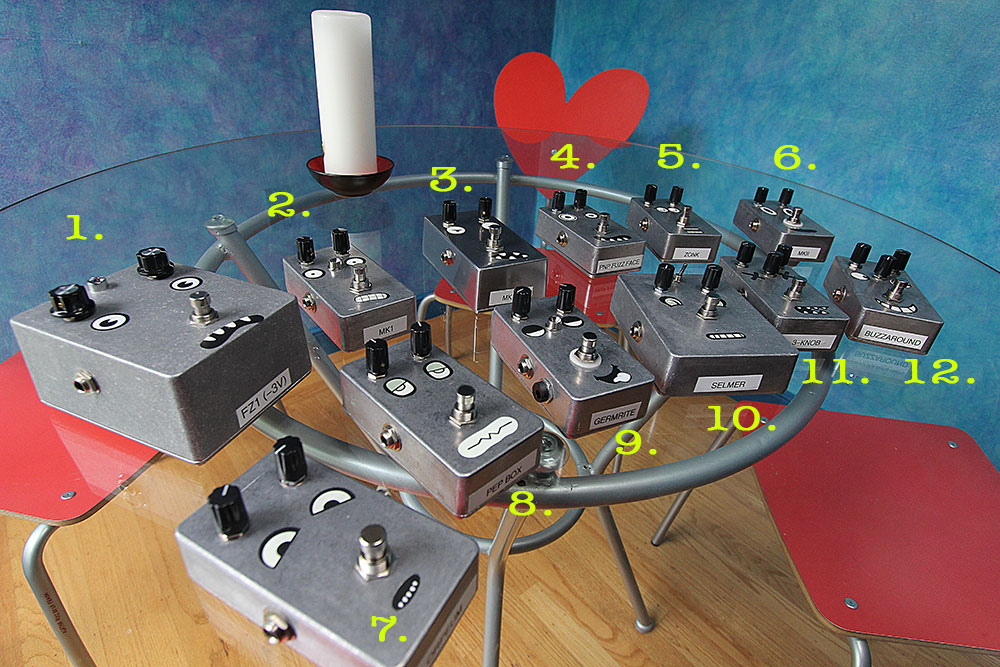
    1. Maestro FZ-1 Fuzz Tone
    2. Sola Tone Bender Mk 1
    3. Hornby-Skewes Zonk Machine
    4. Sola Tone Bender “Mk 1.5” (similar to Vox Tone Benders)
    5. Dallas-Arbiter Fuzz Face
    6. WEM Pep Box Rush
    7. Sola Tone Bender Mk II (same as Marshall Supafuzz)
    8. Mosrite Fuzzrite (germanium version)
    9. Orpheum Fuzz (germanium version)
    10. Selmer Buzz Tone
    11. Sola Tone Bender Mk III (same as Park Fuzz Sound, Carlsbro Fuzz)
    12. Baldwin-Burns Buzzaround.

    WHEN: Like, now, man! (more…)

  • Fuzz Detective: The Plot Thickens!

    Man, I’m glad I announced my intentions about this project! Thanks to your links and suggestions, the “Fuzz Detective” project has grown vastly more ambitious. I need a few more days to make my test recordings are assemble the results, but I believe this will be the most complete and “scientific” audio comparison of 1960s fuzz circuits yet attempted. I’m posting this update to share my current plans β€” and solicit last-minute suggestions for improving them. β€”Joe

    Wanker's Dozen: twelve Germanium fuzz pedals compete on a level playing field.
    Wanker’s dozen: twelve germanium fuzz pedals will finally compete on a level playing field.

    I’ve been a busy little solder monkey! Dig my new pedals:

    1. Maestro Fuzz Tone FZ-1 clone
    2. Sola Tone Bender “Mk I” clone
    3. Sola Tone Bender “Mk 1.5” clone (near-twins: Vox Distortion Booster, Italian Vox Tone Benders)
    4. Dallas-Arbiter Fuzz Face clone (very similar to Tone Bender Mk 1.5)
    5. Hornby-Skewes Zonk Machine clone (near-twin: Tone Bender Mk 1)
    6. Sola Tone Bender “Mk II” clone (near-twin: Marshall Supafuzz)
    7. Orpheum Fuzz clone
    8. WEM Pep Box Rush clone
    9. Mosrite Fuzzrite clone (germanium version)
    10. Selmer Buzz-Tone clone
    11. Sola Tone Bender Mk III (“3-knob”) clone
    12. Baldwin-Burns Buzzaround clone

    About the Fuzz Detective project:

    I’m attempting to create a comprehensive comparative sound library of germanium-transistor fuzz pedal circuits.

    There’s no shortage of audio clips and demo videos featuring the great stompboxes of the ’60s and their modern clones. Yet it’s difficult to make qualitative comparisons between circuits because there are so many other variables at play. Who performed the examples? Using what gear? Were the examples recorded in a pro studio or on a mobile phone? Are the pedals ’60s originals or modern clones? What’s the condition of the transistors? And so on.

    This isn’t about, say, deciding who makes the best Fuzz Face clone. The focus is the circuits themselves. The Fuzz Detective project aims to “level the playing field” by removing as many variables as possible. (more…)

  • Museum of Lost Effects: Klon Centaur

    Museum of Lost Effects: Klon Centaur

    Overdrive from Heaven? Or hype from Hell?

    Has any stompbox ever been as steeped in myth and legend as the Klon Centaur? Doubt it. Original Centaurs are extremely collectible, currently fetching around $1,500 on EBay. But for every player who drools over the prospect of obtaining this rare creature, there’s another who’s foaming at the mouth about idiots who’d pay four figures for a “glorified Tube Screamer.” When you Google “Klon Centaur,” one of the first items to appear is this memorable rant from the always entertaining Zachary of Zachary Guitars:

    Here is a guitar pedal which has been around for about 10 years and stands for total Bull Shit in my opinion. The website, the presentation, the marketing, the hype, the price. Everything about it is why I hate the music business and the shockingly stupid guitar consumers. Its a mediocre and common pedal. Its your typical mild Tube Screamer- type of effect and sound. It really does not do much and is not very versatile. I found it stuffy and midrange sounding.In comparison to the great touch sensitivity, clarity, transparency and the wonderful independent Clean Boost section of the Zachary Pedal, well…there is absolutely no comparison.

    Yow.

    For a bit of perspective, how about we just listen to the thing? Here a little video demo, followed by a few observations. (more…)

  • Octave Fuzz Overdose!Seven Classic Circuits

    Octave Fuzz Overdose!
    Seven Classic Circuits

    These funky homemade pedals represent all the leading octave-fuzz circuits.

    I had no idea I had so many octave fuzz pedals! I had no idea they sounded so different! And after spending way too much time auditioning and recording them, I have no idea when I’m ever going to be able to stand listening to them again!Β :noshake:

    Naw, just kidding β€” I had lots of fun putting together this octa-fuzz fest. It features no name-brand pedals, just DIY clones based on old circuits. But hey, most of today’s octave fuzzes are also clones of old circuits.

    In fact, imitation has always been the name of the game here. The Roger Mayer Octavia used by Jimi Hendrix was inspired by a circuit found in a British mixing console. The US-made Tycobrahe Octavia was a ripoff of Mayer’s circuit, though tone snobs tend to regard it as the superior unit. It’s certainly one of the rarest and most valuable stompboxes ever. Β The name “Octavia” has also been slapped on many other variations of the circuit, including some particularly dismal models. The Prescription Electronics Experience and Lovetone Ultimate Octave are based on the Foxx Tone Machine. The Dan Armstrong Green Ringer was based on the Ampeg Scrambler, and I used the Green Ringer circuit as a jumping-off point for some of my own designs. The sincerest form of flattery abounds here.

    If you make it through this seven-circuit survey, you’ll encounter most of the major players, and if you hear something that particularly interests you, you can build it yourself using readily available schematics, or buy a nice kit or boutique clone.

    Now, don’t confuse this effect with modern digital devices that actually transpose the notes you play. Octave fuzzes use an electronic trick to cancels out much of the fundamental of each note, making the octave overtone stand out more prominently. The process is called full-wave rectification, and ever-knowledgable reader mwseniff explains it far more capably than I in a comment following my previous post on this topic. It’s an odd, glitchy effect that tends to require specific playing techniques for the best results. And for better or worse, it’s an effect that has so far been difficult to mimic digitally. Sure, some of the modeling boxes out there have interesting-sounding octave-fuzz effects, but they tend to score low on the analog-realism scale.

    Check out the video. The post-mortem comes after, as post-mortems usually do.Β  (more…)