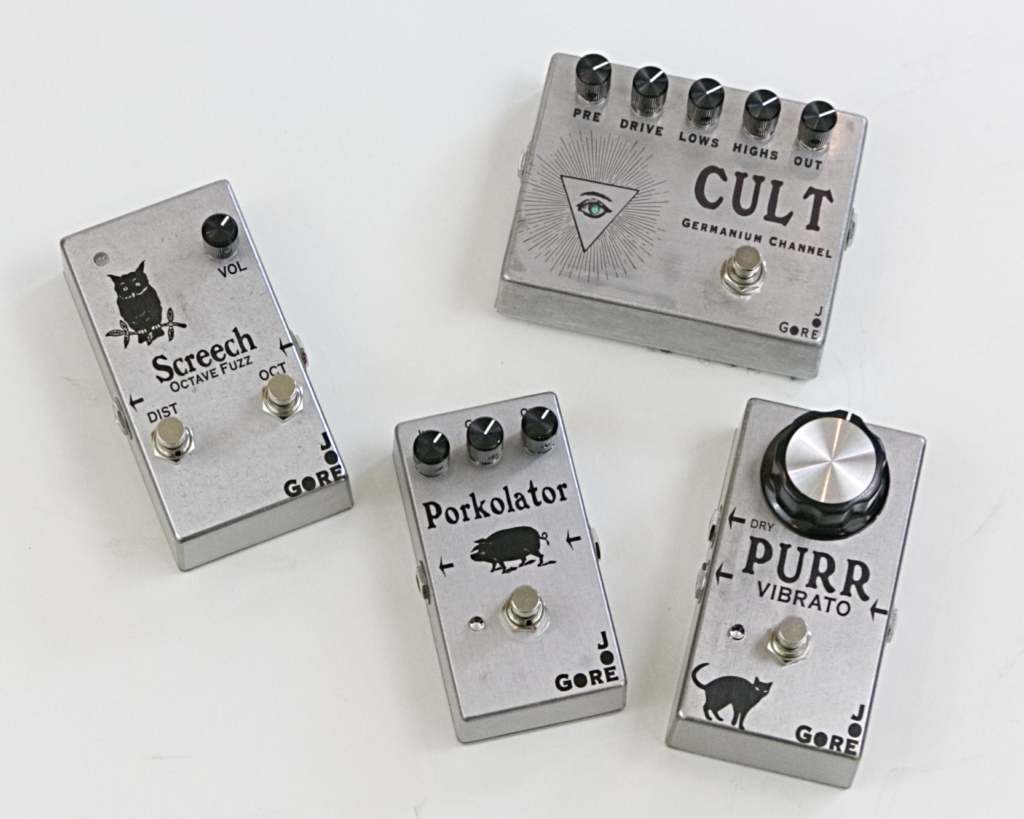
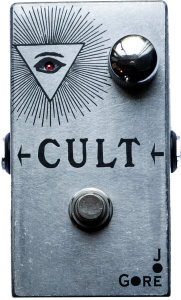
I’ve just tested the first final production model of my long-promised Cult Germanium Channel. As usual, it sounds even better than my funky hand-built prototypes. These will be available in just a couple of weeks from my distribution partners, Vintage King.
There core circuit is the same as in my Cult overdrive. I’ve added a great-sounding active EQ, tuned to just the right frequencies, plus a new input stage with variable capacitance (translation: a sort of “crisp vs. fat” control). There’s much more info on the Joe Gore Pedals product page.
My apologies that this release has taken so long! I hope some players find it worth the wait.
Happy new year, all. Sorry I’ve been so scarce — mostly, I’ve been practicing guitar! I’m trying out lots of challenging new things (for me, anyway) and I’ll share some of them as videos very soon. I’ve also been finalizing the four new Joe Gore pedals I’m debuting at NAMM 2018. Lookit!
They’ve already gone into the production, and they’ll be available via Vintage King very soon. I have yet to make demo videos and detailed spec sheets, and we still haven’t finalized the prices. (It depends how much the damn germanium transistors in Cult Germanium Channel and Porkolator wind up costing.)
In the meantime, here’s the info sheet I’m distributing at NAMM. Also, Premier Guitar is scheduled to record a demo video at the show and post it on their site. (I’ll share the details when that happens.) I hope I sound less like a squirrel on meth than I did for last year’s show-floor video.
If you’re attending the show in Anaheim, please visit me at booth #15517. (It’s a huge booth run by my distributors, M1. I’ll be crammed behind a tabletop somewhere within.) I’d love to say hi.
You know what sucks about attending NAMM as a manufacturer rather than a gear writer? I was epoxied to my booth all day, and I barely saw anything other than my guitar pedals. But on one rare break, I got to hang out with Jannis Anastasakis and his crew from JAM Pedals of Athens, Greece. (I highlighted some of their beautiful work in my pathetically skimpy “NAMM report.”)
Happily, there’s more to celebrate here than great visuals. JAM builds lovely versions of many classic analog effects. Their sounds and production quality are stellar, and JAM often adds modern updates such as realtime expression control, extra knobs, and internal trim pots for customizing tones. It’s quality stuff, used by many a guitar star.
And guess what? Jannis loaned me one of his magnificent Custom Shop analog pedalboards. Γαμώτο!
Sadly, I must now pack up and return this pretty pedalboard. But I’ll be getting my own JAM Delay Llama Supreme, an expanded version of the analog delay heard here, with tap tempo, a cool modulation section, and the almighty infinite-hold switch. (I reviewed it for Premier Guitar a few months ago.)
In the meantime, this experience makes me want to try my own DIY pedalboards. Not as an item for sale — just as a way to group related effects in a single enclosure for stage use. Gears are spinning ….
Oh man — my friends at Premier Guitar just posted a video of me demoing four of my new pedal prototypes at NAMM. I didn’t even think I’d have these ready by showtime, but I powered out at the last minute. (Maybe ’cause I needed something to take my mind of the inauguration.)
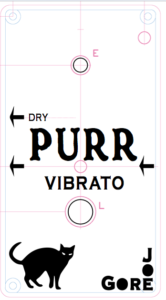
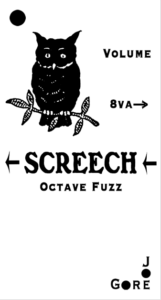
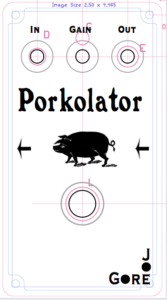
It’s been a busy month since we filmed this. We’ve settled on names, graphics, and specs, and everything is in development. (Though they’re still a few months away from shipping.) I’ve included the first-draft enclosure graphics as well.
Purr is a minimal one-knob optical vibrato. Yep — one knob, which means no independent rate and depth controls. Sound crazy? I agree. But it just sort of works! (I explain my questionable reasoning in the video.)
It’s not a deep, wobbly pitch-shift effect — more like cross between a really warm, pretty tremolo and a subtle optical vibrato. It’ll have the same large knob as my Duh pedal, so you can make adjustments with your foot, assuming you’re not as clumsy as I am.
It’s my fave modulation circuit, one I’ve used on a number of my YouTube videos. Here it’s on throughout at a very subtle setting.
In this video it’s set more strongly, though I toggle it on and off as I loop additional layers.
Screech, a mutant spinoff of the Octavia and Green Ringer octave fuzzes, is an outgrowth of the experiments I did did a few years ago, when I built models of every major octave fuzz design, and then attempted a variation of my own. (It’s not too far removed from the final pedal in this video, which appears at the 10-minute mark.)
It’s got the most extreme octave effect I’ve ever heard from an analog octave fuzz, and unlike on an Octavia or Green Ringer, the effect works in all neck positions and at all pickup settings. You can also bypass the octave portion of the circuit for a straight distortion sound. (That’s not a new idea—it’s a popular Octavia mod. But that non-octave Octavia sound is dull as dirt, whereas this, I think, has a bit more character and impact.)
Porkolator also springs from a video demo/experiment of a few years back. It’s my oddball spin on the Interfax Harmonic Percolator, which is already pretty odd to begin with. It uses the same weird combination of negative- and positive-ground transistors for that sort of gravelly, decidedly non-tube-like distortion that Steve Albini loves so much. But all the part values differ, and the gain stages work very differently. There’s also an independent boost stage that can generate tons of extra level if desired. Again, it’s not that far removed from the final example in my octave fuzz video. (It appears starting at 5:55.)
Unlike the other three pedals, Cult Germanium Channel is pretty much finished. (We were originally going to include it among the 2016 releases, but decided that three new products were enough.) Its heart is the same primitive germanium overdrive circuit as in my Cult pedal, but with lots of added doodads: a tone-shaping pre-gain control, great-sounding active 2-band tone control, and an output trim. You can read more about Cult Germanium Channel here.
The NAMM video also features a demo of Kitty Boy, my imaginary vision of a germanium fuzz that should have existed in the 1960s. It’s sort of a cross between a Maestro Fuzz Tone and a Tone Bender Mk. I, which can go from lightly overdriven “Satisfaction” tones to hyper-saturated Ziggy Stardust glory. (It’s inspired by a conversation with Lyle Workman, so thanks, Lyle!)
I hope folks dig these. I’ll keep you posted about release dates and final prices.
Thanks, Jason Shadrick and Perry Bean, for doing such a nice job with the video and squeezing me into a brutal production schedule at the last minute.
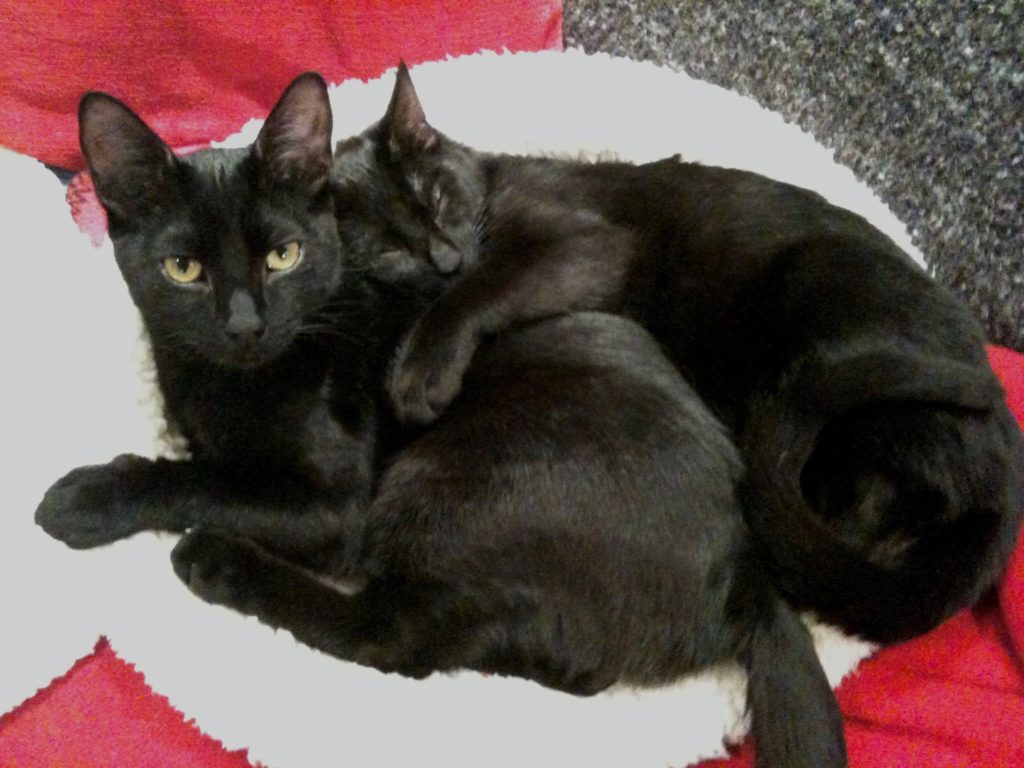
Jet and Kaiju say: “When Joe plugs in those horrible fuzz pedals, we hide in the closet. But that new Purr pedal with the black cat on it isn’t so bad.”
Here’s an overview video that my pals at Premier Guitar shot at the NAMM show last January.
As always, I’m grateful to the friends who helped make this happen, especially Miko Mader from M1, my distributor, and Tony Lott, who oversaw production at the Cusack Music facility in Michigan. In addition to displaying superhuman patience during the long development period, Miko and Tony made many suggestions that improved my original designs. Thanks also to my pal Tom Menrath, who introduced me to Miko and Tony. (Tom used to work at Vintage King, but now he’s with pro audio champs Cutting Edge Audio and Video.)
I’ve posted demo videos for each pedal here before. But I’m reposting them after the jump in case you need a memory refresher. (I certainly do!) And I couldn’t resist including a couple of brag-worthy quotes from some of my early adopters. Thank you all!
Of the four pedals new I announced at NAMM, Cult is probably closest to my heart— it’s my favorite overdrive circuit. If you’ve watched many of my videos, you’ve heard it. I even built it into a few guitars, including this one, this one, this one, and this one. And now Cult is coming in pedal form.
It’s no secret that 90% of today’s overdrive circuits are derived from the Ibanez Tube Screamer. Screamers are great if you want to compress your signal for consistent and predicable results. But Cult provides the opposite effect, expanding your guitar’s dynamic range rather than compressing it. It’s great for players who vary their touch and guitar-knob settings for maximum tonal variation.
Cult is sort of the mutant grandchild of the single-transistor boosters of the 1960s, including the Dallas Rangemaster. It’s no Rangemaster clone, though — the parts, values, controls, and tones have little to do with that classic treble booster. But Cult has the crackling presence and extreme dynamic response you only get from such minimal germanium-transistor circuits. (Guitar Player magazine went so far as to call it “the most dynamic overdrive we’ve heard.”) The pedal heard in this video is a final factory prototype, and the units now in production look and sound identical.
Have a listen:
As the video demonstrates, Cult lets you veer from crispy-clean to spatter distortion just by adjusting your guitar’s volume control. But my favorite way to use it is to set the gain so that you can go from sparkle to splat just by altering your touch, as heard in this video:
Cult with be available from Vintage King in the next month or two. There’s more info on the Joe Gore Pedals product page.
Okay, it’s not the ultimate lipstick-tube guitar for everybody, but it probably is for me. It’s my third lipstick-tube pickup experiment — and definitely my favorite.
You may have heard some of these parts before: I used the neck for all my Mongrel Strat projects, and the Strat-sized Seymour Duncan pickups appeared in my previous lipstick-tube experiments. (I love Duncan’s lipstick-tubes. To my ear, they sound way better than the ones in new-school Danelectros.) The new body is Warmoth’s Hybrid Tele model, in purple with butterfly stickers. It’s très macho. (Better not use if for gigs in Indiana and Arkansas.)
My previous lipstick tube experiments used a MIM Strat body, but I wanted something a little more distinctive, and with a built-in battery compartment (because nothing is a bigger pain than changing batteries in a traditional Strat control cavity). Also, I like how the design evokes both Strat and Tele, since the guitar has three-Strat sized pickups and a whammy, but is wired more like a Tele.
About that wiring: The 3-way pickup selector chooses neck, bridge or both pickups, like on a Tele. Meanwhile, a SPDT switch toggles the middle pickup on and off regardless of the pickup selector, so you get six settings: neck, bridge, neck + bridge, neck + middle, bridge + middle, and all at once. It’s a pragmatic variation on “Nashville Tele” wiring with a switch rather than a pot. That means you can’t dial in varying amounts of middle pickup—it’s all or nothing. But on the plus side, I can jump instantly to an out-of-phase sound from any pickup-selector setting, and it freed up space for the other weird crap I put in this guitar. (Yo, electrical engineers: Don’t bother telling me that combined-pickup settings aren’t really out-of-phase True, they’re not out-of-phase electronically, but they are acoustically, and the distinctive “hollow” sound of combined settings is precisely the result of phase cancellation from two pickups at different positions.)
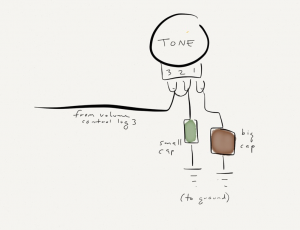
The weirdest detail is what I call a “cap-fade” tone control. It’s an idea I speculated about back in January, and to which many of you contributed cool perspectives. I pretty much followed the scheme in the original diagram:
The idea again: Instead of sending varying amounts of signal to ground via a tone cap, the pot here fades between a small-value cap (which defines the minimum cut when the control is engaged) and a larger one (defining the frequency of the maximum cut). In other words, instead of sending varying amounts of signal to ground, this circuit always sends everything above the cutoff frequency to ground, with the pot determining the frequency. (more…)
Awesome! I just received production prototypes for my next three stompbox releases, in the wake of last month’s launch of my Duh Remedial Fuzz. I’m still making minor tweaks, but these should be available in just a few weeks. Whee!
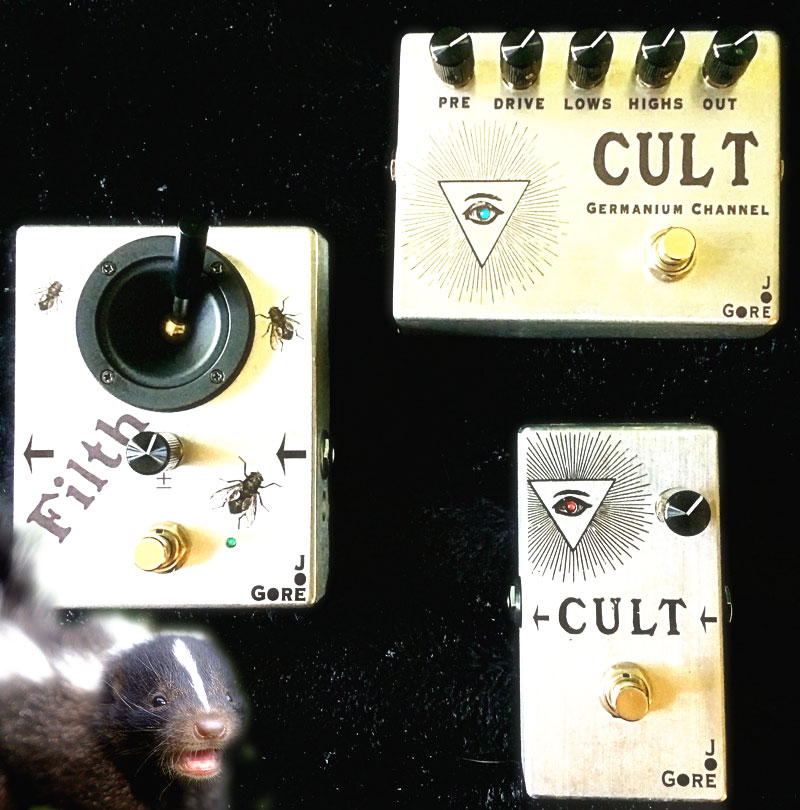
Filth is a freaky joystick fuzz. Cult is my oddball take on Rangemaster-style single-transistor overdrive. It’s my absolute favorite distortion device, and the same one heard in many of my videos and gear reviews. The Cult Germanium Channel supplements this simple but deadly circuit with extra controls and an active EQ stage. (Baby skunk sold separately.)
Filth. I love whack-job fuzz boxes like the Z. Vex Fuzz Factory and the countless “sick fuzz” pedals it’s inspired over the last two decades. But here my goal was to create one with a higher percentage of “likely to use” settings — I wanted to make it easier to find the good stuff. Topologically, the circuit’s nothing tricky — basically a Fuzz Face descendent coupled with an extra JFET boost stage (though it doesn’t sound remotely like any Fuzz Face you’ve ever heard). The main innovation is the x/y control, which jiggers the transistor biasing, producing a broad array of timbres. It’s not a conventional tone control, though it’s arranged so that it’s easy to summon smooth, chubby tones or angry, brittle ones.
There was a lot of interest in this a couple of years ago when Fuzz Box Girl posted a demo (apparently no longer online) of one of my handmade ones. She focused on the pedal’s maximum-gain, My Bloody Valentine side, which was fine — Filth can definitely make your amp melt like a Salvador Dali timepiece. But now it’s easier to dial in crisp, lower-gain tones.
I’m making two Filth versions: the joystick model [pictured], and one with three conventional knobs. They sound identical — only the interfaces differ. The three-knob is good if you want to mark an exact setting for use onstage, while the joystick is more fun when concocting new sounds. (I don’t know the exact pricing yet, but the joystick model will cost more, because that’s an expensive part!)
I’m far from the first builder to create a joystick stompbox, but you usually encounter them on crazy noisemaker effects, or deployed as conventional EQ controls. I’m not aware of another pedal where it regulates the fuzz’s fundamental timbre this way. But then, I don’t get out as much as I should.
Cult. If you’ve seen my videos or heard my audio demos, you’ve probably heard Cult. I’ve built it into several guitars (while others have a built-in Duh fuzz). It’s a one-germanium-transisor boost descended from the Dallas Rangemaster of the 1960s, though the apple has rolled far from the tree: All part values differ, the EQ profile is modernized, and the gain control works in an unconventional way. But like a Rangemaster, it boasts spectacular dynamic response and electrifying tones that crackle with presence.
To my (admittedly odd) ear, no other distortion sounds as bitchin’ as a single-transistor boost between a good guitar and a great amp. The weird thing is, while most players know the countless ’60s rock tracks produced with such primitive boosters, many have never tried this sort of circuit. I love faithful Rangemaster clones, and I love many of the variations I’ve explored over the last five years. But Cult is my very favorite recipe.
Cult Germanium Channel. This one pairs the Cult circuit with relatively modern active EQ/boost stage, with proper tone controls that don’t suck tone. The added circuitry sacrifices a touch of Cult’s explosive presence, but it provides a greater range of tones. There’s also more gain on tap, so it’s better for those high-testosterone rawk tones that I’m far too much of an prissy, effete San Franciscan to use myself.
Thanks a Lott. As mentioned, these are manufactured by Cusack Music in Michigan, under the expert eye of engineer Tony Lott. Cusack builds pedals for numerous boutique brands you know, many of whom prefer to keep the fact a secret. But I’m proud of the relationship, because Tony and his team improve everything I submit. (More about the collaborative process below. It’s fascinating stuff, assuming you’re a geek — which I do assume, since you’re here.) (more…)
I just bought 500 germanium transistors. (Yes, as a matter of fact, I am insane. Why do you ask?)
UPDATE: My Dunlop Fuzz Face Mini review is live at Premier Guitar. Audio clips included!
How and when did it get so frickin’ easy to procure great-sounding germanium transistors?
I’ve been building stompboxes for four years or so. I used to consume article after article detailing the sheer horror of dealing with germanium. Sure, those old-school transistors sound great, I’d read, and they’re necessary for vintage distortion circuits. But they’re unstable. They’re expensive. They’re hard to find. You have to sort through dozens to find the few good ones. And once you do, you must spend countless hours matching and biasing them for optimal sound.
I believed everything I read — until I finally admitted to myself that I seldom encountered any of those problems.
(If you don’t know much about germanium transistors and why they’re cool, here’s my manifesto.)
I used to buy germanium transistors from Small Bear and other parts sites, and was always happy with the results, even though I had to pay eight or ten bucks per transistor. (Small Bear even does the matching for you, offering sets of transistors suitable for various vintage fuzz circuits.) However, it was a little tough finding NPN (negative-ground) germanium transistors. In fact, Small Bear once rejected my order of a dozen or so NPNs because they were so scarce. (To his credit, Small Bear’s Steve Daniels explained that he restricted sales so that everyone who wanted to build a couple of great DIY fuzzes would have the opportunity.)
The workaround is to build pesky positive-ground pedals, or jigger with the schematic in order to use PNP (positive-ground) transistors in negative-ground circuits. (This site’s Fiendmaster project is an example of the latter workaround.)