Categories
DIY

Double Varitone: A Two-Headed Tone Control

I was kind of stoked about my latest wiring experiment: a “double Varitone” scheme I installed in my DIY “Kitschcaster.” I’ve written about these multi-capacitor tone switches a lot on this site, but this is the first time I’ve tried using a similar scheme to cut bass frequencies. The result is a lot like the G&Ls “PTB” circuit (covered here and at Premier Guitar), but with adjustable treble-cut and adjustable bass-cut.

The reason I say I was kind of stoked is, just as I was preparing this post, some fascinating marketing materials appeared in my comments queue. A manufacturer uploaded a barrage of marketing copy about his product, a prefab pickup-switching system. I visited the product site, and learned the most amazing thing: Unlike most of the stuff I write about here, his product can actually get you laid! No way can the double Varitone do that! Here’s how the product works:

Categories
DIY Pickups

A Cool Wiring Diagram Worksheet

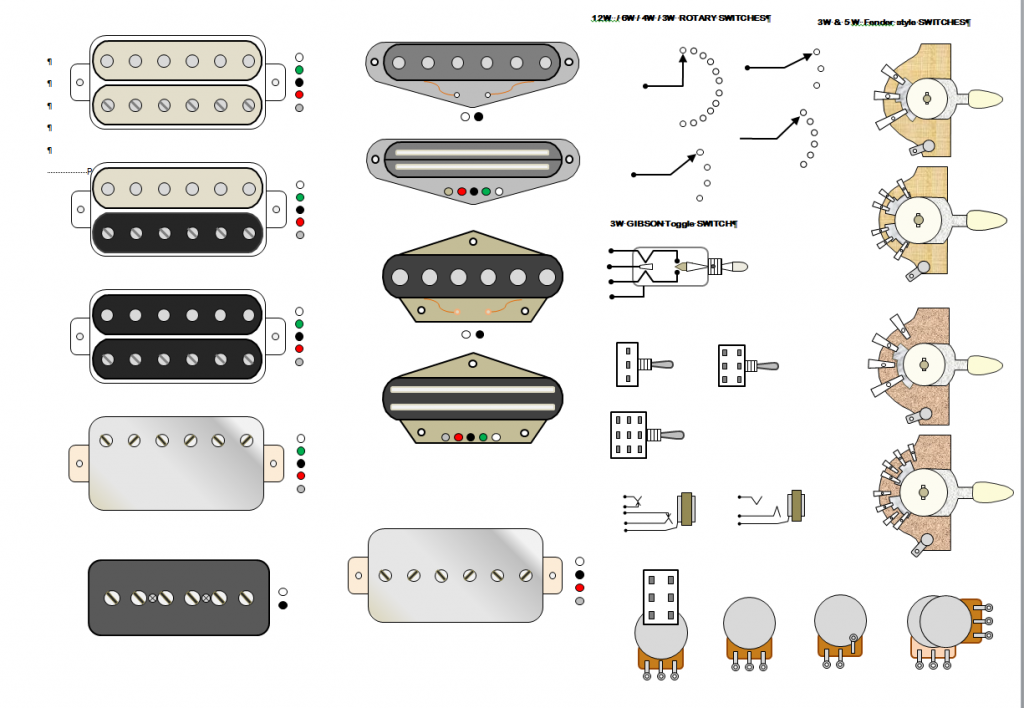
Check it out! Reader Mike Taylor tried to share this cool wiring diagram worksheet in the forum, but sadly, my meager WordPress forum plug-in doesn’t support uploads. It’s so handy and nicely done that I present it here. (Right-click to download.)

wiring sheet image

It’s an MS Word file, with the graphic elements for pickup wiring diagrams embedded as selectable objects. Mike has included all the most popular components, plus some not-so-popular ones of the sort we like to obsess on here. I’m totally going to use this to create future wiring diagrams for the site and elsewhere.

Some notes from Mike:

It can be used to start laying out wiring diagrams by drawing interconnections in Word, or I guess you could just position the building blocks on a page, print it out, and hand draw the connections. The little dots next to the representations of pickups can be changed to match the colour codes of your pickups. All objects are just simple shapes grouped together and set so they preserve their aspect ratios. Hopefully, shrinking and enlarging shouldn’t be too problematic. Anyone can change or add to it, as it’s unprotected. If anyone finds it useful, I hope they do their own thing with it.

Thanks, Mike! :beer:

Anyone else got cool resources like this to share? Don’t be shy — stand and deliver!

Categories
DIY guitar

My Top Three Wiring Mods

Premier Guitar just posted my new article on three favorite electric guitar wiring mods. The concepts won’t be new to anyone who hangs out here — I’ve pretty much flogged them all to death! But the new article includes the step-by-step walkthroughs that I never got around to creating for this site, and PG art director Meghan Molumby created beautifully clear tech diagrams like this one:
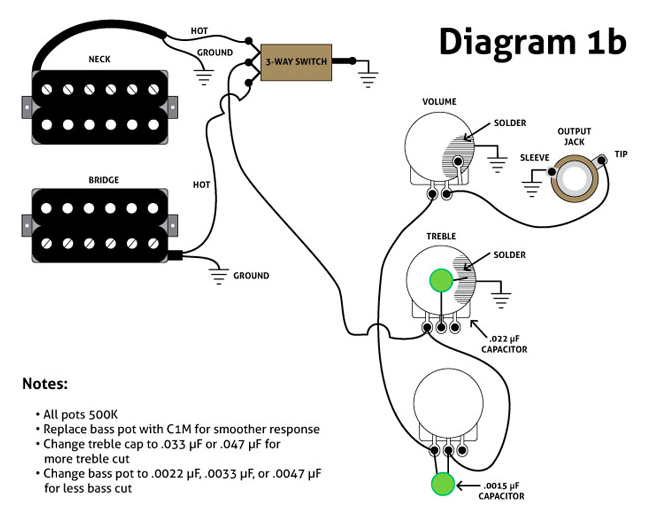
 

Screen Shot 2014-07-23 at 9.54.35 AM

The descriptions and instructions in the new story are clearer and more detailed than my original posts here, plus I’ve refined some details, so I suggest working from the new PG versions.

My three choices:

Yup, the ol’ PTB tone control, the coolest mod I know, at least for players who love distortion. The new version of the project uses the 500K pots you probably already have in your guitar rather than the more eccentric G&L values.

I also revisited the Strat version of the “Nashville-style” Tele wiring popularized by Brent Mason and other Music City cats. It performs brilliantly in a Strat, and IMHO its benefits (vastly more blended-pickup options plus a musical and intuitive control layout) for outweigh the costs (loss of the middle-pickup-alone setting, cost of a 3-way switch). Not to launch a protracted Strat-vs.-Tele battle, but I love the whole notion of “Tele-fying” a Strat via wiring, control layout, and pickup choice.

In the article’s comments thread, several savvy readers also mention Strat wiring systems that provide the sounds of the Nashville mod without sacrificing any others. They’re right — but the more I mess with this stuff, the more I value simplified operation. I’m less concerned with having all options than with having the coolest ones, ergonomically organized. Still, there are many ways you can go here.

Finally, I’m once more beating the dead Varitone horse exploring variations on Gibson’s Varitone concept, updated for modern players. I added a new twist in the PG story: deploying these ideas via toggle switches, rather than a big, clunky rotary switch.

It was fun when PG editor Shawn Hammond asked me to choose my favorite mods. It was easy to decide though — these are the three I keep coming back to, and all three deliver dramatic results, unlike many better-known mods.

So which electric guitar mods would be on your short list? Wiring, hardware, whatever. How do you make your guitars cooler?
Categories
DIY Effects guitar

The Lipstick Lab
New Experiments with Old Pickups

Do you ever get an idea that you just know is going to work out brilliantly? And then discover you were totally wrong?

That’s how it was when I finally reassembled my generic Mexican Strat with Duncan lipstick tube pickups. After I recorded a demoing of it here almost two years ago, the guitar lay in pieces alongside my workbench. I’d stare at decapitated body, feeling guilty and dreaming of all the fantastic mods I’d attempt when I finally got around to reanimating it. I had various ideas for the tone control: Maybe a two-band PTB control? Nope—totally underwhelming results. Perhaps a two-in-one TBX? Meh—even less interesting. I drew a blank, and the guitar wound up with a disappointingly normal tone circuit.

But I did discover some cool twists along the way. Details after the video:

My flatwound string addiction is only getting worse, but this is the first time I’ve combined flats and lipstick tubes. (Has anyone done that since the ’50s?) The results were fascinating. As happens when you put flats on an electric 12-string, you encounter a paradoxical increase in highs, despite the darker-toned bass strings. (Maybe it’s because the treble strings ring truer with less phase-canceling interference from roundwound bass strings.) As you can hear, this instrument doesn’t lack for zing.

The opposite, actually — treble notes explode from the instrument, often more than you’d like. I experimented with various action and pickup height adjustments, but no matter how I set things, it was difficult preventing certain notes from shrieking. The only solution was to play the damn guitar for a few hours and grow accustomed to the touch.

Categories
DIY guitar

What’s Your Favorite Mod? (Here’s Mine.)

How am me make guitar thing better?

What’s your favorite guitar mod? The kind that changes how you play. One you’ve become so accustomed to that you wince when you pick up an axe that lacks it?

I’ll choose pickup wiring mods as a starting point: During the year that Seymour Duncan sponsored tonefiend.com, I devoted many posts to the under-appreciated wiring schemes I found in the company’s wiring diagram database. Some faves:

…and of course, the suicidal soldering mission known as the Pagey Project.

I’ve still got the “advanced” version of the Pagey wiring in my nothing-special beater Les Paul, and I like it so much, I want to fix up the guitar so it feels as nice as it sounds.

But of all the wiring experiments I tried, my absolute favorite is one that doesn’t appear in the Duncan archives: the so-called “PTB” tone control (for “passive treble and bass”). It’s a cliché to call a neglected idea “ahead of its time,” but in this case, it happens to be true. Being able to roll off lows as well as highs is unbelievably useful when sculpting sounds. It makes me want to run into the nearest Bain Capital Guitar Center, grab players by the collar, and shout, “You need to know about this!” (But I probably won’t, ’cause G.C. customers aren’t accustomed to receiving that sort of personal attention, and I wouldn’t want to freak them out.)

Allow me to repost last year’s video, demonstrating the circuit in action:

Over a year later, I remain totally addicted to this circuit, and I recommend it to anyone who doesn’t require a guitar with independent volume controls per pickup. (Everyone, basically.) It seems especially relevant for drop-tuned and 7-string metal players who realize you must sometimes cut a little bass to keep the lowest register tight and articulate. And the circuit is a godsend when used with bass-heavy fuzz pedals (such as vintage-style Fuzz Faces). In fact, I’ve even been building the circuit into the front end of certain loud fuzz pedals for use with guitars lacking this magnificent mod.

But I remembered something interesting this week when I opened up the Hamer 20th Anniversary guitar used in the video:

Categories
Bass DIY guitar Pickups

Cool Prewired Guitar Electronics

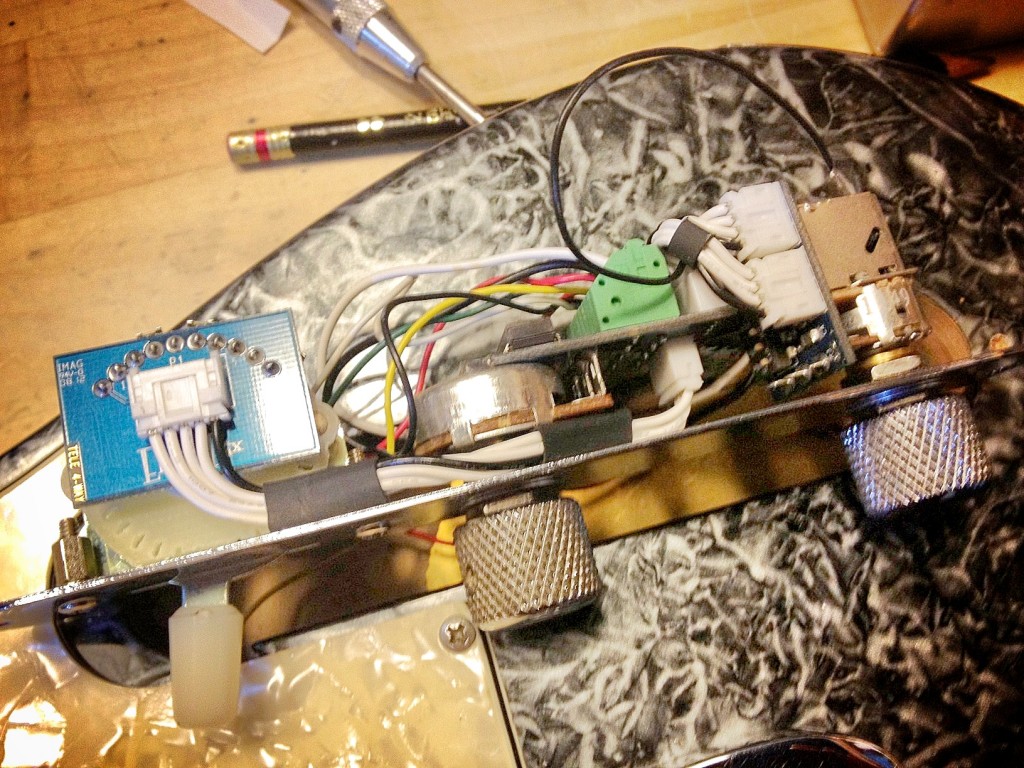
Prewired replacement electronics provide access to many popular wiring mods, minus the soldering.

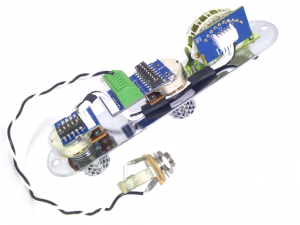
Larry Santellan of Santellan Sounds, maker of the Elec-Trix tone modules, sent me some samples to check out. These pre-wired circuits offer quick access to some of the “greatest hits” of alternate wiring, with an emphasis on Strats and Teles. He has pop-in modules for 5-way Teles, Vari-Tones, passive overdrives, vintage/modern switching, and more.

I haven’t had the time to try everything Larry sent, but for a few months I’ve had his 4-Way Fat Tone Monster Deluxe Wiring Kit in my Tele-like G&L ASAT. It lets me dial in the three standard sounds, plus that humongous series-pickups BLAT! A push/pull pot bypasses the tone control. (I never hear meaningful differences between bypassed tone controls and wide-open ones, but this setup lets me toggle between a bright, wide-open tone a muted one.)

Installation was relatively easy, and the parts and workmanship are top-notch. If you’re interested in alternate pickup wiring options, but don’t have the skill, patience, or time to solder it yourself, well, check out the Elec-Trix catalog.

Solder-free configuration via clever ribbon connectors.
Categories
DIY Effects Gigs Recording

A Tale of Two Pedalboards

Is it just me, or do many guitarists these days find themselves alternating between separate analog and digital setups?

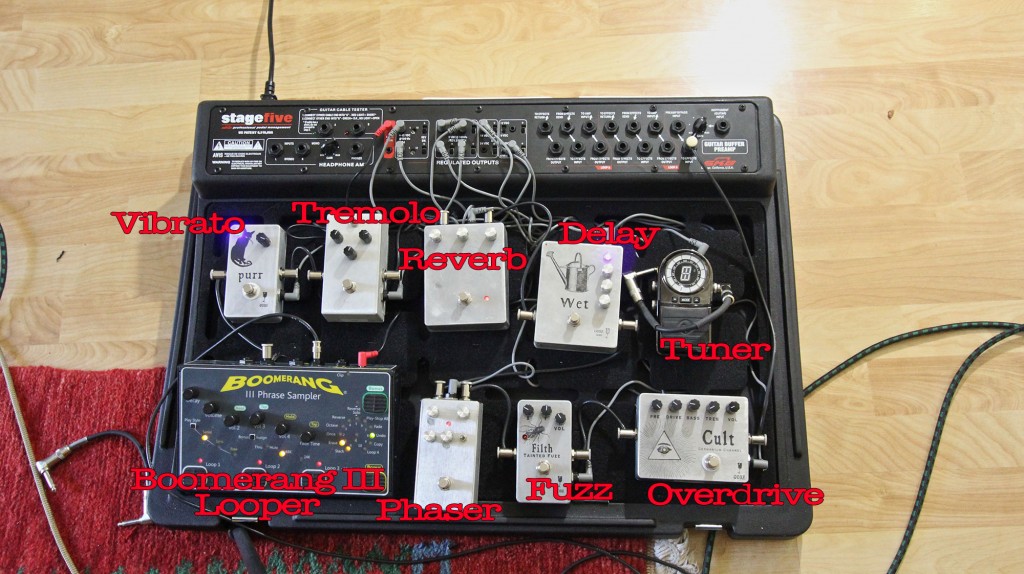
I’m posting some pics of my current pedalboards (bearing in mind that, for reasons I’ll get into in a sec, my pedalboards only tend to stay “current” for a few days at a time). Both were assembled using store-bought housings, though I’ll talk a bit about total DIY boards as well.

First, the mostly analog setup (the exception, of course, is the digital Boomerang III looper).

Joe Gore’s mostly analog pedalboard.

The case is a newly purchased SKB Stage Five, a full-featured unit in a relatively rugged molded plastic case. These retail for a whopping $540, but you can find them heavily discounted. (I forget the exact price I paid for mine, but it was under $300.) It’s loaded with cool features, like dual effect loops, a built-in buffered preamp, and support for 9- through 24-volt DC power, plus 9V AC for those digital pedals like Line 6 modelers and many loopers. There are even trim pots on a few power jacks to simulate dying batteries. I’m less impressed by some of the fittings (like the cheapo plastic jacks), though I suppose they keep the weight down. And make no mistake: This thing is heavy!

Verdict: Too early to tell, since I haven’t subjected it to road abuse, but I trust it enough to at least give it a go. I think I’d be a bit disappointed had I paid full pop, but it strikes me as a fair deal if you can find it at a 40+% discount. 

Categories
Bass DIY Effects guitar

How to Install Onboard Effects

UPDATE: I’ve added a page listing all the “How To” posts on this site. Just click the cleverly titled How-To Posts Are Here! box at upper-right of each page.

There’s got to be a better way!

Several readers asked for more specific tech advice on how to wire up battery-powered effects inside a guitar or bass, so I created a step-by-step tutorial, which you can download here.

Some historical background: Since the ’60s, many guitar companies have toyed with the notion of installing battery-operated effects inside guitars.

And “toyed” is probably the perfect verb for it. Onboard effects have earned a reputation as cheesy, low-budget products. In many cases this reputation is justified. (And sometimes it’s not — the Electra guitars of the ’80s were never particularly popular, but their simple onboard distortion circuit has generated hundreds of “boutique” clones, not to mention our own Bad-Ass Distortion project).

And why would you want to put an effect inside a guitar or bass? You can use a stompbox with any electric instrument, but an onboard effect is married to one axe till solder-do-they-part.

I have an ironclad rebuttal to such concerns: 

Categories
DIY guitar Pickups

“Vintage” Les Paul Wiring: BS or BFD?

Which sounds better: modern or vintage wiring? The experts disagree!

There’s a wealth of information online about the relative merits of “vintage” vs. “modern” wiring in Les Pauls. And after reading page after page on the topic, I was more confused than when I started. So here’s an attempt to pinpoint the sonic differences in a meaningful and relatively “scientific” fashion.

For those new to the debate, here are the basics: Nowadays tone pots in electric guitars usually connect to lug 3 of the volume pot, the same junction as the input from the pickup or pickup selector. Wired this way, the tone control siphons off highs before the volume control siphons off level. But in ’50s Les Pauls, the tone control often connects to lug 2, so treble is nixed after the volume pot does its thing. (I say “often,” because, as in so many other regards, vintage Gibson aren’t 100% consistent.) Here are some comparative schematics.

Most online sources manage to pinpoint the most basic difference: with vintage-style wiring, your tone retains more brightness as you lower the volume. But beyond that, there’s a buttload of b.s., including the frequent claim that vintage tone capacitors sound better or different from new ones. (They don’t.)

Anyway, I’ve made some comparative recording and measurements. After digesting all this geeky goodness, you’ll probably know whether ’50s wiring is an attractive option for you.

Categories
DIY guitar Pickups

“Nashville” Tele Wiring . . . in a Strat?!

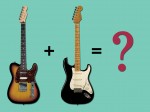
What do you get when you cross . . .

I’ve been coveting one of those “Nashville-Style” Telecasters — you know, the hot-rodded, three-pickup versions popularized by Nashville session superhero Brent Mason, and now a regular Fender production model.

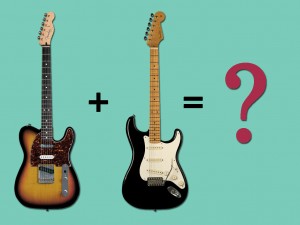
Then it dawned on me: Since some of Mongrel Strats I’ve been playing with have strong Tele tendencies, why not flip the equation? Instead of a Tele that acts like a Strat, why not a Strat that thinks it’s a Tele?

The Fender version replaces the usual Tele 3-way switch with a 5-way, as shown in this wiring diagram, though many players prefer to keep the 3-way switch and add the middle pickup via a blend knob, as in this other wiring diagram.

I took the latter approach, and I am flipping out over all the new tones it unlocks. Check out this little video demo: