Category: guitar

  • The Future of Wishful Thinking

    The Future of Wishful Thinking

    Coming soon to a star system near you!

    Last week I dared all incautious chumps you to prognosticate about our guitaristic future. I knew the resulting comments thread would be fun, but I didn’t expect it to be that fun!

    And also oddly uplifting. Future predictions just seem to skew in an optimistic direction, perhaps because you have to start by assuming that we have a future. So for every funny post suggesting that the most stupid and obnoxious aspects of today’s musical culture will get even more stupid and obnoxious, there’s a complementary positive perspective. In the future, these upbeat dreamers argue, we wil be better…stronger…faster. Of course we’ll have the technology! Better still, we’ll develop common sense.

    Granted, some of the predictions are destined to be as disappointing as a 1948 issue of Popular Mechanics, with its broken promises of personal helicopters and monkey butlers domestic robots. But would it be preferable never to have dreamt of having you own jetpack? I think not!

    Here’s a fine, optimistic example from Thecoslar, writing about “Lego” Pedals and Amps:

    Standardized wiring “harnesses” and interchangeable components will allow companies to produce amp cabinets and pedal cases that consumers will purchase, in addition to compartmentalized circuits. The consumers will “design” their own pedals and amps by mixing and matching that various parts. Combine an optical compressor and a germanium boost. An octave up and a chorus. And that’s just pedals. Imagine what could be done by mixing and matching tone stacks, reverb and delay, or pre amp circuits in amps? Built in analog effects your amp, just by plugging in the components. Everyone and anyone will be able to piece together their own custom circuit, no solder, no muss, no fuss.

    Yeah, that would be frickin’ awesome. Of course, we happen to live in a world with at least four common types of USB connectors, no standardized guitar wiring harnesses, and where millions of consumers sigh as they fork over yet more cash for the latest proprietary i-connector. But we can dream can’t we?

    Hell yeah, we can! I hope you’re enjoying the conversation as much as I am.

    (The fun’s not over, BTW — keep posting your predictions.)
  • The Effect-Order Follies

    The Effect-Order Follies

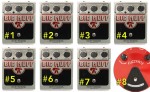
    This effect order ALWAYS works great!

    Weird, isn’t it? You can explain the rules of thumb for ordering your guitar effects in about ten seconds, but you can still get stumped after years of experimentation.

    You probably know the conventional effect-order advice, which goes something like this (in order of appearance):

    1. Distortion effects (fuzzes, distortion, overdrives)
    2. Modulation effects (phasers, flangers, vibratos, tremolos)
    3. Delay effects (digital or analog delays)
    4. Reverbs (analog or digital)

    And that’s good advice, as far is it goes. But you don’t have to dig very deep before encountering alternatives, exceptions, and arrangements that make no sense whatsoever, but still sound great.

    How, for example, do you deal with the following?

    (more…)

  • Who Dares Predict Our Fretboard Future?

    Who Dares Predict Our Fretboard Future?

    “We are all interested in the future, for that is where you and I are going to spend the rest of our lives.” — Criswell, Plan 9 from Outer Space

    UPDATE: Wow, I can’t believe all the cool stuff folks have been posting to comments. I find myself feeling quite inspired about the future of instrument — when I’m not laughing so hard I spit coffee all over my laptop. Thanks for all great ideas. Keep ’em coming! 🙂 :thumbup:

    Prophecy is for suckers. Who’s stupid enough to go on record with bold prognostications about the future of music and music-making, given the near-certainty that the words will reappear someday to bite you on the ass?

    Well, me. And, I hope, you.

    So I invite my fellow foolhardy loudmouths to join me in sharing their half-assed guesses wise and well-informed predictions about our brave new fretboard future.

    The author of the most compelling prediction wins one of my hand-built stompboxes. So does the author of the one that makes me laugh hardest.

    Post your predictions to comments. I’ll go first. 🙂

  • Analog Schmanalog

    Analog Schmanalog

    Ever notice how most analog vs. digital battles discussions boil down to two basic questions?

    1. Can digital sound as good as analog?
    2. What are the practical benefits of digital?

    They’re good questions, but they tend to overshadow another important (and probably more interesting) topic: What are the musical benefits of digital?

    Everyone loves great analog guitar sounds. But there’s lots of cool stuff that you can only do in digital. Here are a few of the ones I enjoy.

    A partial list of the strictly digital sounds and techniques heard here:

    • looping
    • granular synthesis and delay
    • pitch-shifted delays and reverbs
    • impulse-response reverbs
    • subharmonic sysnthesis
    • Realtime MIDI control

    You heard it here first!

    Hey, I’m totally guilty of fostering simplistic analog vs. digital arguments. After all, I launched this blog over a year ago with an Amps vs. Models listening contest. (The prizes have long since been claimed, but you can still take the test.) But maybe we should spend a little less time arguing about how faithfully that amp model mimics the sound of an amp from 1965, and a little more time exploring the cool and meaningful musical applications of post-analog tone production?

  • Psych-Out Special: The Kay Effector!

    Psych-Out Special: The Kay Effector!

    Lookit what Double D found….

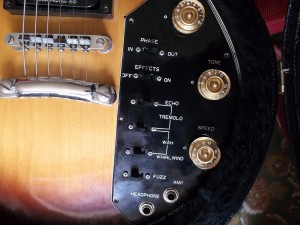
    Oh man — did you guys see what local hero Double D posted over in the Forum under Onboard Effects: Foolish, or Merely Ill-Advised?

    First, he got his hands on a Kay Effector — a psychotronic Korean axe with built-in effects. Then he got it working. Then he recorded a bitchin’ demo. It’s required reading/listening for deviant guitarists.

    Read it here:

    Part 1
    Part 2

    These posts, BTW, are just two among many cool articles at Double D’s blog (and I’m not just saying that because he wrote some nice things about me).

    Thanks, man, for sharing this unspeakably cool guitar with us. 🙂

  • The Great Epiphone Swindle

    The Great Epiphone Swindle

    You don’t have to spend $6,706 to sound like a punk. And don’t ask what the six cents are for!

    My pal Linda B. is a killer rock and roll drummer who also plays a pretty mean guitar. She’s decided to form an all-female Sex Pistols cover band, with her assuming the duties of guitarist Steve Jones.

    An avid rock historian, Linda did her research, which quickly led her to Gibson’s limited edition Steve Jones signature model Les Paul Custom, a slavishly accurate replica of Steve’s iconic axe.

    (The original, which had previously belonged to New York Doll Sylvain Sylvain, was not used on the Sex Pistols’ early singles or the Never Mind the Bollocks album, but was his main stage instrument.)

    Just one problem: the $6,706 price tag.

    So Linda bought a used white Epiphone Les Paul Custom for $299, ordered the same pickups that are in the original and the signature model (a Gibson 498T “Hot Alnico” humbucker in the bridge position, and a 496R “Hot Ceramic” humbucker at the neck), and found some sketchy online vendor who sells replicas of the original’s pinup-girl stickers, plus an even sketchier vendor who sells fake Gibson logos. We popped in the pickups, slapped on the stickers, and made a darn good replica for a bit over $500.

    Wanna hear it? (more…)

  • Small Amps for Small Spaces?

    Small Amps for Small Spaces?

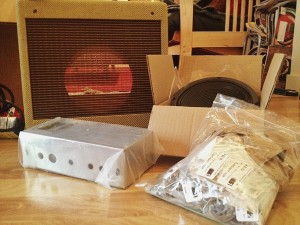
    I’ve got a Tweed Champ kit, and I’m not afraid to use it. Or at least not VERY afraid.

    Why do they make amps so damn loud?

    It’s not just a cranky question from a guitarist who’s drawing depressingly close to the “Get off my lawn!” years. I ask sincerely: Why?

    Big amps make total sense — but only if a) it’s 1969, b) you’re playing venues with Jurassic sound reinforcement, and c) you’re a guitarist in danger of being drowned out by Keith Moon or John Bonham.

    Okay, end of harangue — I’ll have time for that when I’m chasing kids off my lawn (after I move to the suburbs and GET a lawn). But as I get psyched up to build this review model of Tube Depot’s Tweed Champ kit in the coming days, I figured I’d ask what folks are using these days to get cool amp tones in their bedrooms and basements. Not dedicated practice amps, necessarily, but great-sounding stuff that happens to be ultra-low-wattage? Name your petite-amp poison!

    Anyway, I’m stoked about this kit. I’ve already completed a few amp clones from Ceriatone. They were fun to build and sounded great. But I can tell right off the bat that this Tube Depot kit has at least one major advantage over its Malaysian cousins: This one comes with a fabulous 40-page instruction manual. (Most clone vendors simply link you to a schematic.)  Having  created a few step-by-step instruction manuals myself, I can testify how much painstaking work these entail. Hats off to Tube Depot’s Rob Hull for doing it right!

    Details and build report to follow. But now, let’s talk tiny-amp tone!

  • A High-Tech Plastic Guitar — from Half a Century Ago

    A High-Tech Plastic Guitar —
    from Half a Century Ago

    Plastic guitars are not a new idea!

    In comments to a recent post on 3D-printed guitars, we were discussing the pros, cons, and general aesthetics of instruments molded from plastic. But this isn’t exactly a new idea.

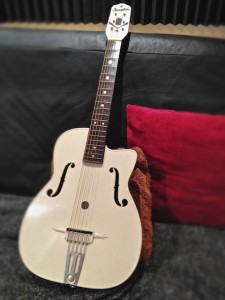
    Back in the 1950s, luthier Mario Maccaferri conceived a line of plastic guitars and ukuleles. (This was many years after Maccaferri designed the D-hole Selmer guitars that will forever be associated with the Gypsy jazz of Django Reinhardt.) These plastic guitars were never very popular, and they’re not particularly valuable today.

    I bought the one pictured here a few years ago at one of the music shops in London’s Denmark Street (I forget which one). I paid a couple of hundred bucks, and felt like a chump.

    But I’ve grown attached to this guitar. It’s lovely to look at, and it plays great. The neck is substantial yet comfy, and it intonates well throughout its range. The tone isn’t warm, complex, or rich. But the Maccaferri has a cool, lo-fi character this sits well in a mix. I also like using it to double conventional acoustic guitars — the sharp, percussive tone adds a rough, aggressive edge.

    Have a listen: (more…)

  • 3D-Printed Guitars?

    3D-Printed Guitars?

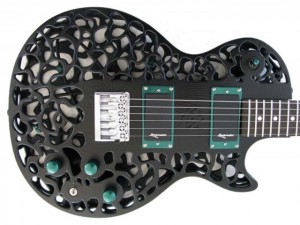
    The Atom guitar body was created on a 3D printer.

    During the Maker Faire a few months back, I wrote about the new wave of absurdly inexpensive 3D printers, and fantasized a bit about a not-too-distant time when many of us will be printing our own guitar parts at home.

    Create Digital Music — one of the music sites I visit daily — has been all over this topic recently. A few days ago, CDM kingpin Peter Kirn posted this excellent article discussing both the current limitations and eventual promise of this emerging technology. And this week Arvid Jense added this fine post focusing on six digitally printed instrument, including the eye-catching Atom guitar picture here. There are more interesting examples of luthier Olaf Diegel’s work at the Odd Guitars site.

    It’s hard to get a take on how good these instruments actually sound. Veteran electric guitar tinkerers know that you can slap strings and a pickup on just about anything, and a good player can make it sound pretty decent, and the plastic compounds used in most current 3D printing aren’t likely to be coveted for their acoustic properties. But it’s hard not to be intrigued by this smooth performance from multi-instrumentalist Dean Marks:

    So what would YOU print if you had one of these gizmos?

  • Museum of Lost Effects: Klon Centaur

    Museum of Lost Effects: Klon Centaur

    Overdrive from Heaven? Or hype from Hell?

    Has any stompbox ever been as steeped in myth and legend as the Klon Centaur? Doubt it. Original Centaurs are extremely collectible, currently fetching around $1,500 on EBay. But for every player who drools over the prospect of obtaining this rare creature, there’s another who’s foaming at the mouth about idiots who’d pay four figures for a “glorified Tube Screamer.” When you Google “Klon Centaur,” one of the first items to appear is this memorable rant from the always entertaining Zachary of Zachary Guitars:

    Here is a guitar pedal which has been around for about 10 years and stands for total Bull Shit in my opinion. The website, the presentation, the marketing, the hype, the price. Everything about it is why I hate the music business and the shockingly stupid guitar consumers. Its a mediocre and common pedal. Its your typical mild Tube Screamer- type of effect and sound. It really does not do much and is not very versatile. I found it stuffy and midrange sounding.In comparison to the great touch sensitivity, clarity, transparency and the wonderful independent Clean Boost section of the Zachary Pedal, well…there is absolutely no comparison.

    Yow.

    For a bit of perspective, how about we just listen to the thing? Here a little video demo, followed by a few observations. (more…)