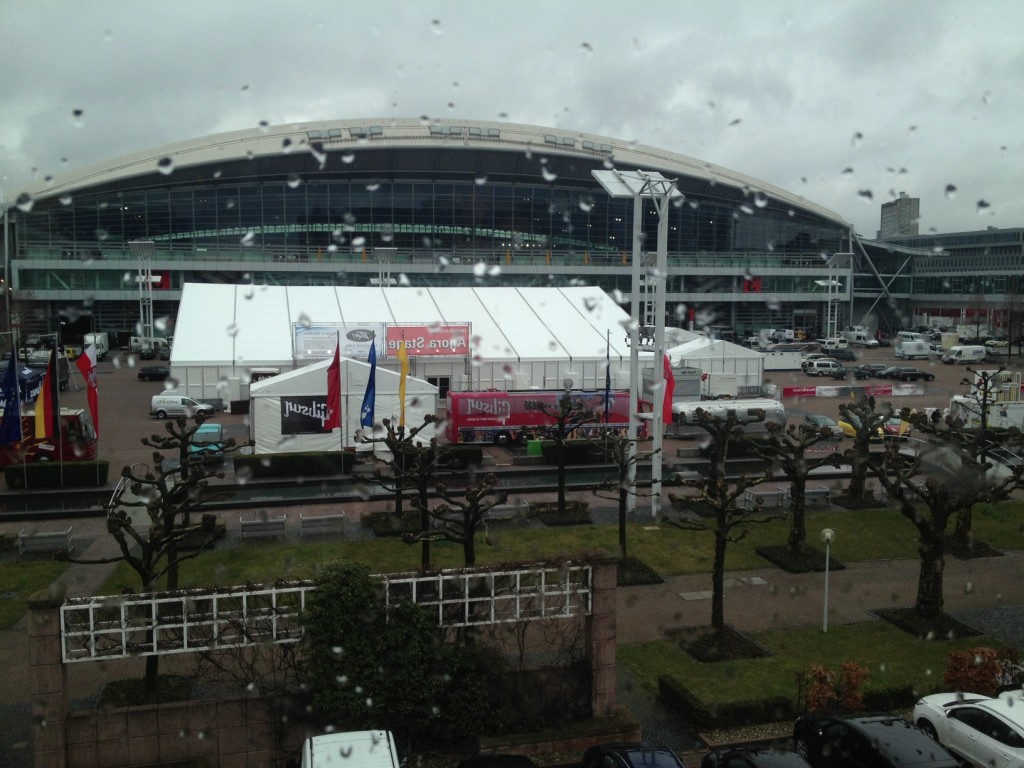
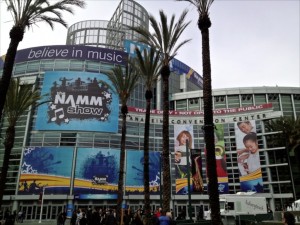
Howdy from Frankfurt, where I arrived this afternoon to attend Musikmesse. United Airlines was its usual scuzzy self, though a nice flight attendant found a place for me to stow my guitar. And my pedalboard seems to have arrived in fine shape, even though I had to checked it in its soft but reassuringly padded Mono case.
I’m here as a demo artist for Fishman’s TriplePlay, but I should have some downtime to poke around and look for cool stuff. I’ll keep you posted!
This event is gigantic — more than twice the size of NAMM. And even on a setup day like today, you can tell how loud it’s going to be, especially since they don’t enforce volume restrictions is stringently as they do in Anaheim. (I’m told it’s like Saturday afternoon at Guitar Center, squared.) And my demo area just opposite the big, loud Gibson stage. It’ll be an adventure! 🙂
Any of you guys ever been? Got any advice to share?
For the first Fishman TriplePlay demo I posted last month, I featured pretty, naturalistic acoustic sounds. This time around I went for something a little less polite.
I’ve been having a blast — albeit a humbling blast — trying to play real-time drum parts from the guitar. I still suck if it’s much more complicated than what I play here, but I can imagine learning to do it well. It’s also fun using the guitar to access the big keyboard sound libraries I’ve built over the years. Perhaps most exciting of all are the hybrid guitar/synth/sample sounds I’m starting to develop. (There aren’t any in this demo — the sounds are either samples or processed guitar, though I blur the lines with guitar-ish samples and guitars processed to sound like machinery. Next time, though, I’ll try to showcase some of those unholy hybrids.)
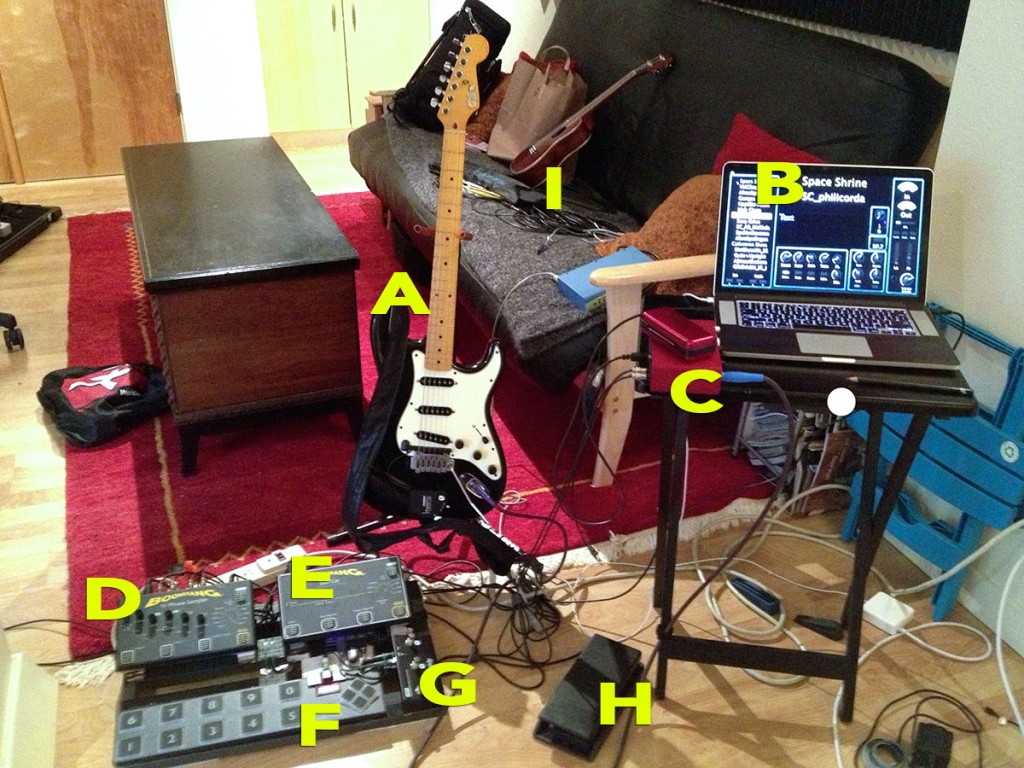
Here’s how the setup looks from my perspective. (I’m not trying to be secretive about what’s on the floor — it’s just hard to fit into the frame, even with a wide-angle lens.)
Joe’s looping/MIDI rig.
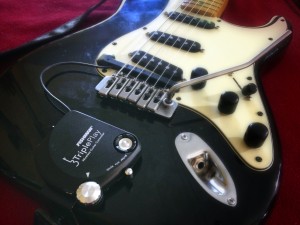
Homemade strat with Fishman controller/pickup. MIDI transmitted wirelessly.
MacBook Pro running Apple’s MainStage software. I use a ridiculous number of plug-ins and some ridiculously huge sample libraries. My main sampler is NI Kontakt.
Focusrite Scarlett interface. All the prosumer interfaces sound pretty decent to me these days, though I like the fact that this one isn’t made out of cheapo plastic.
Boomerang III looper. I love its ergonomics and smooth looping points. I screw up my loop points constantly, but I have fewer disasters with the Boomerang than with anything else I’ve tried.
Boomerang Sidecar. Basically just extra buttons for the Boomerang so you can access more features without reprogramming it or performing awkward foot moves.
Keith McMillen SoftStep MIDI controller. Powerful, rugged, feather-light, and not too expensive.
Logidy UMI3. A nice, rugged, and inexpensive USB MIDI controller — just to have a few extra switches.
Generic controller pedal. Its role varies from patch to patch. It might be a mod wheel, a pan pot, a fader, a filter cutoff control, etc.
Piles of crap. These magically materialize every time I start messing with this stuff.
Just to be clear — these sounds are from my collection, and are not included with TriplePlay. Also, I used TriplePlay in “simple mode” for this video — in other words, I’m not using the dedicated TriplePlay application, but simply using TriplePlay as a generic MIDI controller to trigger sounds loaded into MainStage.
BTW, I’m about to head out for Musik Messe in Frankfurt, Germany, where I’ll be demoing this contraption. Oddly, I’ve never been to this vast musical instruments show, which has been described as a much larger NAMM show with more sausage, beer, and accordions. I’ll be sure to tell you about any cool stuff I see!
DISCLOSURE: Fishman, Apple, and Keith McMillen are among my clients, but no one paid me to make or post this video.
Luna Lee is playing a gayageum, a Korean zither related to the Japanese koto, Vietnamesese dàn tranh, and the Chinese guzheng. She’e got other fun blues and rock covers posted on her YouTube page. Lee’s version of “Voodoo Chile” is the internet hit, but I dig her “Bold as Love” because the canned backing tracks are less intrusive, plus it’s my fave Hendrix song. 🙂
The drumstick as bridge.
Like many guitarists exposed to Asian zither players, I find myself envying the movable bridges they have on each string. By positioning the bridge relatively close to the center of the string (and not, as on guitars, near one end), they can pluck notes or generate vibrato on either side of the bridge.
Lee and Thurston from Sonic Youth achieve related effect by placing drumsticks and screwdrivers between the neck and strings of their guitars near the 12th fret. (It’s not like those guys are Asian music scholars or anything, but another similarity is their use of tunings with closer-than-standard intervals between the strings.)
But no one took the notion further than the late Hans Reichel, whose beautiful, handmade instruments used center-positioned bridges to elicit eerie sonorities and startling portamento and glissando effects. This video is a nice showcase for Reichel’s radical re-imagining of the guitar. (Reichel also demonstrates his dachsophone — literally, “hedgehog-o-phone” — which, depending on your perspective, is one of the most expressive, amusing, or just plain irritating musical contraptions ever conceived.)
Anyone ever explored similar ground? (FWIW, I took a semester of koto back in the Triassic Era college. I sucked.)
I’m lucky — I’ve never suffered from any playing-related pain. (I mean, other than expected stuff, like spurting blood all over a guitar when you bash it a little too hard, or picking up a soldering iron by the wrong end.) But I’ve been blissfully untouched by carpal tunnel syndrome, numbness, arthritis, etc.
Until recently.
A few months ago, my left thumb joint started aching. It didn’t directly affect my playing — all those clams in my videos happened on their own! But it scared the crap out of me.
My doctor suggested it might be non-degenerative arthritis.
“Arthritis?” I squawked. “But I’m only . . . oh, yeah, probably arthritis.”
Which it may well be. But it also occurred to me that I had been indulging in a new behavior for the last year or two, and wondered whether it might be contributing to the problem. See, I’m almost as addicted to my iPad as I am to flatwound strings. I’ve embraced the post-paper lifestyle, and I use the iPad for most of my reading and much of my correspondence. I keep it on my workbench while I solder, use it as a remote in the studio, watch movies while working out, and most important, use it to read comic books in the bathtub. I usually support it with my left hand, with the modest but constant 1.44 lb. weight centered right where I was hurting. I migrated to a .68 lb. iPad Mini a few months ago. Lo and behold, the pain has receded — for now, anyway.
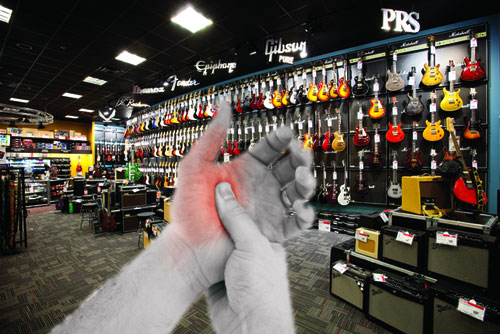
That’s got to hurt!
But it makes me realize how much I take for granted the simple act of pain-free playing. Then I think of all the players who have either been derailed by playing-related pain, or who persevere despite it. And that’s not even taking into account injury-related pain. (Hello, Django!)
So has guitar playing ever become a pain for you? (No, working with singers doesn’t count.) Were you able to overcome it by modifying your technique, or through therapy? Any words of wisdom to share?
A highlight of this year’s NAMM show was hanging out with Derek Song, a 23-year-old digital guitarist whose band, Pinn Panelle, has racked up an astonishing 12.5 million YouTube views with their realtime cover versions of electronic music hits, especially their version of Skrillex’s “Scary Monster and Nice Sprites”
Song, a Berklee College of Music grad, is DIY personified. He’s developed his own innovate guitar controllers and written custom software to milk them to the max. Those hit videos were shot on a shoestring. A Kickstarter campaign financed the Pinn Panelle’s last tour, where they brought live-band energy to DJ-driven EDM concerts and festivals. And the group has created two full albums without help from a label, including the just-released Ghosts and Liars. (However, days before the album’s release, the group’s bassist and keyboardist left the band. Now Derek and drummer Justin Conway are plotting their next moves, though Derek says Pinn Panelle will continue.)
Derek, a blisteringly smart guy with a friendly, unpretentious attitude, was kind enough to let me drag him into a relatively quiet corner of the NAMM show, shove a recorder in his face, and bark questions at him.
But first, that video again:
You’re a music-school dude.
I grew up in Glenview, Illinois, but moved Boston to go to Berklee because I knew I wanted to pursue music and new ideas. When I got there, I figured out that I would waste the least amount of money by pursuing electronic music production rather than performance. I’m not docking performance — some kids get so good at it! But I’ve always been more of a self-learner. I’m a terrible student, especially when I’m given exercises. I just want to play the ideas I have in my mind, and as long as I have the facility to do that, I don’t care about additional technique. But the Electronic Production and Design program at Berkeley had so many cool avenues for exploration, and I knew that technology was the future.
Did you always tinker with tech?
Well, one thing that influenced me as a composer and technologist was the fact that my dad used to fix TVs. Later on, when I started developing my own controllers, I’d work on them with him, and that’s really inspired me musically. When I first started playing in bands, my dad and I invested in a Boss GT-6 multi-effect pedal. I never used stompboxes because I could never afford them! But I read the Boss manual till I knew that thing like the back of my hand, and I still use that GT-6. Basically, I hacked it. I discovered some functions under the surface that open up a lot of opportunities for controlling specific effect parameters.
But I wouldn’t use them on, you know, one of my normal guitars.
But then I recorded that Bartók piece, using the above-mentioned Guid and Bass VI alongside two standard-tuned guitars with roundwounds. The piece has a lot of counterpoint — all these motifs bouncing between the instruments. And the more I listened, the more I realized that I liked the tone of the two flatwound guitars far more than that of the two roundwound guitars.
And then I bottomed out. I put flats on four more guitars. It wasn’t just musically risky — it was economically catastrophic! And that’s what brought me here tonight.
Funny thing about flatwounds: Everytime I pick up a guitar with flats, I react negatively to the dullness of the wound strings. Where’s the shimmer? Where’s the zing?
But the more I listen, the more I get sucked in. Parts layer over each other more readily. Chords speak more clearly. Fuzz and distortion yield sweeter overtones. It’s easier to get a consistent sound from melodies spanning wound and unwound strings. And the feel? Smooth, sleek and sensual.
Sigh. Maybe I’ll try and kick the habit again tomorrow.
For the last few months I’ve been working with Fishman on the documentation for TriplePlay, their long-awaited wireless MIDI guitar system, which will finally ship this quarter. I had a blast demoing TriplePlay at MacWorld a few weeks ago, and I’m looking forward to doing so again at Musikmesse in Frankfurt in April.
But at times, it’s been frustrating. I power up TriplePlay to study some feature, get all excited, and then have to turn it off and write about it instead of going off and playing it for six hours. This little demo was my first real chance to just fool around with the thing. Thoughts and details after the video.
The recent post on Auto-Tune for Guitar generated much interesting discussion, plus a few good Auto-Tune jokes. Thanks, guys! :beer:
The comments from smgear particularly impressed me, because he managed to assemble a wish list for a future digital guitar with more detail and clarity than I could have managed.
It’s always a good idea for smart, articulate musicians to sound off about the musical tools they desire. But that’s especially true now, as manufacturers grapple with technological change with varying degrees of success. People really are listening!
Anyway, smgear wrote:
Basically, the problem is that the majority of the manufacturers seem locked into old paradigms. The bulk of their new designs are intended to mimic something else (Line 6), combine/integrate technologies (Roland) or make the ‘art’ less rigorous (Antares). Those are all fine pursuits and have resulted in some great tech, but they’re basically locking everyone into a pre-1980 palette of sounds, functions, and expression. Quite honestly, after my momentary enthusiasm has passed, I just pick up one of my no-name beater acoustics or electrics and dig in because every day I find a new sound, attack, approach, or whatever that allows me to express something in a new way. It’s true that I could do that playing through those tools, but I don’t need them and they are specifically designed to conform my sound to specific realms rather than to let me explore new spaces.
So with regards to this batch of hex-based modeling tech, my general requirements are fairly simple. I want clean and discrete signals from each string (check), I want a serious multi-core processor AND a couple programmable on-board control knobs/switches (semi-check), and I want an easily accessible and intuitive interface that gives me full control over how each particular string or any group of strings is processed/routed (no check).
Has anyone checked out this video for axes equipped with Antares’s Auto-Tune for Guitar?
I haven’t tried one of these myself, though my pal Art Thompson at Guitar Player gave Peavey’s Auto-Tune-equipped AT-200 a glowing review.
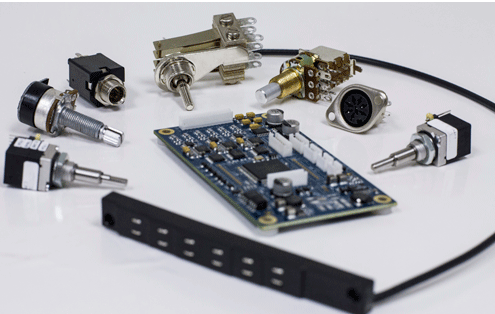
I’d heard of the product, but must admit I hadn’t given it much thought, assuming it was chiefly a pitch-correction tool. But as Antares’s videos make clear, it also does many modeling tasks, and can no doubt be used in some very creative ways. According to the Antares site, the Peavey is the only currently available guitar pre-fitted with the system, though they hint at pending partnerships with other guitar companies. They’ve also announced the upcoming release of a Luthier Custom Kit, which means a) you’ll be able to install the system in a guitar of your choice, and b) there’s a product picture that reveals much about how the system works:
Coming soon: the Auto-Tune for Guitar Luthier Custom Kit.
UPDATE:My apologies if this page failed to load properly before. After a much screaming and crying some careful troubleshooting, it seems to be working correctly now.
I put together a little slideshow of some of the interesting things I saw last week at the 2013 NAMM show in Anaheim.
I covered some of the coolest new digital gear in this post. This time, the focus is analog guitars, amps, and effects. Plus: an ultra-rare sighting of a true California celebrity!