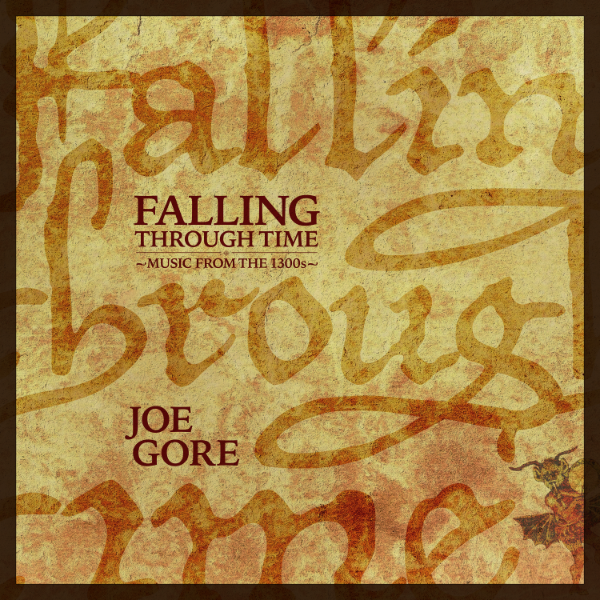
I’ve worked on many projects by many artists, but this is my first release under my own name. And it only took me 50 years!
It’s a back-to-the-roots project for me, though I have some fairly strange roots. When I was a teen I wanted to go into academia, specializing in early music (that is, European classical music from before 1650). Fate choose a different path for me, but I’ve always been fascinated by ancient music, especially the bizarre stuff that emerged toward the end of the Middle Ages. So this is a collection of music composed during the 1300s.
I followed a simple but strict “rule book”: I played only the notes and rhythms the composers specified, but I allowed myself total freedom in applying modern instrumentation and production. (As opposed to when I was young, when my goal, like that of most early music practitioners, was to perform the music as authentically as possible.) The resulting album is surreal, psychedelic, and, for better or worse, unlike anything I’ve ever heard.
This is a digital-only release for now, though I’ll do a vinyl pressing if there’s enough interest.
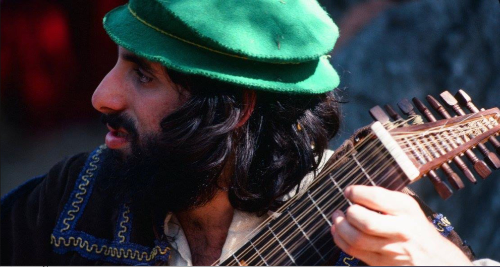
Me at age 17, playing my 15-string lute at — where else? — a Renaissance Faire. Yes, I was a dork even by 1970s standards.
I could say a lot more about the project, but I already did: I created a little booklet with credits, liner notes, background, and lots of amazing 14th-century images. It’s a free download from here:
Adam Levy, looking like the 6-stirng zen master that he is.
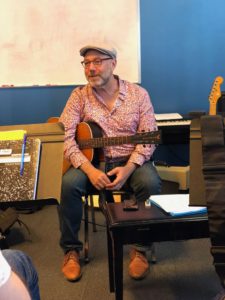
My friend Adam Levy and I had an incredible time co-leading our first master class/workshop here in San Francisco a couple of weeks ago. Now we’ve just announced another event in Los Angeles for Sunday, August 26th, 2018. Details here. Please join us, SoCal pals!
The students at our San Francisco workshop couldn’t have been cooler. Skill levels varied, but everyone was super enthusiastic and quick to comprehend the topics. Judging by some of their comments, they seem to have dug the experience:
“Wonderful class — so worthwhile. Lots to process and apply!”
“It was so fantastic that I found myself looking at my watch a few times and thinking that it was all going too fast—just like a great jam session! Thank you both a thousand times over for such a lovely and inspiring musical event. I feel like you both gave me inspiration and practice material to last at least the next few years.”
“I had a blast and the workshop totally delivered as promised. Thanks.”
“Really inspiring, and tons to process and work on. Thanks so much, both of you!
“I left feeling really glad that I signed up and got the the opportunity to not only learn from musical guitar legends as yourselves, but also just be able to spend time talking to you and other guitar players. That vibe and energy in itself is really cool. I would definitely sign up for another class like this in the future!”
Plus, I always learn volumes by watching Adam teach. He is so calm and reassuring, with an amazing knack for making difficult goals seem attainable. (Note to self: more laid-back, less “squirrel on meth.”)
This was my first return to face-to-face teaching in many years. I’ve been thinking about it for a long time, and yeah, I was nervous. But it was everything I’d hoped it would be and more.
Hope to see you in August. And oh — there’s a discount for students who sign up by the end of July. 🙂
Yesterday we lost a dear friend—and one of the most unique musicians of our lifetimes. Everyone who knew Ralph Carney is mourning the death of a kind, funny, and just plain loveable guy. But you didn’t have to know Ralph personally to appreciate his mad genius. (If you’re unfamiliar with Ralph and his music, check out his Wikipedia page.)
As I write, Ralph’s Facebook page is still up, and it’s overflowing with heartbroken tributes. Each testimonial is uniquely touching, but they all communicate the same message: Ralph was a beautiful man with a beautiful musical mind, and we’re going to miss him like hell.
It’s our nature when we lose loved ones to cite their uniqueness with phrases like, “We won’t see his like again,” or “After they made him, they broke the mold.” But man, have those sentiments ever been truer than in Ralph’s case?
I met Ralph in 1991, when I gave him a lift to my very first session with Tom Waits, recording the soundtrack for Jim Jarmusch’s Night On Earth. (Ralph didn’t drive. If you ever played music with him, chances are you gave him a lift at some point.) I knew who he was, and I was in awe. He’d played on Waits’s Rain Dogs, my favorite album!
But Ralph, of course, was the least pretentious man ever to draw breath, and I immediately dug the guy. That was also the day I met cellist/composer Matt Brubeck, and before long the three of us were playing together as the Oranj Mancinis, later the Oranj Symphonette. (At various times, the band also included drummers Kenny Wolleson, Scott Amendola, and Patrick Campbell, plus keyboardist Rob Burger.)
Ralph and I went on to play together on a half-dozen or so Waits albums and many other projects, from a spoken-word record by the late Kathy Acker to clubbo.com, the massive “hoax record label” project. He and I scored two feature films together. Once Ralph even called me to play on an Allen Ginsberg project, but I was away on tour, dammit.
But Oranj Symphonette is where I truly got to know Ralph’s freakish musicality. I paused for a moment before typing the word “freakish,” but I can’t think of a better adjective. Ralph simply didn’t create music the way most musicians do.
Two things everyone knows about Ralph: He was funny, and he played a lot of instruments. How many? Depending on how you tabulate, somewhere between 30 and infinity. Basically, he conjured beauty, comedy, and tragedy from anything he touched. Ralph’s musical humor varied from sublime to fart-joke vulgar. Sometimes it was wildly inappropriate, like the time Matt Brubeck had hushed the audience with an exquisitely delicate cello solo—until Ralph started honking on one of his duck calls. But most of the time he was left-field brilliant, playing unlikely things on unlikely instruments in ways you or I would be unlikely to do in a million years.
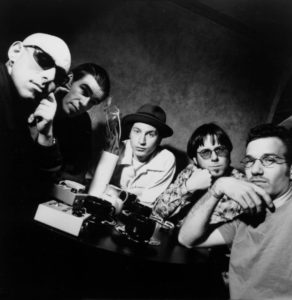
Oranj Symphonette in 1997 (L-R): Me, Matt Brubeck, Rob Burger, Ralph, Scott Amendola.
In Oranj Symphonette, I had the privilege of being the weakest player in the band. (Serious musicians understand why this is a privilege, and anyone who heard the group knows this isn’t false modesty on my part.) Guys like Matt, Scott, and Rob are superhuman players with deep, formal training and sophisticated taste and restraint. But Ralph was anarchy squared. He literally couldn’t be predictable—his fidgety, free-associative mind wouldn’t permit it. If you wanted a musician who could sight-read perfectly or nail the same part identically over and over on command, Ralph was not your guy. His bag was unfettered inspiration.
Ralph’s sense of humor was as uncommon as his musicianship, and the two traits were closely related. It was often through jokes that I got the deepest insight into how Ralph’s mind worked.
Once, backstage at a Latin Playboys concert, someone (one of the Los Lobos guys, I think) mentioned that he’d moved into a suburban-style house, and how weird it was to have a lawn. “Why can’t we all just get a lawn?” Ralph asked wistfully, channeling a dyslexic Rodney King, Jr.
Another time, I could practically see his right brain pulsing: Oranj Symphonette was playing a string of gigs across Canada as part of a national jazz festival. Concertgoers would sometimes request autographs, as if we were celebrities or something. At one point a nice couple approached us. “Can you sign our program?” they asked. “We voted for you in the jazz poll!”
Under his breath Ralph muttered, “Jazz poll … poll … Pol Pot. Can you sign our skull?”
It was hilarious. And sick. And random. And brilliant. And exactly the sort of free-associative backflip that Ralph performed every 10 seconds or so while improvising.
Ralph loved playing the musical clown, but he was a profound, Chaplin-esque clown whose comedy was rich in pathos and melancholy. He embraced styles that can be hard to listen to with a straight face, like klezmer and old-timey hokum. But he never played them strictly for laughs. He was a sensitive, emotional guy, and you heard it in every note he played. (Except maybe the duck calls and slide whistles.)
When we say someone has no filters, it’s often a left-handed compliment, implying rudeness and lack of concern for others—in a word, dickishness. Ralph and filters never met each other, but he was aware of their existence. He was unfailingly kind and considerate and always generous with his time and talent. His filter-free creativity was a joy to all.
I hadn’t played with Ralph since he left San Francisco for Portland a few years ago, though we kept in touch via Facebook. Often it was about politics. Like me, Ralph loathed Trump and everything he represents, and he expressed those feelings with characteristic humor/pain. And of course, Ralph gigged and recorded furiously literally until his last day. One of his Portland pals posted video of a gig from a couple or nights ago, and Ralph uploaded several quiet, elegiac pieces to his Bandcamp page within the last few days.
I was in Portland a few weeks ago, playing a gig with Jane Wiedlin’s new band, Elettrodomestico. Ralph and I failed to connect, but we swapped messages the next day. He told me how much he loved Portland. “It’s amazing here for music,” he said. “It’s like San Francisco 20 years ago!”
Today I’m thinking a lot about San Francisco 20 years ago—and the beautiful soul who helped make it such a memorable time. Farewell, my dear, irreplaceable friend. Everyone who ever met or heard you is going to miss you terribly.
In tribute to Ralph, I’ve posted both out-of-print Oranj Symphonette albums — Plays Mancini and The Oranj Album — to YouTube.
I’m about to rip up my long-running live looping rig to make some changes I’ll write about soon. But before doing that, I’ve posted the solo live-looped version of “Love Will Tear Us Part” that I’ve been playing live. You know, just in case I can’t follow the trail of breadcrumbs back to where I started.
When I first heard the sing more than 35 years ago, it frightened me. So different! So dark! So hopeless! But when I was in Palm Springs earlier this summer, they were playing it over the P.A. at the supermarket. So I guess everything’s okay now.
My friend John Bohlinger from Premier Guitar just shot a Rig Rundown video with one of my utmost guitar heroes, Andy Gill.
I’ve rhapsodized about Gill’s guitar voice more times than I can count. But the aspect of his playing that I love the most is the way he created such a definitive voice with zero reference to prior rock and blues. If I’d ever worked at Art Forum like my wife did, I could probably draw comparisons to Luigi Russolo’s futurism and Jean Dubuffet’s art brut, but really, I just dig Gill’s blunt, brutal badass-ness.
The big surprise for me in this interview: These days Gill plays through a laptop running Logic, and he’s using some of the stuff that I helped make while sound-designing guitar components for Apple. This news makes my year (though given the year we’ve all been through, walking to the corner store without breaking my ankle would probably also make my year).
Nice work, JB! And thanks, Andy, for the endless inspiration since 1979’s Entertainment!
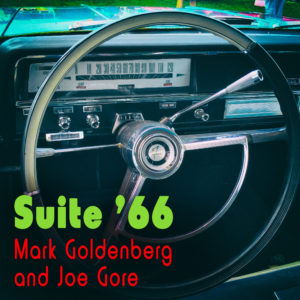
Guitar genius Mark Goldenberg and I recently recorded Suite ’66, a set of improvised duets on four tunes from 1966, in honor of the 50th Anniversary of one of the greatest years in pop music.
We teased this “release” a few months ago with this rehearsal video. The EP features a more developed version of the same tune, plus three others.
Even if you’re not familiar with Mark’s name, you’ve probably heard his playing. Mark has been a leading LA sideman and session player for decades. He’s worked with Jackson Browne, Linda Ronstadt, Bonnie Raiit, Waylon Jennings, Chris Isaak, Willie Nelson, Hugh Laurie, Natalie Imbruglia, and most impressively, William Shatner.
Less well known is Mark’s beautiful solo style, which resides at the intersection of rock, classical, and jazz. I was instantly smitten when I first heard Mark play in person at one of Teja Gerken‘s solo guitar events a couple of years ago. Mark’s musicianship flabbergasted me, plus we bonded over the fact that we shared the same teacher, the late Ted Greene. (Though I studied with Ted when I was a teen, so much of his wisdom went over my head. Mark, however, worked with Ted after becoming one of LA’s most respected players, so he absorbed Ted’s insights on a far deeper level.)
Listening to Mark play is sheer musical ecstasy, whether or not I happen to be picking along with him. He’s been one of my greatest musical inspirations of the last few years. (Translation: I’ve ripped him off more times than I can count.)
Listen and download via SoundCloud:
Tech notes: We recorded and mixed this in my basement studio. I’m on the left channel throughout, and Mark’s on the right. (There are no overdubs.) My instruments are a Gretsch Spectra Sonic electric baritone guitar (kindly loaned by Xander Soren), a Veillette Avant Gryphon octave 12-string, and a Taylor 150e 12-string. Mark plays two magnificent guitars: his Kenny Hill classical and a Collings 001MH steel-string.
IMPORTANT: This non-commercial recording is shared as a gift between us and our friends. It may not be reused for any purposes, especially commercial ones. We’re simply inviting you to listen in on our jam session.
It probably wins my vote for prettiest pop-rock song of all time, and it’s a far-from-controversial opinion. “God Only Knows” and all the other great tracks from the Beach Boys’ incomparable Pet Sounds album are 50 years old. (The album was released on May 26th, 1966.)
I owe a big thanks to my pal Mark Goldenberg who inspired me to really learn the entire tune. Mark performs an exquisite solo version, far more lyrical and poetic than my relatively motoric reading. He and I are also preparing a duo version for an album project in the works.
I say “really learn” because you don’t appreciate the number of perverse composition tricks in the tune until you study it bar by bar. Example: the jarring leap into the bridge after the second verse. Or the way that chromatically snaking bridge seems to usher in a return to the chorus, but it’s only a three-bar tease (and in the “wrong” key at that) before a exquisite harmonic pirouette into the final verse. Or the fact that many, if not most, chords in the song don’t feature their root note in the bass. (Especially that verse! The voice leading simply makes no sense on paper, but it’s perfection in practice.) And while countless musicians have praised the outro’s beautiful choral polyphony, I haven’t got much to add, except to say that it’s frickin’ hard trying to cover all those parts! (I didn’t succeed — I only played as many as I could cram into my left hand.)
And oh, the guitar: It’s the latest installment in the ongoing Mongrel Strat Project.I’ve been hacking away at the same sad parts for years. Literally hacking, in this case: I had to route out the pickup cavity to accommodate a pair of über-retro PAFs (a Duncan Joe Bonamassa signature set). Yeah, a Strat with humbuckers isn’t a new idea. But the pickups used are almost always high-gain models designed for macho soloing. I wanted to try something low-gain and unpotted for relatively bright, resonant sounds not quite so far removed from traditional Strat tones. I’m finishing up a video about the project, and I’ll post it in the next few days.
Anyway: Happy birthday, beautiful. You wear your age well.:)
Lucky me: I just started rehearsing for a duo project with one of my guitar heroes, the brilliant Mark Goldenberg. Here’s a run-through of “Eleanor Rigby,” one of the tunes we’re working on. It’s pretty rough still, and the recording quality ain’t great. But I love Mark’s playing so much here that I couldn’t resist sharing.
I’ve only known Mark a year or two, but we hit it off as soon as we met at one of Teja Gerkin’s solo guitar events. Mark played ravishing solo version of so many of my favorites: “God Only Knows,” “Shenandoah,” “Wichita Lineman,” “Mood Indigo,” and more. I love his ultra-dynamic touch and beautiful Bill Evans-style harmonies. Plus he’s just an cool guy.
And it turns out we both studied with the same teacher: the late Ted Greene. (I took lessons from Ted as a teen, with a few more sessions 20 years later. Mark studied with Ted long after he became a leading LA sideman and session player.) You can read more about Mark on his website. He’s recorded and toured with Jackson Browne, Bonnie Raitt, Linda Ronstadt, Eels, Natalie Imbruglia, Chris Isaak, Waylon Jennings, Willie Nelson, Peter Frampton and — hehehe — William Shatner. It’s a real thrill to collaborate with such an inspired player.
I’m playing a Gretsch TV Jones baritone on loan from my pal Xander Soren. Mark’s playing his magnificent mahogany Collings.
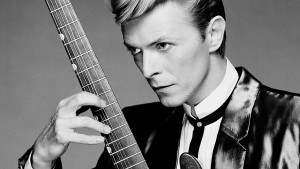
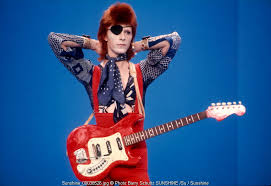
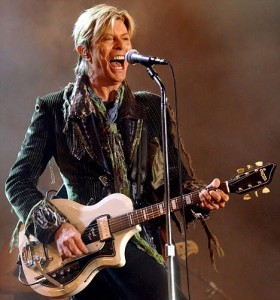
My morning, like everyone’s, started with a devastating gut-punch: “David Bowie died.”
I can’t say I knew Bowie, but I was lucky enough to spend a few hours with him back in the ’90s. And he was every bit as cool as his music.
I’d done a Guitar Player interview with Reeves Gabrels after the release of Tin Machine in 1989, and we’d stayed in touch. When Tin Machine II came out in September 1991, the band came to San Francisco to play at a music conference. My future wife Elise and I offered to show Reeves around the city. And Reeves invited David along, accompanied by an amiable bodyguard. We spent the afternoon tooling around town in my dumpy Mazda two-door hatchback with David perched astride the back-seat hump. (He insisted on taking the most uncomfortable seat.)
David was charming and unpretentious, yet freakishly charismatic. This is going to sound a bit woo-woo, but he just seemed to scintillate with some weird luminous energy. That probably sounds like the typical star-struck reaction of a lifelong fan. But I’ve met several members of the super-famous tribe over the years — Madonna, Springsteen, Ringo, Steve Jobs — and never encountered anything remotely like David’s spark.
Some stars have a gift for dimming their light as needed. For example, I used to see Robin Williams around my San Francisco neighborhood back in the ’80s. He’d be walking down Haight St. close to the building fronts, slouching a bit with his hands in his coat pockets and his face downcast. You wouldn’t notice him till the instant he slinked past. David was the opposite: When he’d round a street corner, it was as if everyone on the block instantly felt the energy shift. It was uncanny.
David and Reeves wanted to get piercings. First we grabbed lunch in Japantown (David had pork katsu, and treated everyone. His credit card was in his real name: David Jones.) Then we took them to the Gauntlet, SF’s premier piercing parlor at the time. It was David’s first piercing. He told us that he and his wife-to-be Iman were both getting simple single-ear piercings. It was an old sailor’s tradition, he said: The departing seaman and his love who stayed behind would get matching piercings as a symbol they’d be reunited some day.
David confessed to being a bit scared. As we scaled the stairway to the second floor, he jokingly clutched the bannister as if hauling himself up against the wishes of his legs. Naturally, the guy behind the counter recognized him within milliseconds. He was too hip to make a fuss, but you could literally see his eyes widen. After the guys got their piercings, the wide-eyed dude explained the maintenance procedure, recommending that David rotate the stud to keep the hole from scabbing over. David initially misunderstood and thought he had to remove the stud from his ear. “No,” Piercing Guy explained. “Leave it in there and just rock it.” He paused for two comically perfect seconds. “You know how to do that.”
We drove up and down the city’s hills, climbing out at viewpoints and talking San Francisco lore. David was easy to chat with. Unlike many of the super-famous, he’d actually listen to what you’d say and would usually respond with something fascinating. At the same time, it was exhausting. I felt like 33% of my mind was on the words. Another third was studying his eyes with their famously mismatched pupils. And everything else was OHMYGODI’MTALKINGTODAVIDBOWIE.
Everywhere we went, shy fans would approach David, thanking him or seeking autographs. Without exception, David would pause what he was doing, take a moment to chat, and humbly thank them. It was like a master class on the right way to be a rock star. What a gentleman!
But the gentlemanly feat that most floored me was purely physical. By that point, Elise insisted that David, the out-of-towner, sit up front while she sat on the hump. When we got out to enjoy some view, David helped her out of the rear seat. It wasn’t just extending a hand — it was a deft and complex balletic gesture, as if levitating her out of the car, bowing slightly, and ushering her on her way. I can’t quite describe the impossibly graceful maneuver, and I couldn’t begin to replicate it. It was like something a 17th-century French courtier might do.
Our last stop was a funky hat shop in North Beach. I jokingly urged David to try on an orange plastic pith helmet with a Grateful Dead sticker front and center. Instead, he asked to see a green felt fedora. “How does this look?” he asked, turning and striking a smoky 1940s film star pose. Elise and I swear we felt an electrical shock. We’d almost relaxed by that point, and suddenly David Bowie was standing there! (And yes, he bought the hat.)
Later, back home, we were exhausted. Elise theorized that there’s something vampiric about that sort of charisma. David didn’t just emanate energy — he seemed to soak it up it from those around him. Yeah, woo-woo again. But that’s how it felt.
My second encounter was in 1995, when I flew to NYC to interview Reeves and David separately and together for a Guitar Player cover story. I got to sit in on a rehearsal, where David was calm, kind, and focused with his band. We also went to a Rosie O’Donnell Show taping where the group played live at some decidedly un-rock n’ roll morning hour. Again, David was the very picture of modesty and graciousness.
My solo interview with David was as fascinating as you’d imagine. The focus, of course, was guitar playing. He had compelling things to say about his great accompanists: Mick, Earl, Carlos, Robert, Stevie Ray, Adrian, and, of course, Reeves. But we also spent a lot of time talking about David’s own underrated playing. Did you know he was the sole guitarist on the Diamond Dogs album? And have you listened to that record lately? Those grinding, clanking guitars are like Sonic Youth 15 years ahead of schedule. And that’s David playing the immortal riff from “Rebel Rebel.” He said it came to him in a flash, and when it did, he looked up at the sky and thanked God.
At one point David made an arch comment about a then-huge band he’d shared a flight with — something like, “They were nice enough kids, and I’m told they’re quite popular.” Back in my hotel room after the interview, the phone rang. “Oh, one thing,” said David. “Would you be so kind as to leave that comment out of the story? It wasn’t a nice thing to say, and I wouldn’t want to hurt anyone’s feelings.” I did as asked.
I almost had a third encounter later that year when I was touring with PJ Harvey. David contacted Polly, asking her to duet with him and his band on “The Man Who Stole the World” for some TV or award show. Polly being Polly, she said she’d only do it if she could use her own band, and we even rehearsed a dirge-like version of the tune. (Without David, of course.) In the end David nixed the idea, opting to perform his song with the musicians of his choice.
I could write reams about David’s music from the perspective of a naïve young fan (I’m old enough to have had Hunky Dory on my radar when it was new), as an aspiring music student during his Berlin era, and from the jaded perspective of a middle-aged music journalist. I probably will at some point. But now I’m just feeling grief for our collective loss, and gratitude for my brushes with Bowie — and getting to spend some time with that remarkable gentleman genius.
Oh, no, the mistletoe! On a rainy December afternoon I prepared a little antidote to holiday music poisoning: a mashup of two of the most summery songs ever. It’s Bob Marley’s “Stir It Up” vs. “Crimson and Clover” by Tommy James and the Shondells.



 I’d done a Guitar Player interview with Reeves Gabrels after the release of Tin Machine in 1989, and we’d stayed in touch. When Tin Machine II came out in September 1991, the band came to San Francisco to play at a music conference. My future wife Elise and I offered to show Reeves around the city. And Reeves invited David along, accompanied by an amiable bodyguard. We spent the afternoon tooling around town in my dumpy Mazda two-door hatchback with David perched astride the back-seat hump. (He insisted on taking the most uncomfortable seat.)
 David and Reeves wanted to get piercings. First we grabbed lunch in Japantown (David had pork katsu, and treated everyone. His credit card was in his real name: David Jones.) Then we took them to the Gauntlet, SF’s premier piercing parlor at the time. It was David’s first piercing. He told us that he and his wife-to-be Iman were both getting simple single-ear piercings. It was an old sailor’s tradition, he said: The departing seaman and his love who stayed behind would get matching piercings as a symbol they’d be reunited some day.
 But the gentlemanly feat that most floored me was purely physical. By that point, Elise insisted that David, the out-of-towner, sit up front while she sat on the hump. When we got out to enjoy some view, David helped her out of the rear seat. It wasn’t just extending a hand — it was a deft and complex balletic gesture, as if levitating her out of the car, bowing slightly, and ushering her on her way. I can’t quite describe the impossibly graceful maneuver, and I couldn’t begin to replicate it. It was like something a 17th-century French courtier might do.
 At one point David made an arch comment about a then-huge band he’d shared a flight with — something like, “They were nice enough kids, and I’m told they’re quite popular.” Back in my hotel room after the interview, the phone rang. “Oh, one thing,” said David. “Would you be so kind as to leave that comment out of the story? It wasn’t a nice thing to say, and I wouldn’t want to hurt anyone’s feelings.” I did as asked.