
Categories
Acoustic Amps Bass Digital DIY Effects Gigs guitar Music Pickups Recording Technique The Secret Room Tonefiend DIY Club

Contest: Build the Tonefiend Forum!

tonefiend forum
A sad, desolate place — but not for long!

One cool thing about going indie with tonefiend  is that fact that I can finally host my own geek forum! It’s already up and running — but it’s a sad, vacant space that desperately needs to be populated by cool people and cool ideas.

How to get there? Sleazy bribes! Cool prizes!

Here’s the deal: I’ve pre-populated the forum with a few topics and threads. Just come on over, register, and chime in on any thread that interests you — or better yet, start one of your own. And on September 1st, 2012, the three forum members who have consistently contributed the liveliest content as judged by some dork me will get a bitchin’ stompbox laboriously hand-built by the same dork me. I can’t disclose exactly what the pedals will do, but I can promise they will be cool, useful, and genuinely unique — original designs, not some lame-ass Screamer clones. And if I manage not to vaporize my hand with the TechShop laser-cutter I’ve been learning to use, they’ll even have wicked laser-etched enclosures.

Naturally, I hope the tonefiend forum will also be cool and unique, and that you’ll enjoy geeking out there even when there’s no contest. But hey, I’m not above greasing the skids with free stompboxes as needed.

Please read the forum rules, though.

FORUM RULES: Be cool.

Categories
Acoustic Amps Bass Digital DIY Effects Gigs guitar Music Pickups Recording Technique The Secret Room Tonefiend DIY Club

The Secret Room: Not So Secret Anymore

Now with more secrets — and less secrecy.

Last winter I tried an odd experiment: a website where players were encouraged to post their best tone secrets — the kinds of tricks and techniques that are almost too good to share. But in order to get, you had to give: The site was password-protected, and the password was only sent to those who contributed secrets.

Musicians responded, no doubt encouraged by the cool prizes awarded to the top secrets, as judged by user ratings. I also asked some cool musician friends to contribute the first round of secrets, yielding tips from the likes of composer/virtuoso Lyle Workman, metallurgist-turned jazzbo Alex Skolnick, original Chili Peppers guitarist Jack Sherman, boy genius Blake Mills, and other great players.

Once the contest ended, traffic slowed, but the site has slowly but surely grown. And now, as an experiment, I’ve removed the password protection. Now anyone can visit the Secret Room, AKA tonesecret.com, even if they haven’t coughed up a secret. So please do!

It’s a fascinating document. Naturally, the quality of secrets varies, as does the level of expertise needed to make the most of them. I exerted a light editorial hand — only silly or flat-out-wrong tips were vetoed, and I didn’t do much in the way of spelling and grammar repair. Sometimes the contents are a little repetitious — but trust me, there is much wisdom and originality throughout.

I hope you find something helpful — and I hope you’re moved to contribute some secrets yourself using the site’s submission form. And who knows? There may be more tawdry bribes fabulous prizes lurking around the corner…

Categories
Bass DIY guitar Pickups

How to Install Pickups

“I always forget — which end gets hot?”

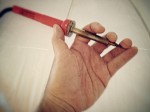
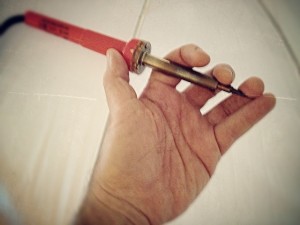
Somewhat embarrassingly, I never got around to changing one of my own pickups until I was knocking on senility’s door recently. I owe part of the inspiration to that fabulous DIY Fest known as the Maker Fair, where each year hundreds of little kids learn to solder craft projects at long picnic tables. Or maybe it was the awesome soldering tutorial by 11-year old W0JAK. Well, after a buttload of pickup installs inspired by this blog, I guess I qualify as some sort of solder “expert,” because Seymour Duncan asked me to make a video designed to walk n00bs through the pickup install process for the first time. It was a lot of fun to prepare, and I learned some important things, like the fact that it’s hard to solder, talk, and operate a camera at the same time. Check it out:

Categories
guitar Pickups

What’s the Deal with Alnico VIII Magnets?

Like this royalty-free clip-art illustration, the Alternative 8 manages to be both aggressive and round.

I was talking to some of the Seymour Duncan dudes the other day about pickups models deserving greater public awareness. One of the first names on everyone’s lips was the Alternative 8, a a high-output humbucker that uses a powerful alnico VIII magnet in lieu of the alnico II or alnico V magnets that fuel the vast majority of non-ceramic pickups.

I was intrigued, so I popped one into the bridge position of my Hamer 20th Anniversary. Yow.

If you’ve been following this blog, you’ve probably noticed that I tend to gravitate toward lower-output, vintage-flavored pickups, generating gain from the amp or a number of sketchy homemade distortion boxes. The Alternative 8, with its blistering DC resistance of 17.68k, is definitely a departure for me, but I found myself captivated by its deft balance of aggression and definition.

Have a listen and see what you think. Post-mortem after the video.

Categories
DIY guitar Pickups

A Cheap Archtop Upgrade!

Sounds like MONEY!

I’ve said it so many times, I feel like the parrot of pickups, but here goes again: These days the weakest links on inexpensive Asian and Mexican guitars are invariably the pickups. Upgrading them often yields a princely axe at a pauperly price.

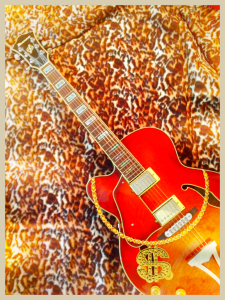
A perfect example is the Ibanez Art Star archtop I just upgraded for my friend Dusty. These aren’t especially sought-after models — they seem to sell used here in the States for for between $400 and $500.

The guitar looked cool and played well, but the pickups were murky and undistinguished. I replaced them with a pair of Duncan ’59s, and man — a merely decent guitar suddenly became very good.

Dusty’s not really a jazz player — more a cool indie-rock-pop guy — so I figured he’d like the option of a brighter, single-coil sound. I requested the ’59 model with four-connector cable (plus chrome covers to maintain the retro look), and used push/pull pots from StewMac for humbucker/single-coil switching. That was also my rationale for choosing “vintage-style” wiring, which keeps the tone relatively bright, even when rolling back the tone pots. Dusty also wanted to keep the guitar’s flatwound string as a departure from his usual roundwounds, which was all the more reason to keep the tone as bright as possible.

Just one disclaimer before you view the demo: Dusty is left-handed, and I am not. I foolishly bravely recorded the performance playing the guitar upside-down without restringing. So you’re going to have to imagine how it would sound played confidently and comfortably! (It was an interesting experience, to say the least, one I wrote about it here.)

Check it out:

Categories
guitar Pickups

Mixing Magnets in One Pickup

Aggressive on the bass side, sweet on the top.

I was talking to Seymour the other day about the types of magnets used in vintage Fender pickups. I knew that Fender used strong, punchy alnico V magnets in most of their models, but I didn’t know that the earliest Teles used softer-sounding alnico IIs, or that the first Strats used even softer-sounding alnico IIIs, a detail confirmed by Fender’s page on the topic.

I recently had a chance to compare the sound of alnico II and alnico V while hacking together guitars for the Mongrel Strat Project. I’d tried an Alnico II Pro in the middle position of this mongrel, and liked it. But as I continued to experiment, I gravitated back to the more traditional alnico V sound — maybe because I play so much in lowered tunings, and in bands without bass, so I really like the strong, defined fundamental you get from an alnico V.

But until now I’d never tried literally splitting the difference via Duncan’s Five-Two, a hybrid that has three alnico V rods for the bass strings and three alnico II rods for the trebles. The idea behind this arrangement is to deliver a bold, snappy sound in the low resister, but with some softening and sweetness on top.

How does it sound? You tell me — here’s a demo video I made. Plus, there’s a micro-contest: The first person to name the tune I’m playing will have their name immortalized for the ages mentioned in an upcoming post. (That might be better than a poke in the eye, depending on whose eye it is.)

Have a listen:

Categories
Amps guitar Pickups

Behold the Synyster Kitty!

Kitty power!!!

Okay, as promised: One more quick video featuring the Hello Kitty Strat, this time with one of those new Duncan Synyster Gates Invader pickups. I’m told the ceramic-magnet Invader is literally the hottest possible non-active pickup. I’m inclined to believe it.

Take this one with a grain of salt. As much as I love trying to make a pink $99 guitar and a Lunchbox amp sound as heavy as possible, this pickup just might sound a wee bit heavier with a big-ass mahogany guitar and a big-ass tube-dude amp. But still.

FYI, here’s the earlier post I did using a Duncan Phat Cat pickup, plus the same built-in fuzz.

Behold, mortals:

Categories
DIY Effects guitar Pickups

Hello Kitty Strat: Not for Pussies!

Would this be anything less than awesome? I think not.

As I gloated last week, Jane Wiedlin gave me her Hello Kitty Stratocaster  — the most bitchin’ $99 guitar ever conceived! I finally had a chance to destroy/customize it yesterday, in what will no doubt be the first of many desecrations/enhancements.

I’d ordered one of those Synyster Gates Duncan Invaders with the pretty white pole pieces for the guitar, but just couldn’t wait to experiment, so I browsed through the ol’ pickup collection, and found a nice Duncan Phat Cat I’d used in a Les Paul experiment some months ago.

I don’t generally recommend choosing pickups because of their names, but come on! Kitty + Cat? How could I resist?

Turns out it was a lucky choice. I hadn’t planned to install a pickup that was actually lower in output than the stock humbucker, but it lets me get nicer clean sounds, and coughs up more than enough crunch when goosed with distortion. Speaking of which: the other custom feature is a built-in-distortion circuit activated via push-pull pot (I took lots of pics of the process for a DIY built-in-effects tutorial I’ll be posting very soon.)

View the carnage in this little video. Thanks, Jane Weidlin! Sorry, Stevie Nicks!

Categories
DIY guitar Pickups

“Vintage” Les Paul Wiring: BS or BFD?

Which sounds better: modern or vintage wiring? The experts disagree!

There’s a wealth of information online about the relative merits of “vintage” vs. “modern” wiring in Les Pauls. And after reading page after page on the topic, I was more confused than when I started. So here’s an attempt to pinpoint the sonic differences in a meaningful and relatively “scientific” fashion.

For those new to the debate, here are the basics: Nowadays tone pots in electric guitars usually connect to lug 3 of the volume pot, the same junction as the input from the pickup or pickup selector. Wired this way, the tone control siphons off highs before the volume control siphons off level. But in ’50s Les Pauls, the tone control often connects to lug 2, so treble is nixed after the volume pot does its thing. (I say “often,” because, as in so many other regards, vintage Gibson aren’t 100% consistent.) Here are some comparative schematics.

Most online sources manage to pinpoint the most basic difference: with vintage-style wiring, your tone retains more brightness as you lower the volume. But beyond that, there’s a buttload of b.s., including the frequent claim that vintage tone capacitors sound better or different from new ones. (They don’t.)

Anyway, I’ve made some comparative recording and measurements. After digesting all this geeky goodness, you’ll probably know whether ’50s wiring is an attractive option for you.

Categories
DIY guitar Pickups

“Nashville” Tele Wiring . . . in a Strat?!

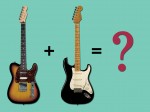
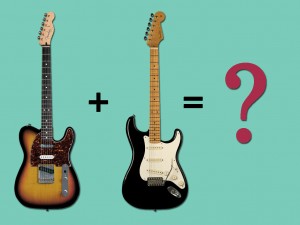
What do you get when you cross . . .

I’ve been coveting one of those “Nashville-Style” Telecasters — you know, the hot-rodded, three-pickup versions popularized by Nashville session superhero Brent Mason, and now a regular Fender production model.

Then it dawned on me: Since some of Mongrel Strats I’ve been playing with have strong Tele tendencies, why not flip the equation? Instead of a Tele that acts like a Strat, why not a Strat that thinks it’s a Tele?

The Fender version replaces the usual Tele 3-way switch with a 5-way, as shown in this wiring diagram, though many players prefer to keep the 3-way switch and add the middle pickup via a blend knob, as in this other wiring diagram.

I took the latter approach, and I am flipping out over all the new tones it unlocks. Check out this little video demo: