Categories
DIY Effects guitar Pickups

Blood on the Workbench

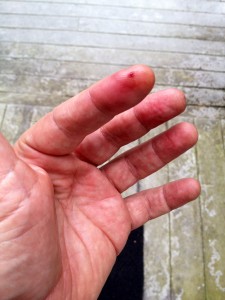
Small puncture, big pain.

I was trying to decide which self-indulgent experiment fascinating project to demo this week when my hand slipped, driving a sharp soldering iron tip into the meat of my fretting-hand index finger. It didn’t hurt all that much—until I tried to play. Ye-OWCH! (No, of course I wasn’t using the tool properly! I was trying to pick loose a knot of wire with the iron’s tip rather than the recommended wire-picker-thingy.)

So no guitar recordings for me this week while my poor l’il finger recuperates. But I’ll try to compensate for this dog-ate-my-homework post by sharing three works in progress. If they turn out well (and they might!), audio and video will follow.

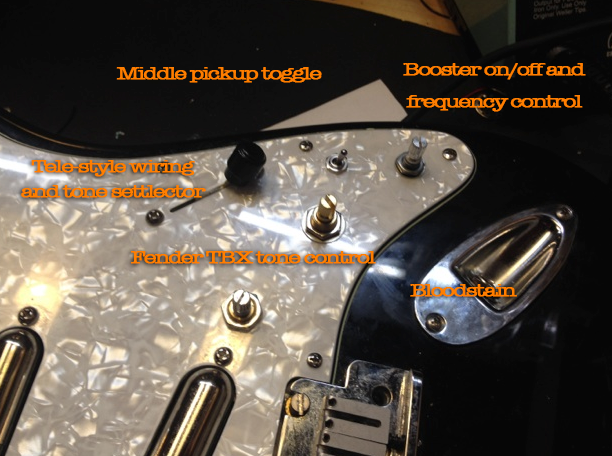
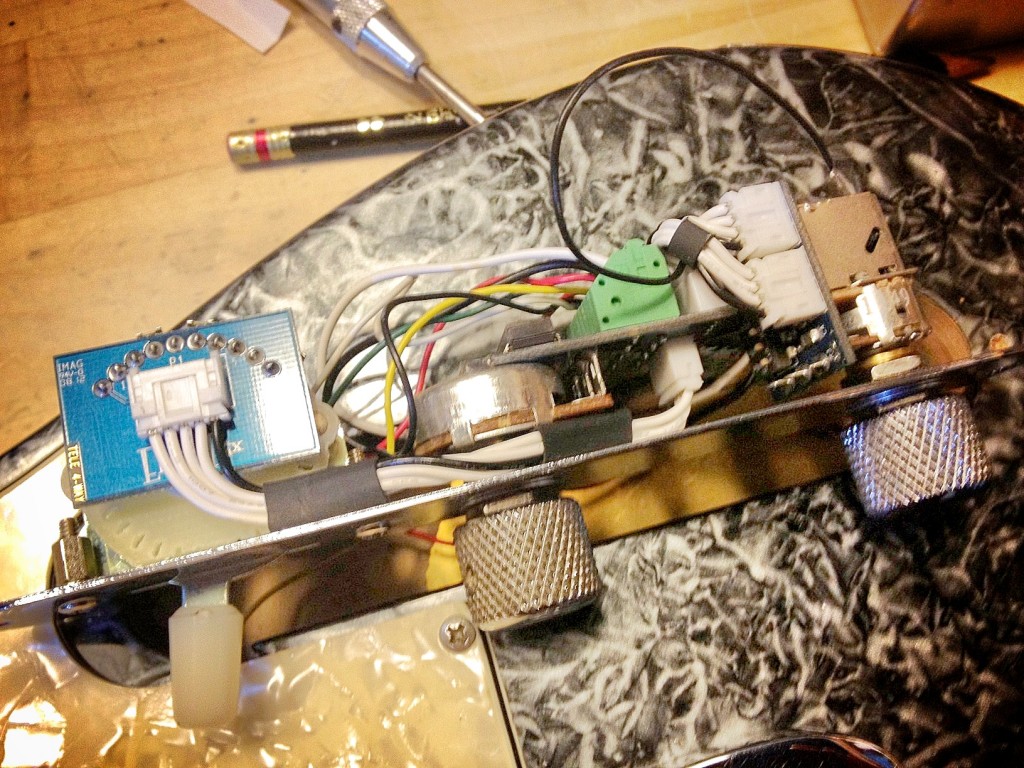
1. Lipstick Tubes Revisited. For more than a year, the generic Mexican Strat I fitted with lipstick tube pickups has lived, disassembled, in a filthy cardboard box next to my workbench, guilt-tripping me every time I fired up the soldering iron. There were a number of experiments I’d been meaning to perform on it, and in a spectacularly bad example of scientific methodology, I incorporated them all at once, making it pretty much impossible to discern what’s doing what. But I hear some things I like. Here’s what’s new (beside the blood spatters):

lipstick_labeled

Not everything is working as desired yet — but there are some promising directions here, and it’s so nice to have a lipstick tube instrument again. :pacman:
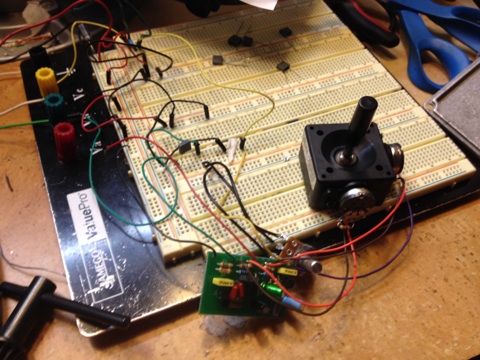
Joystick fuzz: like giving a loaded gun to a monkey.

2. The Joy of Stick. Anyone tried a joystick effect, like Devi Ever’s Drone Fuck Drone? I bought a few joysticks from 4Site and have been having a blast. I thought they’d be difficult to wrangle, but it’s really just two pots, each with the standard three-lug connection, deployed in X/Y configuration. Two things to bear in mind, though: They’re generally available only with identical resistance values for each pot, and more important, you need two controls that have meaningful values throughout their ranges. Fortunately, I had just the circuit for it: my Filth Fuzz (which Fuzzbox Girl was kind enough to demo and review in 2011). I’d even labeled the controls X and Y! (I’m not selling these, but I do hope to bring it to market before long. Honest.)
photo

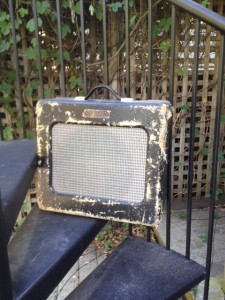
3. A Reanimated Amp.  This one’s personal: I’m finally refurbishing the 1951 “TV front” Fender Deluxe amp that I received for as a bar mitzvah present in the ’70s. (I was mature enough not to express my disappointment over getting some crummy old tweed. But how I longed for that shiny post-CBS crap!) My mom procured it from the son of one of her fellow elementary school teachers, who worked at Fender in nearby Fullerton. (Sadly, I’ve forgotten his name.) I also got to pick from three early-’70s Fender guitars: a sunburst Strat, a paisley Tele, and a black Jazzmaster. I, of course, chose the Jazzmaster — at the exact moment when no one on earth gave a crap about that model.  And naturally, I sold it just when new wave arrived and Jazzmasters became cool again. See? I established my pattern of buying and selling the wrong things at the wrong times while still in my teens!

I didn’t wreck the amp by myself — the process started with the black paint job it acquired long before I entered the picture. Over the years it received a preamp mod from Paul Rivera, and later got totally ruined by an overambitious repairman who added mods I never requested, and who probably stole most of the original electronic parts. But the cab, chassis, speaker, and output transformer are original, and there’s no reason why it shouldn’t sound bitchin’ after I restore it to its original 5A3 circuit. I’m getting expert help from Tube Depot’s Rob Hull, who helped me source parts and make a grommet board to house the components.

So my apologies for all talk, no audio. My boo-boo is healing, and I should be back able to, like, actually play some of this stuff soon!

Categories
Acoustic guitar Pickups

A Lo-Fi Acoustic Guitar Pickup

Part acoustic, part electric—but 100% bitchin'.
Part acoustic, part electric—but 100% bitchin’.

This post is inspired by in interview I just did with Mississippi Allstars guitarist Luther Dickinson, a cool dude and a deep player. I’m digging the band’s new album, World Boogie is Coming. (And for better or worse, that praise comes from someone who hates almost all modern blues albums.) You can read the interview here.

Anyway, Luther was talking about how his entire style is a quest to create a loud, electric version of acoustic country blues. He mentioned how he was more drawn to the Mississippi blues players who went electric by slapping DeArmond pickups on their acoustics, as opposed to, say, Muddy Waters, who swapped his acoustic for a Telecaster. Luther also mentioned that DeArmonds are still his favorite way to amplify an acoustic guitar

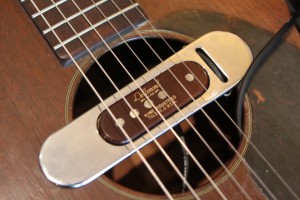
At some point it occurred to me that I’d never actually played an acoustic with a DeArmand. So I picked up a 1950s RHC-B and popped it into my old Martin 0-18. Have a listen:

I’m a longtime fan of magnetic pickups on acoustic guitars. I had a Sunrise in my Lowden for 15 years and loved it, but it croaked last year. I replaced it with one of those hybrid models that combine a mag pickup with an internal mic, and it works fine. But after a year or so, I don’t think I’ve ever used the mic sound. I just like the way the mag pickup sounds.

But is it still acoustic guitar? I’m not sure. I increasingly view amplified acoustic as a guitar category unto itself, residing somewhere between acoustic and archtop.

And the DeArmond? Between its noisiness and reticent highs, it’s probably not the best choice for every occasion. It’s also a bigger pain to install and remove than modern mag pickups. But I dig how it sound in the video, and I’m definitely keeping it!

So what’s you experience with amplifying your acoustic guitars?

Categories
Acoustic Amps Bass Digital DIY Effects Gigs guitar Music Pickups Recording Technique

Tonefiend Book Week is Coming!

Tonefiend Book Week 2013

Next week at tonefiend we’ll be talking about our favorite guitar/music books. I’ll write about some of the titles I find especially useful, inspiring, or entertaining, and I hope you’ll chime in with some of your recommended reading.

Since there’s so much potential material here, I suggest we focus on a different book category each day. Here’s my proposed schedule:

Tonefiend Book Week is strictly an experiment, and a selfish one at that. If the past is any guide, the obsessive geeks experienced and sophisticated players who frequent this site will introduce us to lots of lively lutherie-linked literature. And I’ll do my best to keep up!

So scour your bookshelves, real and virtual. This shit is about to get real promises to be a most edifying conversation.

Categories
Amps Bass Digital Effects guitar Pickups Recording Uncategorized

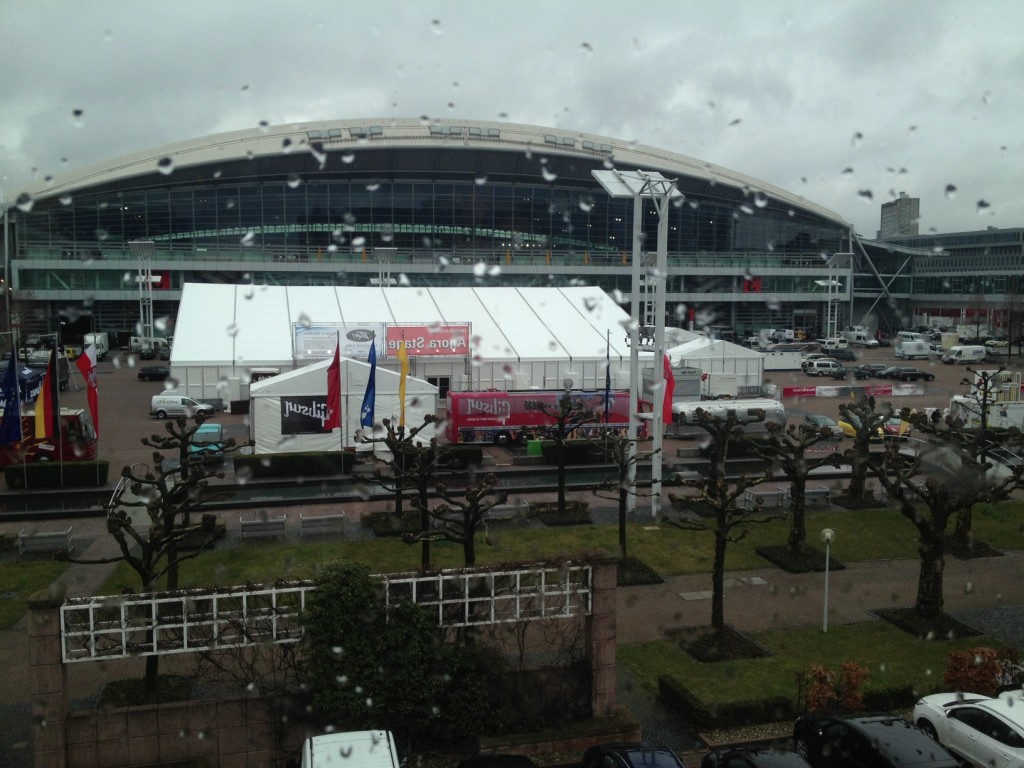
Grüße aus Musikmesse

It's wet. Will it be wild?
It’s wet. Will it be wild?

Howdy from Frankfurt, where I arrived this afternoon to attend Musikmesse. United Airlines was its usual scuzzy self, though a nice flight attendant found a place for me to stow my guitar. And my pedalboard seems to have arrived in fine shape, even though I had to checked it in its soft but reassuringly padded Mono case.

I’m here as a demo artist for Fishman’s TriplePlay, but I should have some downtime to poke around and look for cool stuff. I’ll keep you posted!

This event is gigantic — more than twice the size of NAMM. And even on a setup day like today, you can tell how loud it’s going to be, especially since they don’t enforce volume restrictions is stringently as they do in Anaheim. (I’m told it’s like Saturday afternoon at Guitar Center, squared.) And my demo area just opposite the big, loud Gibson stage. It’ll be an adventure! 🙂

Any of you guys ever been? Got any advice to share?

Categories
Digital guitar Pickups Recording

Demo: Fishman TriplePlay Wireless MIDI Guitar System

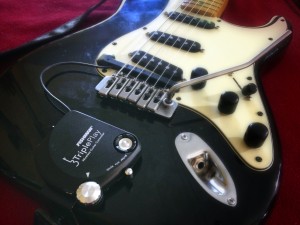
I've installed TriplePlay on this homemade strat.
I’ve installed TriplePlay on the homemade strat.

For the last few months I’ve been working with Fishman on the documentation for TriplePlay, their long-awaited wireless MIDI guitar system, which will finally ship this quarter. I had a blast demoing TriplePlay at MacWorld a few weeks ago, and I’m looking forward to doing so again at Musikmesse in Frankfurt in April.

But at times, it’s been frustrating. I power up TriplePlay to study some feature, get all excited, and then have to turn it off and write about it instead of going off and playing it for six hours. This little demo was my first real chance to just fool around with the thing. Thoughts and details after the video.

Categories
Acoustic Amps Bass Digital DIY Effects Gigs guitar Music Pickups Recording Technique

Who Dares Predict Our Fretboard Future?

“We are all interested in the future, for that is where you and I are going to spend the rest of our lives.” — Criswell, Plan 9 from Outer Space

UPDATE: Wow, I can’t believe all the cool stuff folks have been posting to comments. I find myself feeling quite inspired about the future of instrument — when I’m not laughing so hard I spit coffee all over my laptop. Thanks for all great ideas. Keep ’em coming! 🙂 :thumbup:

Prophecy is for suckers. Who’s stupid enough to go on record with bold prognostications about the future of music and music-making, given the near-certainty that the words will reappear someday to bite you on the ass?

Well, me. And, I hope, you.

So I invite my fellow foolhardy loudmouths to join me in sharing their half-assed guesses wise and well-informed predictions about our brave new fretboard future.

The author of the most compelling prediction wins one of my hand-built stompboxes. So does the author of the one that makes me laugh hardest.

Post your predictions to comments. I’ll go first. 🙂

Categories
DIY guitar Music Pickups

The Great Epiphone Swindle

You don’t have to spend $6,706 to sound like a punk. And don’t ask what the six cents are for!

My pal Linda B. is a killer rock and roll drummer who also plays a pretty mean guitar. She’s decided to form an all-female Sex Pistols cover band, with her assuming the duties of guitarist Steve Jones.

An avid rock historian, Linda did her research, which quickly led her to Gibson’s limited edition Steve Jones signature model Les Paul Custom, a slavishly accurate replica of Steve’s iconic axe.

(The original, which had previously belonged to New York Doll Sylvain Sylvain, was not used on the Sex Pistols’ early singles or the Never Mind the Bollocks album, but was his main stage instrument.)

Just one problem: the $6,706 price tag.

So Linda bought a used white Epiphone Les Paul Custom for $299, ordered the same pickups that are in the original and the signature model (a Gibson 498T “Hot Alnico” humbucker in the bridge position, and a 496R “Hot Ceramic” humbucker at the neck), and found some sketchy online vendor who sells replicas of the original’s pinup-girl stickers, plus an even sketchier vendor who sells fake Gibson logos. We popped in the pickups, slapped on the stickers, and made a darn good replica for a bit over $500.

Wanna hear it?

Categories
Bass DIY guitar Pickups

Cool Prewired Guitar Electronics

Prewired replacement electronics provide access to many popular wiring mods, minus the soldering.

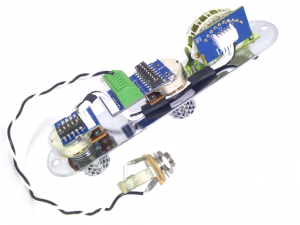
Larry Santellan of Santellan Sounds, maker of the Elec-Trix tone modules, sent me some samples to check out. These pre-wired circuits offer quick access to some of the “greatest hits” of alternate wiring, with an emphasis on Strats and Teles. He has pop-in modules for 5-way Teles, Vari-Tones, passive overdrives, vintage/modern switching, and more.

I haven’t had the time to try everything Larry sent, but for a few months I’ve had his 4-Way Fat Tone Monster Deluxe Wiring Kit in my Tele-like G&L ASAT. It lets me dial in the three standard sounds, plus that humongous series-pickups BLAT! A push/pull pot bypasses the tone control. (I never hear meaningful differences between bypassed tone controls and wide-open ones, but this setup lets me toggle between a bright, wide-open tone a muted one.)

Installation was relatively easy, and the parts and workmanship are top-notch. If you’re interested in alternate pickup wiring options, but don’t have the skill, patience, or time to solder it yourself, well, check out the Elec-Trix catalog.

Solder-free configuration via clever ribbon connectors.
Categories
guitar Pickups

Those Mysterious Burns Pickups

A unique pickup in a “unique” guitar.

I’ve never owned a Burns guitar, and I have only one with Burns pickups: a funky mid-’60s Baldwin Virginian I scored for $100 some 20 years ago. It’s a cheap plywood piece of crap — but it’s my piece of crap, and I’m quite attached to it.

James O. Burns founded Burns London Ltd. in 1960 and had success underselling expensive American imports. Burns users included Hank Marvin, pre-Zep Jimmy Page, and most famously, Brian May, who used Burns’s Tri-Sonic pickups in his iconic homemade guitar.

Cincinnati’s Baldwin company bought Burns in 1965 and quality suffered — much like the same year’s CBS/Fender debacle, only on a smaller scale. But the Baldwin/Burns marriage produced some interesting oddballs, notably the Baldwin Burns Buzzaround (a quirky fuzz pedal favored by Robert Fripp), plus a lot of weirdo guitars. Like this one.

When I was playing with PJ Harvey, I used the Virginian to play the songs she’d written in “Gary Glitter tuning”: AAAAAA, as heard on “Rock and Roll Part 2,” and on this 1995 PJ Harvey clip from The White Room, a great British live music TV show of the era. (As on the UK’s long-running Later with Jools Holland show, bands would set up on multiple stages facing each other across a large room. Also performing the night we tracked this: Oasis, Paul Weller, and Bobby Womack.)

Here’s how the same guitar and guitarist sound 17 years later. Listen and weep:

Categories
Digital guitar Pickups

Synth Guitar:
Did They Finally Get It Right?

Anyone here ever owned a synth guitar? Not a Keytar, but a guitar fitted with a hexaphonic pickup that transmits MIDI data to external devices? And if so, do you readily admit it?

The synth guitar has had one of the most checkered histories outside of, well, checkers. Since the ’70s, many brilliant minds have tried to bridge the gap between the plucked string and the external tone generator. But despite a few notable exceptions (mostly in the prog/fusion realm), guitarists have been reluctant to embrace the technology.

I’ve had a Yahama synth system (basically a clone of the Roland GK-2) for many years, though I rarely use it. Like a lot of players, I balk at the installation hassle and the ugly, cumbersome hardware. (Plus, I’ve played keys longer than I’ve played guitar, so I don’t really need a guitar to conjure synth sounds.) Also, those systems are expensive! Many players have been disappointed. Many businesses too — the Avatar guitar synth probably killed off the ARP company.

But I’ve been thinking about guitar synth again since last January’s NAMM show, where Fishman previewed their Triple Play system, a new take on MIDI guitar which I mentioned at the time here. (Here’s much more info from the company’s Summer NAMM press release.)

I finally got to play a late-stage prototype this weekend. But before I discuss the experience, I need to confide that a) Larry Fishman is a pal of mine, and b) I may be working with his company on the product’s documentation and marketing. (My words of praise are 100% sincere — but as always, consider the source.)