
Tag: guitar

  • Solo Guitar Shows: L.A. Confidential & Furtive Frisco

    Solo Guitar Shows: L.A. Confidential & Furtive Frisco

    LA_kitty

    Psst…this week I embark on a grueling two-city solo guitar tour.

    I’m playing my first ever L.A. solo show next Tuesday, the 12th, with one of my favorite players on the planet: the brilliant Mark Goldenberg. I’d previously know his pop work, but only became aware of his amazing solo playing last year when we both performed at one of Teja Gerken‘s guitar events. It was love at first note. We bonded on our affections for Ellington and ’60s L.A. pop, and the fact that we were both Ted Greene students. Plus, he’s just a cool guy.

    The show’s at Genghis Cohen (740 N. Fairfax near Melrose). Danielle D’Andrea plays at 8:00 PM, Mark’s on at 9:30, and and I play a bit after 10:00. Maybe Mark and I will even work up a duet or two.

    Admission is 10 bucks. The show is all-ages. If you’re in SoCal and free on the 12th, please join us!
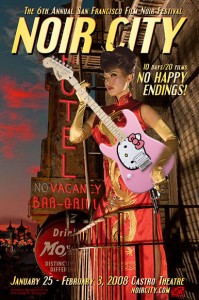
    My pal Bill Selby drew this amazing illustration. I'm going to hell for defacing it in Photoshop.
    My pal Bill Selby drew this amazing illustration. I’m going to hell for defacing it in Photoshop.

    And then, on Thursday, the 14th, I play my monthly solo show at my beloved local dive, San Francisco’s El Rio. This one’s special too: My guest star is another astonishing player, Giacomo Fiore. Giacomo is rightly renowned as one of of our greatest avant-garde classical guitarists, specializing in difficult modern repertoire. But this time, Giacomo’s performing an all-electric set. I have no idea what to expect, though I’m certain it will be astonishing. (In addition to releasing some remarkable recordings, Giacomo lectures at several noted Northern California universities and conservatories, and he gets excellent marks on Rate My Professor. Just sayin’.)

    This show is free, but over-21 only. I play at 7PM sharp, and Giacomo starts around 8.

    Remember, you heard it here first — off the record, on the QT, and strictly hush-hush.*

    * This quote, the post title, and the noir pics are inspired by James Ellroy’s L.A. Quartet, probably the greatest series of hardcore crime novels ever. (And Ellroy’s newly released prequel, Perfidia, is every bit is awesome.)

  • Heaviest. Stompbox. Ever.

    Heaviest. Stompbox. Ever.

    I’ve been breathlessly awaiting one of these since I saw this. It’s Korg’s Miku Stomp, a spinoff from the company’s Vocaloid voice synthesizer. It tracks your pitch as you play and responds with a synthetic voice that forms various syllables and phrases.

    There’s some cheating here: The effect’s latency is quite severe, so I had to slide the Miku track back in time while mixing. Its triggering is also inconsistent, so I replaced a few notes. Miku tracks best when playing melodies on a single string, hence my awkward, position-jumping fingering. (Actually, it tracks pretty well when you play slow melodies full of sustained notes. But steady eighth-notes at 155 BPM as heard here is a major challenge.)

    One of the pedal’s most interesting aspects is the way it interprets slurs. When there’s no break between notes, Miku sings a sort of pseudo diphthong. Detached notes get a syllable with a clear transient.

    IMHO, the inescapable facts that Miku is silly and doesn’t work terribly well doesn’t diminish her total awesomeness. No doubt about it: heaviest stompbox ever.

    The tune, of course, is “Georgy Girl,” which I’ve loved since forever. It was a blast recording the backing tracks with classical guitar, ukulele, ukulele bass, 12-string, toy piano, M-Tron Pro, and a mix of live and sampled percussion. And of course, gobs of my favorite reverb effect: Universal Audio’s EMT140 plate simulation. Yum.

  • Ultimate Lipstick-Tube Guitar (with experimental tone control & onboard overdrive)

    Ultimate Lipstick-Tube Guitar (with experimental tone control & onboard overdrive)

    Okay, it’s not the ultimate lipstick-tube guitar for everybody, but it probably is for me. It’s my third lipstick-tube pickup experiment — and definitely my favorite.

    You may have heard some of these parts before: I used the neck for all my Mongrel Strat projects, and the Strat-sized Seymour Duncan pickups appeared in my previous lipstick-tube experiments. (I love Duncan’s lipstick-tubes. To my ear, they sound way better than the ones in new-school Danelectros.) The new body is Warmoth’s Hybrid Tele model, in purple with butterfly stickers. It’s très macho. (Better not use if for gigs in Indiana and Arkansas.)

    My previous lipstick tube experiments used a MIM Strat body, but I wanted something a little more distinctive, and with a built-in battery compartment (because nothing is a bigger pain than changing batteries in a traditional Strat control cavity). Also, I like how the design evokes both Strat and Tele, since the guitar has three-Strat sized pickups and a whammy, but is wired more like a Tele.

    About that wiring: The 3-way pickup selector chooses neck, bridge or both pickups, like on a Tele. Meanwhile, a SPDT switch toggles the middle pickup on and off regardless of the pickup selector, so you get six settings: neck, bridge, neck + bridge, neck + middle, bridge + middle, and all at once. It’s a pragmatic variation on “Nashville Tele” wiring with a switch rather than a pot. That means you can’t dial in varying amounts of middle pickup—it’s all or nothing. But on the plus side, I can jump instantly to an out-of-phase sound from any pickup-selector setting, and it freed up space for the other weird crap I put in this guitar. (Yo, electrical engineers: Don’t bother telling me that combined-pickup settings aren’t really out-of-phase True, they’re not out-of-phase electronically, but they are acoustically, and the distinctive “hollow” sound of combined settings is precisely the result of phase cancellation from two pickups at different positions.)

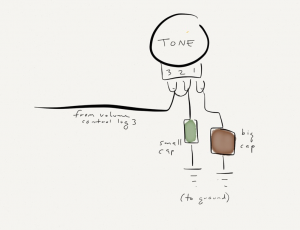
    The weirdest detail is what I call a “cap-fade” tone control. It’s an idea I speculated about back in January, and to which many of you contributed cool perspectives. I pretty much followed the scheme in the original diagram:

    cap-fade tone control

    The idea again: Instead of sending varying amounts of signal to ground via a tone cap, the pot here fades between a small-value cap (which defines the minimum cut when the control is engaged) and a larger one (defining the frequency of the maximum cut). In other words, instead of sending varying amounts of signal to ground, this circuit always sends everything above the cutoff frequency to ground, with the pot determining the frequency. (more…)

  • Magic Fairy Dust: The Veillette Avante Gryphon

    I recently reviewed the gorgeous little Veillette Avante Gryphon for Premier Guitar and liked it so much that I bought one. This was my first opportunity to record it in my studio.

    The Avante Gryphon is a relatively low-cost version of Woodstock luthier Joe Veillette’s Gryphon, an 18.5″-scale 12-string designed to be tuned a minor seventh (an octave minus two frets) above standard. But while 12-string guitars feature octave-tuned string pairs, here all six courses are unisons, as on a mandolin. In fact, the Avante Gryphon sounds a lot like a mandolin, but with a wider range and guitar-like tuning. And unlike the couple of janky plywood mandolins I own, it plays gloriously in tune. It’s made (very nicely!) by Korean CNC robots and sells for $1,400, as opposed to $4K+ for Veillette’s hand-built models.

    For years I’ve been looking for the right upscale mandolin, but now I’m happy I found this instead. My original motivation was a high-tuned soprano instrument for multi-guitar arrangements, or for magic-fairy-dust studio overdubs. But the thing is so fun — and sounds so darn pretty — that I can’t stop playing it solo. This Bach prelude, for example:

    I won’t recap my review here—check it out if you’re curious. Instead, let’s yak about Johann Sebastian! (more…)

  • Frets in Flight, 2015

    Here are the new U.S. Department of Transportation rules on flying with musical instruments. Sounds like carriers are required to check instruments.

    The key passage, per the DOT site:

    The rule requires that each U.S. carrier subject to this regulation allow a passenger to carry into the cabin and stow a small musical instrument, such as a violin or a guitar, in a suitable baggage compartment, such as the overhead bin or a closet, or under the seats, in accordance with FAA safety regulations and the carrier’s FAA-approved carry-on baggage program.

    Carriers must allow passengers to stow their small musical instruments in an approved stowage area in the cabin if at the time the passenger boards the aircraft such stowage space is available. Under the rule, musical instruments as carry-on items are treated no differently from other carry-on items and the stowage space should be made available for all carry-on items on a “first come, first served” basis. Carriers are not required to give musical instruments priority over other carry-on baggage, therefore passengers traveling with musical instruments may want to buy the pre-boarding option offered by many carriers to ensure that space will be available for them to safely stow their instruments in the cabin.

    Maybe we should do like my pal Shelley Doty recommends and carry a copy of this every time we check in for a flight.

    kitty_plane

  • Girls and Guitar Magazines

    Screen Shot 2014-10-30 at 8.31.41 AM

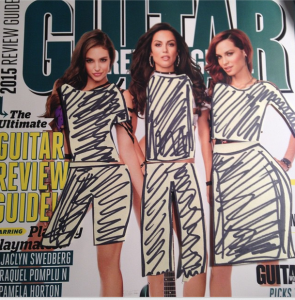
    Pedaltrain didn’t dig the cover of the new Guitar World, so they changed it. (View the best Instagram ever here.) I think I’m going to have to go out and buy even more excellent Pedaltrain boards.

    Funny thing: My friends outside the guitar biz tend to imagine that it’s some super-hip industry, when in fact, it’s a rather retro community where crap like this is depressingly common. Damn, with so many things in our culture to undermine girls’ confidence, who needs more from music mags?

    As a palate cleanser, here’s a video of girls who actually play:

    My band recently had the privilege of playing a Bay Area Girls Rock Camp benefit. The between-acts music was all recorded by the campers, and some of it was awesome. I’m not even a parent, yet I’m grateful the organization exists to counter crap like the Guitar World cover.

    Are there any similar groups in your area? Do any of the moms and dads among you have thoughts about nurturing and empowering young musicians?

  • Next Victim! A New DIY Guitar

    Starjet

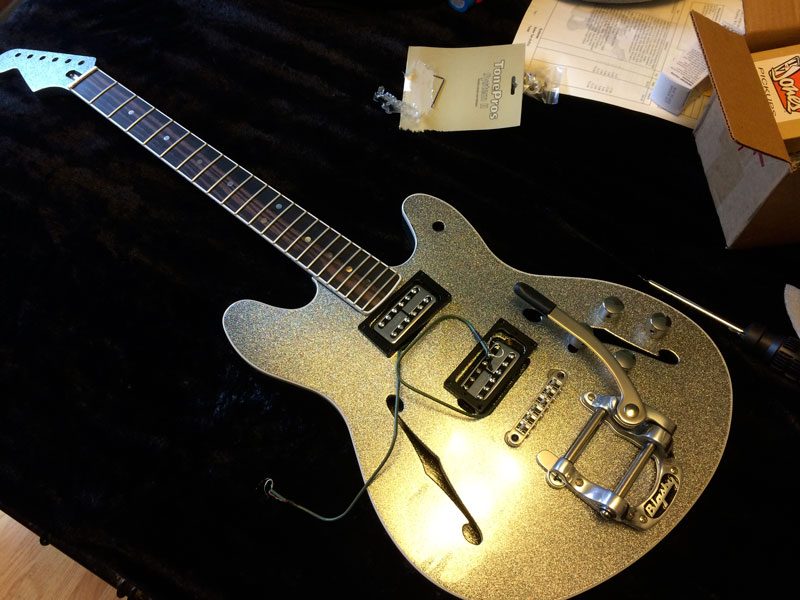
    Look what UPS left on my porch: the neck and body for my latest ill-advised “parts” guitar project. I’ll be slapping it together in the coming days, but I couldn’t resist showing off the pretty parts. The body is Warmoth’s Mooncaster model, which is based on Fender’s semi-hollowbody Starcaster, a quirky cult guitar if ever there was one. But for the neck, I swiped an idea from Warmoth’s Josh Spataro, and substituted a reverse angled Strat neck. The tacky silver finish and extravagant binding are solely the result of my bad taste. (Josh compared it to a pinky ring, which is pretty accurate.) The body is korina, the neck mahogany.

    If my last Warmoth parts guitar was a sort of Fender/Gibson hybrid, this one is more Fender/Gretsch. I’m planning to install a set of TV Jones pickups, and this will be my chance to try out a very different type of tone control scheme, one I’ve been thinking about for a while. If it turns out well, I’ll write about it. If not, I’ll probably delete the last few sentences and deny they ever existed.

    This is my third Warmoth parts project since starting this blog. As before, I’m 100% delighted with the materials and build quality. Since I requested expensive options (like the vulgarly bound and finished neck) and I’m using fancy parts, the guitar probably won’t be vastly cheaper than if I’d bought it already made. But it should be unique and fun. Stay tuned — and I’ll hope the guitar does too.

  • The 18-Watt, Bletchley-Style

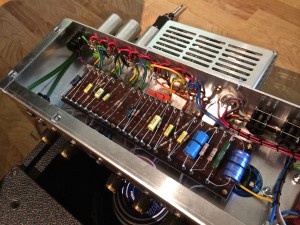
    How come my DIY amps never look this pretty inside?
    How come my DIY amps never look this pretty inside?

    A couple of weeks ago I posted here about a Premier Guitar project in which I built two Marshall 18-watt clone kits. Meanwhile, the magazine received a review model of Marshall’s latest iteration of the 18-watt, a high-end, hand-wired version that sells for $2,700. My new review is online at PG, if you’re curious to hear a proper Marshall as well as the clones.

    My take: It’s a beautifully built, hand-wired amp that sounds as least as good as either clone. Unlike the kits with their single 12″ speakers, the Marshall has a pair of 10s, which I think I prefer in this circuit. At $2,700, though, it’s pretty darn expensive, even for a beautiful, hand-made instrument. But I’ll be sad when I send the review model back to Bletchley.

  • New Guitar Recording Column!

    Screen Shot 2014-02-24 at 10.57.35 AM

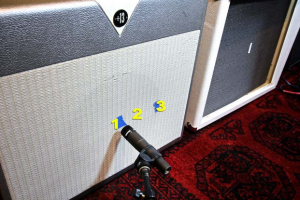
    May I take this opportunity to pimp my new monthly recording column in Premier Guitar? The first installment covers basic electric guitar miking technique. It’s ground that’s been covered often enough before, though I hope the article’s many audio files (recorded via ReAmp, moving the mic between “takes”) shed some new light on the topic.

    Meanwhile, I’m breathlessly stoked about my new “Partsmaster.” It’s a Korina “Split Jazzmaster” body from Warmoth with Fralin P-92s and some new tricks I’ve been wanting to try with wiring and onboard overdrive, plus several other ill-considered, stab-in-the-dark adventurous experiments. It’s like some wacky Firebird/Jazzmaster hybrid (“Birdmaster?”) I hope to post some video later this week, but right now, the guitar is awaiting the plek treatment at Gary Brawer’s shop. Gary is also prettying up some of my clever but sloppy wiring, and remedying the fact that, when I brought the beast in, the strings were about a half-inch from the fretboard.

    Can’t wait — this is an interesting one! 🙂

  • Odds & Ends & Pixies

    jazzm (1)

    Oh man — the gods have been generous this week.

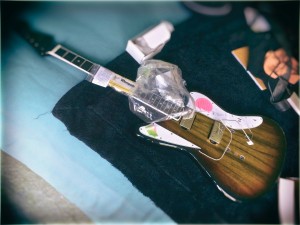
    I just received from Warmoth all the parts for my next DIY guitar. I loved testing eight sets of P-90 pickups for Premier Guitar, but I don’t own any P-90-eqipped guitars.I will soon, though!

    This one will be a bit of a platypus — as opposed to, you know, all my other other platypi. (The actual plural of “platypus” is “platypuses,” but “platypi” is more fun to type.) It’s built from Warmoth’s “split Jazzmaster” template, with a korina body, bound neck, Tune-o-matic/stop-tailpiece bridge, and a pair of hum-cancelling Fralin P-92s. Yeah, it’s kind of a stab-in-the-dark experiment, and not a inexpensive one. But hope springs eternal. Prepare to be bored with details!

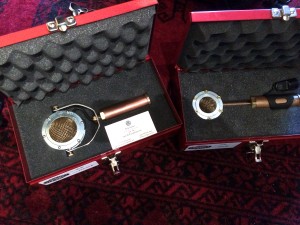
    I’ve also just received an amazing-looking pair of condenser mics from Portland, Oregon’s Ear Trumpet Labs. ETL kingpin Philip Graham’s business card identifies him as “proprietor and bricoleur.” Bricolage, of course, is the ten-dollar word for “making stuff out of junk and other found objects.” Dig the steampunk vibe of that repurposed hardware! I haven’t even plugged these in yet (though the reviews I’ve read have been stellar). I just like staring at them! But I’m going to try them out at my monthly Strung Out! show tonight.

    Ear Trumpet Labs' Edwina and Edna models: a higher calling for found objects!
    Ear Trumpet Labs’ Edwina and Edna models: a higher calling for found objects!

    Which brings me another of this week’s highlights: I got to perform last night with my dear friends Teja Gerken and Adam Levy. Teja is an astonishing acoustic fingerstylist and a fine composer. His vocabulary has hints of Bensusan, Hedges, and classical, but he’s molded those influences into a thoroughly unique sound. And Adam, who I’ve known since my Guitar Player magazine days, is equally renowned for his jazz work and for accompanying such singer/songwriters as Norah Jones and Tracy Chapman. (I get to play some of Adam’s cool parts when I gig with Tracy.) These days Adam’s focusing on songwriting, and he his sings his “smart Americana” songs (my description, not Adam’s) in a sweet, soulful voice. Man, what a treat to hear both of them up close. And tonight, Adam, Shelley Doty, and I perform at my local dive, El Rio. Can life get any better?

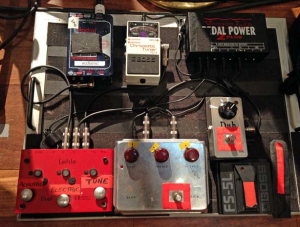
    Apparently so! Yesterday Premier Guitar posted John Bohlinger’s piece on the Pixies, which includes a pic of Charles “Frank Black/Black Francis” Thompson’s pedalboard, with my grubby, hand-built Duh fuzz pedal front and center. I’d originally made if for Joey Santiago, the other Pixies guitarist, but I guess Charles swiped it. Hey, I’d be honored if either guy spat on the thing! They’ve been heroes since I first heard the band in a small San Francisco club back in ’88. (Everyone went to hear the Sugarcubes, but left talking about that awesome opening act from Boston.)

    Lookit! I'm Pixies-approved!
    Frank Black’s pedalboard: Lookit! I’m Pixies-approved!

    It’s funny, because I really was thinking “Pixies” when I sound-designed the Duh. I was going for “bubblegum metal” — a thick, heavy sound, but not a macho one. The tone is too fizzy and funny for 100% sincere heavy rock, IMHO. It’s more of a “greasy kid stuff” distortion. (Note to readers under 45: That was once the tagline for a “dry look” mens hair product, referring to the outdated coiffures that would return with a vengeance when punk broke a few years later.) It’s a vaguely Muff-like sound, but with less compression, less scoop, and one big, stupid knob. I also like building that circuit into guitars. Like this one:

    So it’s been a grand week, but a hectic one. Thanks for reading this far. Next week I promise a proper post, and not another collection of … odds & ends.