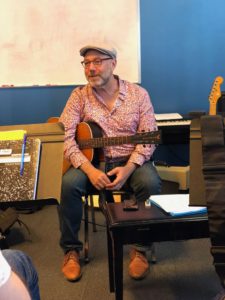
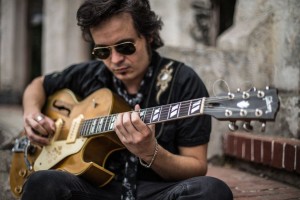
Adam Levy, looking like the 6-stirng zen master that he is.
My friend Adam Levy and I had an incredible time co-leading our first master class/workshop here in San Francisco a couple of weeks ago. Now we’ve just announced another event in Los Angeles for Sunday, August 26th, 2018. Details here. Please join us, SoCal pals!
The students at our San Francisco workshop couldn’t have been cooler. Skill levels varied, but everyone was super enthusiastic and quick to comprehend the topics. Judging by some of their comments, they seem to have dug the experience:
“Wonderful class — so worthwhile. Lots to process and apply!”
“It was so fantastic that I found myself looking at my watch a few times and thinking that it was all going too fast—just like a great jam session! Thank you both a thousand times over for such a lovely and inspiring musical event. I feel like you both gave me inspiration and practice material to last at least the next few years.”
“I had a blast and the workshop totally delivered as promised. Thanks.”
“Really inspiring, and tons to process and work on. Thanks so much, both of you!
“I left feeling really glad that I signed up and got the the opportunity to not only learn from musical guitar legends as yourselves, but also just be able to spend time talking to you and other guitar players. That vibe and energy in itself is really cool. I would definitely sign up for another class like this in the future!”
Plus, I always learn volumes by watching Adam teach. He is so calm and reassuring, with an amazing knack for making difficult goals seem attainable. (Note to self: more laid-back, less “squirrel on meth.”)
This was my first return to face-to-face teaching in many years. I’ve been thinking about it for a long time, and yeah, I was nervous. But it was everything I’d hoped it would be and more.
Hope to see you in August. And oh — there’s a discount for students who sign up by the end of July. 🙂
I haven’t posted any new video in months and months. It’s not just laziness or business, though I suffer from both. I’ve just been locked away in my studio, trying to create a new live looping system.
I still haven’t nailed it down, so I’m not going to get into a complete run-down yet. But here are the basic ideas.
• I’ve moved from a hardware looper to software looping. When I started this godforsaken looping project years ago, I’d just finished a lot of work on Apple’s then-new MainStage software. At the time, the program’s looper simply wasn’t reliable enough for live performance. Also, my intense signal processing was pushing my MacBook Pro to its limits. But since then, the program has gone through many upgrades. Meanwhile, after years of relative stagnation, Apple finally issued a major MacBook Pro upgrade in 2017. Between the more powerful computer and the refined software, I could finally shift looping and signal processing to the computer. Yeah, there are a couple of disadvantages. For one thing, MainStage’s looper lacks a “copy” function, something I’ve come to rely on a great deal in my arrangements. But it sure is nice not having to run the entire mix through the relatively cheap hardware looper convertors — just the snazzy ones in my Apollo interface. (Of course, now that I’ve transitioned, Electro-Harmonix has just announced a compelling-looking 6-track looper. I’ll have to check that out…)
• I’ve put aside for now the Fishman TriplePlay MIDI pickup. I have no complaints about TriplePlay, which is far and away the best MIDI pickup ever created, and a product I recommend without reservation. But I wanted to be free from the hardware setup. This way, I can plug in any guitar, any time. (I’ve been experimenting with acoustic looping — more on that soon.) I’m still using MIDI sounds, but again, it’s all in software via Jam Origin’s brilliant MIDI Guitar plugin. It works incredibly well without a MIDI pickup, but it’s not nearly as fast as TriplePlay. It’s fine for doubling, or for melodic and textural stuff, but it’s just not speedy enough to play MIDI drums at even moderate tempos. Which bring me to the other big departure …
• I confess: I’m playing to a drum machine. I’m triggering and changing patterns using a KMI !2 Step foot controller. I really wrestled with this decision. I loved the idea of using no machine tempos — it all came from the hands. But at some point I realized that the main reason I was committed to that approach was for bragging rights: “No prerecorded tracks, and no machine rhythms” I could boast. But who cares except geeks like me? Anyway, I still have misgivings about the change, but I’m going with it for now. I think that means, though, that I’ll create more arrangements without percussion, just so I’m not locked to the machine for an entire set.
Meanwhile working with a tempo clock lets me do fun stuff with synchronized effects. I’m especially besotted with Sugar Bytes’s Effectrix, a mind-bending multi-effector that lets you activate and edit effects on a note-by-note basis. You hear it a lot in the “solo” in this video.
I’ve played a few shows with the new setup. The first one was flawed but promising. The second was an unmitigated disaster. Then I doubled up on practicing and (not kidding) started meditating again, which helped a lot. Last time I tried this live, it went really well! We’ll see how it goes at my gig this week.
Anyway, it’s still a work in progress. I’ll keep the curious updated.
I played this cover tune with no irony whatsoever. I love the original.
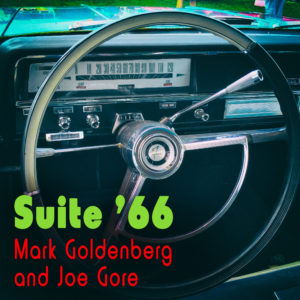
Guitar genius Mark Goldenberg and I recently recorded Suite ’66, a set of improvised duets on four tunes from 1966, in honor of the 50th Anniversary of one of the greatest years in pop music.
We teased this “release” a few months ago with this rehearsal video. The EP features a more developed version of the same tune, plus three others.
Even if you’re not familiar with Mark’s name, you’ve probably heard his playing. Mark has been a leading LA sideman and session player for decades. He’s worked with Jackson Browne, Linda Ronstadt, Bonnie Raiit, Waylon Jennings, Chris Isaak, Willie Nelson, Hugh Laurie, Natalie Imbruglia, and most impressively, William Shatner.
Less well known is Mark’s beautiful solo style, which resides at the intersection of rock, classical, and jazz. I was instantly smitten when I first heard Mark play in person at one of Teja Gerken‘s solo guitar events a couple of years ago. Mark’s musicianship flabbergasted me, plus we bonded over the fact that we shared the same teacher, the late Ted Greene. (Though I studied with Ted when I was a teen, so much of his wisdom went over my head. Mark, however, worked with Ted after becoming one of LA’s most respected players, so he absorbed Ted’s insights on a far deeper level.)
Listening to Mark play is sheer musical ecstasy, whether or not I happen to be picking along with him. He’s been one of my greatest musical inspirations of the last few years. (Translation: I’ve ripped him off more times than I can count.)
Listen and download via SoundCloud:
Tech notes: We recorded and mixed this in my basement studio. I’m on the left channel throughout, and Mark’s on the right. (There are no overdubs.) My instruments are a Gretsch Spectra Sonic electric baritone guitar (kindly loaned by Xander Soren), a Veillette Avant Gryphon octave 12-string, and a Taylor 150e 12-string. Mark plays two magnificent guitars: his Kenny Hill classical and a Collings 001MH steel-string.
IMPORTANT: This non-commercial recording is shared as a gift between us and our friends. It may not be reused for any purposes, especially commercial ones. We’re simply inviting you to listen in on our jam session.
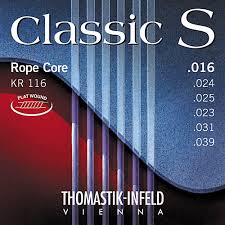
Ordinarily, these Thomastik-Infeld Classic S strings sound more like nylon strings than steel ones.
But their cores ARE steel — which means you can play through a magnetic pickup and mutilate the tone with amps and effects. I’m playing through effects designed for Apple’s MainStage software. (Some of them are in Logic Pro’s included sound library.)
I’m working on this version of Leonard Cohen’s “Suzanne” as part of album in progress: a collection of radically reinterpreted songs from 1967. I haven’t nailed down the final song list. (If you review the list of amazing songs from that year, you’ll understand why. And that link only cites the songs that charted, and doesn’t include classics like the first Velvet Underground album, some great Jobim tunes, random stuff like “Some Velvet Morning,” and lots more.) By hook or by crook, I hope to have the project done before year’s end in time to cynically capitalize on pay tribute to the 50th anniversary of that musically monumental year.
Some interesting tech notes: I’ve you followed this blog, you’re no doubt sick to death of my evangelizing for Thomastik-Infeld rope-core strings. But this is the first time I’ve put them on my Lowden S-25, my main acoustic guitar for nearly 20 years. Its default tone is super loud and bright. (Larry Fishman once referred to it as “a fucking cannon.”) But these days my ears are drawn to darker, softer tones. The Classic S transformed this laser-bright acoustic into an expressive crooner.
Meanwhile, I’ve become a bit alienated from traditional nylon strings over the years, but these, with their hybrid nylon/steel sound, hit just the right sweet spot for me. They’re extremely quiet (though they don’t sound like it when close-miked like this), but they have vast dynamic range and a smooth, sexy feel.
I’d previously written that this set is the same as the (cheaper in the U.S.) John Pearse Folk Series Fingerpicking strings, but I was mistaken. The story I hear was that the late Mr. Pearse, working with Thomastik-Infeld, devised this set for Brazilian guitar monster Bola Sete. But on the current Pearse set, the bass strings have nylon cores, while the Classic S bass strings have steel cores. That means you can use the TI set with a magnetic soundhole pickup, allowing you to plug into amps and effects. (I’ll be posting an example soon as a companion piece to this video.) But both sets sound lovely, and both allow you to bend strings as you would on an electric guitar — something you definitely can’t accomplish on conventional classical strings.
I don’t have a ton to add about the sublime Leonard Cohen. But “Suzanne” has always exerted a deep emotional spell on me — even, as here, minus the lyrics.
Sorry for even more solipsistic stompbox stuff, but I couldn’t resist. David Torn, one of the players I admire most on earth, just posted an unsolicited demo of my Filth Fuzz on Soundcloud. I love his post-apocalyptic soundscape.
For the uninitiated, David is one of those rare players who deploys staggering technical skill in a bold, unique style utterly unpolluted by cheesy guitar heroics. He’s recorded with Bowie, Tori Amos, John Legend, Madonna, and k.d. lang and created many brilliant solo albums. Last year’s Only Sky is particularly magnificent. It makes a great introduction to this singular guitarist/composer.
Lucky me: I just started rehearsing for a duo project with one of my guitar heroes, the brilliant Mark Goldenberg. Here’s a run-through of “Eleanor Rigby,” one of the tunes we’re working on. It’s pretty rough still, and the recording quality ain’t great. But I love Mark’s playing so much here that I couldn’t resist sharing.
I’ve only known Mark a year or two, but we hit it off as soon as we met at one of Teja Gerkin’s solo guitar events. Mark played ravishing solo version of so many of my favorites: “God Only Knows,” “Shenandoah,” “Wichita Lineman,” “Mood Indigo,” and more. I love his ultra-dynamic touch and beautiful Bill Evans-style harmonies. Plus he’s just an cool guy.
And it turns out we both studied with the same teacher: the late Ted Greene. (I took lessons from Ted as a teen, with a few more sessions 20 years later. Mark studied with Ted long after he became a leading LA sideman and session player.) You can read more about Mark on his website. He’s recorded and toured with Jackson Browne, Bonnie Raitt, Linda Ronstadt, Eels, Natalie Imbruglia, Chris Isaak, Waylon Jennings, Willie Nelson, Peter Frampton and — hehehe — William Shatner. It’s a real thrill to collaborate with such an inspired player.
I’m playing a Gretsch TV Jones baritone on loan from my pal Xander Soren. Mark’s playing his magnificent mahogany Collings.
I just started a Tonefiend Instagram feed, ’cause I know there’s not enough junk in your inbox. If you’re an Instagram user, feel free to follow. (Or just friend me on Facebook, where all the Instagram images also appear. I’m not picky—I’ll friend anyone, at least till they start posting links to $19 Prada handbag knockoffs.)
Often I don’t post here at tonefiend.com till I’ve cobbled together a relatively substantial item, which means the site can fester for weeks without an update. But for better or worse, I plan to post a steady stream of square cell phone pics compelling images and trivial pithy thoughts on Instagram/FB/Twitter.
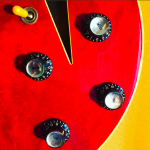
On Instagram, I’m starting out with two weekly posts. Both are pretty silly, but each has inspired some surprisingly cool conversations. The first series is “Name That Gear,” which is simply a close-up shot of some music gizmo, but with some telling detail that reveals its identity. Not much too it, but it can be fun.
Page vs. Wagner: Who’d Win in a Fight?
The other recurring item is “Who’d Win in a Fight?” These are deliberately absurdist: The first post matched Jimmy “Hammer of the Gods” Page against Richard “Twilight of the Gods” Wagner. But amazingly, it inspired a long, fascinating, and drop-dead funny Facebook conversation. (Thanks for my wife for suggesting both ideas.)
Naturally, I’ll also be using those feeds to shamelessly flog my music and gear. I’m going to be showing the first five Joe Gore Pedals stompboxes at the LA Amp Show in Van Nuys, California on October 3rd and 4th—just a couple of weeks from now! The product announcements aren’t quite ready yet, but trust me—I bombarding you with them very soon. 🙂
No, I don’t mean like, “What’s better: B-flat or F-sharp?” Rather, is there a single note from a great recording or performance that haunts your dreams?
Here’s what go me on the topic: One of my Premier Guitar colleagues, Gary Ciocci, recently turned me on to El Twanguero (aka Diego Garcia), a brilliant Spanish-born, Argentina-based electric guitarist who’s created a head-spinning fusion of classic Latin jazz and rockabilly guitar. The only thing I don’t worship about the great Afro-Caribbean music of the 1950s and ’60s is the fact that it rarely includes guitar. But in Garcia’s retro fantasia, it’s as if the great Cuban and Puerto Rican mambo kings had migrated to Memphis instead of settling in NYC.
Diego “El Twanguero” Garcia: ¡Bien tocado, señor!
When I explored Garcia’s YouTube channel, I immediately clicked on his version of “Cherry Pink and Apple Blossom White,” a Perez Prado classic that topped the charts in 1955. (You probably know the tune even if you don’t recognize the title — it’s been in a zillion movie soundtracks.) I was eager to hear how Garcia would interpret the famous trumpet slur — perhaps the booziest single note ever recorded. (Yes, theory sticklers — I’m using the word “note” to mean a single articulated note, even when it spans multiple pitches over its duration.)
The tipsy note appears right at the top — it’s the fourth pitch in the trumpet melody. But it gets boozier and woozier with each repetition, and by its dead-drunk appearance at 2’27”, it’s amazing anyone’s still standing up.
Okay, try to convince me that it isn’t the sleaziest note ever! (Just for fun, here’s a live performance, where you can see what Prado looks like when emitting his signature grunt.)
How the hell would you render that on guitar without period-inappropriate distortion and locking tremolo? Take it away, Sr. Garcia!
Love it! ¡Bien tocado, Señor!
That got me thinking about other favorite notes. My #1 choice was easy — it comes at the end of this post. But two others also sprang to mind.
George Harrison’s “It’s All Too Much” used to be considered one of the Beatles’ least important tracks, though it seems to have been critically rehabilitated over of the course of the last few psychedelic revivals. It was cut in 1967 between the recording and release of Sgt. Pepper, just when the Beatles were discovering LSD. (It shows). But it wasn’t issued until 1969, when it appeared as a throwaway on the Yellow Submarine soundtrack — the first album I ever purchased with my own money. (And I’ve never recovered from the horror of discovering that side B features no Beatles material — just George Martin’s twee orchestral soundtrack.) But that blast of sustained feedback carved its way into my consciousness.
The experts say George played it, though I doubt anyone present was coherent enough to recall. I’m not saying it ain’t George, though I can’t help noting that whenever you investigate a particularly ferocious bit of Beatles guitar work, the perpetrator always seems to be Paul. (Examples: “Helter Skelter” and the solos on “Taxman” and “Good Morning.”) I dunno — maybe acid unleashed Harrison’s inner beast.
Another note that’s possessed me for decades is from Miles Davis’s heartbreaking take on Rogers and Hart’s “It Never Entered My Mind.” (From Workin’ — the first jazz album I bought with my own cash, at age 14.) Man, you could write a dissertation on the first eight bars of Miles’ solo, and someone probably has. Even though the notes are few and far between, I dare you to try playing along, matching the trumpet phrasing. But the highlight for me is the sublimely out-of-tune note in the fifth bar of the trumpet head. (It first appears at 0’33” in this clip.)
The performance is in A-flat, and the special note is a very flat E-flat — about halfway to D-natural. Man, how does something so wrong feel so … not just right, but transcendent?
That was my favorite note for many years, until I became a born-again Ellingtonian. Friend/genius Stephen Yerkey turned me on to Ellington’s 1938 remake of his own “Black and Tan Fantasy,” whose original 1927 version is universally regarded as one of the most important early jazz discs. But the 1938 remake is equally brilliant. Duke’s band was at or near the height of its powers. The orchestration is sublime. The piano work is radical. Each solo is a jewel. And then there’s THE NOTE.
Now, there’s nothing I find more musically distasteful than a cheesy, star-searchin’ vocalist wowing the crowd with a long sustained note. I hate it just as much when operatic singers do it (as did many of the great opera composers). And using the national anthem at ball games as a pretext is just plain nauseating.
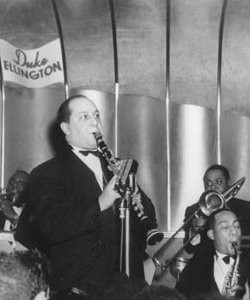
Did Barney Bigard play the greatest note ever?
Yes, THE NOTE is impossibly long and difficult. But there’s more here than sheer virtuosity. The painfully slow glissando literally makes you dizzy, as if the world were tilting off-axis. (It’s more psychoactive than the Beatles on acid!) It exerts exquisite tension against the backing harmonies, and it lets Duke display his most Debussy-like side in his watery, chromatic piano accompaniment. And the dismount is astonishing: Another wind player would be gasping on the floor, but incomparable clarinetist Barney Bigard (also featured on the 1927 original) concludes with a soft, casual phrase, as if he had all the time and breath in the world. For me, this is the ultimate musical embodiment of “cool” in its most profound African diaspora sense.
Play it, Mr. Bigard! The miracle commences right after 1’15” (but please, treat yourself to the entire performance).
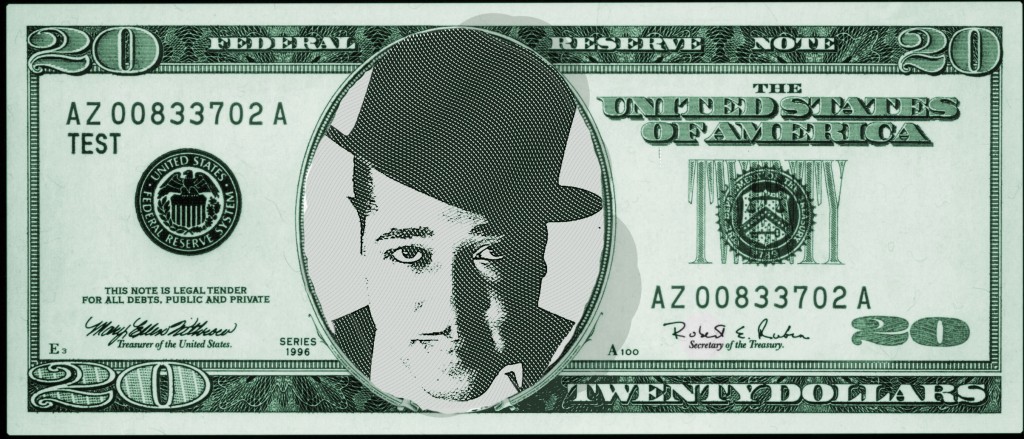
(I know I’ve said this about 50 times on this blog, but I repeat it whenever possible: In much of the civilized world — Europe in particular — the arts are considered precious, and musicians routinely appear on currency. If Americans gave a crap about culture, our greatest composer would grace the $20 bill, not genocidal Jackson. Though admittedly, there’s a strong case for Harriet Tubman.)
Okay, enough of my yakkin’! What’s your favorite note?
For a while I’ve been playing this loop-based cover of Foster the People’s “Pumped-Up Kicks” at solo gigs and with my duo band, Mental 99. At risk of sounding like a pompous dick, I’ve annotated the performance, highlighting techniques I’ve found useful for making loop-based performances livelier and less predictable.
I’ve covered some of this ground before, particularly in this Premier Guitarlooping-technique article. But here I call out the techniques mid-performance, and I’ve included a few new ones. I hope you find some of them useful.
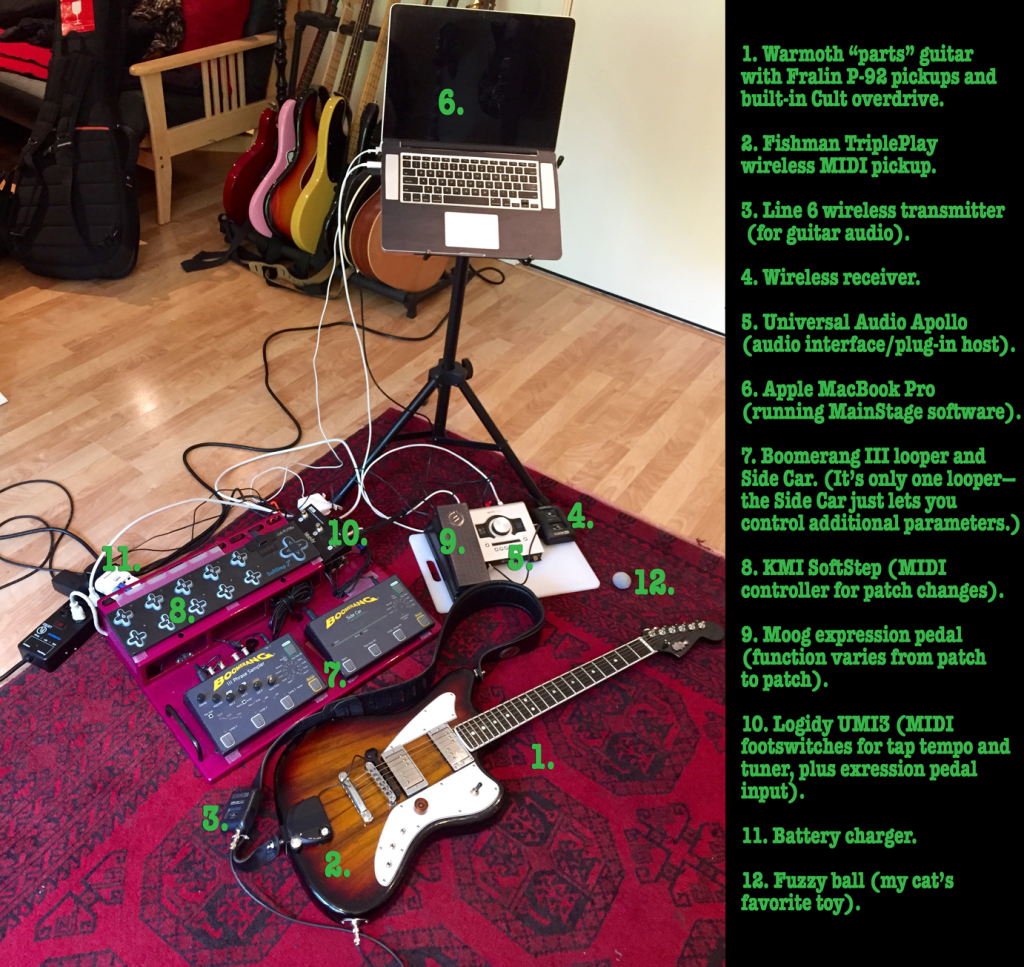
Likewise, I’ve already written about my live looping rig, but it’s changed a bit since then, and I’ve recently integrated a Universal Audio Apollo Twin interface (plus the stellar plug-ins it allows me to run). An updated overview:
The arrangement perform nicely, and I dig the individual components. But I dislike the system’s Rube Goldberg complexity—it’s a royal pain to set up and schlep. I’m always looking for ways to simply. (Other than, you know, just plugging the guitar into a frickin’ amp.) I’m open to suggestions for streamlining!
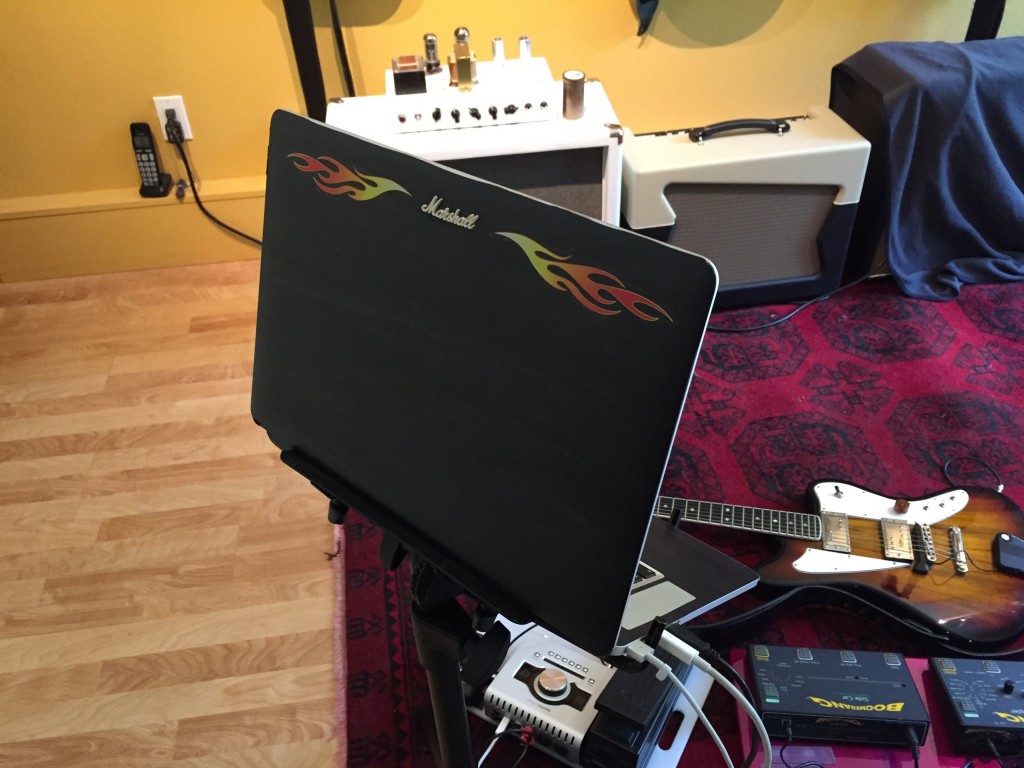
I love Apple products, but I hate having Macs onstage (mainly ’cause they’re so much better looking than me). Covering it in black wrap makes it less obtrusive. The Marshall logo is from one of those “toy” stacks (which, of course, can be far more than toys in the studio).