This is an exciting post for me, and not just because I get a desperately needed break from Klons and Screamers. I’m thrilled to bits about Logic Pro X and MainStage 3, though I’m still wrapping me head around them. (Yeah, I worked as a developer for both products, but I didn’t get a proper program-wide view until last week’s release.)
Also, it’s my first story for Premier Guitar, whose staff I’ve just joined as a senior editor. I’m stoked because it reunites me with PG editor Shawn Hammond and senior editor Andy Ellis, both of whom I remember fondly from my Guitar Player magazine days.
There’s much talent and coolness on the staff. I’m a happy little guitar nerd. Plus, the schedule is loose enough that I can still record, perform, and continue to work with audio/software clients.
What does the gig mean for this blog? Good things. I have no plans for a major course change — there are too many things I can only cover on a non-commercial site, including some of the topics closest to my heart. Meanwhile, working with PG will keep me more up-to-date on new music, new gear, and scurrilous guitar community gossip. In some cases, though, I may link to a PG article I’ve written rather than duplicate the work here. Today, for example. 🙂
Apple released the long-awaited Logic X a few minutes ago. And it’s dripping with cool new guitar and bass stuff: a fabulous bass amp modeler. Lots of new virtual stompboxes. Vast new libraries of guitar tones, and newer, smarter ways of accessing them. More product info here.
FYI, I’m the furthest thing from an unbiased source: Apple is one of my clients, and I was a major indie developer for this product. But hey — the guitar features here are seriously bitchin’.
Using the same “reasonably scientific” techniques deployed in my recent germanium fuzz survey, I’ve created a blind listening test that removes as many variables as possible from the equation.
The video details the testing procedures. But basically, the A/B recordings are identical save for the use of one pedal or the other. The rival pedals are Klon Centaur #309 (the unit reviewed in Guitar Player back in the ’90s) and a new BYOC Overdrive 2, a DIY Tube Screamer clone kit with extra knobs and pots to provide the most popular boutique mods.
This Klon would fetch north of $2,000 on EBay. You can order the Overdrive 2 online for $95.
Now, these two pedals are NOT identical circuits. (The key differences are covered in the video.) But they share the same topology and sonic character. It’s not an apples and oranges comparison — more like two apples of distinct but related varieties.
For the video I dialed in five different sounds from across the Klon’s range, and then tried to duplicate them with the BYOC Screamer clone. You’ll hear the same material ten times, like so:
Example 1: medium gain, medium tone
Pedal A =
Pedal B =
Example 2: high gain, medium tone
Pedal A =
Pedal B =
Example 3: low gain, medium tone
Pedal A =
Pedal B =
Example 4: medium gain, bright tone
Pedal A =
Pedal B =
Example 5: medium gain, dark tone
Pedal A =
Pedal B =
To compete, just fill in the blanks and copy your answers into the comments thread below.
The pedals might not appear in the same order for each pair of audio clips. Other than that, there are no sneaky tricks. (For example, you really do hear two different pedals for every example.)
The first three contestants to submit perfect scores before Tuesday, July 23rd, 2013, will each win fabulous prizes one of my hand-built stompboxes. On that date I’ll post the answers and announce the winners here, assuming there are some. You can still test your ears after that by watching this video and not peeking at the answers — but sorry, no more prizes.
Only one entry per person. Anyone caught circumventing this rule via multiple identities may be subject to global ridicule.
I’ll hold off on any sonic observations till I post the correct answers next week.
Good luck, and may the best ears win some gnarly stompbox.
Soloist, Sideman & Steely Dan’s Guitarist of Choice
One unexpected pleasure of my recent Marianne Faithful mini-tour was getting to hear guitarist Jon Herington at the Kate Wolf Music Festival.
Jon Herington with his Gibson ES-336. [Photo: Tony Kukulich.]
Since 1999, Herington has been best known to audiences as Steely Dan’s touring and recording guitarist. He also performs with The Dukes of September Rhythm Review, an all-star band featuring Donald Fagen, Michael McDonald, and Boz Scaggs. And when he’s home in New York, he sings and plays with his trio, the Jon Herington Band, whose material blend bluesy raunch with sly, jazz-informed harmonies in a way that Steely Dan fans are likely to love. (Their latest release is Time on My Hands.) He’s also worked with many other jazz and pop luminaries (partial discography here).
Angel-voiced Madeleine Peyroux was onstage when out van pulled up at the festival. She was performing a set of intimate chamber jazz, complete with strings and a whisper-quiet rhythm section. We couldn’t see the band, but man, could we hear them! When the guitarist took flight with a ravishingly lyrical slide solo — in standard tuning, no less — my bandmate Rob Burger and I turned to each other. “Who is that?” I mouthed. More lovely guitar work wafted from the stage: a fluent bop solo. Sublimely understated rhythm guitar work straight out of a 1940s session. “Seriously,” I muttered. “Who is that?”
It was Jon, of course. As he left the stage, I plied him with as many questions as the quick set change permitted. How did he get those tones? How did he wring such a great slide sound from that Gibson ES-336 using conventional tuning and a standard setup? I was also curious about the demands of the Steely Dan gig, and not merely the challenge of performing a vast catalog of complex guitar parts for the notoriously demanding duo of Walter Becker and Donald Fagen. How, I wondered, would a player approach those oh-so-varied riffs and solos? How would a guitarist honor those beloved solos without making them sound canned?
I didn’t have time to ask half those questions. But Jon, a charming, articulate fellow, agreed to an email interrogation upon his return home, even though he’s busy with Steely Dan rehearsals in advance of the band’s summer tour. (more…)
D’oh! I omitted a circuit from the Fuzz Detective video. It’s the germanium version of the Shin-Ei Companion Fuzz FY-2. So here’s a brief Fuzz Detective Appendix.
The silicon version of the FY-2 is a cult item, a nasty little thing best known for its appearance on Jesus and Mary Chain’s Psychocandy album. The germanium version (which I didn’t even know existed until reader Bear pointed it out!) is a very different beast. Most notably, it lacks the silicon version’s signature midrange scoop, delivering a thicker, fatter sound.
As noted in the video, I replaced the stock B50K gain pot with a B5K. (The overall range of tones is pretty much the same, but this way, all the variations aren’t crammed into 10% of the knob’s range.) Construction details and testing procedures are the same as they were for the 12 Fuzz Detective pedals. (more…)
WHAT: Twelve germanium fuzz circuits compared and analyzed. These represent the sounds of almost every fuzz pedal introduced between 1962 and 1968.
WHY: A tool to help players identify the circuits most relevant to their musical needs. This isn’t about particular brands of pedals, but the circuits they employ. If you hear something you like, you can either do as I did and build a clone from the schematic, or buy one based on that particular design. (The relative merits of rival clones is another story.) Of course, if you’re rich and you desire an ancient pedal that probably doesn’t sound as good as a new clone, you can always purchase a vintage original. 😉
HOW: I tried to establish a “level playing field” by removing as many sonic variables as possible. I used the same signal chain, the same guitars, the same musical material, etc. (Tech details below.)
WHO:
Maestro FZ-1 Fuzz Tone
Sola Tone Bender Mk 1
Hornby-Skewes Zonk Machine
Sola Tone Bender “Mk 1.5” (similar to Vox Tone Benders)
Dallas-Arbiter Fuzz Face
WEM Pep Box Rush
Sola Tone Bender Mk II (same as Marshall Supafuzz)
Mosrite Fuzzrite (germanium version)
Orpheum Fuzz (germanium version)
Selmer Buzz Tone
Sola Tone Bender Mk III (same as Park Fuzz Sound, Carlsbro Fuzz)
Tonefiend Book Week is simple: I discuss a few titles I’ve found particularly enlightening, useful, or entertaining, and then you jump in and do the same. I’ve organized the days of this week by subject matter. Today’s topic: musical fiction.
In comments to yesterday’s installment on musical autobiographies, several folks mentioned the Real Frank Zappa Book. Which reminds me of a quote often (and apparently incorrectly) attributed to Frank: “Writing about music is like dancing about architecture.”
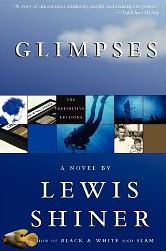
A music fan rescues ’60s rock via time travel. (Not as dorky as I’m making it sound!)
The line probably originated in reference to music journalism, but it applies just as well to fiction about music. Countless novelists and screenwriters are ardent music lovers. Yet there aren’t many novels or films that capture the act of music creation — what’s it’s like to be a musician.
The problem isn’t a lack of passion for music. Leo Tolstoy, Thomas Mann, and Victor Hugo were knowledgable listeners who channeled the emotions they perceived in great music into equally great prose. But even among literary titans, depictions of the music-making process tend to be as bogus as that clichéd Hollywood montage: Composer paces room. Furiously crumbles aborted manuscript page. Howls at moon. And then — Eureka! — a Masterpiece is born.[CUT TO END OF CONCERT, STANDING OVATION.]
Writers seem to do better depicting the worlds that surround music. For example, Jennifer Egan’s 2011 novel A Visit from the Goon Squad includes scenes set in the old San Francisco punk scene, and she nails the vibe. Many fine younger writers — Egan, Dave Eggers, Jonathan Lethem — are obvious rock geeks who skillfully evoke the experience of music consumption. There are also memorable depictions of fandom, notably Nick Hornby’s 1996 novel High Fidelity. But few books attempt to provide glimpses into the musicianly mind. (Actually, I haven’t yet read Lethem’s You Don’t Love Me Yet, which is set in the indie rock scene. Have any of you? I sure love his Motherless Brooklyn and Fortress of Solitude.)
At worst, smart writers sound stupid when attempting to write knowingly of music creation. I dig most Salman Rushdie I’ve read, but man, his 2000 “rock” novel, The Ground Beneath Her Feet is a stinker. Rushdie attempts an alternate rock history via his signature South Asian magic realism, and the result isn’t fantastical — it’s bunk. Sorry, partying with members of U2 doesn’t automatically afford vast insight into the musicianly mind. Or at least that’s been my experience. 😉
Tonefiend Book Week is simple: I discuss a few titles I’ve found particularly enlightening, useful, or entertaining, and then you jump in and do the same. I’ve organized the days of this week by subject matter. Today’s topics are musical biographies and autobiographies.
Classic rock fans have been rewarded with many cool autobiographies in recent years: Keith Richards’ Life, Patti Smith’s Just Kids, Bob Dylan’s Chronicles, Neil Young’s Waging Heavy Peace, and Pete Townshend’s Who Am I: A Memoir, to name a few. I’ve read Richards and Smith, and I plan to read the others. Any thoughts about those and similar titles?
And then there are the great jazz autobiographies, such as Miles Davis’s Miles and Duke Ellington’s Music is My Mistress. Despite their alleged omissions and inaccuracies, both are epic accounts of epic lives dedicated to epic music. (So which is better: a lively, lying-through-the-teeth autobiography, or a dry but truthful biography?)
But my favorite musical autobiography is Hector Berlioz’s Mémoires, first issued in 1865.
Hector Berlioz: total punk!
This, admittedly, isn’t a book for all musicians, or even most musicians. It concerns the explosive classical music scene of 19th-century Europe. If that topic holds no interest, the Mémoires probably won’t either.
But consider: Berlioz (1803-1869) is, along with Debussy, France’s greatest composer. He was a founder of Romanticism, and the first composer to fuse literature and instrumental music on a grand scale. He helped create the modern concept of orchestration and wrote the first orchestration manual. And of all the great composers, Berlioz is hands-down the best writer. He is arrogant, irreverent, sarcastic, and blisteringly funny. If you enjoy, say, the acidic humor of Mark Twain’s essays, you’ll dig Berlioz’s voice.
And like Twain, Berlioz played guitar. (More on that in a bit.)
The Mémoires drip attitude from page 1:
Needless to say, I was brought up in the Catholic faith. This charming religion (so attractive since it gave up burning people) was for seven whole years the joy of my life, and although we have long since fallen out, I have always kept the most tender memories of it.
Berlioz’s music was often less than subtle. Here’s one contemporary caricature.
…and it never lets up. We meet the era’s greatest composers and performers and learn what it was like to be a professional musician in an era before recorded music. Concerts were longer. Audiences were more passionate. Wars were waged in the music journals. If you think going on tour today is demanding, imagine it in an era of unpaved roads and horse-drawn carriages. (more…)
This week we’re talking about our favorite guitar/music books. The plan is simple: I discuss a few titles I’ve found particularly enlightening, useful, or entertaining, and then you jump in and do the same. I’ve organized the days of this week by subject matter. Today’s topic is guitar gear.
Guitar gear books seem to fall into three categories:
Pornographic. Lavish publications featuring beautiful photos of rare instruments, often focusing on a single manufacturer or collector.
Encyclopedic. Thick reference books covering wide swaths of guitar history.
Pragmatic. Books that explain the inner workings of guitar technology, with an emphasis on how to turn this info to your musical advantage.
Even if I weren’t a jaded former guitar mag editor, I doubt I’d have much interest in coffee-table guitar porn books (and the occasional guitar porn magazine). Or at least, no more interest than I’d have in photos of, say, beautiful watches, speedboats, or nutcrackers. I’m not a guitar collector.
Not on my coffee table, you don’t!
Hey — stop laughing! Yeah, I own more than 20 guitars. (The exact number depends on whether I count guitars I’ve loaned out indefinitely and ones I’ve borrowed indefinitely.) I appreciate my instruments greatly, and I am very aware of how fortunate I am to have access to so many musical tools. But in the end, they are just tools to me, with little significance beyond their musical applications.
I realize this is a pretty weird attitude for a guitar dude, and one reason why I was probably never a perfect fit as a guitar mag editor. (I must be missing some crucial male gene, because I’m equally blasé about cars and sports. With rare exceptions.)
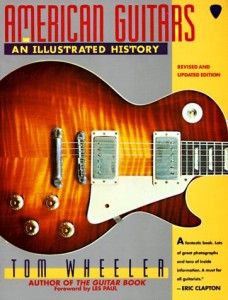
The classic reference book.
Reference books are a different story, especially the books of George Gruhn and Walter Carter, and those of Tom Wheeler. Sure, some of their weightier works have guitar porn aspects, but always paired with vast historical knowledge and the expertise of longtime industry insiders. Gruhn and Carter may know more about American guitars than anyone. But I always gravitate to Tom Wheeler’s books, and not just because he’s a longtime friend and mentor. Tom is a fine writer, an impeccable researcher (he’s been a journalism prof for the last 20 years), and he still conveys a teenager’s passion for the instrument. Tom is my hero.
(Bonus question: Has Wikipedia rendered the guitar reference book obsolete?)
But these days, the gear books that excite me most are the technically slanted, nuts-and-bolts titles. It’s one thing to ogle pretty instruments, and another to explain how they work, why they sound the way they do, and what that all means for the music we make today. And that’s why I love the books of Dave Hunter. (more…)
Silk and steel — bad-ass, or strictly for wusses?.
It’s been a long, long time since I’ve tried silk and steel strings.
I’ve always thought of them as a transitional set for students migrating from nylon to steel strings. At least that’s how my mom used to explain them to me back when she was giving me my first lessons. Like many players, I viewed them more as a remedy for tender fingertips than a sound you’d actively seek out.
But over time, almost everything I thought I knew about strings turned out to be wrong. So I figured I’d give silk-and-steels a fresh listen.
This thread over at the Acoustic Guitar Forum seems like a fair summary of common attitudes about these strings. Opinions seems divided between players who simply find silk-and-steel strings too soft and quiet to be of much use, and those who enjoy them for fingerstyle playing, especially on small-bodied guitars.
I’ve been frustrated finding the right strings for the old Martin acoustic I picked up last year. I had a violent reaction against coated bronze strings, which I wrote about here. But I was kind of digging the way Martin Marquis 80/20s bronze strings sounded on the instrument, as heard in this video. Sometimes, though, the tone is just too harsh and clacky, so I wanted to try something lighter and softer.
I slapped down this quick duet performance of “Drewrie’s Accordes,” an anonymous lute duet found in The Jane Pickering Lute Book, a manuscript anthology of late 16th-century lute pieces. (This would have been played on gut strings in its day, and is usually performed on nylon-string classical guitar or lute today. My steel treble strings are definitely not historically correct, though some wire-stringed fretted instruments such as the cittern did exist in the Renaissance.)
Observations after the video.
Compared to all-metal strings, the silk-and-steels are definitely quieter, with less treble bite. I like their soft, malleable feel for intricate fingerstyle playing like this. They offer relatively smooth transitions between unwound and wound strings. They exhibit less clacky string and fingernail noise. Playing aggressively with a pick definitely “overloads” them, and would no doubt destroy the windings in short order. Even when playing exclusively fingerstyle, you get the sense that the bass strings aren’t long for this world. But I enjoy their sweet, quasi-classical tone, which to my ear does indeed split the difference between nylon and all-metal strings.
Still, I’m not sure I want to commit to having these on the guitar all the time. (I wish the guitar had a switch to toggle between a bronze and silk-and-steel sound!) Also, these are lighter than I usually play (the treble is .0115, and I pretty much never go below .012). But the relaxed tension does seem to suit this particular guitar.
How about you guys? Any experience with these soft-spoken strings? Do you think they sound cool, or are they merely a salve for sore fingers? And has anyone tried John Pearse silk-and-bronze strings? (That’s probably the next stop on this particular string quest.)
P.S.: This is also a pretty good example of how I apply lute techniques to steel-string playing, as I mentioned here. For most of the fast bits, I pick alternately using my right-hand thumb and index finger. A proper classical player would be more likely to alternate index- and middle-finger. Also, my right thumb sometimes drifts “behind” my right-hand fingers (that is, closer to the bridge). Classical players rarely position their picking thumbs closer to the bridge relative to the fingers. It’s not conscious on my part — it just what my hand does when I’m trying to brighten the bass notes and darken the trebles.
 As promised: an overview of Apple’s new Logic X Pro, with an emphasis on what’s new and cool for guitarists and bassists. Lots of movies and audio!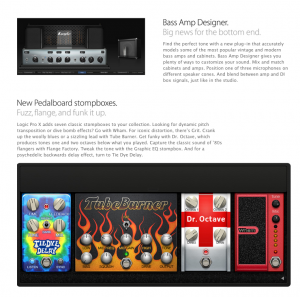
![Jon Herington with his Gibson ES-336. [Photo: Tony Kukulich.]](https://tonefiend.com/wp-content/uploads/AMK001-199x300.jpg)