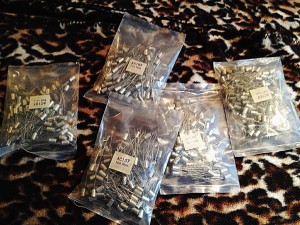
(Yes, as a matter of fact, I am insane. Why do you ask?)
UPDATE: My Dunlop Fuzz Face Mini review is live at Premier Guitar. Audio clips included!
How and when did it get so frickin’ easy to procure great-sounding germanium transistors?
I’ve been building stompboxes for four years or so. I used to consume article after article detailing the sheer horror of dealing with germanium. Sure, those old-school transistors sound great, I’d read, and they’re necessary for vintage distortion circuits. But they’re unstable. They’re expensive. They’re hard to find. You have to sort through dozens to find the few good ones. And once you do, you must spend countless hours matching and biasing them for optimal sound.
I believed everything I read — until I finally admitted to myself that I seldom encountered any of those problems.
(If you don’t know much about germanium transistors and why they’re cool, here’s my manifesto.)
I used to buy germanium transistors from Small Bear and other parts sites, and was always happy with the results, even though I had to pay eight or ten bucks per transistor. (Small Bear even does the matching for you, offering sets of transistors suitable for various vintage fuzz circuits.) However, it was a little tough finding NPN (negative-ground) germanium transistors. In fact, Small Bear once rejected my order of a dozen or so NPNs because they were so scarce. (To his credit, Small Bear’s Steve Daniels explained that he restricted sales so that everyone who wanted to build a couple of great DIY fuzzes would have the opportunity.)
The workaround is to build pesky positive-ground pedals, or jigger with the schematic in order to use PNP (positive-ground) transistors in negative-ground circuits. (This site’s Fiendmaster project is an example of the latter workaround.)
Then some odd things happened: