Categories
Gigs Music Pickups Recording

Guitar Mag Gossip: Personal and Practical

Screenshot 2015-11-02 12.42.23

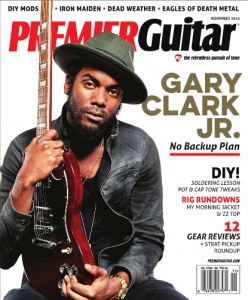
I’d like to call out several items of interest in the November issue or Premier Guitar. The first one is personal: As head honcho Shawn Hammond mentions in his monthly editor’s letter, I’m changing roles at the magazine. After two years as a part-time senior editor, I’m going part-part-time as a contributing editor.

It was a tough call for me — it was a fun gig working with awesome people on subjects I love. But I’ve felt an increasing need to dedicate more time to my own projects: playing, recording, writing, developing gear, and trying to make my tonefiend.com blog and YouTube channel seem a bit livelier than something you’d encounter at Urban Ghosts. (It’s one of my favorite websites, but not the attitude I’m aiming for here.)

If you’ve enjoyed the articles I’ve contributed to PG, well, first of all, thanks! And second, note that I’ll actually be contributing more columns and reviews than before. That may sound contrary to the laws of physics, but it’s possible because I will no longer be editing material by other writers. (I’d been processing an average of 35 stories per month in addition to my bylined pieces.) Picking up the slack will be new hire Ted Drozdowski, a fine writer and player, a lovely guy, and one of the music journalists I looked up to when I got into the guitar mag racket decades ago. (Ted was part of the now-legendary Musician magazine of the ’80s and ’90s.) Meanwhile, I’ll be contributing my Recording Guitarist column and at least three major gear reviews per issue.

Also in the issue are several tech-oriented pieces that I found particularly interesting. My old pal Frank Falbo — a leading pickup designer and master luthier — contributed a great piece on pot and capacitor substitutions. More than anything I’ve read, Frank’s article nails down exactly what changes to expect when swapping out part values, documented via audio files.

For me, the most fascinating part is how varying tone-pot values change your guitar’s tone, even when the tone knob is wide-open. Yeah, a lot of us would expect some change, because pots of varying resistances exert different loads on your pickups. But as far as I know, no one has ever nailed down the exact differences the way Frank has.

Others generalize. Frank Falbo nails it down.

Spoiler alert: The differences are massive — it’s a far bigger deal than I’d always assumed. Check out Frank’s first set of sound clips and prepare to be impressed.

It’s not a new idea that you can shift the overall tone of a guitar “bright-ward” or “dark-ward” by swapping pots, but Frank makes explicit how dramatic such changes can be, and what to expect from the likeliest substitutions.

I also learned much from two articles I wrote. The first is a shootout between five sets of ultra-vintage-style Strat replacement pickups, featuring models by Amalfitano, Fender, Klein, Manlius, and Mojotone. (Spoiler alert #2: They all sound pretty great, though the Kleins and Mojotones were my personal faves.)

I only realized after evaluating tones that the two sets I loved most don’t deploy a hotter pickup in the bridge position, while the other three do. (I don’t mean some blazing-hot bridge pickup, but one just a tasteful tad louder than the others, an approach many Strat players seem to love.) In the Klein and Mojotone sets, the middle pickup is loudest. Food for thought.

There are good reasons why few guitar mags run serious pickups reviews, and almost never compare models directly: It’s labor-intensive, and it’s damned hard to establish a level playing field. Here, I tried to remove as many variables as possible, installing all the pickups in the same test guitar, scrupulously measuring everything from pickup height to mic position, and laboring mightily to create identical demo performances for each set. My favorite part appears on the final page of the article, where you can directly compare each pickup from each manufacturer side-by-side.
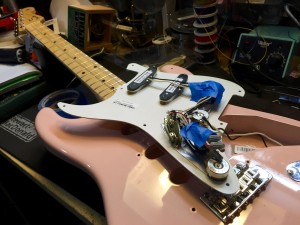
This poor pink Strat got one hell of a workout.

Finally, you might find interesting the audio clips in my latest Recording Guitarist column. It’s about is direct recording, a topic I’ve been covering since this blog began. I got cool sounds using a JHS Colour Box (a dumbed-down Neve channel in stompbox form) and especially with the Neve preamp simulations in the latest Universal Audio software. I’m hardly the first to point this out, but wow! Some recent plug-ins are so stupefyingly realistic that they can mimic analog gear pushed to extremes — a longstanding weak link in faux-analog plug-ins. I found it easy to create cool and compelling sounds without amps or amp simulators. Let me know what you think.

Okay, now I’m nodding off from jet lag. I just returned from a two-week trip to Italy, which generated some interesting musical thoughts and discoveries that I’ll share here soon. 🙂

Categories
Pickups

What’s Your Favorite Note?

No, I don’t mean like, “What’s better: B-flat or F-sharp?” Rather, is there a single note from a great recording or performance that haunts your dreams?

Here’s what go me on the topic: One of my Premier Guitar colleagues, Gary Ciocci, recently turned me on to El Twanguero (aka Diego Garcia), a brilliant Spanish-born, Argentina-based electric guitarist who’s created a head-spinning fusion of classic Latin jazz and rockabilly guitar. The only thing I don’t worship about the great Afro-Caribbean music of the 1950s and ’60s is the fact that it rarely includes guitar. But in Garcia’s retro fantasia, it’s as if the great Cuban and Puerto Rican mambo kings had migrated to Memphis instead of settling in NYC.

¡Bien tocado, señor!
Diego “El Twanguero” Garcia: ¡Bien tocado, señor!

When I explored Garcia’s YouTube channel, I immediately clicked on his version of “Cherry Pink and Apple Blossom White,” a Perez Prado classic that topped the charts in 1955. (You probably know the tune even if you don’t recognize the title — it’s been in a zillion movie soundtracks.) I was eager to hear how Garcia would interpret the famous trumpet slur — perhaps the booziest single note ever recorded. (Yes, theory sticklers — I’m using the word “note” to mean a single articulated note, even when it spans multiple pitches over its duration.)

The tipsy note appears right at the top — it’s the fourth pitch in the trumpet melody. But it gets boozier and woozier with each repetition, and by its dead-drunk appearance at 2’27”, it’s amazing anyone’s still standing up.

Okay, try to convince me that it isn’t the sleaziest note ever! (Just for fun, here’s a live performance, where you can see what Prado looks like when emitting his signature grunt.)

How the hell would you render that on guitar without period-inappropriate distortion and locking tremolo? Take it away, Sr. Garcia!

Love it! ¡Bien tocado, Señor!

That got me thinking about other favorite notes. My #1 choice was easy — it comes at the end of this post. But two others also sprang to mind.

George Harrison’s “It’s All Too Much” used to be considered one of the Beatles’ least important tracks, though it seems to have been critically rehabilitated over of the course of the last few psychedelic revivals. It was cut in 1967 between the recording and release of Sgt. Pepper, just when the Beatles were discovering LSD. (It shows). But it wasn’t issued until 1969, when it appeared as a throwaway on the Yellow Submarine soundtrack — the first album I ever purchased with my own money. (And I’ve never recovered from the horror of discovering that side B features no Beatles material — just George Martin’s twee orchestral soundtrack.) But that blast of sustained feedback carved its way into my consciousness.

The experts say George played it, though I doubt anyone present was coherent enough to recall. I’m not saying it ain’t George, though I can’t help noting that whenever you investigate a particularly ferocious bit of Beatles guitar work, the perpetrator always seems to be Paul. (Examples: “Helter Skelter” and the solos on “Taxman” and “Good Morning.”) I dunno — maybe acid unleashed Harrison’s inner beast.

Another note that’s possessed me for decades is from Miles Davis’s heartbreaking take on Rogers and Hart’s “It Never Entered My Mind.” (From Workin’ — the first jazz album I bought with my own cash, at age 14.) Man, you could write a dissertation on the first eight bars of Miles’ solo, and someone probably has. Even though the notes are few and far between, I dare you to try playing along, matching the trumpet phrasing. But the highlight for me is the sublimely out-of-tune note in the fifth bar of the trumpet head. (It first appears at 0’33” in this clip.)

The performance is in A-flat, and the special note is a very flat E-flat — about halfway to D-natural. Man, how does something so wrong feel so … not just right, but transcendent?

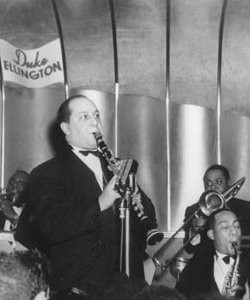
That was my favorite note for many years, until I became a born-again Ellingtonian. Friend/genius Stephen Yerkey turned me on to Ellington’s 1938 remake of his own “Black and Tan Fantasy,” whose original 1927 version is universally regarded as one of the most important early jazz discs. But the 1938 remake is equally brilliant. Duke’s band was at or near the height of its powers. The orchestration is sublime. The piano work is radical. Each solo is a jewel. And then there’s THE NOTE.

Now, there’s nothing I find more musically distasteful than a cheesy, star-searchin’ vocalist wowing the crowd with a long sustained note. I hate it just as much when operatic singers do it (as did many of the great opera composers). And using the national anthem at ball games as a pretext is just plain nauseating.

Did Barney Bigard play the greatest note ever?

Yes, THE NOTE is impossibly long and difficult. But there’s more here than sheer virtuosity. The painfully slow glissando literally makes you dizzy, as if the world were tilting off-axis. (It’s more psychoactive than the Beatles on acid!) It exerts exquisite tension against the backing harmonies, and it lets Duke display his most Debussy-like side in his watery, chromatic piano accompaniment. And the dismount is astonishing: Another wind player would be gasping on the floor, but incomparable clarinetist Barney Bigard (also featured on the 1927 original) concludes with a soft, casual phrase, as if he had all the time and breath in the world. For me, this is the ultimate musical embodiment of “cool” in its most profound African diaspora sense.

Play it, Mr. Bigard! The miracle commences right after 1’15” (but please, treat yourself to the entire performance).

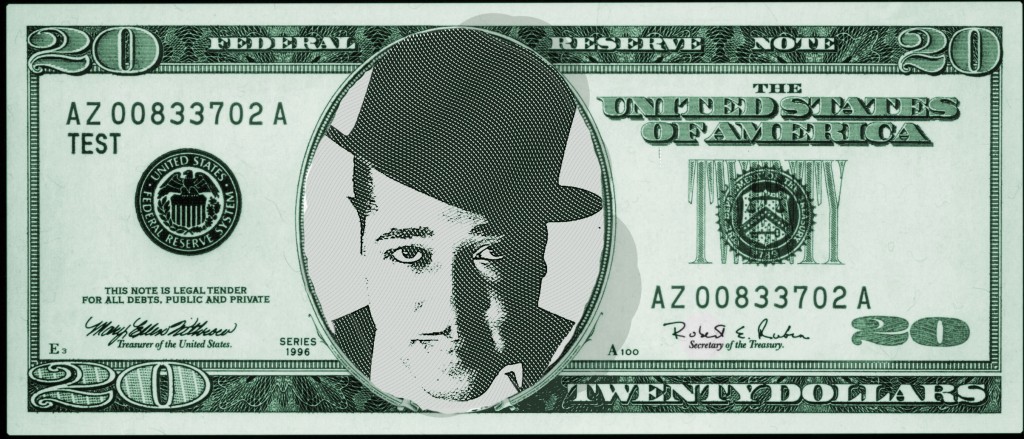
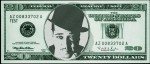
(I know I’ve said this about 50 times on this blog, but I repeat it whenever possible: In much of the civilized world — Europe in particular — the arts are considered precious, and musicians routinely appear on currency. If Americans gave a crap about culture, our greatest composer would grace the $20 bill, not genocidal Jackson. Though admittedly, there’s a strong case for Harriet Tubman.)

duke_dollars

Okay, enough of my yakkin’! What’s your favorite note?

Categories
Digital Recording

My New Fave Mobile Interface

Apollo-Twin_WEB-Award

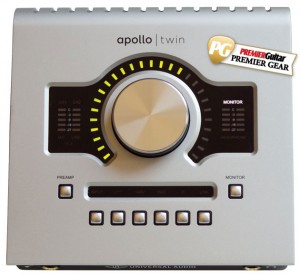
Premier Guitar has posted my review of Universal Audio’s Apollo Twin interface. Short version: I love the thing.

A rackmount Apollo interface has been the core of my studio for two years, replacing both a Pro Tools HD rig and a complicated Apogee setup. I adore Apollo’s great-sounding preamps, lucid interface, and innovative software, which, among other things, lets you track through simulated preamps on your way into your DAW. Also, UA’s analog modeling is second to none. (You hear their reverbs and tape simulations on most of the stuff I’ve recorded for this site.)

The intensity of my Apollo love is rivaled only by my scorn for the crappy mobile interfaces I’ve previously used with my live laptop rig. The problem isn’t audio quality — even the cheapest ones can sound surprisingly decent — so much as lousy ergonomics and flimsy construction. I’ve burned through half a dozen interfaces in the last few years. They just aren’t built to last onstage. Or anywhere else.

That’s why I’m so stoked to have the small-format Apollo on my digital pedalboard. It’s built well. The UI is brilliant. There are no horrid breakout cable octopi. It has the same preamps and processors as the rackmount Apollo. And I have access to my favorite UA plug-ins, including the juicy EMT plate reverb simulations, the stellar tape echo models, and a suite of low-latency virtual preamps. It’s pricy for a mobile interface: $700 for the single-processor model and $900 for the dual-processor model. But I’d spent far more than that on self-destructing junk that I wound up giving away or recycling.

Anyone else tried Apollo in its various formats? Or any other cool converters? Your observations, please?

Categories
Recording

Death by Doubling

Screen Shot 2014-05-19 at 3.40.19 PM
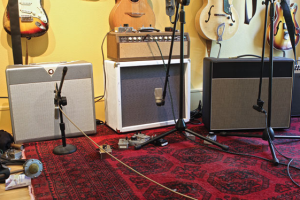
This photo was originally a line of 137 amps, but I had to crop it to fit this small space.

Premier Guitar has just posted a new installment in my Recording Guitarist column. The topic: doubling riffs for fatter sounds. Using a single guitar part (and a great drum performance swiped from Dawn Richardson), I tried every doubling trick in the book. plus some ones that wise editors expunged from the book. We’re talking amps, mics, panning, processing, analog vs. digital—real OCD stuff.

Is it interesting enough to justify  listening to the same part doubled 20 different ways? Depends how big a geek you are!

For the less geeky, here’s a concise executive summary:

Q. How many doubles do you need for maximum fatness?

A: Between zero and a lot.

Q: How many is too many?

A: Fewer than the 21 tracks in my last over-the-top example.

That, plus some helpful information, just to keep things lively. :smirk:

Categories
Acoustic guitar

Strange, Strange Strings

No longer ridiculously expensive — just REGULAR expensive.
No longer ridiculously expensive. Now they’re just very expensive.

I spent last week covering the Musikmesse musical instrument trade show in Frankfurt, Germany, for Premier Guitar. I had a blast, and Chris Kies and I posted details and pics of more than 70 new products. (Here’s the short list of our personal faves.) Kies shot lots of video, and will be posting more than 50 demo segments to the PG site in the coming weeks.

But Messe is hellishly loud, far noisier than NAMM. When I finally got home and picked up a guitar, it was an acoustic. I was trying something new, based on info I obtained from Mary Faith Rhoads-Lewis, CEO of Breezy Ridge, a company that distributes several brands for acoustic musicians, including John Pearse strings.

I’d previously geeked out here about about the strangest and most expensive guitar strings I’d ever tried: this “rope core” set from Austria’s Thomastik-Infeld. Reader/cool guy Al Milburn turned me on to them, and I wrote about them here. And I recently posted this video demonstrating how the transformed my old Martin 0-17 into a compelling steel/nylon hybrid with a unique and expressive voice.

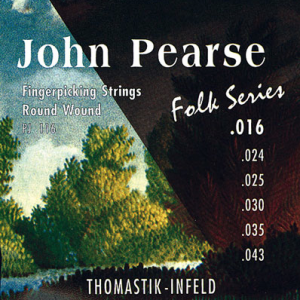
Anyway, Ms. Rhoads-Lewis told me that the late John Pearse originally created this set for Thomastik, and that the John Pearse Folk Fingerpicking set [PJ116] is identical to what the Austrian company sells. Best part: You can get them in the States for under $20, as opposed to a walloping $35 for the Thomastiks. She also told me that their magic works in reverse: You can put this relatively low-tension set on a classical guitar for a very different sort of hybrid steel-string sound. (This, she said, is exactly what the great Brazilian player Bola Sete used to do.)

I popped a set on my old Yairi classical. The feel was — totally strange, and in precisely the opposite way as on the Martin. The tone was edgy and exciting, but the tension seemed a little too extreme. If just seemed a little too … high-strung, in every sense. Then I tried lowering the entire tuning a whole step, with the sixth dropped all the way to C.

And … oh, my. Check it out:

Summary: Holy cannoli, I love how this sounds. And there’s something psychologically satisfying about the transformation too. See, this guitar has always been a bit … tragic to me. I got it when I was 16. My classical guitar prof at UCLA said I needed a better instrument, and my every-supportive folks, bless ’em, helped me buy this Alvarez Yairi for around $700 (in 1970s dollars). It was a top-tier model for Alvarez, signed by luthier Kazuo Yairi, and boasting lovely Brazilian rosewood backs and sides. It was a huge upgrade for me, but as I got deeper into classical playing, its shortcomings emerged. Had I not shifted my studies to composition, I’d have needed to upgrade again. I envied the Igancio Fleta y Hijos models my two teachers played, but at around $3,000, they were beyond my budget, even with parental help. (Pity — their current value is approaching $50,000.) So I’ve used this instrument as a limited but decent-sounding model suitable for pop work, if not serious classical concertizing.

Categories
Recording

New Guitar Recording Column!

Screen Shot 2014-02-24 at 10.57.35 AM

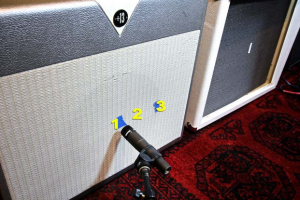
May I take this opportunity to pimp my new monthly recording column in Premier Guitar? The first installment covers basic electric guitar miking technique. It’s ground that’s been covered often enough before, though I hope the article’s many audio files (recorded via ReAmp, moving the mic between “takes”) shed some new light on the topic.

Meanwhile, I’m breathlessly stoked about my new “Partsmaster.” It’s a Korina “Split Jazzmaster” body from Warmoth with Fralin P-92s and some new tricks I’ve been wanting to try with wiring and onboard overdrive, plus several other ill-considered, stab-in-the-dark adventurous experiments. It’s like some wacky Firebird/Jazzmaster hybrid (“Birdmaster?”) I hope to post some video later this week, but right now, the guitar is awaiting the plek treatment at Gary Brawer’s shop. Gary is also prettying up some of my clever but sloppy wiring, and remedying the fact that, when I brought the beast in, the strings were about a half-inch from the fretboard.

Can’t wait — this is an interesting one! 🙂

Categories
Amps DIY guitar Recording

Small Amps for Small Spaces?

I’ve got a Tweed Champ kit, and I’m not afraid to use it. Or at least not VERY afraid.

Why do they make amps so damn loud?

It’s not just a cranky question from a guitarist who’s drawing depressingly close to the “Get off my lawn!” years. I ask sincerely: Why?

Big amps make total sense — but only if a) it’s 1969, b) you’re playing venues with Jurassic sound reinforcement, and c) you’re a guitarist in danger of being drowned out by Keith Moon or John Bonham.

Okay, end of harangue — I’ll have time for that when I’m chasing kids off my lawn (after I move to the suburbs and GET a lawn). But as I get psyched up to build this review model of Tube Depot’s Tweed Champ kit in the coming days, I figured I’d ask what folks are using these days to get cool amp tones in their bedrooms and basements. Not dedicated practice amps, necessarily, but great-sounding stuff that happens to be ultra-low-wattage? Name your petite-amp poison!

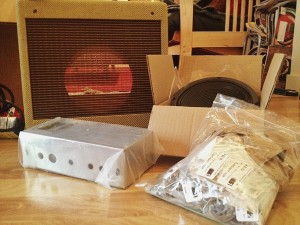
Anyway, I’m stoked about this kit. I’ve already completed a few amp clones from Ceriatone. They were fun to build and sounded great. But I can tell right off the bat that this Tube Depot kit has at least one major advantage over its Malaysian cousins: This one comes with a fabulous 40-page instruction manual. (Most clone vendors simply link you to a schematic.)  Having  created a few step-by-step instruction manuals myself, I can testify how much painstaking work these entail. Hats off to Tube Depot’s Rob Hull for doing it right!

Details and build report to follow. But now, let’s talk tiny-amp tone!

Categories
DIY Effects Gigs Recording

A Tale of Two Pedalboards

Is it just me, or do many guitarists these days find themselves alternating between separate analog and digital setups?

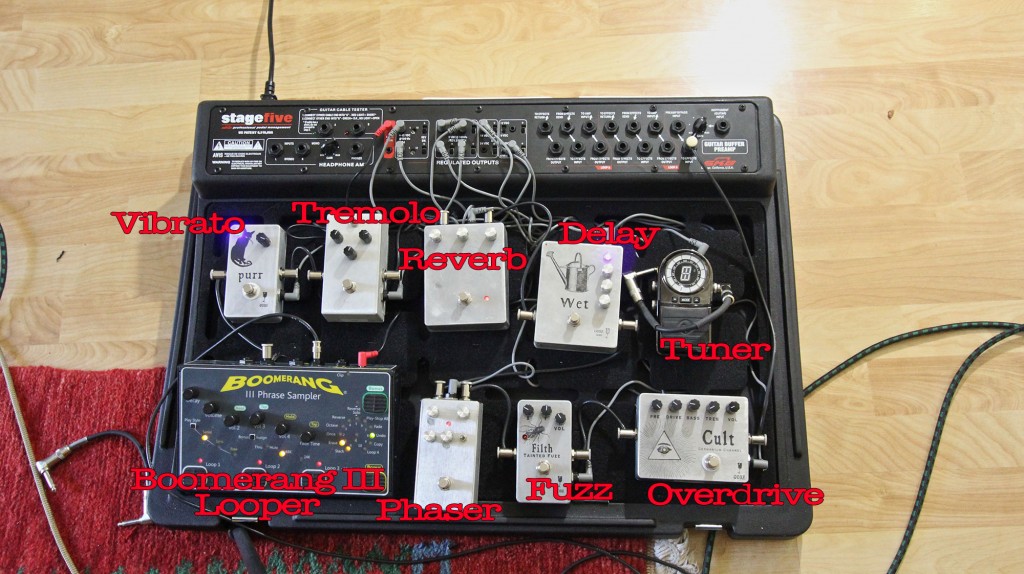
I’m posting some pics of my current pedalboards (bearing in mind that, for reasons I’ll get into in a sec, my pedalboards only tend to stay “current” for a few days at a time). Both were assembled using store-bought housings, though I’ll talk a bit about total DIY boards as well.

First, the mostly analog setup (the exception, of course, is the digital Boomerang III looper).

Joe Gore’s mostly analog pedalboard.

The case is a newly purchased SKB Stage Five, a full-featured unit in a relatively rugged molded plastic case. These retail for a whopping $540, but you can find them heavily discounted. (I forget the exact price I paid for mine, but it was under $300.) It’s loaded with cool features, like dual effect loops, a built-in buffered preamp, and support for 9- through 24-volt DC power, plus 9V AC for those digital pedals like Line 6 modelers and many loopers. There are even trim pots on a few power jacks to simulate dying batteries. I’m less impressed by some of the fittings (like the cheapo plastic jacks), though I suppose they keep the weight down. And make no mistake: This thing is heavy!

Verdict: Too early to tell, since I haven’t subjected it to road abuse, but I trust it enough to at least give it a go. I think I’d be a bit disappointed had I paid full pop, but it strikes me as a fair deal if you can find it at a 40+% discount. 

Categories
Acoustic guitar Recording

How Nashville High-Stringing Works

You don’t have to be high in Nashville to enjoy Nashville high-strung.

Nashville high-strung tuning is one of the guitar’s great magic tricks. It has a delicious, “secrets of the Guild” quality — you feel like an insider just knowing what it is.

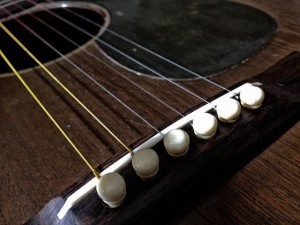
Not that I did know what it is until embarrassingly late in life. For the sake of my fellow late-bloomers, I’ll explain: You replace your guitar’s lowest four strings with thinner strings tuned an octave higher than normal.

You can think of it as using the higher-pitched of a each pair in a 12-string string set. (Or the top two strings of a normal set, and the top four strings from another normal set, with the first string as the third string, the second string as the fourth, etc.)

I love how this tuning can work subliminal magic, or step front and center for marquee riffs. Nashville session players conceived it as a way to add stereo shimmer to doubled acoustic guitar tracks. But rock players have used it to great effect as a foreground sound, as heard on the Stones’ “Wild Horses,” Floyd’s “Hey You,” Kansas’s “Dust in the Wind,” and Tracy Chapman’s “The Promise.”

Here’s a quick little demonstration, both solo and in a mix:

Categories
Effects Recording

A History of Reverb

Hi there. We changed musical history!

Tonefiend reader Scott S. hipped me to a fabulous little article that just appeared in the online edition of The Atlantic: a history of artificial reverb that’s both technically savvy and fun to read. Author William Weir covers all the right gizmos: echo chambers, plates, springs, tape echo, custom convolution reverbs (which I wrote about here), and Duane Eddy’s 2,000-gallon water tank. Plus there’s lots of of fascinating historical speculation: Did Stonehenge draw some of its ritualistic power from its unique acoustic properties? Did the long reverb times of medieval cathedrals hasten the birth of polyphony?

Quick! Can you name the first hit to feature fake reverb? You will after you read this fine piece!