Categories
Pickups Uncategorized

Happy Humbucker-Sized P-90s!

Happy-P-90s

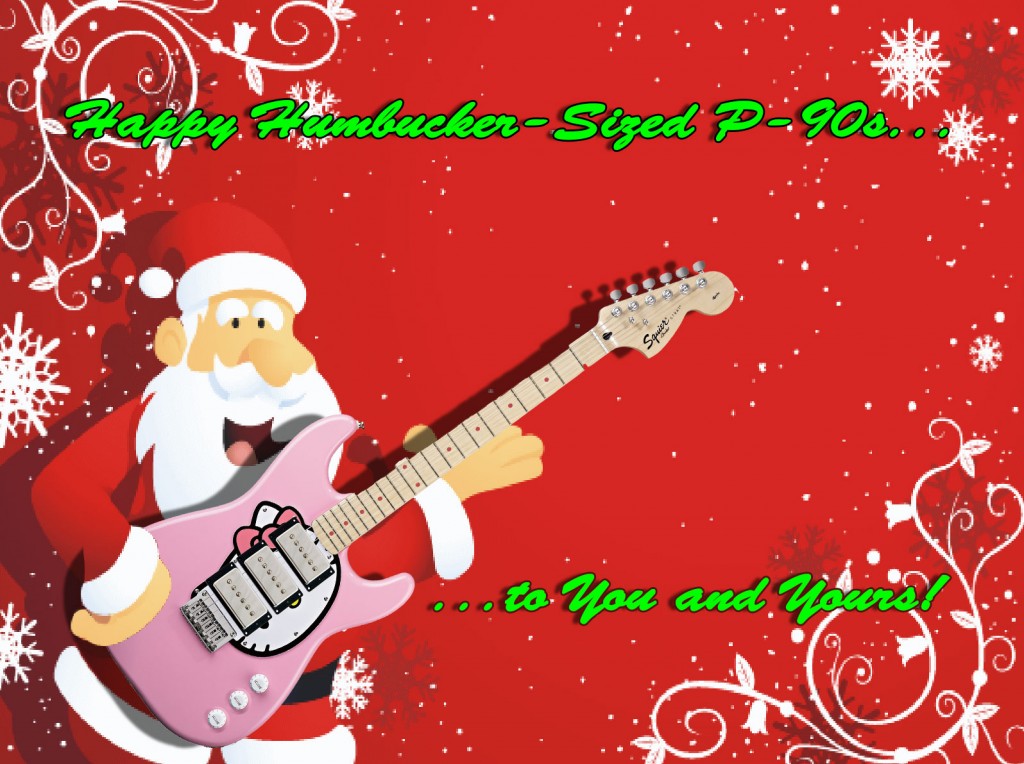
Just in time for the single-coil holiday season: my comparison review of 16 humbucker-sized P-90 pickups is live at Premier Guitar. This heartwarming holiday fun-fest has it all: Mouth-watering adjectives. Freshly baked audio clips. Irate manufacturers. Don’t miss it!

This was a fun, if challenging project. Comparison pickup reviews are such cans of worms! Not only are they sadistically labor-intensive, but the differences between one pickup and the next are easily overshadowed by other variables in the tone chain.

After much thought about how to create meaningful comparisons, we came up with an intriguing process: I tested all the pickups in the same guitar, with identical setups, and ReAmped them through the same combo amps with identical recording settings. If this were an amp or pedal review, I would have used the same performances throughout, but of course, each example had to be played anew with each pickup, so I spent much time matching performances to guard against misleading variations in touch and intensity. It’s not a perfect solution, but better than most, and in the end quite revealing.

And what did it reveal, exactly? You’ll find out at the link. Beyond that, I can report that:

  • All the products sounded pretty good.
  • They sounded more similar than you might expect.
  • I’m gonna find me a guitar to house a set of my favorites — though I’m not sure which ones are my faves! Really, they’re close enough that, say, the tone of a particular body wood alone would be enough to sway the decision. It’s not so much a case of “better or worse” as “brighter or darker” and “louder or quieter.”

As mentioned in the article, there’s no “gold standard” of P-90 tone — or rather, every P-90 lover has his or her own standard. Gibson’s ’50s original are notoriously inconsistent in their output, even their magnet type. Plus, the mere fact that you’re winding coils around a narrow, tall humbucker bobbin rather than a wide, low P-90 one has sonic implications. So I tend to think of this entire pickup category as either “single-coils that are ballsier than Fender single-coils,” or, in the case of hum-canceling models, “humbuckers with brighter highs and clearer mids.” (Or as my ol’ pal Steve Blucher from DiMarzio calls them, “humbuckers that hum.”)

Funny thing: I love P-90s, but don’t own any guitars fitted with them. Not yet. :satansmoking:

So talk to me about P-90s! Your faves? Beloved P-90 guitars? Fave P-90 players and performances?

Categories
Effects guitar

Phasers That Stun

phaser_stun


UPDATE: My Premier Guitar Heptode Virtuoso review is live. Read and listen here.

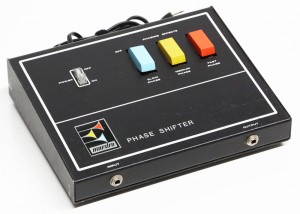
I’ve got phase shifters on the brain, especially after encountering a couple of truly stunning ones. I just wrote a review for Premier Guitar of Heptode’s Virtuoso phaser, a superb clone of the old Maestro PS-1A. (I’ll link to the review when it goes live.)

It took me back to my Pleistocene pre-teen years, when I once spent hours in my local music shop playing an electric nylon-string through a big-ass PS-1A mounted on a music stand. Despite its size, it had few controls — just big colored switches that could have been swiped from one of the era’s cheesy home organs. It sounded glorious to my 12-year-old ears. I’ve never since held such a high opinion of my own playing.

I haven’t played a PS-1A since then, but the Heptode pedal took me right back. It really is a gorgeous-sounding phaser, and one that vanished soon after the debut of the cheaper, smaller, and awesome-sounding MXR Phase 90. The sound captivated me all over, though I’m not sure if I actually like it more than the Phase 90, or if it just sounds so cool because it’s a less familiar color.

The plastic switches make it sound better.

I dug out a few other favorite phasers, like the $89 BYOC Phase Royale that usually lives on my analog pedalboard. It’s yet another brilliant DIY kit from BYOC’s Keith Vonderhulls. It’s basically a Phase 90, but with all the cool mods, like mix and resonance controls, plus a six-stage phasing option. (The Phase 90 and the Uni-Vibe are four-stage, while the Maestro is six-stage). It’s a fun build, and an excellent next step for DIYers who have built a few fuzzes and are ready for something a bit more challenging.

I concluded my little phase-fest by unearthing my old Lovetone Doppelganger, a bitchin’ dual-LFO phaser from the late ’90s. Not to be confused with today’s Lovepedal brand, Lovetone was a British company run by Dan Coggins and Vlad Naslas. They specialized in large-format pedals with an almost absurd number of controls. (Their brilliant slogan — “Big Pedals to Trip Over” — is rivaled only by Zachary Vex’s “Crazy Effects for Rich People.”) I’d flip out when each new Lovetone pedal came in for review at Guitar Player. Even then, they were expensive, usually in the $400-500 range. Now, of course, they’re obscenely rare and valuable. I bought as many review models as I could afford, and to this day I regret not purchasing their Meatball, Wobulator, and Brown Source. I did, however, snag the Big Cheese, Flange with No Name, Ring Stinger, and this guy:

I haven’t heard the Doppelganger in years, and it was interesting to revisit it. See, while I always loved the ideas behind the Lovetone boxes and was happy to own them, I’d found that I just didn’t tend to use them a lot for gigging and recording. For me, they had tons of cool sounds, but often not quite the right one. But I’ve gotten better at dialing in tones in recent years, and really dug the sounds I got yesterday while making the video. Maybe it just took me 15 years to learn how to wrangle these beasts!

Anyway, the Doppelganger is now a Museum of Lost Effects inductee, and it’ll be joined soon by its big-box brothers.

Categories
DIY Effects guitar

It’s Raining Germanium!

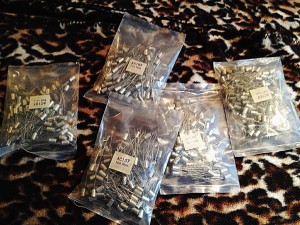
I just bought 500 germanium transistors. Yes, as a matter of fact, I am insane. Why do you ask?
I just bought 500 germanium transistors.
(Yes, as a matter of fact, I am insane. Why do you ask?)

UPDATE: My Dunlop Fuzz Face Mini review is live at Premier Guitar. Audio clips included!

How and when did it get so frickin’ easy to procure great-sounding germanium transistors?

I’ve been building stompboxes for four years or so. I used to consume article after article detailing the sheer horror of dealing with germanium. Sure, those old-school transistors sound great, I’d read, and they’re necessary for vintage distortion circuits. But they’re unstable. They’re expensive. They’re hard to find. You have to sort through dozens to find the few good ones. And once you do, you must spend countless hours matching and biasing them for optimal sound.

I believed everything I read — until I finally admitted to myself that I seldom encountered any of those problems.

(If you don’t know much about germanium transistors and why they’re cool, here’s my manifesto.)

I used to buy germanium transistors from Small Bear and other parts sites, and was always happy with the results, even though I had to pay eight or ten bucks per transistor. (Small Bear even does the matching for you, offering sets of transistors suitable for various vintage fuzz circuits.) However, it was a little tough finding NPN (negative-ground) germanium transistors. In fact, Small Bear once rejected my order of a dozen or so NPNs because they were so scarce. (To his credit, Small Bear’s Steve Daniels explained that he restricted sales so that everyone who wanted to build a couple of great DIY fuzzes would have the opportunity.)

The workaround is to build pesky positive-ground pedals, or jigger with the schematic in order to use PNP (positive-ground) transistors in negative-ground circuits. (This site’s Fiendmaster project is an example of the latter workaround.)

Then some odd things happened:

Categories
Effects guitar

Fuzz Detective:
The Case of the 12 Germanium Fuzzes

As threatened, the Fuzz Detective video:

WHAT: Twelve germanium fuzz circuits compared and analyzed. These represent the sounds of almost every fuzz pedal introduced between 1962 and 1968.

WHY: A tool to help players identify the circuits most relevant to their musical needs. This isn’t about particular brands of pedals, but the circuits they employ. If you hear something you like, you can either do as I did and build a clone from the schematic, or buy one based on that particular design. (The relative merits of rival clones is another story.) Of course, if you’re rich and you desire an ancient pedal that probably doesn’t sound as good as a new clone, you can always purchase a vintage original. 😉

HOW: I tried to establish a “level playing field” by removing as many sonic variables as possible. I used the same signal chain, the same guitars, the same musical material, etc. (Tech details below.)

WHO:

  1. Maestro FZ-1 Fuzz Tone
  2. Sola Tone Bender Mk 1
  3. Hornby-Skewes Zonk Machine
  4. Sola Tone Bender “Mk 1.5” (similar to Vox Tone Benders)
  5. Dallas-Arbiter Fuzz Face
  6. WEM Pep Box Rush
  7. Sola Tone Bender Mk II (same as Marshall Supafuzz)
  8. Mosrite Fuzzrite (germanium version)
  9. Orpheum Fuzz (germanium version)
  10. Selmer Buzz Tone
  11. Sola Tone Bender Mk III (same as Park Fuzz Sound, Carlsbro Fuzz)
  12. Baldwin-Burns Buzzaround.

WHEN: Like, now, man!

Categories
DIY Effects guitar

The “Super-Fiend” DIY Fuzz Face!

You can purchase a kit, or source your own parts.

UPDATE [06.16.2013]: Build instructions updated to v02.

The Fuzz Face has inspired countless spinoffs since Ivor Arbiter unveiled the device in 1966. Some introduced meaningful improvements. Many didn’t.

The goal of this project, created by my friend Mitchell “Super-Freq” Hudson, is to create a pedal very similar to the original. It’s a great way to explore one of the iconic sounds of ’60s rock (and lots of ’60s-influenced rock).

The instructions are available here. [19MB PDF.]

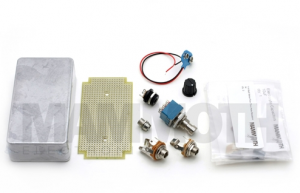
You can order a kit from Mammoth for $45. (Disclosure: Neither tonefiend nor super-freq has any financial stake in these kits. I simply asked the Mammoth guys to create one for your parts-sourcing convenience. All necessary parts are readily available from other vendors.)

But before you attempt the project, please be aware of some of its quirks. (And if you’re curious, you can read about how I customized the pedal I used in my video demo.)

Categories
DIY Effects guitar

Fuzz Face:
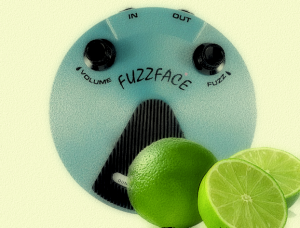
The Daiquiri of Distortion Pedals?

fuzzlimeMost sentient guitarists love Hendrix, but not everyone is equally fond of his signature distortion pedal.
So what’s your take on the Fuzz Face?

I used to hate them — but only because my sole exposure to them was via the crappy reissues of the ’70s, ’80s, and ’90s. They sounded so brittle and harsh! Not till this century did I encounter the pedal in its original incarnation.

What a difference!

Vintage-style Fuzz Faces produce tones that are warm, rich, and unbelievably dynamic. It was like the first time I tasted a vintage-style daiquiri. Like the Fuzz Face, the classic daiquiri is a delicate concoction made from a few simple yet complexly interactive ingredients — nothing like those nasty blended drinks that taste like Slurpees spiked with Everclear.

Here’s everything I love about vintage Fuzz Faces, compressed into 60 seconds:

My DIY version is based on inventor Ivor Arbiter’s original 1966 schematic. That’s also the basis for a new DIY project created by my stompbox-buildin’ pal Mitchell Hudson, who runs the cool DIY site Super-Freq. We’ll both be posting it on our sites in the next few days. You can source the parts on your own, or order a kit for less than $50 — not as cheap as some of our other DIY projects, thanks to its two relatively pricy germanium transistors.

Most lore about “mojo” stompbox parts is utter nonsense, but there is something harmonically unique about the germanium transistors used in ’60s fuzz pedals, including original Fuzz Faces. (See my “Germanium Mystique” post/rant for more info.) You don’t need germanium for a good fuzz sound — there are many great tones available via silicon transistors, integrated circuits, and digital modeling. But one problem with those god-awful Fuzz Face reissues was that they often simply substituted high-gain silicon transistors for germanium ones without modifying anything else in the circuit. The result was more gain, but at the cost of harsh, excessively bright tones and inferior dynamic response.

In the last decade or so, builders have wised up. Numerous manufacturers offer authentic ’60s-style replicas. Meanwhile, the DIY community has created countless variations, many of which use post-germanium parts to great effect. These days it’s pretty easy to find a Fuzz Face that doesn’t suck.

I’ve build many Fuzz Face variants, but until Mitchell created his Fuzz Face project, I’d never done a strict original, with positive-ground wiring, PNP transistors, and few latter-day “refinements.” (Don’t sweat it if those terms mean nothing to you — they’re all explained within the project.)

Anyway, that’s the circuit you hear in the video above. It’s not a fuzz for all seasons — it doesn’t have a ton of gain, and its loose, spongy distortion is unsuitable for metal and modern hard rock. But I love its warm, non-macho timbre and phenomenal dynamic response. It’s simple, classic, and delicious, much like this.

Categories
Effects guitar

Ring Modulation: The Effect from HELL!

effect_from_hell
Only very bad dogs like ring modulation!

No disrespect to Chuck Berry, but I seriously doubt Johnny B. Goode played guitar just like a-ringin’ a bell unless he was using a ring modulator. That’s the only effect that can give you the complex, clangorous harmonics of a bell or a cymbal. Or make you sound like a ravenous horde of mutant robot ants.

Theoretically, Johnny could have used one. By 1958, when Berry documented the guitarist in song, the effect was already being exploited extensively by avant-garde classical composers, notably the late Karlheinz Stockhausen, who used it to terrifying effect in his Gesang Der Jünglinge [1956].

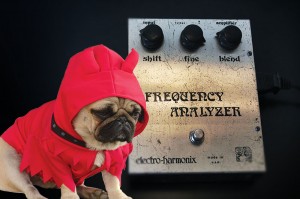
This post drips with perverse ring-mod love, including a demo of a rare vintage Electro-Harmonix Frequency Analyzer, and another featuring Roswell Ringer, a wicked ring mod plug-in.

Categories
Amps

The Last Affordable Vintage Amps?

You can probably get cool tones from any old crap with a tube in it, such as this ’60s PA amp.

There were lots of interesting replies to last week’s post on small amps. Thanks for all the tips about some of today’s best tiny terrors!

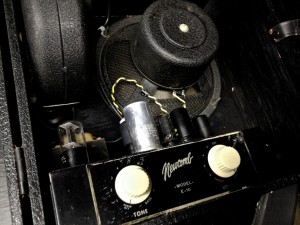
The discussion reminded me of a cool old amp that’s been gathering dust in my garage — and also of a notion of mine I call the “any old crap” theory. The idea is simple: Any funky old amp, including P.A. models never intended for guitar, usually has some compelling sounds in it. Plus, those old Newcomb, Masco, and Tapco amps are among the few remaining affordable vintage amps.

Case in point: This early-’60s Newcomb P.A. amp I picked up a few years ago at my local cool guitar shop. Actually, my pal/hero Tchad Blake spotted it and bought it for a hundred bucks or so. He was here in San Francisco working on Tracy Chapman’s Where You Live album. When we finished the project, he decided he had too much gear to schlep back to the UK, so I took it off his hands. I used it on Tom Waits’s Orphans album, and then promptly forgot about it till last week. So I fired it up and made a little video demo with an old cheap guitar that didn’t cost much more than amp:

Categories
Acoustic guitar

A High-Tech Plastic Guitar —
from Half a Century Ago

Plastic guitars are not a new idea!

In comments to a recent post on 3D-printed guitars, we were discussing the pros, cons, and general aesthetics of instruments molded from plastic. But this isn’t exactly a new idea.

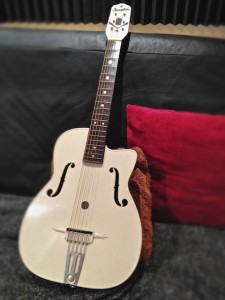
Back in the 1950s, luthier Mario Maccaferri conceived a line of plastic guitars and ukuleles. (This was many years after Maccaferri designed the D-hole Selmer guitars that will forever be associated with the Gypsy jazz of Django Reinhardt.) These plastic guitars were never very popular, and they’re not particularly valuable today.

I bought the one pictured here a few years ago at one of the music shops in London’s Denmark Street (I forget which one). I paid a couple of hundred bucks, and felt like a chump.

But I’ve grown attached to this guitar. It’s lovely to look at, and it plays great. The neck is substantial yet comfy, and it intonates well throughout its range. The tone isn’t warm, complex, or rich. But the Maccaferri has a cool, lo-fi character this sits well in a mix. I also like using it to double conventional acoustic guitars — the sharp, percussive tone adds a rough, aggressive edge.

Have a listen:

Categories
guitar Pickups

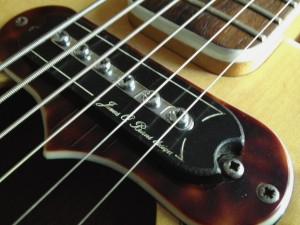
Those Mysterious Burns Pickups

A unique pickup in a “unique” guitar.

I’ve never owned a Burns guitar, and I have only one with Burns pickups: a funky mid-’60s Baldwin Virginian I scored for $100 some 20 years ago. It’s a cheap plywood piece of crap — but it’s my piece of crap, and I’m quite attached to it.

James O. Burns founded Burns London Ltd. in 1960 and had success underselling expensive American imports. Burns users included Hank Marvin, pre-Zep Jimmy Page, and most famously, Brian May, who used Burns’s Tri-Sonic pickups in his iconic homemade guitar.

Cincinnati’s Baldwin company bought Burns in 1965 and quality suffered — much like the same year’s CBS/Fender debacle, only on a smaller scale. But the Baldwin/Burns marriage produced some interesting oddballs, notably the Baldwin Burns Buzzaround (a quirky fuzz pedal favored by Robert Fripp), plus a lot of weirdo guitars. Like this one.

When I was playing with PJ Harvey, I used the Virginian to play the songs she’d written in “Gary Glitter tuning”: AAAAAA, as heard on “Rock and Roll Part 2,” and on this 1995 PJ Harvey clip from The White Room, a great British live music TV show of the era. (As on the UK’s long-running Later with Jools Holland show, bands would set up on multiple stages facing each other across a large room. Also performing the night we tracked this: Oasis, Paul Weller, and Bobby Womack.)

Here’s how the same guitar and guitarist sound 17 years later. Listen and weep: