It’s the latest chapter in my ongoing search for the right acoustic strings. Most available options simply sound far too harsh and bright to my ears, especially for fingerstyle playing on the small-bodied guitars I favor. Even though the Martin silk-and-steels I used were dramatically quieter than most bronze strings, I dug their warmth and strong fundamentals — and the absence of the hyped sizzle of bronze.
Several of you responded in comments with string suggestions, including several types I barely knew existed. Despite some rather shocking expenditures for these high-end, imported strings, I found much to love. Now I’m rich in tone, if nothing else.
Since I’m hot on the trail of a cool new fuzz circuit, I haven’t yet had time to record demos (and besides, I’d rather wait till the strings wear in a bit). But I’d like to share details about several products that impressed me. (more…)
Silk and steel — bad-ass, or strictly for wusses?.
It’s been a long, long time since I’ve tried silk and steel strings.
I’ve always thought of them as a transitional set for students migrating from nylon to steel strings. At least that’s how my mom used to explain them to me back when she was giving me my first lessons. Like many players, I viewed them more as a remedy for tender fingertips than a sound you’d actively seek out.
But over time, almost everything I thought I knew about strings turned out to be wrong. So I figured I’d give silk-and-steels a fresh listen.
This thread over at the Acoustic Guitar Forum seems like a fair summary of common attitudes about these strings. Opinions seems divided between players who simply find silk-and-steel strings too soft and quiet to be of much use, and those who enjoy them for fingerstyle playing, especially on small-bodied guitars.
I’ve been frustrated finding the right strings for the old Martin acoustic I picked up last year. I had a violent reaction against coated bronze strings, which I wrote about here. But I was kind of digging the way Martin Marquis 80/20s bronze strings sounded on the instrument, as heard in this video. Sometimes, though, the tone is just too harsh and clacky, so I wanted to try something lighter and softer.
I slapped down this quick duet performance of “Drewrie’s Accordes,” an anonymous lute duet found in The Jane Pickering Lute Book, a manuscript anthology of late 16th-century lute pieces. (This would have been played on gut strings in its day, and is usually performed on nylon-string classical guitar or lute today. My steel treble strings are definitely not historically correct, though some wire-stringed fretted instruments such as the cittern did exist in the Renaissance.)
Observations after the video.
Compared to all-metal strings, the silk-and-steels are definitely quieter, with less treble bite. I like their soft, malleable feel for intricate fingerstyle playing like this. They offer relatively smooth transitions between unwound and wound strings. They exhibit less clacky string and fingernail noise. Playing aggressively with a pick definitely “overloads” them, and would no doubt destroy the windings in short order. Even when playing exclusively fingerstyle, you get the sense that the bass strings aren’t long for this world. But I enjoy their sweet, quasi-classical tone, which to my ear does indeed split the difference between nylon and all-metal strings.
Still, I’m not sure I want to commit to having these on the guitar all the time. (I wish the guitar had a switch to toggle between a bronze and silk-and-steel sound!) Also, these are lighter than I usually play (the treble is .0115, and I pretty much never go below .012). But the relaxed tension does seem to suit this particular guitar.
How about you guys? Any experience with these soft-spoken strings? Do you think they sound cool, or are they merely a salve for sore fingers? And has anyone tried John Pearse silk-and-bronze strings? (That’s probably the next stop on this particular string quest.)
P.S.: This is also a pretty good example of how I apply lute techniques to steel-string playing, as I mentioned here. For most of the fast bits, I pick alternately using my right-hand thumb and index finger. A proper classical player would be more likely to alternate index- and middle-finger. Also, my right thumb sometimes drifts “behind” my right-hand fingers (that is, closer to the bridge). Classical players rarely position their picking thumbs closer to the bridge relative to the fingers. It’s not conscious on my part — it just what my hand does when I’m trying to brighten the bass notes and darken the trebles.
We’re far from the first to cover this ground. In fact, I should have mentioned a couple of great articles on Fuzz Face mods. We’ve talked about the technique of using sockets in your build so you can audition multiple components. Years ago DIYer Gary Burchett took this notion to its logical conclusion with the Multi-Face, a Fuzz Face with most of the components socketed. It’s definitely worth trying this. Meanwhile, this Instructables project by randofo explains how to create a super-versatile Fuzz Face using switchable components.
Trust me — despite the simplicity of the circuit and the sheer number of adventurous souls who have deconstructed and reconstructed it, it’s hard not to play around with it and find something cool and new. That too is a truth universally acknowledged!
UPDATE [06.16.2013]:Build instructions updated to v02.
The Fuzz Face has inspired countless spinoffs since Ivor Arbiter unveiled the device in 1966. Some introduced meaningful improvements. Many didn’t.
The goal of this project, created by my friend Mitchell “Super-Freq” Hudson, is to create a pedal very similar to the original. It’s a great way to explore one of the iconic sounds of ’60s rock (and lots of ’60s-influenced rock).
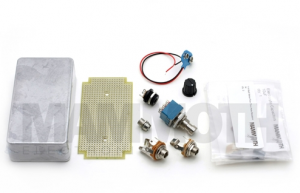
You can order a kit from Mammoth for $45. (Disclosure: Neither tonefiend nor super-freq has any financial stake in these kits. I simply asked the Mammoth guys to create one for your parts-sourcing convenience. All necessary parts are readily available from other vendors.)
But before you attempt the project, please be aware of some of its quirks. (And if you’re curious, you can read about how I customized the pedal I used in my video demo.) (more…)
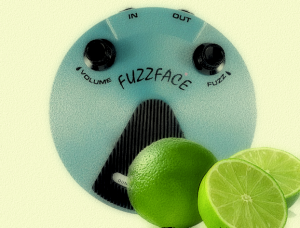
Most sentient guitarists love Hendrix, but not everyone is equally fond of his signature distortion pedal.
So what’s your take on the Fuzz Face?
I used to hate them — but only because my sole exposure to them was via the crappy reissues of the ’70s, ’80s, and ’90s. They sounded so brittle and harsh! Not till this century did I encounter the pedal in its original incarnation.
What a difference!
Vintage-style Fuzz Faces produce tones that are warm, rich, and unbelievably dynamic. It was like the first time I tasted a vintage-style daiquiri. Like the Fuzz Face, the classic daiquiri is a delicate concoction made from a few simple yet complexly interactive ingredients — nothing like those nasty blended drinks that taste like Slurpees spiked with Everclear.
Here’s everything I love about vintage Fuzz Faces, compressed into 60 seconds:
My DIY version is based on inventor Ivor Arbiter’s original 1966 schematic. That’s also the basis for a new DIY project created by my stompbox-buildin’ pal Mitchell Hudson, who runs the cool DIY site Super-Freq. We’ll both be posting it on our sites in the next few days. You can source the parts on your own, or order a kit for less than $50 — not as cheap as some of our other DIY projects, thanks to its two relatively pricy germanium transistors.
Most lore about “mojo” stompbox parts is utter nonsense, but there is something harmonically unique about the germanium transistors used in ’60s fuzz pedals, including original Fuzz Faces. (See my “Germanium Mystique” post/rant for more info.) You don’t need germanium for a good fuzz sound — there are many great tones available via silicon transistors, integrated circuits, and digital modeling. But one problem with those god-awful Fuzz Face reissues was that they often simply substituted high-gain silicon transistors for germanium ones without modifying anything else in the circuit. The result was more gain, but at the cost of harsh, excessively bright tones and inferior dynamic response.
In the last decade or so, builders have wised up. Numerous manufacturers offer authentic ’60s-style replicas. Meanwhile, the DIY community has created countless variations, many of which use post-germanium parts to great effect. These days it’s pretty easy to find a Fuzz Face that doesn’t suck.
I’ve build many Fuzz Face variants, but until Mitchell created his Fuzz Face project, I’d never done a strict original, with positive-ground wiring, PNP transistors, and few latter-day “refinements.” (Don’t sweat it if those terms mean nothing to you — they’re all explained within the project.)
Anyway, that’s the circuit you hear in the video above. It’s not a fuzz for all seasons — it doesn’t have a ton of gain, and its loose, spongy distortion is unsuitable for metal and modern hard rock. But I love its warm, non-macho timbre and phenomenal dynamic response. It’s simple, classic, and delicious, much like this.
If you like reading about internet memes that have just passed their sell-by date, tonefiend is the place to be!
Witness this brief video on triggering goat sound via guitar, created in a fit of desperation when a planned DIY post was delayed divine inspiration.
It’s based, of course, on the unbelievably popular video of unbelievably weird goats making unbelievably human-like sounds. It’s inspired countless spinoffs, including mine. I made these in my hotel room in Frankfurt during Musikmesse, feeling grateful the entire time that I live in an era when you can do crap like this in a German hotel room at midnight. Because trust me, there weren’t a lot of alternatives.
Tech details: homemade Strat, Fishman TriplePlay, Apple MainStage software hosting NI’s Kontakt sampler, goats.
Okay, I promise: tonefiend is not going to become an all-digital blog. I’ve got two new DIY analog pedal projects in the pipe, plus a piece on that delightfully retro technology, the book.
But while there’s more to life than MIDI, for the last few months my particular life has been all MIDI, all the time. I worked on the documentation for the Fishman TriplePlay MIDI guitar system, then demoed the product at MacWorld and Musikmesse. And now that the smoke has cleared and I’m off the Fishman clock, I’m still obsessed with the musical possibilities here. In fact, I’m just getting to the fun part: bending the technology to taste and making weird-ass music for weird-ass people compelling new sounds.
I’m posting two new pieces spun off from my Musikmesse demos. Technical and musical comments after the videos.
In my first TriplePlay demo, I used simple, recognizable acoustic instrument samples. For the second one, I focused on aggressive/distorted sounds. But now I’m getting into what really interests me: solo guitar arrangements featuring hybrid colors, deployed so that it’s often difficult to tell the guitar sounds from the synths and samples.
No, I had not. And they’re soooo good. All three are from YouTube user MotorGoblin. I don’t know anything about him, beyond the fact that he’s clever, funny, and very musical.
Anyone have any similar techniques to share? (I’ve been meaning to do a post on my “plastic tube Leslie”…)
While responsible guitar journalists like my ol’ pal Art Thompson from Guitar Player and the fine young fellows from Premier Guitar scoured Musikmesse 2013 tirelessly and systematically, I did the opposite, randomly stumbling through the vast exhibition halls in a jet-lagged daze between my performances, aiming my iPhone at anything vaguely cool or weird.
The result: this collection of poorly focused images and poorly researched comments. But since I wasn’t being paid to cover the show, I have nothing to lose except your respect, dear reader.
My headline is charitable — this is more of a quarter-assed Musikmesse report. :poop:
Like the African elephant, Musikmesse is huge but endangered. It’s way larger than NAMM, but participation decreases year by year. Manufacturers resent the high exhibition costs, and both consumers and instrument companies seem to find the event less essential in the internet era.
When it comes to EDM innovation, Europe leads the way. But in the unbelievably loud electric guitar hall, the vibe is strictly 1993. You don’t hear nearly as much bad shred guitar at NAMM these days, but that’s pretty much ALL you hear at Messe.
Did I mention that the electric guitar hall was loud? It makes NAMM sound like a library.
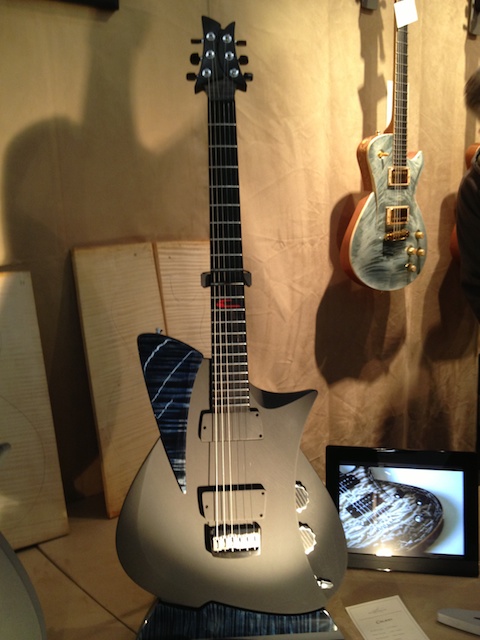
I love the expressionist look of the Caligo model from German luthier Frank Hartung. He’s clearly been watching the same movie as Robert Smith.
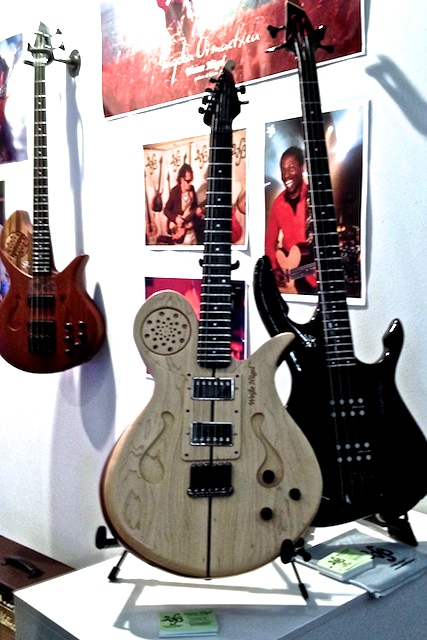
The Amathone model from Barcelona’s Weiss-Hügel Guitars looks like a crazy, mad-scientist ax, and it is! I had a blast playing it. That rosette on the upper bout is an adjustable baffle whose setting fine-tunes the high-end content. I don’t quite understand it, but the Weiss-Hügel website explains:
“When in Weisse Hügel we consider to make an instrument of hollow box, we think of creating something that was supporting the indispensable qualities of this type of guitars and that, in turn, had the most common problems completely decisive of these: Feedback problematic Final touch, Definition, Frequencies of cancellation (Notes of shade), Is absent of sustain in many cases, besides a relative versatility. The result has been the Amathone.”
That should clarify matters.
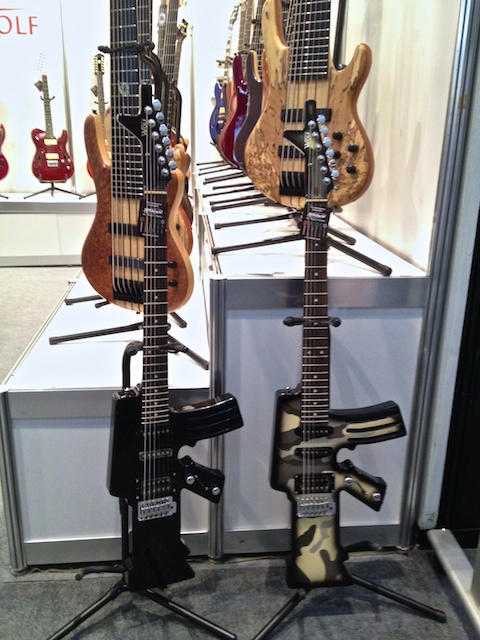
I hope they get these guitars back to South Korea before Kim Jong Un makes his move!
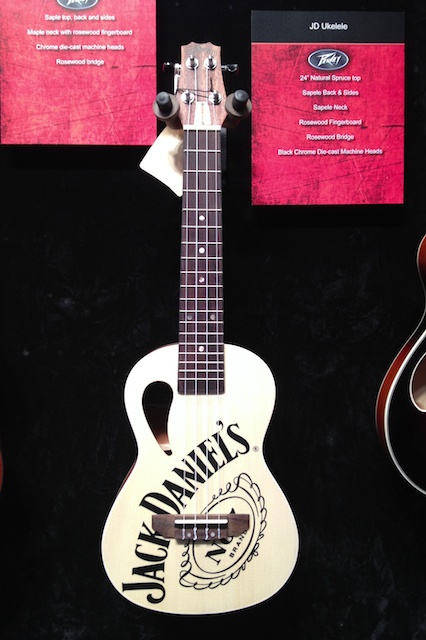
Peavey created this uke for the upcoming FX series Justified Five-O.
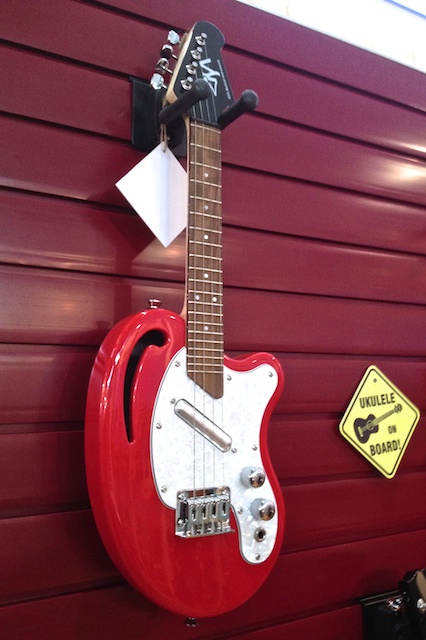
At least you could play surf music on this lipstick-tube electric uke, from Germany’s RISA.
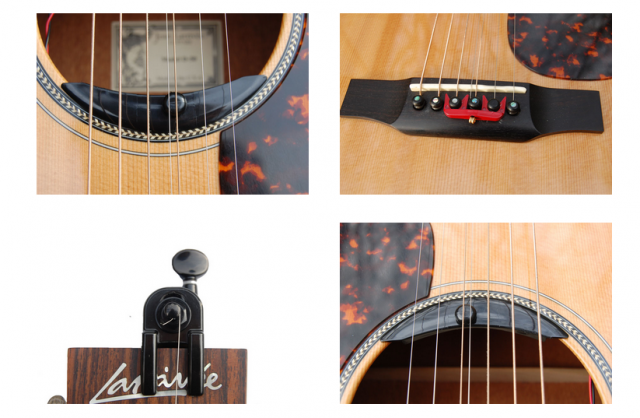
Ever notice how much of the shimmery 12-string effect is really all about the high G string? This clever Dutch gizmo from Addventor mimics the effect via a removable seventh-string. You can even temporarily nix the effect by clipping the added string under the soundhole-mounted button. The only needed guitar modification is an extra notch in the nut.
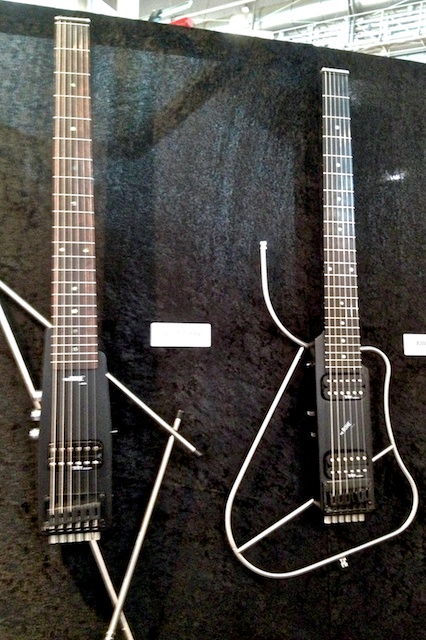
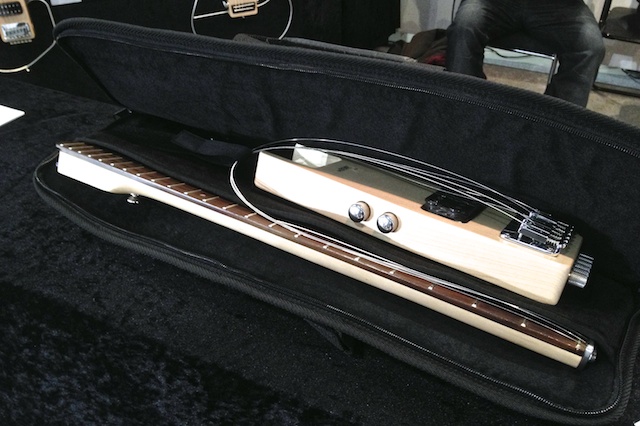
If your Steinberger is feeling too bulky, consider The Bone from Switzerland. These micro-guitars actually sound pretty decent, with more low end than you’d expect. They also make a MIDI guitar and a faux-acoustic with a piezo bridge pickup.
The smallest Bone of all, the Mosquito, weighs in at under three pounds.
T-Rex Effects was offering free haircuts. I would have taken advantage of the offer if I had hair. Those nice Danish boys were kind enough to loan me a power supply after mine fried on Euro-voltage.
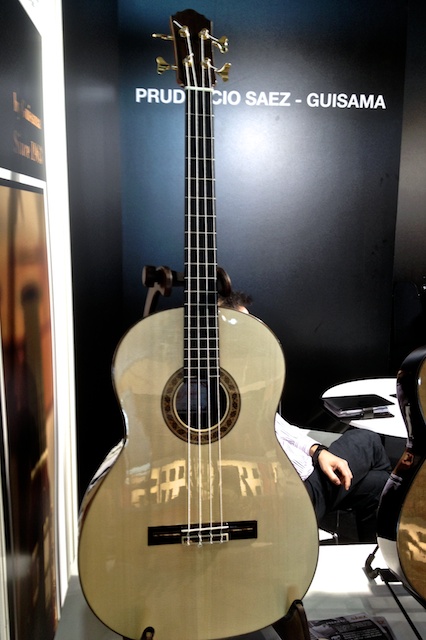
Oh man, I’d love to have a nylon-string classical bass like this one from Prudiencio Saez.
I was set up near this Guitar Grip installation. It received far more attention than I did.
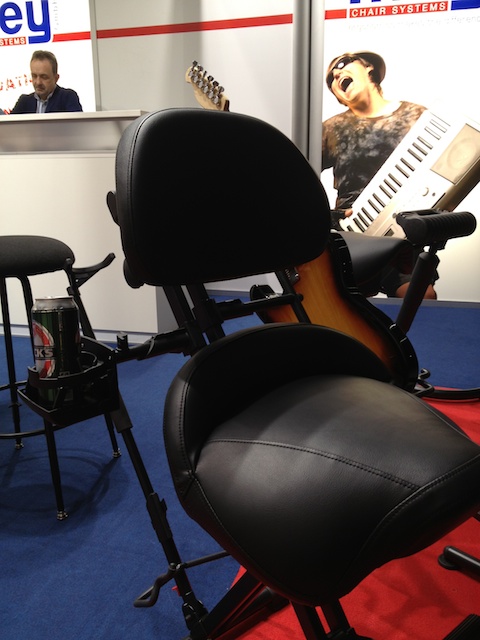
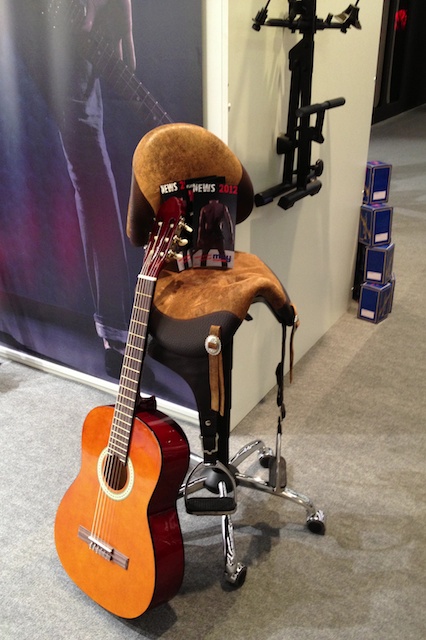
You’ll be strumming in style perched in your Mey Chair System, especially if you add the optional guitar and beer holders. They have many styles to choose from . . .
. . . including this special country-and-western edition.
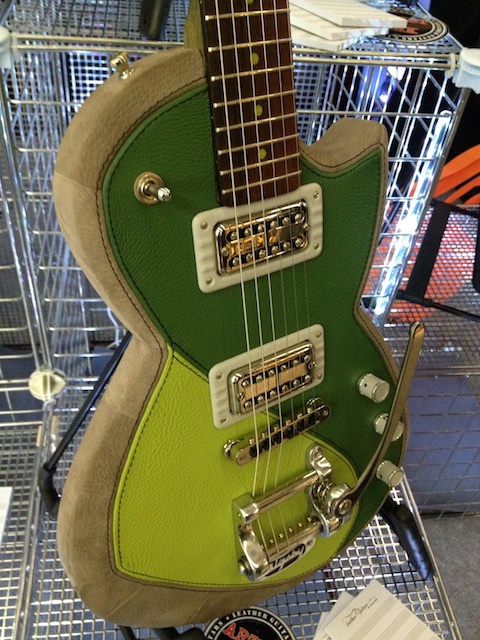
German luthier Georg Beïs specializes in guitars made from nature’s finest tonewood: leather! Shown here: the Samaria Nature model.
Folks smoke more in Europe than in the States. As a result, they’ve developed some highly idiosyncratic tobacco-based practices.
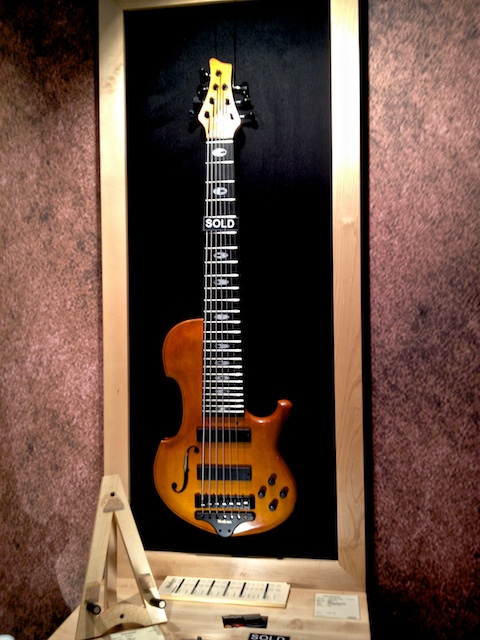
There’s a special breed of bassists for whom six strings simply aren’t enough. Such players require a Marleaux.
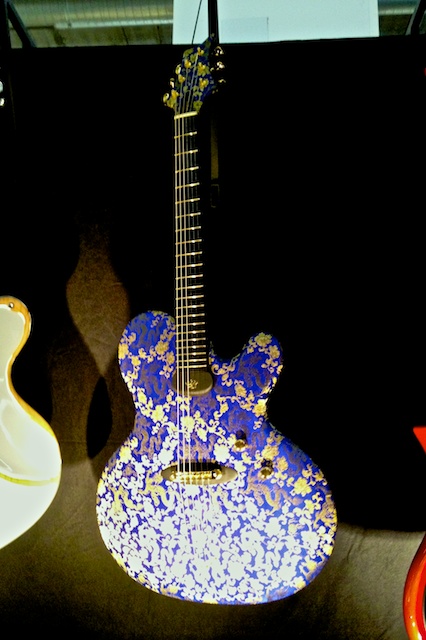
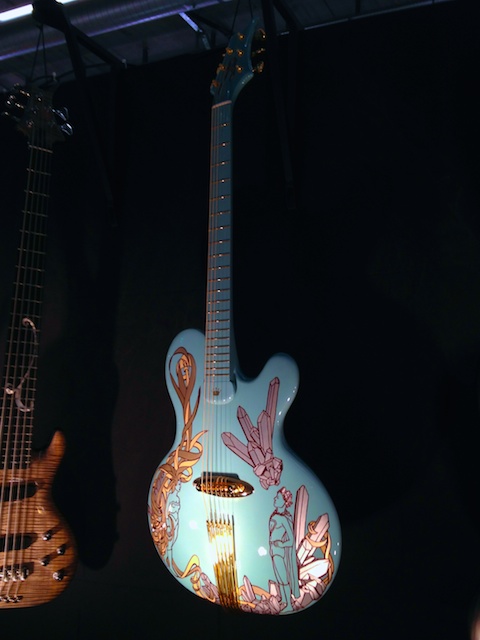
This crappy photo doesn’t do justice to the this remarkable damascene finish on this Jens Ritter guitar.
Yeah, I could make some hippie-crystal joke, but Jens Ritter‘s workmanship is too remarkable to mock.
You already knew that Madrid’s José Ramirez workshop crafts some of the world’s finest classical guitars. But did you also know they made the world’s prettiest shopping bag?
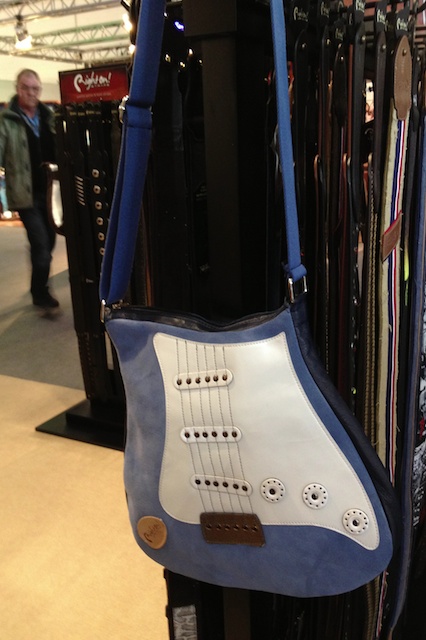
Speaking of bags! But now I want a handbag-shaped guitar.
I dig Anthrax’s Scott Ian. Especially when he’s three stories tall!
Rocksmith seems to be the opposite of Guitar Hero: a video game where the ability to play is actually an advantage.
In a perfect world, guitarists wouldn’t need help keeping a steady beat. But we live in this world, so the BodyBeat Sync from Peterson Tuners could be a very helpful tool.
From 30,000 feet up, Greenland seems appealingly quiet.
If you’ve been reading this blog for a while, you may have noticed a recurring pattern: I attend some interesting event and promise to report on it, only to get subverted by work, crowds, jabbering with old acquaintances, and jetlag. True to form, I’ve spend the first two days either demoing TriplePlay, or staggering to the coffee bar. Yesterday I spent hours staring at these Guitar Grip guitar hangers, which are mounted on the wall right next to the spot where I’m playing. They remind me of the human-hand candelabras from Jean Cocteau’s La belle et la bête.
It’s been fun playing for so many hours, though I’m still not very good at the MIDI guitar/drums thing. I was having a fairly disastrous moment when John McLaughlin came by. Isn’t that always how it is? You’re having an off day, and then you look up and see that frickin’ McLaughlin. Is it just me, or does everyone hate that? :shake:
This is my first time here, but the old hands tell me that the show is relatively dead, and that a lot of manufacturers have either already given up on Messe, or are planning to next year. We’ll see what transpires tomorrow afternoon and Saturday, when the show opens to the public. (So far, it’s industry-only.) And I really will try to scope out some gear!



 Most sentient guitarists love Hendrix, but not everyone is equally fond of his signature distortion pedal.