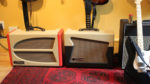
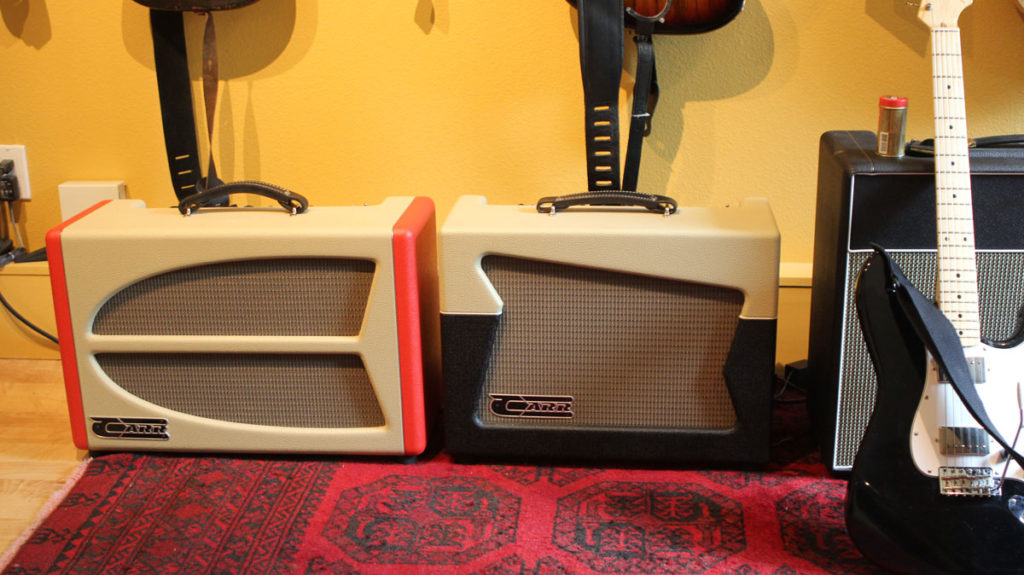
I’ve been using my Carr Skylark amp incessantly for the last 18 months or so. I’d originally reviewed it for Premier Guitar magazine, and then I bought one for myself. I dig the fact that, while Skylark is inspired by 1960s Fender amps, builder Steve Carr made numerous departures from the Fullerton template. To my ear Skylark sounds better than my ’60s originals. That’s especially true of its re-voiced tone stack, where the ranges are smaller and subtler than on vintage Fenders, with more of a Matchless-style “no bad settings” sensibility.
For better or worse, history repeated itself earlier this year when I reviewed Carr’s Lincoln in PG. Lincoln is to Vox what Carr is to Fender — not a clone, but vintage-inspired model with its own character and unique twists. Its dual EL-84 architecture makes it a cousin of the AC-15. But I think of it more as a “fantasia on a theme by Vox.” It’s captures the Vox qualities I dig, minus the ones that can make dealing with vintage Voxes a major drag.
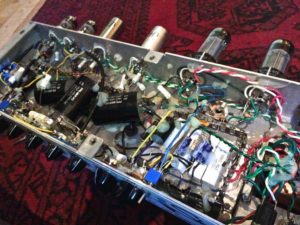
Skylark features true point-to-point wiring, with no circuit or turret board. (Lincoln, however, uses bits of circuit board for non-audio functions such as channel-switching.)
If you’ve listened to many of my videos and demo clips from the last year or so, you’ve heard these amps, so I figured I’d focus on them. For tech details, see the reviews. This video is more about how the amps inspire me musically.
From their flawless cabinetry to their ravishing tones, these amps are simply stunning. Cheap, they ain’t, but I felt like I was (RATIONALIZATION ALERT!) investing in musical art. Or maybe I’m making up for not buying a Trainwreck amp back in the ’90s when they were affordable.
I especially love how these Carr amps sound with my flatwound-strung guitars, and I used them on most of the demos for my pedals because they’re so very flattering. Ironically, I thought I’d given up buying new amps, because I was having so much fun building from kits. But trust me — both these instruments sound way better than any of my kit amps. Have a listen!
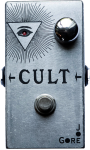
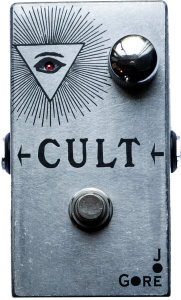
Of the four pedals new I announced at NAMM, Cult is probably closest to my heart— it’s my favorite overdrive circuit. If you’ve watched many of my videos, you’ve heard it. I even built it into a few guitars, including this one, this one, this one, and this one. And now Cult is coming in pedal form.
It’s no secret that 90% of today’s overdrive circuits are derived from the Ibanez Tube Screamer. Screamers are great if you want to compress your signal for consistent and predicable results. But Cult provides the opposite effect, expanding your guitar’s dynamic range rather than compressing it. It’s great for players who vary their touch and guitar-knob settings for maximum tonal variation.
Cult is sort of the mutant grandchild of the single-transistor boosters of the 1960s, including the Dallas Rangemaster. It’s no Rangemaster clone, though — the parts, values, controls, and tones have little to do with that classic treble booster. But Cult has the crackling presence and extreme dynamic response you only get from such minimal germanium-transistor circuits. (Guitar Player magazine went so far as to call it “the most dynamic overdrive we’ve heard.”) The pedal heard in this video is a final factory prototype, and the units now in production look and sound identical.
Have a listen:
As the video demonstrates, Cult lets you veer from crispy-clean to spatter distortion just by adjusting your guitar’s volume control. But my favorite way to use it is to set the gain so that you can go from sparkle to splat just by altering your touch, as heard in this video:
Cult with be available from Vintage King in the next month or two. There’s more info on the Joe Gore Pedals product page.
My Filth Fuzz pedal is finally in production and will be shipping within a few weeks. It’s one of three new pedals I’ll be showing at this week’s NAMM show in Anaheim, California. I just finished the demo video, and I’m stoked about how it’s sounding.
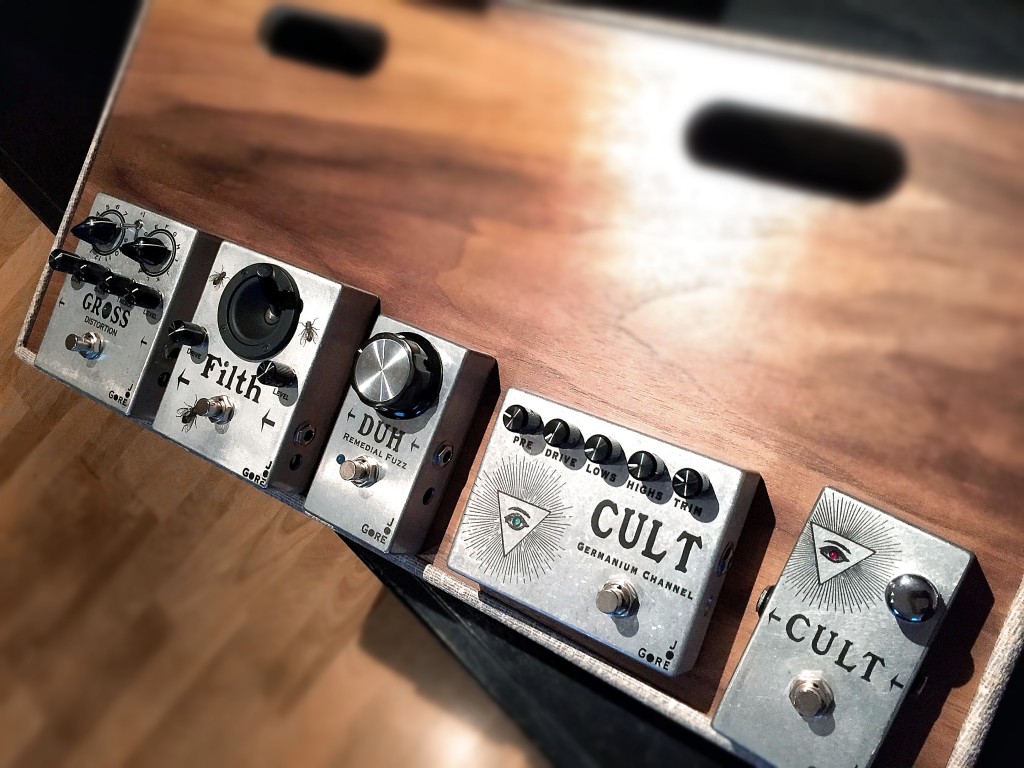
I’ll also be debuting three other new pedals: Gross Distortion, Cult Germanium Overdrive, and Boring Boost & Buff. Filth, Gross, Cult, and are finalized and in production, and should be available from my partner, Vintage King, sometime in February. (Vintage King is also currently the sole vendor of my Duh Remedial Fuzz, released last year.) We’re still working out a minor bug in Boring, but it should arrive soon after.
Now, it’s not like I can afford a proper booth or anything, so when I say “I’ll be showing these at NAMM,” I mean I’ll be walking around with a bag of merchandise. I’ll have a pedalboard with all my products on display at the Vintage King booth in Hall A, but sadly, it won’t be set up for demoing — there just isn’t enough space. However, my super-cool friends at Voodoo Labs will have a Filth Fuzz on their demo pedalboard, so you can take it for a spin in their booth while checking out the new stuff from that ever-innovative company. (I have no business connection to Voodoo Labs — they’re just helping me out because they’re nice.)
If you’re going to the show and would like to meet up, contact me and we’ll work something out. 🙂
Here’s what I wrote about Filth on its product page. (If you’re allergic to marketing copy, skip ahead, where I share some interesting backstory on how we arrived at the interface design.)
Man, I love those mad scientist fuzzes with too many knobs! I’ve collected them for decades and used them on a zillion sessions. It got to the point were people were hiring me specifically to make those sort of farting, fried-circuit tones.
But the downside of those complex fuzzes is that they’re a little too wide-ranging, with many settings you’ll probably never use. It’s easy to spend 20 minutes dicking around with the dials without nailing the perfect tone. I’ve always wished for a wild, highly variable fuzz that was a bit more “curated,” with easier access to the tones you’re likeliest to use.
That’s what inspired the Filth Fuzz. It’s only got four controls, but it’s a cornucopia of cool, quirky, and usable fuzz flavors.
The drive and level controls do what you’d expect. But unlike many fuzz drive controls, this one sounds great throughout its range. Extreme settings are molten-lava thick. Lower settings are like…slightly cooled lava, maybe?
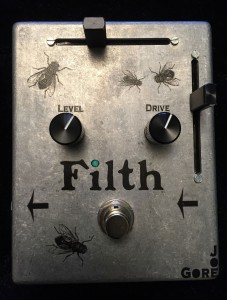
But the real action is in the two sliders. They’re tone controls of a sort, but not in the usual way. Most fuzz tone controls are tone-sucking passive circuits situated downstream from the fuzz effect. But here, the sliders alter the voltages at the transistors, radically changing not only the tone, but also the timbre, response, attack, sustain, and compression. In other words, the sliders radically alter the fuzz’s core character, as opposed to simply EQing a single core tone.
TO USE: Set desired gain and output levels. Move the sliders till it sounds awesome.
CAUTIONS: Filth sounds best before any buffered effects. It usually works best at or near the front of your effect chain.
Filth Fuzz was created in San Francisco and is built in Michigan by skilled craftspeople earning a fair wage.
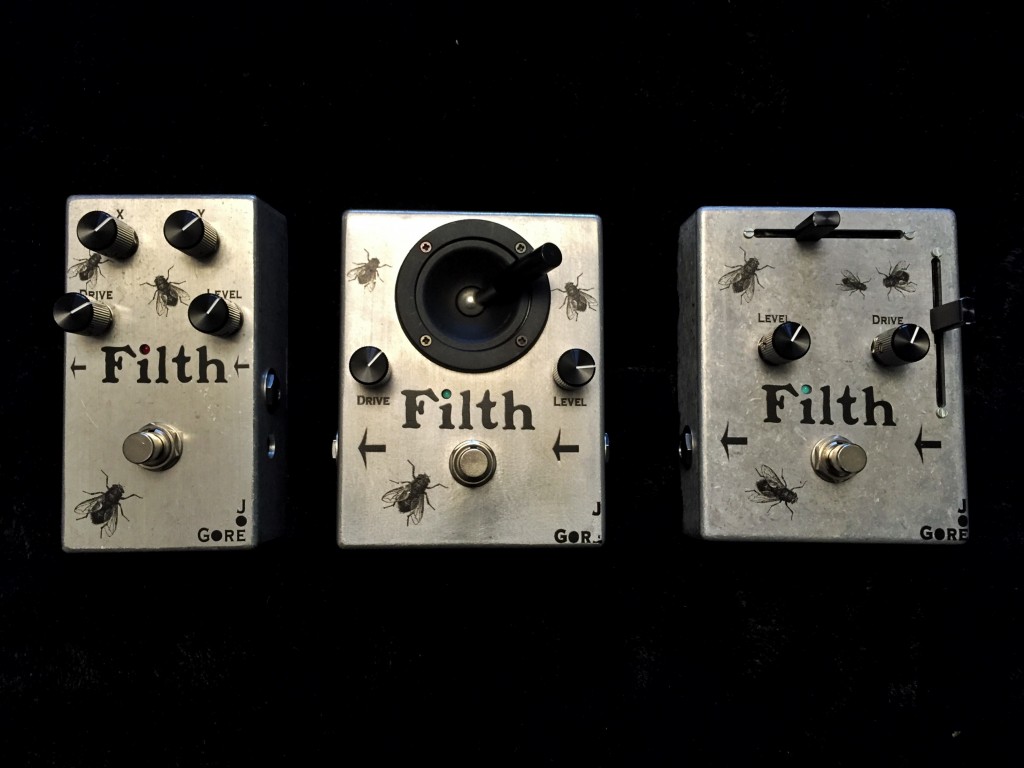
Filth’s sound hasn’t changed since I concocted the circuit on breadboard a few years ago. but the interface has gone through many iterations. It kept changing even after I sent schematics and prototypes to Tony Lott at Cusack Music (my manufacturer). Here’s a pic of three production prototypes:
Three incarnations of Filth Fuzz (in order of appearance).
To dial in tones on Filth, you adjust two highly interactive pots (let’s call them x and y), which tweak the voltages going in and out of the transistors, providing many tone variations. The original version used two standard pots for these x/y controls. It worked okay, but the ergonomics weren’t ideal. I’ve found that the fastest way to refine sounds is to move both pots at once over a sustained note or chord, and it was just a bit awkward having to take both hands off the guitar to turn the controls simultaneously.
So I decided to employ a joystick, which lets you adjust x and y with one hand (and it looks pretty bitchin’). The ergonomics were great, and I thought we’d finalized the format.
But then I showed a joystick prototype at the L.A. Amp Show in October, and for the first time I had a chance to sit back and watch other guitarists interact with the device. Players seemed to have a blast with it, but I kept noticing how often a heavy stompbox foot would land perilously close to the joystick’s none-too-sturdy shaft.
Meanwhile, we discovered that the the only compatible joystick option cost about $25 per unit — enough to jack the retail cost way up. Also, it was tricky to replicate exact setting via the joystick, which would suck if, say, you were trying to get identical tones night after night on tour. (I knew that when I first opted for the joystick, but I’d figured the fun factor would more than compensate.)
Then Miko Mader, a clever guitarist who works for my distributor, M1, came up with the perfect solution: Why not use two sliders instead of pots? Tony at Cusack sourced the perfect part, and we prototyped a third version.
Bingo!The ergonomics were great (check out the demo video to see how quickly you can change sounds with one hand). You can mark exact settings with tape if you need to, easily repeating specific sounds. The two sliders are a fraction of the cost of a single joystick, so we can sell the pedal for far less. (We’re still nailing down the retail price as I write.) There’s no fragile shaft to break. And while I miss the goofy fun of the joystick, the sliders are still pretty darn entertaining. (So thanks, Miko, for your brilliant idea.)
I’m really stoked about this pedal. I hope you enjoy it as well.
UPDATE: I just posted detailed pedal descriptions at gorepedals.com
Anyone going to the big LA Amp Show this weekend? I’ve never been, though I’ve heard it’s a blast. (Literally: Unlike at NAMM, exhibitors set up in separate hotel suites, reportedly without noise restrictions.) I always like geeking out at musical instrument trade shows, but this one is special for me: It’s my pedal premiere, the public debut of my next four stompboxes. They’re not shipping quite yet (except Duh, available here), though they’ll be out in time for a crunchy-as-hell Kwanzaa.
The pedals pictured may look like my usual sketchy handmade stuff, but they’re actually slick factory-made versions, painstakingly styled to look like sketchy handmade stuff. (Michigan’s Cusack Effects is my manufacturer.) They sound like my handmade prototypes, but are less likely to break every 15 minutes.
I’ll be showing them off in the Vintage King suite. (They’re my production partners, and for now, my sole retailer, though the pedals will eventually make their way to hip guitar shops.) Magnatone, Jackson Ampworks, and Moog pedals will also share the VK suite, so my pedals will be in lofty company.
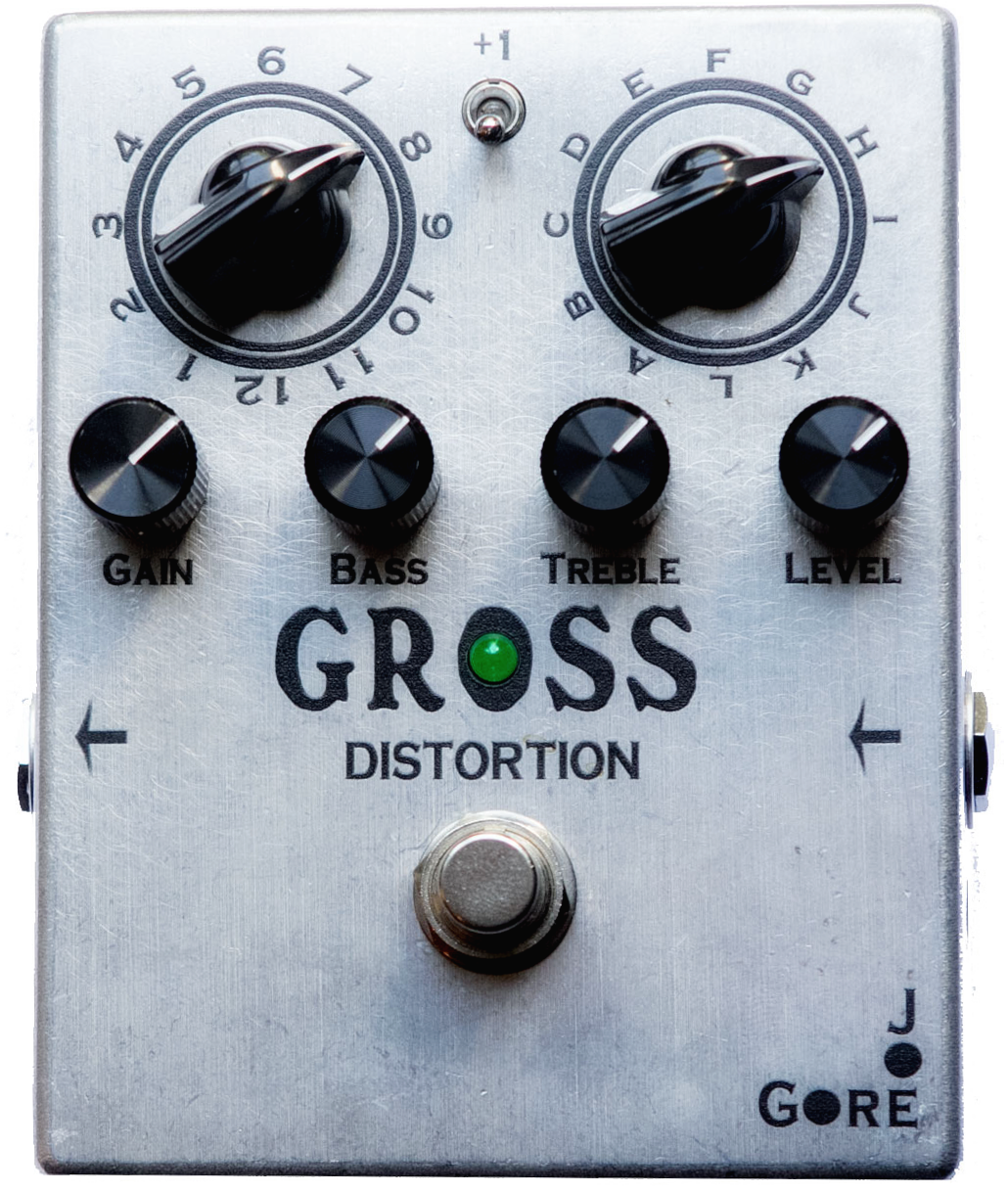
I’ve already written about Filth, Cult, and Cult Germanium Channel, though I haven’t yet finished their demo videos. (If you’ve spent any time on this site or my YouTube channel, you’ve heard them.) But I think this is the first time I’ve mentioned Gross Distortion, a twisted new take on a cool old crunch circuit. Here’s a demo I just made:
… and here’s how I describe it on the upcoming product page:
There’s never been a distortion pedal quite like Gross—so it needs an explanation.
At its heart, Gross is a simple, one-transistor distortion from the same family tree as the Electra circuit. This simple yet powerful effect was built into Electra guitars in the late ’70s, and was later adopted by many boutique stompbox builders. For good reason: It’s a lively, dynamically responsive circuit with less compression than most modern IC-based distortion pedals. The transistor boosts the level, and then the signal hits a pair of clipping diodes, which provide the signature distortion.
Every diode combination sounds slightly different. In fact, several boutique pedal companies have based their businesses on creating Electra derivatives with slightly varied diode choices. (Just Google “Electra distortion clone.”)
Gross isn’t an Electra clone. I’ve changed parts and values for a fatter sound and even greater dynamic response. I also added an active 2-band tone control—something seldom, if ever combined with primitive distortion like this. The distortion isn’t too “gainy.” It’s more about definition than sheer power—one reason it pairs well with other gain pedals. The character of your guitar and fingers always comes through.
The oddest feature is the diode section. Instead of a fixed diode pair, two 12-position rotary switches select from 24 diodes for 78 possible diode combinations! An additional switch adds a third diode for asymmetric distortion, which makes156 possible shades. My target number was 144—that’s why I called it Gross, though that may have happened the other way around.
Some combinations are as different as night and day. Others are only as different as noon and 12:05. But this network of germanium, silicon, and LED diodes provides many crunch colors.
With its labeled and detented selector knobs, you can call up favorite settings onstage. But for me, Gross’s forte is as a studio tool. It’s great for “texturizing” guitar overdubs—just spin the dials till you find a tone that sits perfectly in the track. It’s especially useful for doubling.
Gross Distortion was created in San Francisco and is built in Michigan by skilled craftspeople earning a fair wage. Available soon from Vintage King!
TO USE: Set the desired gain and level. Grab the big knobs and start spinning. Toggle the +1 switch frequently for asymmetric distortion—the changes can be dramatic! When you hear a cool tone, refine it with the bass and treble knobs. (Note: the higher the gain setting, the more dramatic the diode-tone contrast.)
Wow — I can’t believe my eyes! After years of planning, scheming, and screwing around, my very first batch of production fuzz pedals has arrived at my distributor, ready for sale. Will they gather dust or sell like hotcakes? That depends on you, dear reader!
You can read about the Duh Remedial Fuzz, hear a demo, and place orders from the product page at Vintage King. (For now, Vintage King is my sole distributor.) If you’ve been following my videos, you’ve heard Duh already — I’ve got the circuit mounted inside some of my favorite guitars, including the Hello Kitty! and lipstick-tube Strats.
Excuse me for quoting again from the great review I got in Guitar Player — I’m just a proud pedal papa! Have a cigar.
“Remarkable … responsive dynamics and simultaneously fierce and expressive tone. This is a pedal that doesn’t give up even one less-than-spectacular sound. It reminds me of ’60s records where the fuzz sound jumped right out of the grooves and changed my world.” [Editor’s Pick Award recipient.] — Guitar Player magazine, 2014
Using the same “reasonably scientific” techniques deployed in my recent germanium fuzz survey, I’ve created a blind listening test that removes as many variables as possible from the equation.
The video details the testing procedures. But basically, the A/B recordings are identical save for the use of one pedal or the other. The rival pedals are Klon Centaur #309 (the unit reviewed in Guitar Player back in the ’90s) and a new BYOC Overdrive 2, a DIY Tube Screamer clone kit with extra knobs and pots to provide the most popular boutique mods.
This Klon would fetch north of $2,000 on EBay. You can order the Overdrive 2 online for $95.
Now, these two pedals are NOT identical circuits. (The key differences are covered in the video.) But they share the same topology and sonic character. It’s not an apples and oranges comparison — more like two apples of distinct but related varieties.
For the video I dialed in five different sounds from across the Klon’s range, and then tried to duplicate them with the BYOC Screamer clone. You’ll hear the same material ten times, like so:
Example 1: medium gain, medium tone
Pedal A =
Pedal B =
Example 2: high gain, medium tone
Pedal A =
Pedal B =
Example 3: low gain, medium tone
Pedal A =
Pedal B =
Example 4: medium gain, bright tone
Pedal A =
Pedal B =
Example 5: medium gain, dark tone
Pedal A =
Pedal B =
To compete, just fill in the blanks and copy your answers into the comments thread below.
The pedals might not appear in the same order for each pair of audio clips. Other than that, there are no sneaky tricks. (For example, you really do hear two different pedals for every example.)
The first three contestants to submit perfect scores before Tuesday, July 23rd, 2013, will each win fabulous prizes one of my hand-built stompboxes. On that date I’ll post the answers and announce the winners here, assuming there are some. You can still test your ears after that by watching this video and not peeking at the answers — but sorry, no more prizes.
Only one entry per person. Anyone caught circumventing this rule via multiple identities may be subject to global ridicule.
I’ll hold off on any sonic observations till I post the correct answers next week.
Good luck, and may the best ears win some gnarly stompbox.
Some boutique stompbox builders pursue endless refinements of classic pedal designs, developing ever-more-suave iterations of the Tube Screamer and Ross Compressor.
And some just want to blow shit up.
Guess which category Portland, Oregon’s Devi Ever falls into? Hint: Her extensive line of guitar and bass pedals includes such anarchy boxes as the Little Shit, the Ruiner, the Heroin Lifestyle, and the Truly Beautiful Disaster.
Here’s what I’m talking about: Check out Devi’s video demo for her Shoe Gazer fuzz…
…or this one of Wilco’s mighty Nels Cline giving Devi’s Soda Meiser a workout: