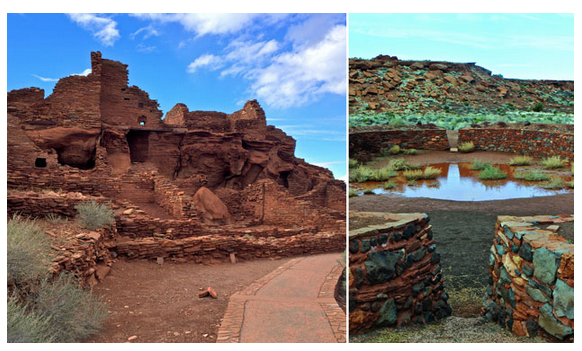
Premier Guitar just posted my latest Recording Guitarist column. The subject: Capturing the haunting reverbs of Southwestern ruins via impulse-response reverbs.
Many years ago I marveled at the eerie reflections within the stone-walled ball court at Wupatki, an hour north of Flagstaff, Arizona. On this visit, I attempted to clone the tone. I did the same at the Wildrose charcoal kilns in a remote, mountainous corner of Death Valley. The article includes audio clips, tech notes, and a download link for the impulse responses, suitable for use in any IR reverb program (or in the Logidy EPSi stompbox).
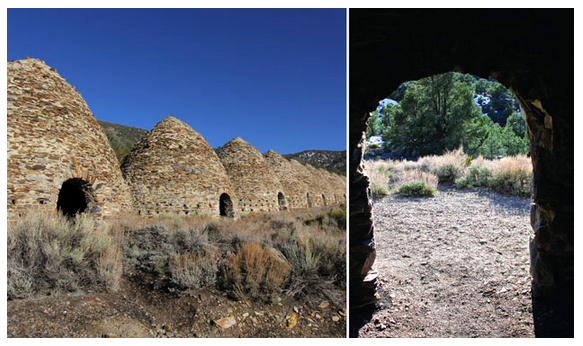
Like a dope, I’d forgotten to bring the relatively high-quality recorder I’d intended to use, so I worked with noisy, lo-fi recordings from my iPhone 6’s Voice Memos app. After some digital cleanup (detailed in the article), the results were cool and compelling, though not a completely accurate audio snapshot due to various types of distortion.
(Actually, I had an earlier experience capturing quick-and-dirty reverbs when I visited the Neolithic caves of France and Spain last year. It wasn’t my idea—I just happened to wind up on a tour group with composer Craig Safan, who was conceptualizing a piece inspired by those evocative spaces. He’d packed a proper Zoom mobile recorder, and we made ad hoc impulse responses by clacking small stones together. Craig has since completed the work, Rough Magic, and he tells me his mixing engineer wound up using our IRs a great deal. I’ve heard the piece, and it’s awesome. It’s not public yet, but I’ll tell you when it is.)
Since writing this Premier Guitar piece, I’ve been pondering whether damaged/distorted impulse response files might be an interesting avenue for sonic exploration. Generating cool sounds via weird IRs isn’t a new idea—the Space Designer plug-in in Apple’s Logic Pro includes a little-known IR preset folder titled “Warped,” which uses unusual sources like synth tones and noise bursts to generate reverbs not found in nature. But my interests are reverbs that are both familiar and surreal—the echoes of distorted reality.
And coincidentally, just as I was writing this post, a friend sent this wonderful video: an old Teletubbies clip, processed through a smeary, distorted black-and-white filter and paired with Joy Division’s “Atmosphere.”
I’m pretty much talking about an audio equivalent to that video processing. Has anyone else thought about or explored this idea?