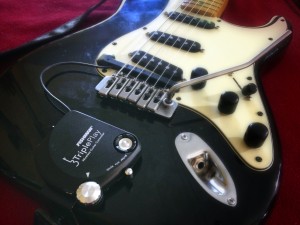
For the last few months I’ve been working with Fishman on the documentation for TriplePlay, their long-awaited wireless MIDI guitar system, which will finally ship this quarter. I had a blast demoing TriplePlay at MacWorld a few weeks ago, and I’m looking forward to doing so again at Musikmesse in Frankfurt in April.
But at times, it’s been frustrating. I power up TriplePlay to study some feature, get all excited, and then have to turn it off and write about it instead of going off and playing it for six hours. This little demo was my first real chance to just fool around with the thing. Thoughts and details after the video.
The recent post on Auto-Tune for Guitar generated much interesting discussion, plus a few good Auto-Tune jokes. Thanks, guys! :beer:
The comments from smgear particularly impressed me, because he managed to assemble a wish list for a future digital guitar with more detail and clarity than I could have managed.
It’s always a good idea for smart, articulate musicians to sound off about the musical tools they desire. But that’s especially true now, as manufacturers grapple with technological change with varying degrees of success. People really are listening!
Anyway, smgear wrote:
Basically, the problem is that the majority of the manufacturers seem locked into old paradigms. The bulk of their new designs are intended to mimic something else (Line 6), combine/integrate technologies (Roland) or make the ‘art’ less rigorous (Antares). Those are all fine pursuits and have resulted in some great tech, but they’re basically locking everyone into a pre-1980 palette of sounds, functions, and expression. Quite honestly, after my momentary enthusiasm has passed, I just pick up one of my no-name beater acoustics or electrics and dig in because every day I find a new sound, attack, approach, or whatever that allows me to express something in a new way. It’s true that I could do that playing through those tools, but I don’t need them and they are specifically designed to conform my sound to specific realms rather than to let me explore new spaces.
So with regards to this batch of hex-based modeling tech, my general requirements are fairly simple. I want clean and discrete signals from each string (check), I want a serious multi-core processor AND a couple programmable on-board control knobs/switches (semi-check), and I want an easily accessible and intuitive interface that gives me full control over how each particular string or any group of strings is processed/routed (no check).