Categories
Bass

Just How Heavy Can a U-Bass Get?

I've had this cool Kala U-Bass for a few years. (I did a video on it back when I got it.) I've used it on a few things, especially when I want a sort of Latin-flavored Ampeg Baby Bass sound. (That solidbody upright from the 1960s is largely forgotten, except in Latin dance bands, where it's considered the classic bass.)

But I've recently started rehearsing with a new band featuring my pals Jane Wiedlin, Pietro Straccia, and Dawn Richardson. And for perversity's sake, I decided to try using this little uke bass as the sole bass in band. (And Dawn hits those drums pretty hard!)

The above video demos some sounds I concocted using Fractal's AX8, the "light" pedalboard version of Axe-FX II, the company's flagship amp/effect modeler. I'm quite encouraged by the results! AX8 has no power amp, so I've been plugging into one or both of the Fishman LoudBoxes I use for my solo looping gigs. And if we play somewhere with good monitoring, I can just bring the uke bass and a small shoulder bag. Total lazy old guy gig!

The sonic missions were pretty simple: Amp up the lows. Nix as much of the ugly piezo pickup quack as possible. Concoct enough patches to make a nice, interesting palette for a set. There's still more to do, especially in terms of modifying my technique for the instrument. I'm still not quite comfy to the super-short scale. Also, I'm too accustomed to resting my picking hand on the body or bridge, and the piezo loves to amplify those thumping and scraping sounds.

But overall, I'm encouraged. Plus it's just sick fun. :)
Categories
Effects guitar

Museum of Lost Effects:
Morley “Oil Can” Wah

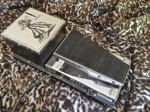
The mighty Morley Rotating Sound Wah

Two indisputable facts about Leslie rotating speaker cabinets: They sound awesome, and they’re approximately the size and weight of Rhode Island. Since the ’60s manufacturers have attempted to mimic the spinning-speaker effect in a more modest package. And one of the best mimics is the second exhibit in our Museum of Lost Effects.

The Morley Rotating Sound Wah is less well known than an earlier pseudo-Leslie, the Univox Uni-Vibe,forever associated with Hendrix. Like the Uni-Vibe, it a) tried to duplicate the Leslie, b) failed, but c) wound up creating a cool tone of its own. But while the Uni-Vibe milks its modulation from a series of optical sensors, the Morley relies on a rotating disc inside a can of electrostatic fluid. The result is a cool and complex modulation sound unlike any other (and one I’ve never been terribly successful at mimicking digitally).

This technology is descended from the “oil can” delays produced in the ’60s by the Los Angeles-based Tel-Ray company.In fact, Morley was a Tel-Ray spinoff — company founders Ray and Marv Lubow chose the name Morley for their line of guitar pedals based on the boast that this relatively compact modulation effect offered “more-lie,” as opposed to “less-lie.” (Note that I said “relatively” compact, since this beast is far and away the heaviest stompbox I’ve ever owned.)

The Morley Rotating Sound Wah is ugly, clunky, and klugey. If you drop it on your foot, you’ll never walk again. But I think it sounds incredibly cool.

Have a listen and see whether you agree: