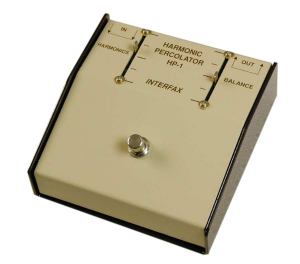
Few guitar pedals can rival the cult cachet of the Harmonic Percolator, a singularly ugly distortion stompbox produced in minuscule numbers in the early ’70s by Interfax, a small company based in Milwaukee, Wisconsin. And guess what? They sound ugly too, though they’re ugly in a cool and useful way.
They don’t get much rarer — or uglier. (This is a cosmetically faithful reproduction from Theremaniacs.)
I’ve been wanting to write about these for years, but was hindered by the fact that I don’t have access to one. No one does! Well, except the pedal’s best-known user, producer/guitarist Steve Albini. (Steve has posted several popular YouTube videos in which he sings the praises of the original and evaluates it against modern clones.)
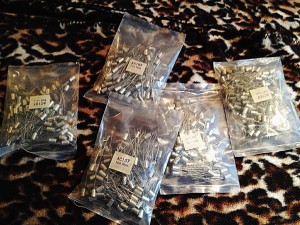
But I revisited the idea recently when Christian Magee, who runs Tube Depot, sent me a couple of old 2N404A transistors from a stash he recently acquired. This rare PNP germanium transistor appeared in the original, along with an NPN 2N3565 (also rare, but not as ridiculously rare as the 2N404A). Yes—this pedal uses both a positive-ground germanium transistor and a negative-ground silicon transistor in the same circuit. (Another Fuzz Face/Tone Bender clone, this ain’t!)
I whipped up several variants:
• a clone using the original parts
• a near-clone using more readily available alternatives
• a Harmonic Jerkulator, an all-silicon/no-diodes variation created by DIY stompbox titan Tim Escobedo
I was just in Europe, but I’m heading right back — this time on vacation. We’re going to spend a few days knocking around some fave cities, then embark on a tour of Paleolithic cave painting sites in France and Spain.
Our Cro-Magnon ancestors had to contend with such hardships as poor stage lighting, inadequate sound reinforcement, and excessively reflective surfaces.
I know it’s hard to tell when I’m being sarcastic, but this time I’m not. I wanted to be an archaeologist as a kid, until my mom said, “Why? All you’ll do is sit in a closet polishing worthless scraps with a toothbrush.” (Fortunately, she was more supportive of my musical dreams. She never said, “Why do you want to be a studio musician? All you’ll do is sit in a closet polishing worthless scraps with Pro Tools.”)
Since I won’t be able to post and reply as often as usual until I return at the end of the month, I figured you guys could help me keep things interesting. Which brings me to the latest tonefiend contest: the Cro-Mag Comedy Competition!
The rules are simple, just like the musicians we’ll be poking fun at. All you must do to enter is post a funny musical anecdote to the comments section below. It doesn’t have to be about musical stupidity, though experience suggests that those are the funniest stories. Nor does it have to be about guitar, though there are few things stupider than stupid guitarist stories. (Drummer, bassist, and vocalist stories are the obvious exceptions.) The tales should be true, or at least sufficiently true-sounding to dupe the rest of us. If they involve real people, please change their names enough to avoid legal action.
I’ll winnow down the entires to a manageable number via some as-yet-undertermined means (dartboard, or maybe animal entrails), and you, dear readers, will get to select the final three winners, each of whom will receive one of my unique handmade stompboxes, created in a closet at my cutting-edge workbench out of worthless scraps premium mojo parts.
Enter as many times as you like — but please, only one anecdote per comment. Also, please post your anecdotes here on the site, rather than in Facebook comments. Stories can be as long as you like, but remember: Your judges will be musicians, so they may have difficulty grappling with complex sentences.
The contest runs till I get back, or till jet lag subsides — whichever comes last.
Here’s a sample story to get the ball rolling. Naturally, I’m ineligible for the competition because I already have enough crappy little pedals it’s the ethical thing to do.
I heard this one from one of my favorite guitar techs. He’s such a pro that he refused to reveal the identity of the musicians in question, though I managed to pry from him the fact that it’s a leading UK or Irish band you’ve probably heard of.
Anyway, the band’s bass player insisted on using a large, loud, miked amp onstage, even though the front of house guy used only the direct signal in the PA. “Please don’t use an amp,” the crew and band pleaded. “It leaks into the other mics. It screws up everyone’s onstage mix. It makes everyone’s life more difficult. You can have as much bass in your wedges as you like. Or wear-in-ear monitors. Or anything! But please, no amp!”
“Sorry,” said the bassist. “It’s my sound. What’s more, I refuse to step foot onstage tonight unless I see my amp up there with a mic on it!”
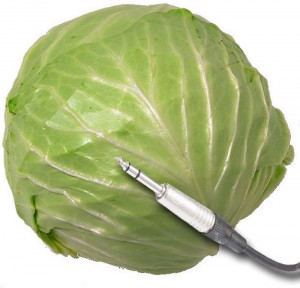
That night the amp was right where the bassist expected it, with the usual mic in the usual place. But unbeknownst to the bassist, the mic cable wasn’t connected to the sound system. The cable ran offstage, where it was plugged into … a cabbage, pilfered from catering.
I just received from Warmoth all the parts for my next DIY guitar. I loved testing eight sets of P-90 pickups for Premier Guitar, but I don’t own any P-90-eqipped guitars.I will soon, though!
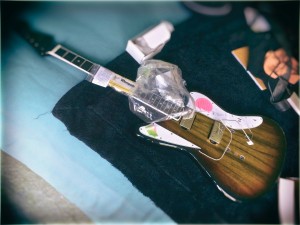
This one will be a bit of a platypus — as opposed to, you know, all my other other platypi. (The actual plural of “platypus” is “platypuses,” but “platypi” is more fun to type.) It’s built from Warmoth’s “split Jazzmaster” template, with a korina body, bound neck, Tune-o-matic/stop-tailpiece bridge, and a pair of hum-cancelling Fralin P-92s. Yeah, it’s kind of a stab-in-the-dark experiment, and not a inexpensive one. But hope springs eternal. Prepare to be bored with details!
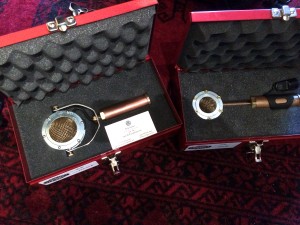
I’ve also just received an amazing-looking pair of condenser mics from Portland, Oregon’s Ear Trumpet Labs. ETL kingpin Philip Graham’s business card identifies him as “proprietor and bricoleur.” Bricolage, of course, is the ten-dollar word for “making stuff out of junk and other found objects.” Dig the steampunk vibe of that repurposed hardware! I haven’t even plugged these in yet (though the reviews I’ve read have been stellar). I just like staring at them! But I’m going to try them out at my monthly Strung Out! show tonight.
Ear Trumpet Labs’ Edwina and Edna models: a higher calling for found objects!
Which brings me another of this week’s highlights: I got to perform last night with my dear friends Teja Gerken and Adam Levy. Teja is an astonishing acoustic fingerstylist and a fine composer. His vocabulary has hints of Bensusan, Hedges, and classical, but he’s molded those influences into a thoroughly unique sound. And Adam, who I’ve known since my Guitar Player magazine days, is equally renowned for his jazz work and for accompanying such singer/songwriters as Norah Jones and Tracy Chapman. (I get to play some of Adam’s cool parts when I gig with Tracy.) These days Adam’s focusing on songwriting, and he his sings his “smart Americana” songs (my description, not Adam’s) in a sweet, soulful voice. Man, what a treat to hear both of them up close. And tonight, Adam, Shelley Doty, and I perform at my local dive, El Rio. Can life get any better?
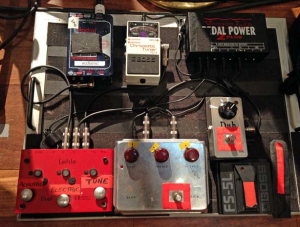
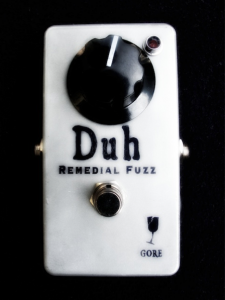
Apparently so! Yesterday Premier Guitar posted John Bohlinger’s piece on the Pixies, which includes a pic of Charles “Frank Black/Black Francis” Thompson’s pedalboard, with my grubby, hand-built Duh fuzz pedal front and center. I’d originally made if for Joey Santiago, the other Pixies guitarist, but I guess Charles swiped it. Hey, I’d be honored if either guy spat on the thing! They’ve been heroes since I first heard the band in a small San Francisco club back in ’88. (Everyone went to hear the Sugarcubes, but left talking about that awesome opening act from Boston.)
Frank Black’s pedalboard: Lookit! I’m Pixies-approved!
It’s funny, because I really was thinking “Pixies” when I sound-designed the Duh. I was going for “bubblegum metal” — a thick, heavy sound, but not a macho one. The tone is too fizzy and funny for 100% sincere heavy rock, IMHO. It’s more of a “greasy kid stuff” distortion. (Note to readers under 45: That was once the tagline for a “dry look” mens hair product, referring to the outdated coiffures that would return with a vengeance when punk broke a few years later.) It’s a vaguely Muff-like sound, but with less compression, less scoop, and one big, stupid knob. I also like building that circuit into guitars. Like this one:
So it’s been a grand week, but a hectic one. Thanks for reading this far. Next week I promise a proper post, and not another collection of … odds & ends.
One of the coolest gizmos from last weeks NAMM show is already in my grubby little hands: It’s the Logidy EPSi, the first customizable convolution reverb pedal. I ordered it the instant I heard about it, and it arrived right before I left for Anaheim.
Convolution (or impulse response) reverbs can mimic acoustic spaces and outboard gear with astonishing accuracy. (If this concept is new to you, check out this article by me. Or better yet, this one written by someone who knows what he’s talking about.) Nutshell: You create impulse response (IR) files by playing and recording a test tone in rooms or through gear. Once you load the file into an IR reverb device or plug-in, it can make anything sound as if it was recorded with the same ambience.You can also generate eerie, otherworldly sounds by loading unusual audio files.
Many software and hardware amp and effect modellers use IRs to mimic gear. Software convolution reverb plug-ins such as Audio Ease’s Altiverb, Logic Pro’s Space Designer, and Waves IR1 include reverb libraries, and also let you load your own IRs. But as far as I know, EPSi us the first device that lets you load your IRs into a stompbox and access them without playing through a computer.
I’m psyched to add IR reverbs to my (mostly) analog pedalboard, and EPSi makes it relatively easy to load the IR libraries I’ve compiled. The files require special treatment: They must be 44.1kHz WAVs, and the names must be formatted quite specifically, as detailed in Logidy’s documentation. The interface is extremely minimal: just a bypass footswitch and a knob/button pair to navigate the simple menus.
This unique reverb stompbox sounds great and offers limitless opportunities for creative sound design. You can load your own impulses, or add ones from from some of the fine freeware libraries online. (Thanks for the link, Scott!) On the downside, it’s difficult to load or edit sounds on the fly, so while it might be fun to spelunk for new sounds in the studio with EPSi, don’t plan on modifying sounds onstage. (The ability to recall several saved presets would vastly improve EPSi as a gigging tool.)
It’s almost always a bad idea to label something a manifesto. It’s pretentious, and it makes you sound like a crank, especially if you were born between 1890 and 1990. But it is dramatic. And would anyone pay attention if I gave this post a more accurate title, like “Please Participate in My Stompbox User Interface Focus Group?”
Anyway, I’ve been having this recurring workbench experience. (No, not the solder burns.) Every time I breadboard a stompbox project, I poke through the circuit, looking for places where I might add a switch or knob to unlock cool sounds. I usually find nice variations and build accordingly. But as soon as I plug in the pedal, I always seem to like one setting a lot more the others. Then I rebuild, hard-wiring the preferred value and ditching the switch or pot. Eventually almost everything I build winds up with only one or two knobs. (Unless I’m making it for personal use, in which case it often has no knobs.) It’s not a love of minimalism, and it’s certainly not an assumption that users are too stupid for anything more complex. It’s just that time and again, the simplest solutions sound best to me.
Meanwhile, I just had an interesting experience reviewing a (gulp) $5,000 amp for Premier Guitar, which crystallized some of my thoughts. The amp in question is a Little Walter 50/22 (which is actually two independent amps in a single housing), and I’ll link to the review when it goes live in a few days. But suffice it to say that Little Walter amps draw their inspiration from the earliest Fender tweeds, and have minimal controls to match: one volume knob and one tone knob. Furthermore, builder Phil Bradbury all but advises against using the tone control, pointing out that vintage-stye tube amp tone controls are strictly subtractive, and that you get maximum impact and richness with the tone circuit wide-open. And Bradbury is right. As on many great vintage amps, the Little Walter controls are practically superfluous. If you locate the right sweet spot, you can park the controls there and make any needed gain or tone adjustments the old-fashioned way: by playing them. Dig in harder for more distortion. Back of the volume to clean up. Use your angle of attack as a tone control. Like that.
But you don’t encounter many new-production amps that adhere to the philosophy. I get the sense that a lot of designers would like to create minimalist amps such as these, but they fear that the public wouldn’t get it. How could the one-knob amp possibly sound as good as the one with 11 knobs? But I suspect that the more experience you have with amps, the likelier you are to believe that simple sounds better. Now I want to build a great-sounding tube amp with only an on/off switch.
Three knobs?! What, do I look like Einstein to you?
I’m finding the same to be true with distortion/fuzz/overdrive stompboxes. For many players, the minimum complement of controls is gain, tone, and master volume. But almost every circuit I’ve explored sounds better without a tone control, and it’s hard to make a gain control sound great throughout its entire range. So more and more I find myself fine-tuning circuits to what I feel are the best gain and tone settings, hard-wiring them there, and then just slapping on a master volume for level-matching. (And if the pedal doesn’t add a great deal of volume, I often skip the master as well.) If you “tune” the distortion, you can control the gain perfectly well via your hands and guitar.
“But,” I hear the inquiring player ask, “don’t you need a tone control so you can use the same pedal with different guitars?” (Sadly, I sometimes believe I’m hearing the voices of inquiring players when I’ve neglected my meds.) Increasingly, I think not. In almost all cases, there’s a sweet spot where a circuit sounds good on everything from a bright Tele bridge pickup to a tubby neck humbucker. Those extremes don’t sound the same, of course. But if you’re playing distorted on a Tele, can’t we assume that you want a bright edge? (And vice-versa with the neck humbucker.) And if you do want to modify the tone, isn’t doing so with via fingers, amp, or mixing board a better solution than using a tone-sucking stompbox tone circuit?
Another example: I spent countless hours pursuing a stompbox vibrato circuit. (I mean true pitch-shift vibrato, not tremolo.) I’d obtained great tones, but I couldn’t get the effect to sound good at all rates and depths, because the perceived depth changes along with the rate. Finally, it occurred to me to go the one-knob route, using only a rate control, and letting that determine the depth. That may sound like a half-assed non-solution, but I’ll be danged if I didn’t suddenly have the most gratifying vibrato pedal I’ve ever played. Like the minimal controls on ’50s amps, the arrangement just worked.
Other factors influence my one-knob attitude: Since I’ve spent much of the last few years in the digital guitar realm, analog guitar has become a refuge from that sometimes math-based approach. When I switch on the analog rig, my goal isn’t maximum user options, but a primal experience. Also, there’s probably an element of advanced-player snob appeal. I don’t know much about cars, bicycles, motorcycles, or sporting goods, but there’s probably a parallel between minimalist musical tools that demand a fair amount of technical finesse, and vehicles and sports gear with stripped-down, featherweight, only-for-pros features. Not every bicycle needs a kick-stand, and not every fuzz pedal needs a gain control. (Or something like that.) Additionally, I hope to bring my pedal designs to market, and what a crowded market it is! Sure, it’s mainly crowded by clones, but many brilliant builders are creating complex mad scientist boxes. Maybe there’s a niche for one-knob mad-scientist boxes…
I’m not sure it’s kosher to conclude a manifesto with questionnaire. But I’m eager to hear your replies to these queries—or anything else you feel inspired to add. Thanks!
Do you tend to change tone settings on amps and pedals when you switch guitars?
How often do you fiddle with stompbox knobs mid-performance?
Do you use your guitars’ tone knobs much? If so, how and why?
Does anyone out there actually use their guitar volume knobs to veer from clean to dirty sounds? Or is just the wishful thinking of pompous guitar “journalists?”
Would you consider using a no-knob stompbox that pretty much requires you to use your guitar’s knobs?
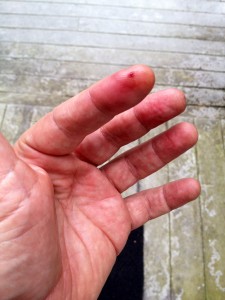
I was trying to decide which self-indulgent experiment fascinating project to demo this week when my hand slipped, driving a sharp soldering iron tip into the meat of my fretting-hand index finger. It didn’t hurt all that much—until I tried to play. Ye-OWCH! (No, of course I wasn’t using the tool properly! I was trying to pick loose a knot of wire with the iron’s tip rather than the recommended wire-picker-thingy.)
So no guitar recordings for me this week while my poor l’il finger recuperates. But I’ll try to compensate for this dog-ate-my-homework post by sharing three works in progress. If they turn out well (and they might!), audio and video will follow.
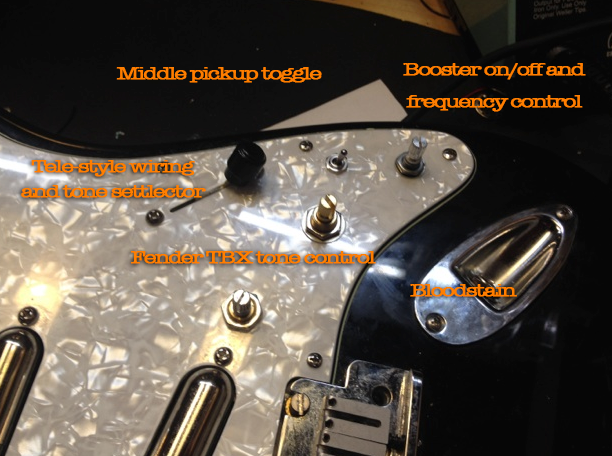
1. Lipstick Tubes Revisited. For more than a year, the generic Mexican Strat I fitted with lipstick tube pickups has lived, disassembled, in a filthy cardboard box next to my workbench, guilt-tripping me every time I fired up the soldering iron. There were a number of experiments I’d been meaning to perform on it, and in a spectacularly bad example of scientific methodology, I incorporated them all at once, making it pretty much impossible to discern what’s doing what. But I hear some things I like. Here’s what’s new (beside the blood spatters):
Not everything is working as desired yet — but there are some promising directions here, and it’s so nice to have a lipstick tube instrument again. :pacman:
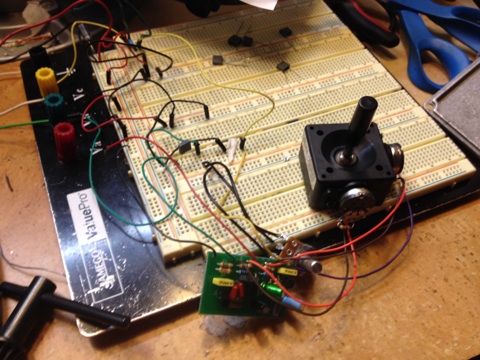
Joystick fuzz: like giving a loaded gun to a monkey.
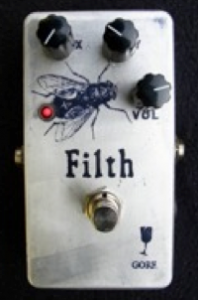
2. The Joy of Stick. Anyone tried a joystick effect, like Devi Ever’s Drone Fuck Drone? I bought a few joysticks from 4Site and have been having a blast. I thought they’d be difficult to wrangle, but it’s really just two pots, each with the standard three-lug connection, deployed in X/Y configuration. Two things to bear in mind, though: They’re generally available only with identical resistance values for each pot, and more important, you need two controls that have meaningful values throughout their ranges. Fortunately, I had just the circuit for it: my Filth Fuzz (which Fuzzbox Girl was kind enough to demo and review in 2011). I’d even labeled the controls X and Y! (I’m not selling these, but I do hope to bring it to market before long. Honest.)
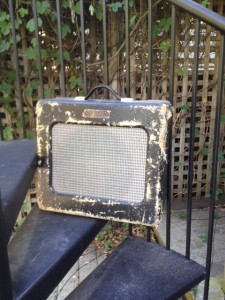
3. A Reanimated Amp. This one’s personal: I’m finally refurbishing the 1951 “TV front” Fender Deluxe amp that I received for as a bar mitzvah present in the ’70s. (I was mature enough not to express my disappointment over getting some crummy old tweed. But how I longed for that shiny post-CBS crap!) My mom procured it from the son of one of her fellow elementary school teachers, who worked at Fender in nearby Fullerton. (Sadly, I’ve forgotten his name.) I also got to pick from three early-’70s Fender guitars: a sunburst Strat, a paisley Tele, and a black Jazzmaster. I, of course, chose the Jazzmaster — at the exact moment when no one on earth gave a crap about that model. And naturally, I sold it just when new wave arrived and Jazzmasters became cool again. See? I established my pattern of buying and selling the wrong things at the wrong times while still in my teens!
I didn’t wreck the amp by myself — the process started with the black paint job it acquired long before I entered the picture. Over the years it received a preamp mod from Paul Rivera, and later got totally ruined by an overambitious repairman who added mods I never requested, and who probably stole most of the original electronic parts. But the cab, chassis, speaker, and output transformer are original, and there’s no reason why it shouldn’t sound bitchin’ after I restore it to its original 5A3 circuit. I’m getting expert help from Tube Depot’s Rob Hull, who helped me source parts and make a grommet board to house the components.
So my apologies for all talk, no audio. My boo-boo is healing, and I should be back able to, like, actually play some of this stuff soon!
UPDATE:My Premier Guitar Heptode Virtuoso review is live. Read and listen here.
I’ve got phase shifters on the brain, especially after encountering a couple of truly stunning ones. I just wrote a review for Premier Guitar of Heptode’s Virtuoso phaser, a superb clone of the old Maestro PS-1A. (I’ll link to the review when it goes live.)
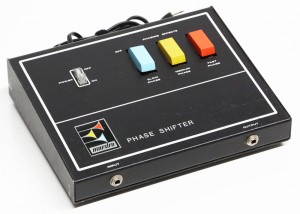
It took me back to my Pleistocene pre-teen years, when I once spent hours in my local music shop playing an electric nylon-string through a big-ass PS-1A mounted on a music stand. Despite its size, it had few controls — just big colored switches that could have been swiped from one of the era’s cheesy home organs. It sounded glorious to my 12-year-old ears. I’ve never since held such a high opinion of my own playing.
I haven’t played a PS-1A since then, but the Heptode pedal took me right back. It really is a gorgeous-sounding phaser, and one that vanished soon after the debut of the cheaper, smaller, and awesome-sounding MXR Phase 90. The sound captivated me all over, though I’m not sure if I actually like it more than the Phase 90, or if it just sounds so cool because it’s a less familiar color.
The plastic switches make it sound better.
I dug out a few other favorite phasers, like the $89 BYOC Phase Royale that usually lives on my analog pedalboard. It’s yet another brilliant DIY kit from BYOC’s Keith Vonderhulls. It’s basically a Phase 90, but with all the cool mods, like mix and resonance controls, plus a six-stage phasing option. (The Phase 90 and the Uni-Vibe are four-stage, while the Maestro is six-stage). It’s a fun build, and an excellent next step for DIYers who have built a few fuzzes and are ready for something a bit more challenging.
I concluded my little phase-fest by unearthing my old Lovetone Doppelganger, a bitchin’ dual-LFO phaser from the late ’90s. Not to be confused with today’s Lovepedal brand, Lovetone was a British company run by Dan Coggins and Vlad Naslas. They specialized in large-format pedals with an almost absurd number of controls. (Their brilliant slogan — “Big Pedals to Trip Over” — is rivaled only by Zachary Vex’s “Crazy Effects for Rich People.”) I’d flip out when each new Lovetone pedal came in for review at Guitar Player. Even then, they were expensive, usually in the $400-500 range. Now, of course, they’re obscenely rare and valuable. I bought as many review models as I could afford, and to this day I regret not purchasing their Meatball, Wobulator, and Brown Source. I did, however, snag the Big Cheese, Flange with No Name, Ring Stinger, and this guy:
I haven’t heard the Doppelganger in years, and it was interesting to revisit it. See, while I always loved the ideas behind the Lovetone boxes and was happy to own them, I’d found that I just didn’t tend to use them a lot for gigging and recording. For me, they had tons of cool sounds, but often not quite the right one. But I’ve gotten better at dialing in tones in recent years, and really dug the sounds I got yesterday while making the video. Maybe it just took me 15 years to learn how to wrangle these beasts!
Anyway, the Doppelganger is now a Museum of Lost Effects inductee, and it’ll be joined soon by its big-box brothers. (more…)
I just bought 500 germanium transistors. (Yes, as a matter of fact, I am insane. Why do you ask?)
UPDATE: My Dunlop Fuzz Face Mini review is live at Premier Guitar. Audio clips included!
How and when did it get so frickin’ easy to procure great-sounding germanium transistors?
I’ve been building stompboxes for four years or so. I used to consume article after article detailing the sheer horror of dealing with germanium. Sure, those old-school transistors sound great, I’d read, and they’re necessary for vintage distortion circuits. But they’re unstable. They’re expensive. They’re hard to find. You have to sort through dozens to find the few good ones. And once you do, you must spend countless hours matching and biasing them for optimal sound.
I believed everything I read — until I finally admitted to myself that I seldom encountered any of those problems.
(If you don’t know much about germanium transistors and why they’re cool, here’s my manifesto.)
I used to buy germanium transistors from Small Bear and other parts sites, and was always happy with the results, even though I had to pay eight or ten bucks per transistor. (Small Bear even does the matching for you, offering sets of transistors suitable for various vintage fuzz circuits.) However, it was a little tough finding NPN (negative-ground) germanium transistors. In fact, Small Bear once rejected my order of a dozen or so NPNs because they were so scarce. (To his credit, Small Bear’s Steve Daniels explained that he restricted sales so that everyone who wanted to build a couple of great DIY fuzzes would have the opportunity.)
The workaround is to build pesky positive-ground pedals, or jigger with the schematic in order to use PNP (positive-ground) transistors in negative-ground circuits. (This site’s Fiendmaster project is an example of the latter workaround.)
This is an exciting post for me, and not just because I get a desperately needed break from Klons and Screamers. I’m thrilled to bits about Logic Pro X and MainStage 3, though I’m still wrapping me head around them. (Yeah, I worked as a developer for both products, but I didn’t get a proper program-wide view until last week’s release.)
Also, it’s my first story for Premier Guitar, whose staff I’ve just joined as a senior editor. I’m stoked because it reunites me with PG editor Shawn Hammond and senior editor Andy Ellis, both of whom I remember fondly from my Guitar Player magazine days.
There’s much talent and coolness on the staff. I’m a happy little guitar nerd. Plus, the schedule is loose enough that I can still record, perform, and continue to work with audio/software clients.
What does the gig mean for this blog? Good things. I have no plans for a major course change — there are too many things I can only cover on a non-commercial site, including some of the topics closest to my heart. Meanwhile, working with PG will keep me more up-to-date on new music, new gear, and scurrilous guitar community gossip. In some cases, though, I may link to a PG article I’ve written rather than duplicate the work here. Today, for example. 🙂