I just tried an interesting tone comparison, one I’ve never seen attempted. It concerns the search for loud amp sounds at low volumes.
Have any of you ever experimented with speaker attenuators — the passive load boxes that reside between your amp output and speaker input, which let you crank the amp while maintaining a low level from the speaker?
I’ve worked with one model before, a borrowed THD Hot Plate, and thought it performed well. I decided to purchase my own attenuator after several Premier Guitar reviews of large amps. As a small amp fan (not to mention an aging player with fragile ears), I wanted to minimize the aural assault of evaluating loud-ass amps.
But first, I wanted to determine whether it’s legit to evaluate amps at attenuated levels. Does attenuation inevitably alter the tone? And if so, can you compensate for via recording software?
Online opinions about attenuators range from “works like a charm!” to “totally killed my tone!” So I picked up a Swart Night Light and started recording and measuring. (I didn’t compare rival products. I just went with the Swart for its reasonable price, solid online reviews, and dual outputs for driving two cabs. I didn’t A/B it with a Hot Plate, though the results seem roughly similar.)
I direct-recorded a brief guitar phrase using my black Les Paul with Bigsby and PAFs, and then ran it through a ReAmp to my early ’60s Tremoverb, a 35-watt Fender with two 6L6 power tubes. I dimed the volume and left the EQ flat. Tt was insanely loud in my small studio. After recording that, I tracked the same clip again using the attenuator at each of its three settings. The lowest attenuation setting reduced the sound from insanely loud to very loud. Medium attenuation reduced to somewhat loud. Strong attenuation produced a sound quiet enough to speak over. I recorded the results through Royer R-121 ribbon mic. I added a touch of plate reverb, but no compression or EQ. (Though I did normalize the files so they played back at similar levels.) In other words, you hear the same clip four times through a head whose settings never vary.
So did the tone change? Have a listen:
Do you hear what I hear?
IMHO, none of the clips sound particularly great. (Most amps, including this one, don’t sound their best at 10.) But the unattenuated loud sound has some qualities the others examples lack. The attenuated clips have a little less low-mid impact, and the higher-register single notes that sound a bit thin and prickly even on the original sound even thinner and pricklier post-attenuation.
Why, since the amp settings don’t change, and the performance are identical? Mics can respond differently at different sound pressure levels, and the relatively restrained speaker movement alters the result as well. Conclusion: the timbres of the attenuated signals are fairly faithful to the original, but there are slight spectral differences and a bit less body/fatness, especially on single notes.
Then I introduced some additional wrinkles: (more…)
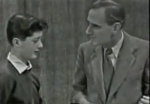
Aha! Now we know why no one has developed a cancer cure! It’s because young James Page took that skiffle thing a little too seriously.
Yep — it’s Jimmy Page at 13 in 1957. (He turned 70 this week.) Imagine how different the world would be had he followed his stated goal of becoming a cancer researcher. We’d probably have eliminated cancer 30 years ago, but our music would be a lot crappier.
As much as I love Pagey’s playing, I’ve long felt his greatest influence was as a producer. He defined what rock sounds like, largely via his unprecedented innovations in exploiting and manipulating reverberant spaces. Zep sounds like modern rock. Nothing before does.
Condescending BBC presenter: “What are you going to do when you leave school? Take up skiffle?”
Many years ago I was kicking that notion around with my friend Andrew Goodwin, the brilliant British media studies scholar. He expanded our ramblings into a journal paper, and gave me an entirely undeserved co-author credit. To this day, it’s my only academic publication. Andrew went on to create a Led Zeppelin course at the University of San Francisco. He was working on a Zep book when he died in a freak apartment fire a few month ago. I assume he was aware of this clip, though I’m not certain. He definitely would have loved it! I miss him.
What’s your favorite Pagey moment? I think mine is from one of those leaked studio outtakes, an excerpt from “Heartbreaker.” You hear the amp close-miked and claustrophobic-sounding. Then you hear it miked from a distance, spooky and reverberant. Then you hear both sounds together. Voilà — modern rock guitar.
My fave Pagey solo is — hehe — “Sympathy for the Devil.” Yeah — I still think he played that one.
Earlier this year I got to do a couple of shows with Marianne Faithfull, who prompted the song in the first place when she gave Mick a copy of Bulgalkov’s brilliant novel The Master and Margarita. We were talking about the song, so I figured it was my moment to finally solve the mystery.
“So who played the solo?” I asked.
She rolled her eyes and sighed. “I just knew you were going to ask me something idiotic like that.”
It’s a holiday miracle! The 30-minute Bigsby tremolo installation.
Sometimes it pays to write for a guitar magazine!
My old pal and Premier Guitar colleague Andy Ellis hipped me to the Vibramate, an adapter that allows you to install a Bigsby tremolo on many types of guitars with no drilling or other permanent modifications to your instrument.
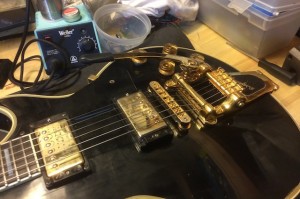
A Bigsby and Vibramate were a centerpiece of a cool makeover project the magazine concocted, transforming a beat-up ’70s Epiphone in a bitchin’ Bigsby-bedecked bombshell. Inspired, I decided to give myself the shakes for Xmas. I bought a Bigsby B7 and corresponding Vibramate kit and popped them onto my long-suffering Les Paul. Check it out:
Yup, this is the much abused ’82 Les Paul that I’ve used in many tonefiend experiments, especially the OCD-approved Pagey Project. What a journey this guitar has been on! Never a big Les Paul fan, I picked up the cheapest old one I could find because I needed it as a reference for the sound design work I was doing for Apple. Trust me — it was a thoroughly unremarkable instrument. But then I started playing with pickups … and alternate wirings … and replacement hardware … and after several years of hacking, I have an instrument I love.
Pity about the gold hardware though — I should have switched to chrome early on. It’s the downside, I suppose, of incremental makeovers. By the time I got to the Bigsby, I had to cough up extra cabbage for the vulgar finish. (My wife recoiled when she saw the Bigsby box on the counter: “Eww — what’s this gold thing?”)
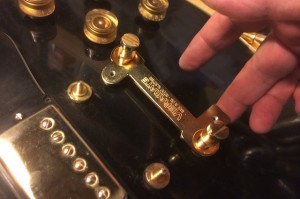
The Vibramate bracket screws into the existing tailpiece bushings.
I’m no Bigsby expert. I’ve never owned a Bigsby-fitted guitar (though I’ve had a couple of long-term loan). It’s odd, because I like how they perform, look, and feel, and “bling cringe” aside, I love it on this guitar. It definitely changes the tone — though in spectacularly unscientific fashion, I replaced the previous roundwound strings with flatwounds while doing the installation, and it’s tricky to sort out which changes are exclusively related to that hardware, and which to the strings. The guitar feels brighter and more resonant. (I’m reminded of Ry Cooder’s dictum: The more springs you add to a guitar, the livelier the acoustic response.) The treble response is WAY different — I needed to lower the treble sides of the pickups to offset the face-slapping response of the high E string.
I’ve bored everyone to tears with my incessant testimonials to the glory of great flatwound strings. This guitar has never worn flats — I’ve kept it in roundwounds for writing product reviews, and for sessions where I specifically need a roundwound sound. But I’m loving the way they sound and feel here, so I guess I’ll have to select another Gibson-flavored guitar as a dedicated roundwound instrument.
The installation was a breeze. The quality of materials is superb. I also added Vibramate’s String Spoiler, a clever little bracket that clips onto the tiny nubbins that usually secure strings to a Bigsby. The Spoiler makes string changes way easier. I’m deeply impressed by the Vibramate products — even in frickin’ gold.
Oh — the demo tune is the late John Barry’s wonderful Midnight Cowboy theme. Berry wasn’t a guitarist, but he contributed so much to the guitar vocabulary through his scores, especially for the early James Bond films. I was privileged to interview Barry for Guitar Player back in the ’90s. What a cool and brilliant musician!
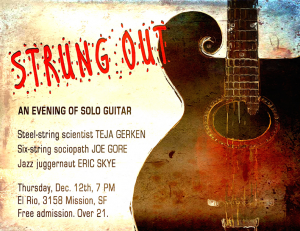
I’m thrilled to bits about a show I’m playing Thursday eve in San Francisco featuring two guitarists of impeccable skill and taste, plus me.
Teja Gerken and I are co-hosting a monthly solo guitar night at El Rio, my groovy neighborhood dive.Our guest is the amazing Eric Skye who, among other things, plays gorgeous solo guitar versions of classic Miles Davis tunes. If you happen to be in cold, cold San Francisco this week, stop by and say hi!
I’ve been doing the digital looping thing with Mental 99 for a few years now, and man, trying to work out solo arrangements with live-looped MIDI drums has been seriously humbling. You know all those jokes we love about how drummers speed up, slow down, drool, and generally disappoint? I can do all those things and everything else a drummer does, except occasionally play a competent groove. Some of the problems have to do with MIDI tracking in general, and some are simply general suckage. Man, it sure makes me appreciate my brilliant musical partner Dawn Richardson, who never speeds up and drools only rarely.
But those who can’t, teach. So I whipped up a little tutorial on playing drums with MIDI guitar. The first half covers the moves, and the second half features a live improv based on my fave afrobeat pattern. (Tony Allen is my rhythm god.) It also includes some of the hybird synth/guitar sounds I’ve been exploring, like double single-not lines an octave lower, mixing trashy guitar and trashy organ, and of course, space pigeons. (I stole the organ line from my pal Robin Balliger.)
In other news: I’ve been speaking to the ultra-knowledgable Rob Hull from Tube Depot about creating a minimalist DIY amp kit inspired by our conversations here. Lots more details to come. Tube Depot has a track record of making real nice amp kits, and Rob’s documentation/build instruction are the best in the biz. I reviewed their cool tweed Champ clone kit here.
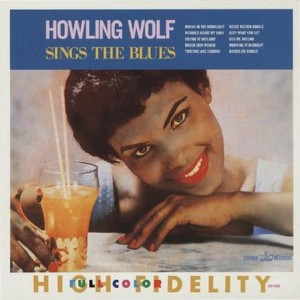
My pal Josh Hecht is making a documentary on Howlin’ Wolf. Josh, a noted engineer and audio instructor who came of age hanging out in Chicago blues clubs in the ’60s and ’70s, has corralled great interviews with the likes of Sam Phillips, Jimmy Page, and the late Hubert Sumlin, Wolf’s longtime guitarist. He also speaks with younger Wolf fanatics such as Dan Auerbach and Kirk Hammett. This work-in-progress will be cool indeed.
(Don’t be surprised that Kirk is a Wolf worshipper. He’s an extremely well-rounded listener, a lifelong guitar student, and an exceptionally cool and smart dude. Long after he became a star, he studied music a San Francisco State University, where Josh was one of his instructors. Josh shot cool footage of Kirk in his practice room, playing “Smokestack Lightning” on a funky old Epiphone — a Coronet, I think.)
Josh dropped me a note yesterday, telling me he was going over to Kirk’s to shoot additional interview footage, and asking whether I had ideas for further questions. Here’s what sprang to mind:
Many of the interviewees point out the things that rock drew from from Wolf: the riff-based composition, the power and aggression, the distortion. But it’s also interesting to consider the ways later players veered from Wolf’s path, and ponder what was left behind.
1. Take groove: Wolf’s rhythms are powerful but rubbery. The beat wobbles and floats like surfboard. The note placement floats relative to the beat, like a skateboard atop the surfboard. Today’s players are more like slot cars speeding along a pre-carved groove. We’re metronomic and predictable in comparison, even when not performing to click. Bands play together in tight lockstep, favoring even note values and motoric rhythms. Where did the looseness go?
2. Or take distortion: We’ve been in an overdrive arms race for decades, using fuzz pedals, heavier amps, aggressive signal processing. But doesn’t the relatively light distortion of Wolf’s guitarists permit tonal nuance, dynamic range, note-per-note color we can’t equal? So many of our tones are always on 10, squeezed to maximum density like toothpaste. What did we surrender to get there?
3. Or phrasing: Consider, say, Sumlin’s solo on “Shake for Me,” full of oddball phrases of uneven length. Today’s players tend to lock into a single type of vibrato. In “Shake,” there aren’t even two notes with identical vibrato. He smears in and out of notes in ways no one seems to do these days. It’s like we’re punching out notes on an assembly line, while Sumlin is carving each one individually from wood.
What happened? How might it have gone differently? Might any of those aesthetics return?
I have no idea whether Josh will use my questions, and if so, what response they may elicit. But what do you think?
Some inspiration:
Sumlin’s solo above isn’t quite as awesome as on the studio version, which may be my fave solo ever. (God knows, I’ve stolen from it often enough.) But still.
Oh man — I got to open for Television last night in San Francisco, accompanying storyteller Dennis Driscoll. These days the band includes original members Tom Verlaine, Billy Ficca, and Fred Smith, plus Jimmy Rip filling in quite capably for original guitarist Richard Lloyd. They’ve been doing shows where they play their debut album, Marquee Moon, in its entirety (though they mixed and matched songs last night).
Television recorded other cool records, including a lovely 1992 reunion album. But Marquee Moon is one of those instances in which an artist’s aesthetic is etched in stone from the beginning. The two-guitar interplay … the abstract, almost architectural arrangements … the contrasts between stiff and loose time … Verlaine’s free-floating rhythm and quavering 16th-note-triple vibrato—all were present from the get-go 36 frickin’ years ago.
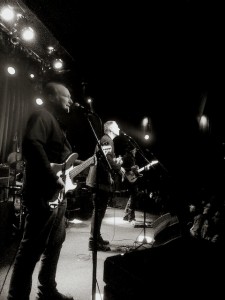
Of course this picture of Television sucks—I took it! L-R: Fred Smith, Tom Verlaine and Jimmy Rip, with a little bit of Billy Ficca’s hair in the background.
I couldn’t help comparing Television’s artistic arc to that of their contemporaries, Talking Heads. Sure, the latter’s debut, Talking Heads ’77, is a classic, but had the band stopped recording after its release, we’d have only a vague inkling of what the group would become. More than once Jerry Harrison has told me that today’s bands rarely have the luxury of defining themselves over the course of several albums as Talking Heads did, slowly finding their audience and refining their sound. Today’s music business demands spectacular success from the start. A latter-day Talking Heads (if you can imagine such a thing) wouldn’t have the luxury of recording three albums before releasing a bona-fide hit like Remain in Light.
Most great musicians evolve over time—imagine how we’d regard the Beatles, the Stones, Springsteen, Prince, or Dylan if they’d thrown in the towel after one album. That, I think, seems intuitive to most of us. The talent is there—it simply needs time to reach its apogee.
But artists who seem to materialize fully formed mystify and fascinate me. I’m not just talking about Mozart syndrome, prodigies who display phenomenal talent while very young. Mozart grew artistically throughout his brief life. His juvenile works barely hint at the later masterpieces.
On the other hand, consider Charlie Christian, whose style was fully realized from his first recordings with Benny Goodman in 1939, soon after the guitarist’s 23rd birthday. At his initial audition/gig, this kid from Oklahoma was mocked by the Goodman band hipsters for his hick cowboy clothes—until he blew them off the bandstand with 20 consecutive choruses of “Rose Room.” It was the most radical guitar sound the musicians had ever heard. From his first sessions to his last a mere two-and-half years later, Christian’s style never evolved. It was perfect from Day 1.
Dig it! (Charlie’s solo starts at 1:10.)
Another fascinating case: I’ve always had a soft spot for Cheap Trick, though I don’t know their music exhaustively. Like many listeners, I relate more to the relatively raw live versions of their hits on the Budokan album than to the tepid studio originals. The Budokan version of “I Want You to Want Me” has so much more power and passion than the slow, limp, overdub-laden version on In Color. But it wasn’t till 1996’s Sex, America, Cheap Trick compilation that I encountered the original demo of “I Want You to Want Me.” And holy crap—it’s simply one of the most perfect rock and roll tracks ever.
Wow. No overdubs. Monster groove. Fabulous lead vocal. A perfect distillation of Elvis, Chuck Berry, and the Beatles. With all due respect to this long-running and hard-working band, I don’t believe they ever again nailed it quite like this.
Since I’m already probably picking fights, I may as well blurt out that I view the first Doors album and Are You Experienced? in a similar light. Not that Strange Days and Electric Ladyland aren’t great—just that both Hendrix and the Doors entered the public consciousness with their artistry fully formed, and that they never recorded anything that wasn’t implicit in those initial recordings.
Why do some artists just seem to come out of the chute fully mature, while others need time to realize their potential? And which ones would you include on a “Getting It Right the First Time” list?
Are there any particular guitar solos you’re obsessed with lately?
Here’s one I can’t stop listening to: Jim Hall’s solo on Sonny Rollins’ 1964 recording of “God Bless the Child.”
This may seem like a weird statement, given how much self-indulgent wanking infests this site, but I have a love/hate relationship with guitar solos. (Or more like a hate relationship leavened by occasional stirrings of love.) That’s especially true with singer/songwriter tracks. A good song drags you into its emotional world, and so often it strikes me as emotionally jarring to suspend the drama for a fretwork display. It can be like an ill-timed intermission in a great movie, as if you were watching Citizen Kane or Grand Illusion, and they paused the film two-thirds of the way through to bring out a juggling monkey.
That’s one reason I love this solo so much. Hall just plays beautifully all the way through. He’s like the Loch Ness Monster, undulating continuously just beneath the surface and gently lifting his head above the waterline when his moment comes.
Another is the sheer bravery with which Hall employs silence. Talk about pregnant pauses! It would be fascinating to transcribe only the rhythms of the solo, not even the pitches. The asymmetrical phrases. The late entries. It’s so suspenseful. So poignant. So unpredictable. So frickin’ brilliant.
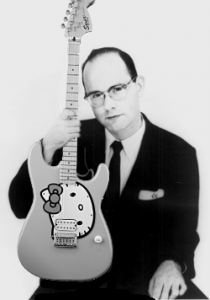
He’s such a genius, I almost feel guilty Photoshopping in a joke guitar.
Equally amazing is liquid blend of chords and melodies. For many players, that’s a binary distinction: Either you’re soloing, or you’re comping. This is just…music.
But the thing that amazes me most of all, I think, is Hall’s mastery of register. Baroque music scholars sometimes refer to a technique known as “compound melody,” best exemplified in the music of — who else? — J.S. Bach. Compound melodies are melodic lines that imply multi-voice counterpoint, even when they’re strictly single notes. A tune might center in one register, then leap high or low, establishing a beachhead in another register before returning to the original one. It then bounces back and forth between the regions, almost as if two tunes were being played simultaneously on adjacent channels, with the listener flicking back and forth between them.
I’m not sure I’ve explained that coherently. But Hall does it.
Jim Hall’s students (including Bill Frisell, whose playing this track so vividly anticipates) report that he kept a sign inside his guitar case that read “Make musical sense.” For many of us, soloing is about practice, practice, practice, and then when the moment comes, we turn off part of our analytical mind and hope that our instincts and muscle memory huck up something acceptable. But I get the sense that Hall, in pursuit of “musical sense,” never turns off his analytical mind. That’s not to say his approach is cold or scientific—he wears his heart on his sleeve here! But he’s always intelligent and thoughtful.
It’s said that improvisation is spontaneous composition. Sure, sometimes. But it’s rarely this spontaneous, or this composerly.
Gotta listen one more time—BRB.
Yeah, it’s still amazing. 🙂
So what are your current guitar solo obsessions? Any style. Any skill level. Anything that makes you feel intense things.
Do you ever get an idea that you just know is going to work out brilliantly? And then discover you were totally wrong?
That’s how it was when I finally reassembled my generic Mexican Strat with Duncan lipstick tube pickups. After I recorded a demoing of it here almost two years ago, the guitar lay in pieces alongside my workbench. I’d stare at decapitated body, feeling guilty and dreaming of all the fantastic mods I’d attempt when I finally got around to reanimating it. I had various ideas for the tone control: Maybe a two-band PTB control? Nope—totally underwhelming results. Perhaps a two-in-one TBX? Meh—even less interesting. I drew a blank, and the guitar wound up with a disappointingly normal tone circuit.
But I did discover some cool twists along the way. Details after the video:
My flatwound string addiction is only getting worse, but this is the first time I’ve combined flats and lipstick tubes. (Has anyone done that since the ’50s?) The results were fascinating. As happens when you put flats on an electric 12-string, you encounter a paradoxical increase in highs, despite the darker-toned bass strings. (Maybe it’s because the treble strings ring truer with less phase-canceling interference from roundwound bass strings.) As you can hear, this instrument doesn’t lack for zing.
The opposite, actually — treble notes explode from the instrument, often more than you’d like. I experimented with various action and pickup height adjustments, but no matter how I set things, it was difficult preventing certain notes from shrieking. The only solution was to play the damn guitar for a few hours and grow accustomed to the touch. (more…)
I just procured some clever new gizmos designed to help unfortunate players who were born without 12-inch fingers and five-foot arms.
First up: The VKnob from Option Knob, an angled plastic lever that replaces standard volume and tone knobs. It’s worth investigating if you’re interested in pedal steel-style swells, “manual tremolo,” or wah-flavored tone-knob manipulation. There’s a half-inch notch in the lever, perfectly position for resting your picking-hand pinky and spinning the knob without having to stray too far from the springs. It takes getting used to, and it may collide with some whammy bars, but it’ll be a cool solution for many players. FWIW, I tend to play fingerstyle, and I’m accustomed to spinning knobs with my pinky while picking strings with my thumb. Even so, the VKnob makes the technique easier, and it may be a godsend for pickstyle players. (Price: US $13.)
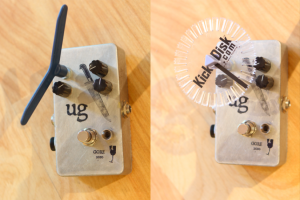
Option Knob also created the OKnob, a Y-shaped replacement knob for stompboxes. It lets you manipulate pedal knobs by “kicking” the OKnob’s arms or resting your foot in the fork where they meet. I’ve enjoyed using OKnobs to control the cutoff frequency on filter-type effects, especially when playing The World’s Nastiest Stompbox™. Like so:
But now the OKnob has competition in the form of the KickDisk, a circular, clear plastic replacement knob. The OKnob (left) and KickDisk (right).
Both knobs work great, and each has its advantages. The OKnob doesn’t force you to position your foot at a specofic altitude, and it looks freaky-cool. But it can be awkward to manipulate from some angles, especially when the arms are positioned north and south. The KickDisk is easier to operate from all angles, and its transparency prevents it from obscuring stompbox LEDs. I like both options. (OKnobs are ten bucks each, or $12 for the glow-in-the-dark model. KickDisks go for $7.50.)
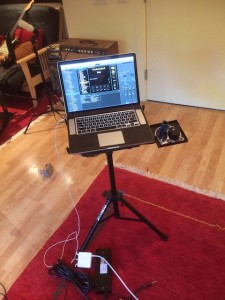
Obviously, your stompboxes must be secured to a pedalboard or other surface, or you’ll just kick everything over. But while knocking pedals over is a drag, it’s not nearly as bad as toppling your laptop. That’s why I was eager to replace the flimsy stools and utility tables I’ve been using for laptop gigs with my band Mental 99.
Don’t tread on me.
There are several stage-worthy laptop stands, though most are tabletop models aimed at laptop-lugging DJs. I opted for the Quik Lok LPH-003, a sturdy metal tripod when a laptop shelf plus an extensible mousepad surface, which works great as a holder for picks, slides, EBows, and street drugs.
The LPH-003 weighs a lot more than my old stands, but it’s far less likely to get knocked over, even by a hyperkinetic klutz like me. Particularly reassuring are the four adjustable, rubber-tipped arms that secure your leptop, even at steeply slanted angles. So far, I’m digging it. I’ll let you know how it works at gigs. (I paid a little under $100 for mine.)
Have any of you tried these? Or can you share info on any other clever, simple, and cheap guitar prosthetics that help you do what you do?
It’s almost always a bad idea to label something a manifesto. It’s pretentious, and it makes you sound like a crank, especially if you were born between 1890 and 1990. But it is dramatic. And would anyone pay attention if I gave this post a more accurate title, like “Please Participate in My Stompbox User Interface Focus Group?”
Anyway, I’ve been having this recurring workbench experience. (No, not the solder burns.) Every time I breadboard a stompbox project, I poke through the circuit, looking for places where I might add a switch or knob to unlock cool sounds. I usually find nice variations and build accordingly. But as soon as I plug in the pedal, I always seem to like one setting a lot more the others. Then I rebuild, hard-wiring the preferred value and ditching the switch or pot. Eventually almost everything I build winds up with only one or two knobs. (Unless I’m making it for personal use, in which case it often has no knobs.) It’s not a love of minimalism, and it’s certainly not an assumption that users are too stupid for anything more complex. It’s just that time and again, the simplest solutions sound best to me.
Meanwhile, I just had an interesting experience reviewing a (gulp) $5,000 amp for Premier Guitar, which crystallized some of my thoughts. The amp in question is a Little Walter 50/22 (which is actually two independent amps in a single housing), and I’ll link to the review when it goes live in a few days. But suffice it to say that Little Walter amps draw their inspiration from the earliest Fender tweeds, and have minimal controls to match: one volume knob and one tone knob. Furthermore, builder Phil Bradbury all but advises against using the tone control, pointing out that vintage-stye tube amp tone controls are strictly subtractive, and that you get maximum impact and richness with the tone circuit wide-open. And Bradbury is right. As on many great vintage amps, the Little Walter controls are practically superfluous. If you locate the right sweet spot, you can park the controls there and make any needed gain or tone adjustments the old-fashioned way: by playing them. Dig in harder for more distortion. Back of the volume to clean up. Use your angle of attack as a tone control. Like that.
But you don’t encounter many new-production amps that adhere to the philosophy. I get the sense that a lot of designers would like to create minimalist amps such as these, but they fear that the public wouldn’t get it. How could the one-knob amp possibly sound as good as the one with 11 knobs? But I suspect that the more experience you have with amps, the likelier you are to believe that simple sounds better. Now I want to build a great-sounding tube amp with only an on/off switch.
Three knobs?! What, do I look like Einstein to you?
I’m finding the same to be true with distortion/fuzz/overdrive stompboxes. For many players, the minimum complement of controls is gain, tone, and master volume. But almost every circuit I’ve explored sounds better without a tone control, and it’s hard to make a gain control sound great throughout its entire range. So more and more I find myself fine-tuning circuits to what I feel are the best gain and tone settings, hard-wiring them there, and then just slapping on a master volume for level-matching. (And if the pedal doesn’t add a great deal of volume, I often skip the master as well.) If you “tune” the distortion, you can control the gain perfectly well via your hands and guitar.
“But,” I hear the inquiring player ask, “don’t you need a tone control so you can use the same pedal with different guitars?” (Sadly, I sometimes believe I’m hearing the voices of inquiring players when I’ve neglected my meds.) Increasingly, I think not. In almost all cases, there’s a sweet spot where a circuit sounds good on everything from a bright Tele bridge pickup to a tubby neck humbucker. Those extremes don’t sound the same, of course. But if you’re playing distorted on a Tele, can’t we assume that you want a bright edge? (And vice-versa with the neck humbucker.) And if you do want to modify the tone, isn’t doing so with via fingers, amp, or mixing board a better solution than using a tone-sucking stompbox tone circuit?
Another example: I spent countless hours pursuing a stompbox vibrato circuit. (I mean true pitch-shift vibrato, not tremolo.) I’d obtained great tones, but I couldn’t get the effect to sound good at all rates and depths, because the perceived depth changes along with the rate. Finally, it occurred to me to go the one-knob route, using only a rate control, and letting that determine the depth. That may sound like a half-assed non-solution, but I’ll be danged if I didn’t suddenly have the most gratifying vibrato pedal I’ve ever played. Like the minimal controls on ’50s amps, the arrangement just worked.
Other factors influence my one-knob attitude: Since I’ve spent much of the last few years in the digital guitar realm, analog guitar has become a refuge from that sometimes math-based approach. When I switch on the analog rig, my goal isn’t maximum user options, but a primal experience. Also, there’s probably an element of advanced-player snob appeal. I don’t know much about cars, bicycles, motorcycles, or sporting goods, but there’s probably a parallel between minimalist musical tools that demand a fair amount of technical finesse, and vehicles and sports gear with stripped-down, featherweight, only-for-pros features. Not every bicycle needs a kick-stand, and not every fuzz pedal needs a gain control. (Or something like that.) Additionally, I hope to bring my pedal designs to market, and what a crowded market it is! Sure, it’s mainly crowded by clones, but many brilliant builders are creating complex mad scientist boxes. Maybe there’s a niche for one-knob mad-scientist boxes…
I’m not sure it’s kosher to conclude a manifesto with questionnaire. But I’m eager to hear your replies to these queries—or anything else you feel inspired to add. Thanks!
Do you tend to change tone settings on amps and pedals when you switch guitars?
How often do you fiddle with stompbox knobs mid-performance?
Do you use your guitars’ tone knobs much? If so, how and why?
Does anyone out there actually use their guitar volume knobs to veer from clean to dirty sounds? Or is just the wishful thinking of pompous guitar “journalists?”
Would you consider using a no-knob stompbox that pretty much requires you to use your guitar’s knobs?