It has been brought to my attention that there is, in fact, another event this weekend called a NAMM show. I’ll be there Friday and Saturday with Seymour Duncan. If you’re at the show, please stop by. And tomorrow — Thursday — I’m playing a show at Taix in LA’s cool Echo Park neighborhood with my band, Mental 99. Please come by and say hi! (And for those who live in or near my fair city of San Francisco, we’re also playing tonight at the super-cool Madrone Art Bar.)
I’ll try to post pics of the cool stuff I see in Nam at NAMM!
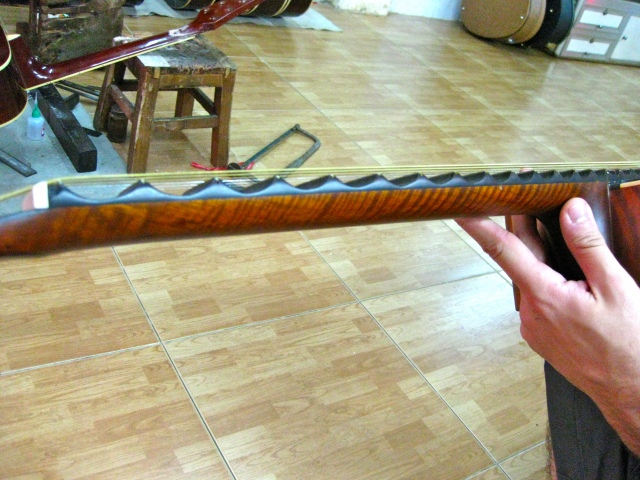
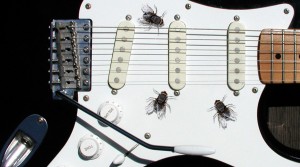
This is not a Swedish guitar. (Photo by Candace Burnham.)
Everyone’s talking about the upcoming Nam show, so I figured I should post something relevant. I’ve never been to Southeast Asia, though everyone I know who has loves the place. And I’ve been floored by the beauty and originality of those Vietnamese electric guitarists who scallop their fretboards not because they love Yngwie, but to replicate the wild swoops and expressive quavering of their indigenous folk instruments. Put it all through a cheap solid-state amp and vulgar digital reverb, and it’s…perfection.
I’m no expert on the style, so I turned to Scott Collins, who’s posted here a few times. He’s a dauntingly knowledgable player and teacher who runs an interesting site called Guitarchitecture. The centerpiece is a comprehensive guitar method he’s created that applies visual metaphors to the process of mastering the fretboard.
Anyway, Scott hastens to point out that he’s no expert on Vietnamese guitar either, yet he’s created a beautiful little piece on the topic. He visited Viet Nam with an eager ear, a respectful attitude, and keen powers of observation. You won’t be bored. —Joe
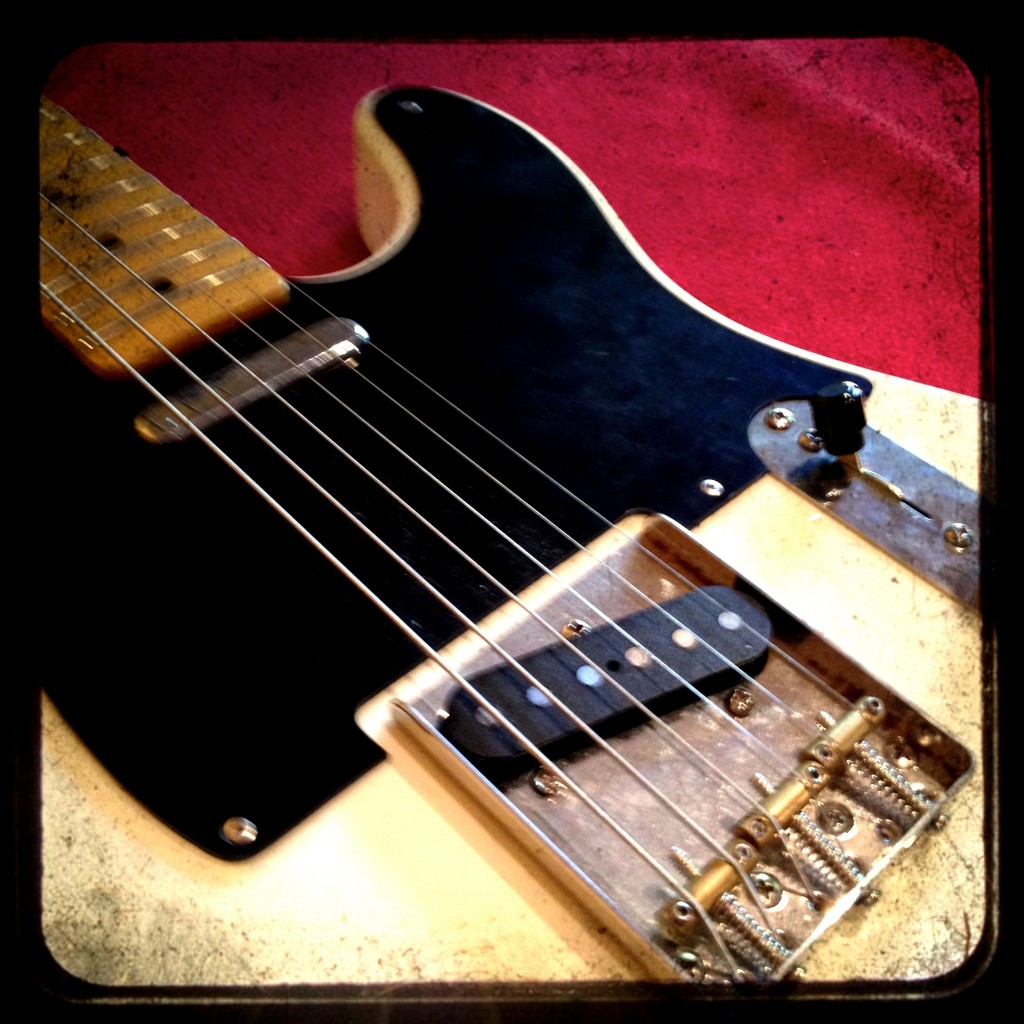
Much like an iPhone photo app makes this new Squier Tele look old, Duncan's Vintage Broadcaster set makes it SOUND old.
An iPhone photo app makes this new Squier Tele look old. Duncan's Vintage Broadcaster Set makes it SOUND old.
Sometimes an antiquated idea can acquire new relevance.
Example: The ancient Fender Broadcaster wiring scheme, in which the guitar has no tone control per se, but the second knob acts as a pickup-blend control. I wired up a guitar this old-fashioned way, with some very surprising results.
My experiment had other motives: I wanted to check out Seymour Duncan’sVintage Broadcaster Set, which replicates those earliest Telecaster-family pickups. And once again, I wanted to see just how much of a sonic upgrade a simple pickup replacement could bestow on a humble guitar: in this case, a cheap, Chinese-made Squier Telecaster.
UPDATE:My thanks to reader William Badjek, who found in error on page 31 of the v01 project file, which would have prevented the tone control from working properly. (The schematics, however, were correct in v01.) If you’ve encountered that issue, please revisit that page of the v02 project file, now available at the link below. My apologies to anyone who got stuck on this!
Hey, DIY victims fans!
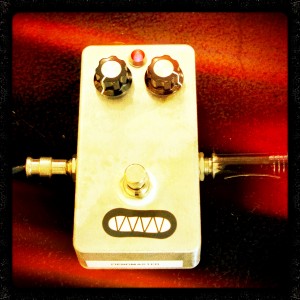
Here’s the project file for Tonefiend DIY Club Project #4: the Fiendmaster, a fab-sounding update of the Dallas Rangemaster, the circuit that put the punch in so much classic British rock. If your record collection includes a lot of albums from around 1970 featuring skinny guys with long hair and flared trousers, you need one of these!
It sounds incredible. It’s a relatively easy build. And unlike strict clones, this version runs on a regular modern power supply like the rest of your pedals. It also includes a knob that fades between the original’s bright, snappy Brit blues sound, and the humungous sludgetone that spawned Sabbath. You can round up all the parts from the usual suppliers for less the 30 bucks, or just order a pre-assembled kit from Mammoth Electronics.
View a brief demo video of the final product here. Learn more about the circuit’s significance here. And fill your cranium with everything you need to know about germanium here. Happy soldering!
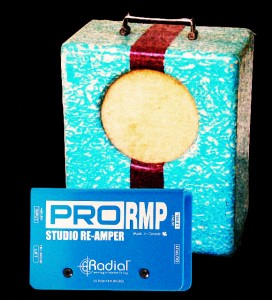
The latest version of the ReAmp, the Radial PRO RMP Studio Re-Amper, lists for a recession-friendly US$115, which means you can probably snag one for under a C-note.
Teisco amp not included. Pity.
The device, created by engineer John Cuniberti (best known as Joe Satriani’s studio wiz), is a recording direct box in reverse: It lets you play recorded tracks through guitar stompboxes and amps by stepping the signal down from line level to instrument level. Applications include:
• recording guitars direct or through amp simulators, and then choosing the perfect analog amp sound after other crucial tracks are in place
• running non-guitar tracks through guitar effects and amps
• making objective comparisons between amps, effects, and DIY project options by running identical signals through multiple pieces of gear.
If you’ve been following this blog, you’ve heard a lot of ReAmp. I recommend them to all studio provocateurs — especially now that the price is right!
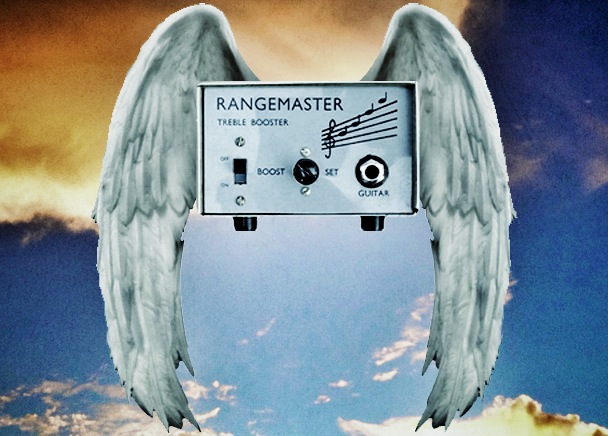
Technically speaking, the originals didn't have angel wings, though they should have. Dig the musically illiterate treble clef!
Technically speaking, original Dallas Rangemasters didn't have angel wings, though they probably should have. However, the musically illiterate treble staff IS historically accurate.
The next Tonefiend DIY Club project is a cool update of the Dallas Rangemaster treble booster — for my money, the wickedest overdrive ever. I’ll post all the project files within the next week, but I’m introducing the project here so you can listen to the pedal, decide if you’re interested, and if so, start rounding up the parts.
Like our first project, this is a single-transistor distortion device. But this one gets it glorious Brit-rock tones from a funky old germanium transistor.
At the end of this post is a parts list, plus names of dealers who sell reliable germanium transistors. And once again, Mammoth Electronics is offering a pre-assembled kit with everything needed to build a ready-for-gigging Fiendmaster. [FYI, neither I nor Seymour Duncan have any financial stake in this item. I’ve simply asked Mammoth to put together a kit for your DIY shopping convenience.] You can order the kit here. If you don’t see it on the page yet, check back — it’ll be up soon.
Check out this brief video to hear the wicked beast in action:
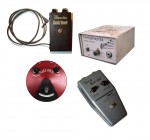
Some of the classic pedals that relied on germanium transistors.
Germanium is actually a boring, silvery-gray color. Aren't you glad I added cheesy digital effects?
“Germanium” is a magical word among guitar gearheads, right up there with “pre-CBS,” “true bypass,” “matched tubes,” “point-to-point wiring,” and “scatter-wound.” And like those other phrases, it owes its cachet to a mix of fact and fancy.
Germanium was used extensively in electronic component production the 1950s and ’60s, but was abandoned in favor of silicon components, which boasted superior performance, consistency, and value. Today no one cares about rare and finicky germanium components except certain audio geeks — especially the ones who play guitars.
In the stompbox realm, you’re liable to encounter two types of germanium components: germanium diodes, which lend distortion pedals a softer, smoother tone relative to silicon diodes or LEDs, and germanium transistors, which are typically used in clones of ’60s drive and fuzz pedals. Germanium components are usually available only from specialized distributors, who inevitably sell them for many times the cost of their silicon equivalents.
Compared to silicon transistors, germaniums are . . . different.
Location, location, location: IR reverbs can make your guitar sound like it was recorded ANYWHERE!
Impulse response reverbs are one of the handiest tools in the digital-audio junk drawer. If you’re new to the concept, prepare to be amazed. (And if you’re familiar with the technology, jump to the end of this post to score some cool free reverb sounds.)
Impulse response reverbs, also known as IR or convolution reverbs, fake the sounds of genuine acoustic spaces. Say you want to be make your tracks sound as if they were recorded in a 12th-century dungeon: Just visit your nearest medieval castle and set up a small PA system in the dungeon. Next, play a test signal (usually a sine-wave sweep or a starter-pistol shot) and make a recording of it echoing in the space. Back at your studio, your IR software compares the new recording to the original test tone, and creates a reverb preset that you can apply to any audio source. Just slap it on a guitar track, say, and voilà — you’re rocking out in the dungeon, minus rats, mildew, and torture implements.
But wait, there’s more! You can use the same technology to mimic hardware effects and speakers. Just run the test signal through an amp or effect, and you’ll have a digital clone of the physical device. Here’s a brief video demonstrating the idea:
We got into a discussion about buzzing single-coil pickups over in the lipstick tube thread. Reader Matthew Seniff chimed in with some well-informed observations and remedies. I’ve moved them here so more folks will see.
Another reader had written: “Every time my kids turn on my kitchen light my amp starts buzzing. It’s due to the rheostat that controls it. It’s old but I’m too lazy to change it.” To which Matthew replied:
It’s hard to discuss the Beatles without summoning their shadow: the Stones. Since posting last week about Randy Bachman solving the mystery of the “Hard Day’s Night” chord, I can’t stop thinking about another 1960s conundrum: Who played the solo on “Sympathy for the Devil?”
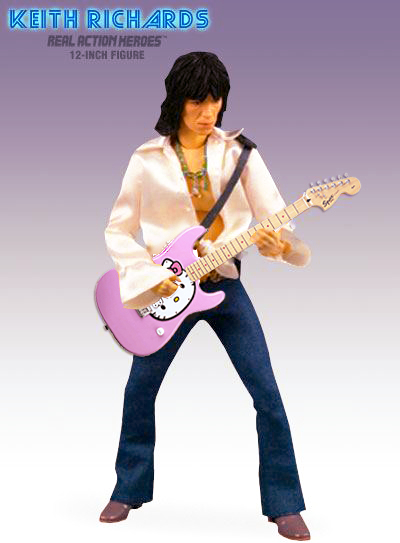
There’s one key reason why so many listeners suspect that it wasn’t Keith Richards: It simply doesn’t sound like anything else he ever recorded, and certainly nothing like his solos on the many live versions of the song.
A couple of years ago a wrote a short piece on the solo for a “100 greatest guitar solos” anthology. Sadly, the project remains unpublished for legal reasons — a pity, since it boasted contributions from many great guitar-centric music writers. But I’m rather relieved my piece never appeared, since I argued that Keith did in fact play the solo. Now I suspect the opposite. Here’s what I wrote: