I haven’t posted any new video in months and months. It’s not just laziness or business, though I suffer from both. I’ve just been locked away in my studio, trying to create a new live looping system.
I still haven’t nailed it down, so I’m not going to get into a complete run-down yet. But here are the basic ideas.
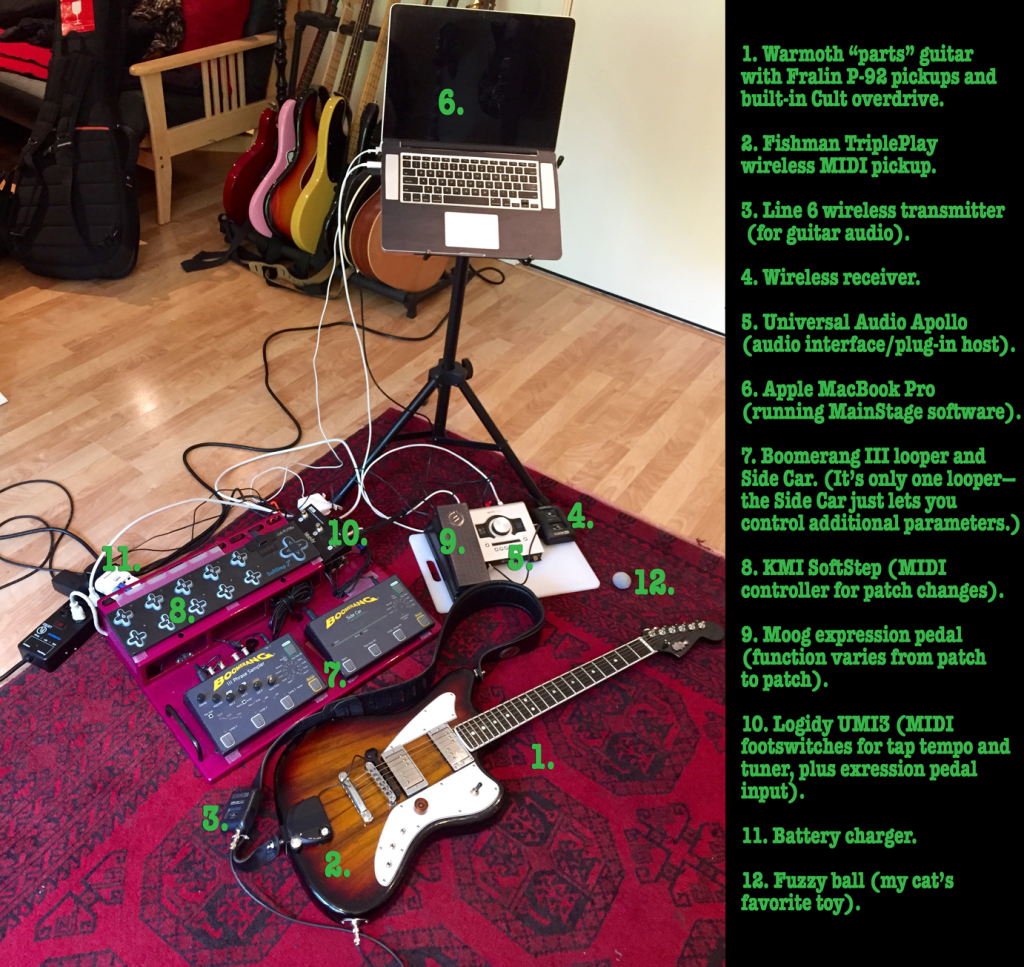
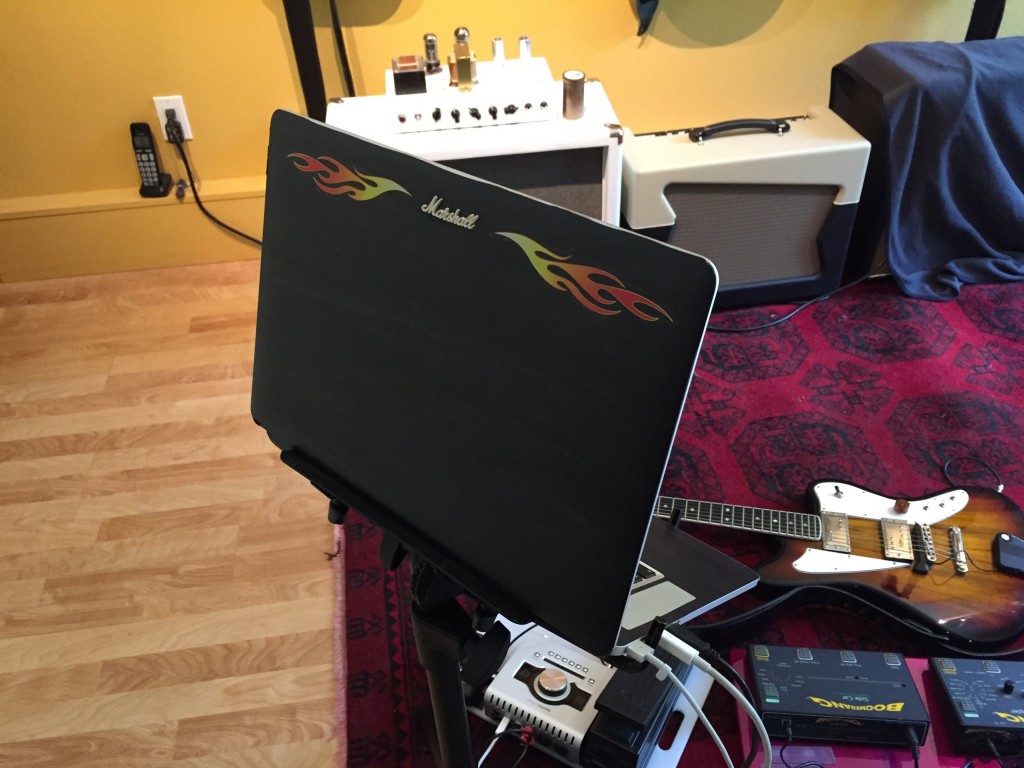
• I’ve moved from a hardware looper to software looping. When I started this godforsaken looping project years ago, I’d just finished a lot of work on Apple’s then-new MainStage software. At the time, the program’s looper simply wasn’t reliable enough for live performance. Also, my intense signal processing was pushing my MacBook Pro to its limits. But since then, the program has gone through many upgrades. Meanwhile, after years of relative stagnation, Apple finally issued a major MacBook Pro upgrade in 2017. Between the more powerful computer and the refined software, I could finally shift looping and signal processing to the computer. Yeah, there are a couple of disadvantages. For one thing, MainStage’s looper lacks a “copy” function, something I’ve come to rely on a great deal in my arrangements. But it sure is nice not having to run the entire mix through the relatively cheap hardware looper convertors — just the snazzy ones in my Apollo interface. (Of course, now that I’ve transitioned, Electro-Harmonix has just announced a compelling-looking 6-track looper. I’ll have to check that out…)
• I’ve put aside for now the Fishman TriplePlay MIDI pickup. I have no complaints about TriplePlay, which is far and away the best MIDI pickup ever created, and a product I recommend without reservation. But I wanted to be free from the hardware setup. This way, I can plug in any guitar, any time. (I’ve been experimenting with acoustic looping — more on that soon.) I’m still using MIDI sounds, but again, it’s all in software via Jam Origin’s brilliant MIDI Guitar plugin. It works incredibly well without a MIDI pickup, but it’s not nearly as fast as TriplePlay. It’s fine for doubling, or for melodic and textural stuff, but it’s just not speedy enough to play MIDI drums at even moderate tempos. Which bring me to the other big departure …
• I confess: I’m playing to a drum machine. I’m triggering and changing patterns using a KMI !2 Step foot controller. I really wrestled with this decision. I loved the idea of using no machine tempos — it all came from the hands. But at some point I realized that the main reason I was committed to that approach was for bragging rights: “No prerecorded tracks, and no machine rhythms” I could boast. But who cares except geeks like me? Anyway, I still have misgivings about the change, but I’m going with it for now. I think that means, though, that I’ll create more arrangements without percussion, just so I’m not locked to the machine for an entire set.
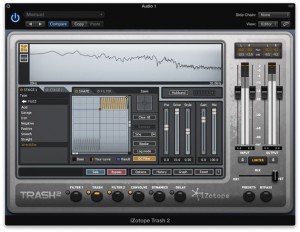
Meanwhile working with a tempo clock lets me do fun stuff with synchronized effects. I’m especially besotted with Sugar Bytes’s Effectrix, a mind-bending multi-effector that lets you activate and edit effects on a note-by-note basis. You hear it a lot in the “solo” in this video.
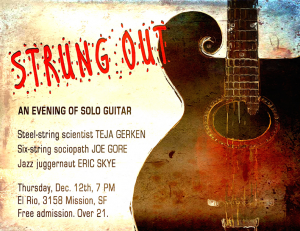
I’ve played a few shows with the new setup. The first one was flawed but promising. The second was an unmitigated disaster. Then I doubled up on practicing and (not kidding) started meditating again, which helped a lot. Last time I tried this live, it went really well! We’ll see how it goes at my gig this week.
Anyway, it’s still a work in progress. I’ll keep the curious updated.
I played this cover tune with no irony whatsoever. I love the original.