Categories
Digital guitar

Analog Schmanalog

Ever notice how most analog vs. digital battles discussions boil down to two basic questions?

1. Can digital sound as good as analog?
2. What are the practical benefits of digital?

They’re good questions, but they tend to overshadow another important (and probably more interesting) topic: What are the musical benefits of digital?

Everyone loves great analog guitar sounds. But there’s lots of cool stuff that you can only do in digital. Here are a few of the ones I enjoy.

A partial list of the strictly digital sounds and techniques heard here:

• looping
• granular synthesis and delay
• pitch-shifted delays and reverbs
• impulse-response reverbs
• subharmonic sysnthesis
• Realtime MIDI control

You heard it here first!

Hey, I’m totally guilty of fostering simplistic analog vs. digital arguments. After all, I launched this blog over a year ago with an Amps vs. Models listening contest. (The prizes have long since been claimed, but you can still take the test.) But maybe we should spend a little less time arguing about how faithfully that amp model mimics the sound of an amp from 1965, and a little more time exploring the cool and meaningful musical applications of post-analog tone production?
Categories
DIY Effects Gigs Recording

A Tale of Two Pedalboards

Is it just me, or do many guitarists these days find themselves alternating between separate analog and digital setups?

I’m posting some pics of my current pedalboards (bearing in mind that, for reasons I’ll get into in a sec, my pedalboards only tend to stay “current” for a few days at a time). Both were assembled using store-bought housings, though I’ll talk a bit about total DIY boards as well.

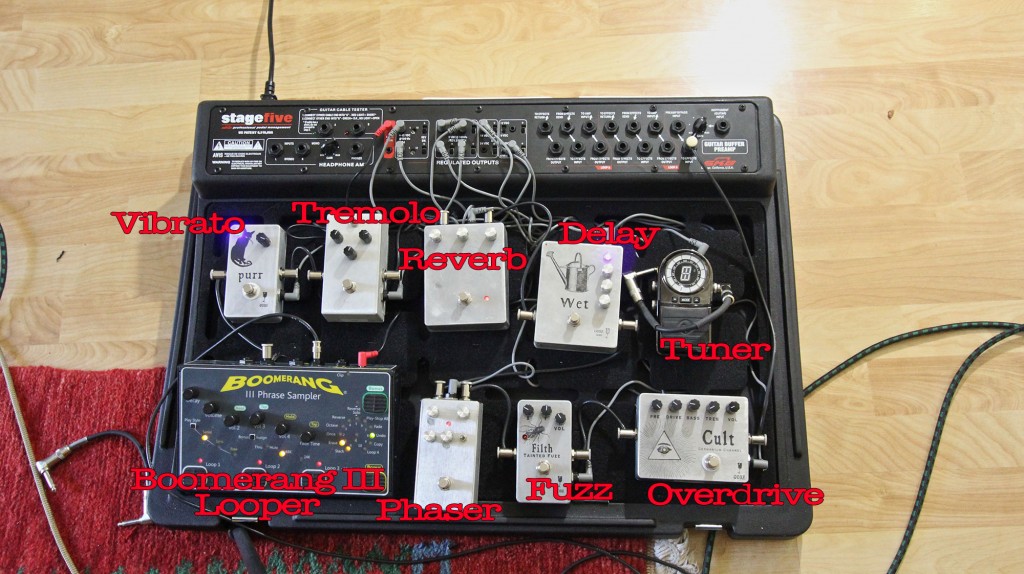
First, the mostly analog setup (the exception, of course, is the digital Boomerang III looper).

Joe Gore’s mostly analog pedalboard.

The case is a newly purchased SKB Stage Five, a full-featured unit in a relatively rugged molded plastic case. These retail for a whopping $540, but you can find them heavily discounted. (I forget the exact price I paid for mine, but it was under $300.) It’s loaded with cool features, like dual effect loops, a built-in buffered preamp, and support for 9- through 24-volt DC power, plus 9V AC for those digital pedals like Line 6 modelers and many loopers. There are even trim pots on a few power jacks to simulate dying batteries. I’m less impressed by some of the fittings (like the cheapo plastic jacks), though I suppose they keep the weight down. And make no mistake: This thing is heavy!

Verdict: Too early to tell, since I haven’t subjected it to road abuse, but I trust it enough to at least give it a go. I think I’d be a bit disappointed had I paid full pop, but it strikes me as a fair deal if you can find it at a 40+% discount. 

Categories
Bass guitar Recording

Credit Where It’s Due — Please!

Move along — there's nothing to see here.

Ordinarily I wouldn’t publicize “causes” on this site, but this one has special relevance for musicians and music fans.

My pal Count, a producer/mixer who’s done work for Radiohead, DJ Shadow, New Order, the Stones, No Doubt, and many other artists, is launching an online campaign to get musicians, producers, engineers, and other contributors credited on iTunes, Pandora, and other digital music services.

Consider the absurdity of the current situation: Why, in the digital age, are we granted only a fraction of the info available in the analog age? Why should fans be denied the details of their favorite recordings? And for underpaid musicians and technicians, the credit is often the only meaningful payment for services, a possible path to future work. The current state of affairs is just plain wrong!

If you agree that this is worthy goal, check out the page for Count’s Credit Is Due Facebook campaign.