Categories
DIY

Indispensable DIY Tool

UPIf you build pedals, you REALLY want this $41 tool.

UPDATE: A Facebook friend of mine found the same tool on eBay for $25.49.

Jon Cusack — the pedal builder, not the actor — recently turned me on to one of the best DIY tools I’ve ever owned: The Multi-Function Tester TC1.

Jon’s Michigan shop manufactures  the pedals I design. He and I were trying to pinpoint the optimal gain for the germanium transistors in two of the new pedals I’m about to release.

I’d been using a multimeter to test gain, which is measured in terms of hFE. An old germanium transistor might have hFE of 50 or less, while a hot silicon Darlington transistor such as an MPSA13 might check in at hFE = 5,000. As you can imagine, it’s a crucial measurement for any stompbox that employs transistors.

But like many before me, I encountered two big problems. First, most multimeters don’t have an hFE function. (To make such measurements, the device needs a trio of sockets so you can plug in the transistor’s three legs.) It’s not a matter of cost. In fact, most high-end multimeters, such as the Fluke models  whose prices start at well over $100, omit the function. (To be fair, we’re talking about antique transistor technology, which is pretty much extinct in most modern electronics.) You’re likelier to find an hFE tool on cheaper, more obscure models. So I’d been using bunch of cheap-ass Chinese multimeters just to measure hFE.

But there’s another problem: Those multimeter hFE testers are notorious for their inaccuracy. They’re especially prone to overstating the actual gain. They’re not quite useless, but they’re close.

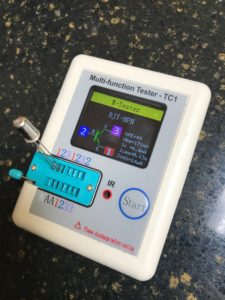
Jon recommended the TC1 ($41.50), which apparently is only available via eBay in the US. And it’s more useful than I could have imagined.

First off, it gives accurate hFE readings within a hundredth of an hFE unit. It works with silicon and germanium BJTs, FETS, JFETS, and MOSFETS. And dig this: It doesn’t matter which way you orient the pins — it knows which leg is which, so no more  jumping online to verify the pinout of a particular part.

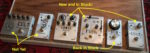
Check out the photo: The LCD image tells me that the pin in socket 3 is the collector. Had I inserted it the transistor the other way around, the collector would be marked with a 1. Better still, it also works with resistors, capacitors, and diodes. You don’t even have to switch metering functions, as on a  multimeter. Just pop in the part, secure it with the clamp, and TC1 does the rest.

Trust me — if you work with transistors, resistors, caps, and diodes, you want this tool. Now I seldom use my crappy multimeter unless I need its continuity (“beeper”) tool.

Thanks for the excellent tip, Jon! 🙂
Categories
Effects

Pinch Me. My Three New Pedals Are Finally Out!

Pedals In Stock

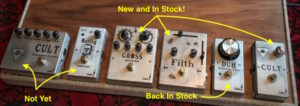
Holy crap, I can’t believe it! My three new pedals are actually in stock and for sale at Vintage King.

The new arrivals are Filth Fuzz, Cult Germanium Overdrive, and Gross Distortion. (Meanwhile, Duh Remedial Fuzz, which debuted last year, is back in stock after the last batch sold out.)

Here’s an overview video that my pals at Premier Guitar shot at the NAMM show last January.

As always, I’m grateful to the friends who helped make this happen, especially Miko Mader from M1, my distributor, and Tony Lott, who oversaw production at the Cusack Music facility in Michigan. In addition to displaying superhuman patience during the long development period, Miko and Tony made many suggestions that improved my original designs. Thanks also to my pal Tom Menrath, who introduced me to Miko and Tony. (Tom used to work at Vintage King, but now he’s with pro audio champs Cutting Edge Audio and Video.)

I’ve posted demo videos for each pedal here before. But I’m reposting them after the jump in case you need a memory refresher. (I certainly do!) And I couldn’t resist including a couple of brag-worthy quotes from some of my early adopters. Thank you all!

Categories
Effects

Fuzz Detective: The Plot Thickens!

Man, I’m glad I announced my intentions about this project! Thanks to your links and suggestions, the “Fuzz Detective” project has grown vastly more ambitious. I need a few more days to make my test recordings are assemble the results, but I believe this will be the most complete and “scientific” audio comparison of 1960s fuzz circuits yet attempted. I’m posting this update to share my current plans — and solicit last-minute suggestions for improving them. —Joe

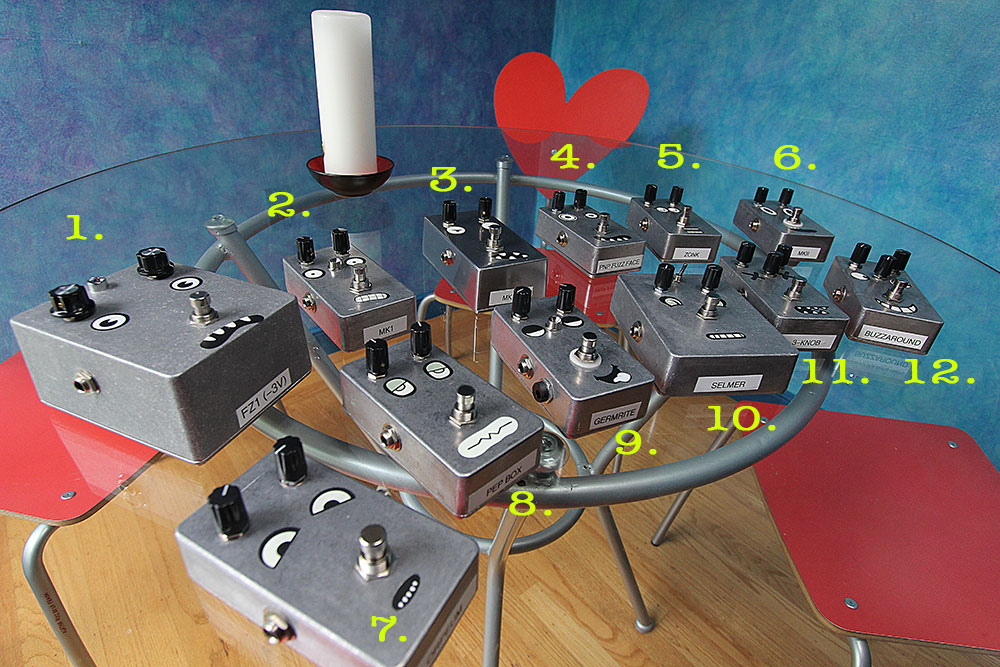
Wanker's Dozen: twelve Germanium fuzz pedals compete on a level playing field.
Wanker’s dozen: twelve germanium fuzz pedals will finally compete on a level playing field.

I’ve been a busy little solder monkey! Dig my new pedals:

1. Maestro Fuzz Tone FZ-1 clone
2. Sola Tone Bender “Mk I” clone
3. Sola Tone Bender “Mk 1.5” clone (near-twins: Vox Distortion Booster, Italian Vox Tone Benders)
4. Dallas-Arbiter Fuzz Face clone (very similar to Tone Bender Mk 1.5)
5. Hornby-Skewes Zonk Machine clone (near-twin: Tone Bender Mk 1)
6. Sola Tone Bender “Mk II” clone (near-twin: Marshall Supafuzz)
7. Orpheum Fuzz clone
8. WEM Pep Box Rush clone
9. Mosrite Fuzzrite clone (germanium version)
10. Selmer Buzz-Tone clone
11. Sola Tone Bender Mk III (“3-knob”) clone
12. Baldwin-Burns Buzzaround clone

About the Fuzz Detective project:

I’m attempting to create a comprehensive comparative sound library of germanium-transistor fuzz pedal circuits.

There’s no shortage of audio clips and demo videos featuring the great stompboxes of the ’60s and their modern clones. Yet it’s difficult to make qualitative comparisons between circuits because there are so many other variables at play. Who performed the examples? Using what gear? Were the examples recorded in a pro studio or on a mobile phone? Are the pedals ’60s originals or modern clones? What’s the condition of the transistors? And so on.

This isn’t about, say, deciding who makes the best Fuzz Face clone. The focus is the circuits themselves. The Fuzz Detective project aims to “level the playing field” by removing as many variables as possible.