Categories
DIY guitar

My Top Three Wiring Mods

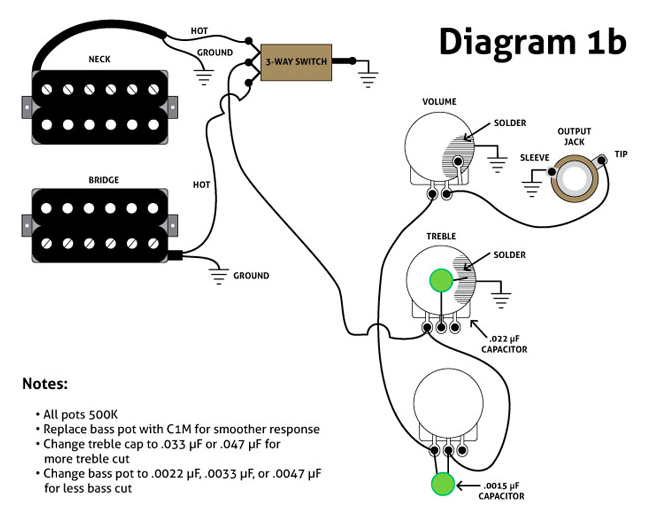
Premier Guitar just posted my new article on three favorite electric guitar wiring mods. The concepts won’t be new to anyone who hangs out here — I’ve pretty much flogged them all to death! But the new article includes the step-by-step walkthroughs that I never got around to creating for this site, and PG art director Meghan Molumby created beautifully clear tech diagrams like this one:
 

Screen Shot 2014-07-23 at 9.54.35 AM

The descriptions and instructions in the new story are clearer and more detailed than my original posts here, plus I’ve refined some details, so I suggest working from the new PG versions.

My three choices:

Yup, the ol’ PTB tone control, the coolest mod I know, at least for players who love distortion. The new version of the project uses the 500K pots you probably already have in your guitar rather than the more eccentric G&L values.

I also revisited the Strat version of the “Nashville-style” Tele wiring popularized by Brent Mason and other Music City cats. It performs brilliantly in a Strat, and IMHO its benefits (vastly more blended-pickup options plus a musical and intuitive control layout) for outweigh the costs (loss of the middle-pickup-alone setting, cost of a 3-way switch). Not to launch a protracted Strat-vs.-Tele battle, but I love the whole notion of “Tele-fying” a Strat via wiring, control layout, and pickup choice.

In the article’s comments thread, several savvy readers also mention Strat wiring systems that provide the sounds of the Nashville mod without sacrificing any others. They’re right — but the more I mess with this stuff, the more I value simplified operation. I’m less concerned with having all options than with having the coolest ones, ergonomically organized. Still, there are many ways you can go here.

Finally, I’m once more beating the dead Varitone horse exploring variations on Gibson’s Varitone concept, updated for modern players. I added a new twist in the PG story: deploying these ideas via toggle switches, rather than a big, clunky rotary switch.

It was fun when PG editor Shawn Hammond asked me to choose my favorite mods. It was easy to decide though — these are the three I keep coming back to, and all three deliver dramatic results, unlike many better-known mods.

So which electric guitar mods would be on your short list? Wiring, hardware, whatever. How do you make your guitars cooler?

Categories
DIY guitar

What’s Your Favorite Mod? (Here’s Mine.)

How am me make guitar thing better?

What’s your favorite guitar mod? The kind that changes how you play. One you’ve become so accustomed to that you wince when you pick up an axe that lacks it?

I’ll choose pickup wiring mods as a starting point: During the year that Seymour Duncan sponsored tonefiend.com, I devoted many posts to the under-appreciated wiring schemes I found in the company’s wiring diagram database. Some faves:

…and of course, the suicidal soldering mission known as the Pagey Project.

I’ve still got the “advanced” version of the Pagey wiring in my nothing-special beater Les Paul, and I like it so much, I want to fix up the guitar so it feels as nice as it sounds.

But of all the wiring experiments I tried, my absolute favorite is one that doesn’t appear in the Duncan archives: the so-called “PTB” tone control (for “passive treble and bass”). It’s a cliché to call a neglected idea “ahead of its time,” but in this case, it happens to be true. Being able to roll off lows as well as highs is unbelievably useful when sculpting sounds. It makes me want to run into the nearest Bain Capital Guitar Center, grab players by the collar, and shout, “You need to know about this!” (But I probably won’t, ’cause G.C. customers aren’t accustomed to receiving that sort of personal attention, and I wouldn’t want to freak them out.)

Allow me to repost last year’s video, demonstrating the circuit in action:

Over a year later, I remain totally addicted to this circuit, and I recommend it to anyone who doesn’t require a guitar with independent volume controls per pickup. (Everyone, basically.) It seems especially relevant for drop-tuned and 7-string metal players who realize you must sometimes cut a little bass to keep the lowest register tight and articulate. And the circuit is a godsend when used with bass-heavy fuzz pedals (such as vintage-style Fuzz Faces). In fact, I’ve even been building the circuit into the front end of certain loud fuzz pedals for use with guitars lacking this magnificent mod.

But I remembered something interesting this week when I opened up the Hamer 20th Anniversary guitar used in the video:

Categories
DIY guitar

Two-Band “PTB” Tone Control:
Useful, Easy, Cheap & AWESOME!

The PTB Circuit was one of many G&L innovations.

After the frantic soldering fest that was The Pagey Project, I figured it might be time for a nice, simple DIY wiring project. At the suggestion of tonefiend reader JH, I played with variations on the 2-band tone control that appeared in some G&L guitars. And I am over the moon with the results!

This circuit, sometimes called “PTB” (for “passive treble and bass”) combines a standard treble-bleed tone knob with a bass-cut control. The latter has a huge effect on the way distortion pedals and amps respond to the pickups, especially with humbuckers. Cutting some bass makes the pickups sound cleaner, airier, and more dynamic (i.e., less compressed). To my ear, the bass pot is not so much a tone control as a clarity knob.

Check out this brief demo video: