Categories
Music

Suite ’66: Free EP by Goldenberg & Gore!

suite-66-cover

A free EP from we to thee!

Guitar genius Mark Goldenberg and I recently recorded Suite ’66, a set of improvised duets on four tunes from 1966, in honor of the 50th Anniversary of one of the greatest years in pop music.

We teased this “release” a few months ago with this rehearsal video. The EP features a more developed version of the same tune, plus three others.

Even if you’re not familiar with Mark’s name, you’ve probably heard his playing. Mark has been a leading LA sideman and session player for decades. He’s worked with Jackson Browne, Linda Ronstadt, Bonnie Raiit, Waylon Jennings, Chris Isaak, Willie Nelson, Hugh Laurie, Natalie Imbruglia, and most impressively, William Shatner.

Less well known is Mark’s beautiful solo style, which resides at the intersection of rock, classical, and jazz. I was instantly smitten when I first heard Mark play in person at one of Teja Gerken‘s solo guitar events a couple of years ago. Mark’s musicianship flabbergasted me, plus we bonded over the fact that we shared the same teacher, the late Ted Greene. (Though I studied with Ted when I was a teen, so much of his wisdom went over my head. Mark, however, worked with Ted after becoming one of LA’s most respected players, so he absorbed Ted’s insights on a far deeper level.)

Listening to Mark play is sheer musical ecstasy, whether or not I happen to be picking along with him. He’s been one of my greatest musical inspirations of the last few years. (Translation: I’ve ripped him off more times than I can count.)

Listen and download via SoundCloud:

Tech notes: We recorded and mixed this in my basement studio. I’m on the left channel throughout, and Mark’s on the right. (There are no overdubs.) My instruments are a Gretsch Spectra Sonic electric baritone guitar (kindly loaned by Xander Soren), a Veillette Avant Gryphon octave 12-string, and a Taylor 150e 12-string. Mark plays two magnificent guitars: his Kenny Hill classical and a Collings 001MH steel-string.

IMPORTANT: This non-commercial recording is shared as a gift between us and our friends. It may not be reused for any purposes, especially commercial ones. We’re simply inviting you to listen in on our jam session.

Categories
guitar

The PAF Strat

As threatened, here’s a closer look at Strat with PAF humbuckers used for my recent “God Only Knows” cover. Most parts are from the long-suffering guitar used for all the Mongrel Strat Project experiments. And this one is especially mongrel-ific, with its blend of vintage Fender and Gibson.

Obviously, Gibson pickups is a Strat is far from a new idea. But usually, that arranged marriage is designed to spawn macho, high-gain solos minus the characteristic shrillness of vintage Strat bridge pickups. While many players I love have used humbucker-equipped Strats, I’ve always loathed playing them myself. But what, I wondered, if you didn’t use a hot humbucker, but an über-vintage PAF?

Like many players my age and younger, I was astonished when I first encountered a vintage-voiced humbucker. It was nothing like the dark, over-overdriven tones I associated with the word humbucker. A good PAF is sparkly, resonant, and perfectly capable of gloriously bright and clean tones. Here I used a Seymour Duncan Joe Bonamassa signature set, the same one heard in a more Gibson-like context here.

The results are … compelling. As expected, notes have far more mass than on a conventional Strat, and the bass response is vastly increased. There’s no shortage of top-end either, though the big lows can overwhelm the highs at times. So while I’m pretty much always obsessed with bass-cut controls (especially the high-pass section of the PTB circuit I’ve written about approximately 37 zillion times), it’s especially invaluable in this case. Since lows disproportionately drive distortion, even modest bass cuts clean up the tone and make highs speak more clearly.

I’ve also incorporated the dual-capacitor treble control I wrote about here. It creates a Vari-Tone/ToneStyler effect in a simplified way: Instead of using a clunky rotary switch to choose from a large set of treble-trimming capacitors, it fades between a large cap and a small cap, yielding the same resonant effect as the more complex options. I’ve incorporated this circuit in several guitars now, and it’s still working for me. It’s especially nice here, when paired with a Steinberger JackPot potentiometer, which lets you bypass the entire tone circuit for absolute maximum volume and brightness. I chose the small cap based on the minimum amount I’d ever want to remove from the signal, and the larger one based on the maximum cut I’d use.

I would have included a photo of the project in progress, but I didn’t because I’m embarrassed about how awful it looks inside. I needed to route out the pickup cavities to accommodate these larger pickups. But instead of taking it to a professional, or getting a proper router and learning how to use it, I chipped away with the tiny routing bit on an inexpensive Dremel tool. Do yourself a favor, kids, and don’t follow my lazy-ass example.

But hey, what’s a Strat pickguard for if not to conceal your shoddy workmanship? The guitar looks okay in the end, and I’m digging its sounds, even though it was far harder to get accustomed to than I’d anticipated. I had to recalibrate my right-hand dynamics to prevent treble notes from screeching. I was almost ready to chalk this up as a failed experiment, but after a few days of noodling around, I started to get the hang of it and enjoy the results. I think I’ll keep it this way for a while — or at least until the next Mongrel Strat concept wafts up from the bowels of Hell. 🙂

Categories
Effects

Torn Asunder

Sorry for even more solipsistic stompbox stuff, but I couldn’t resist. David Torn, one of the players I admire most on earth, just posted an unsolicited demo of my Filth Fuzz on Soundcloud. I love his post-apocalyptic soundscape.

For the uninitiated, David is one of those rare players who deploys staggering technical skill in a bold, unique style utterly unpolluted by cheesy guitar heroics. He’s recorded with Bowie, Tori Amos, John Legend, Madonna, and k.d. lang and created many brilliant solo albums. Last year’s Only Sky is particularly magnificent. It makes a great introduction to this singular guitarist/composer.

Thanks, David!

Categories
Effects

Filth Fuzz is (Almost) Here …

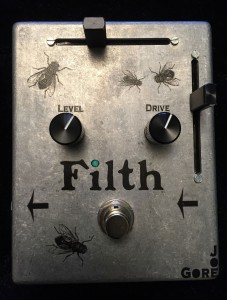
Filth

My Filth Fuzz pedal is finally in production and will be shipping within a few weeks. It’s one of three new pedals I’ll be showing at this week’s NAMM show in Anaheim, California. I just finished the demo video, and I’m stoked about how it’s sounding.

I’ll also be debuting three other new pedals: Gross Distortion, Cult Germanium Overdrive, and Boring Boost & Buff. Filth, Gross, Cult, and are finalized and in production, and should be available from my partner, Vintage King, sometime in February. (Vintage King is also currently the sole vendor of my Duh Remedial Fuzz, released last year.) We’re still working out a minor bug in Boring, but it should arrive soon after.

Now, it’s not like I can afford a proper booth or anything, so when I say “I’ll be showing these at NAMM,” I mean I’ll be walking around with a bag of merchandise. I’ll have a pedalboard with all my products on display at the Vintage King booth in Hall A, but sadly, it won’t be set up for demoing — there just isn’t enough space. However, my super-cool friends at Voodoo Labs will have a Filth Fuzz on their demo pedalboard, so you can take it for a spin in their booth while checking out the new stuff from that ever-innovative company. (I have no business connection to Voodoo Labs — they’re just helping me out because they’re nice.)

If you’re going to the show and would like to meet up, contact me and we’ll work something out. 🙂

Here’s what I wrote about Filth on its product page. (If you’re allergic to marketing copy, skip ahead, where I share some interesting backstory on how we arrived at the interface design.)

Man, I love those mad scientist fuzzes with too many knobs! I’ve collected them for decades and used them on a zillion sessions. It got to the point were people were hiring me specifically to make those sort of farting, fried-circuit tones.

But the downside of those complex fuzzes is that they’re a little too wide-ranging, with many settings you’ll probably never use. It’s easy to spend 20 minutes dicking around with the dials without nailing the perfect tone. I’ve always wished for a wild, highly variable fuzz that was a bit more “curated,” with easier access to the tones you’re likeliest to use.

That’s what inspired the Filth Fuzz. It’s only got four controls, but it’s a cornucopia of cool, quirky, and usable fuzz flavors.

The drive and level controls do what you’d expect. But unlike many fuzz drive controls, this one sounds great throughout its range. Extreme settings are molten-lava thick. Lower settings are like…slightly cooled lava, maybe?

But the real action is in the two sliders. They’re tone controls of a sort, but not in the usual way. Most fuzz tone controls are tone-sucking passive circuits situated downstream from the fuzz effect. But here, the sliders alter the voltages at the transistors, radically changing not only the tone, but also the timbre, response, attack, sustain, and compression. In other words, the sliders radically alter the fuzz’s core character, as opposed to simply EQing a single core tone.

TO USE: Set desired gain and output levels. Move the sliders till it sounds awesome.

CAUTIONS: Filth sounds best before any buffered effects. It usually works best at or near the front of your effect chain.

Filth Fuzz was created in San Francisco and is built in Michigan by skilled craftspeople earning a fair wage.

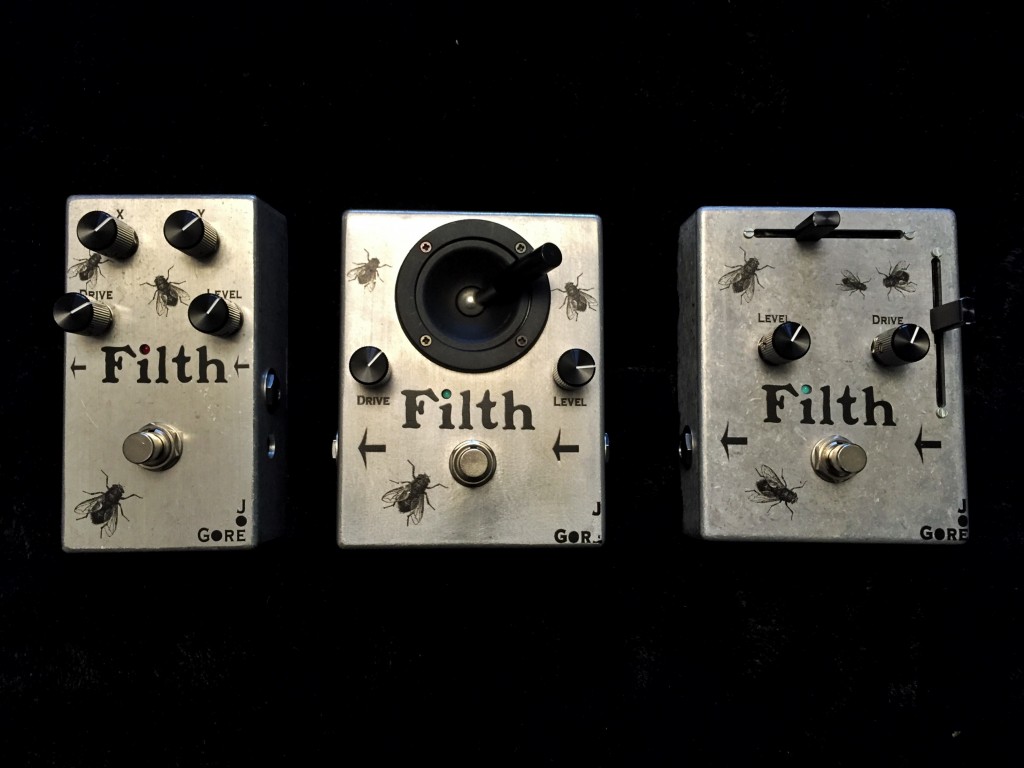
Filth’s sound hasn’t changed since I concocted the circuit on breadboard a few years ago. but the interface has gone through many iterations. It kept changing even after I sent schematics and prototypes to Tony Lott at Cusack Music (my manufacturer). Here’s a pic of three production prototypes:

Filth Fuzz
Three incarnations of Filth Fuzz (in order of appearance).

To dial in tones on Filth, you adjust two highly interactive pots (let’s call them x and y), which tweak the voltages going in and out of the transistors, providing many tone variations. The original version used two standard pots for these x/y controls. It worked okay, but the ergonomics weren’t ideal. I’ve found that the fastest way to refine sounds is to move both pots at once over a sustained note or chord, and it was just a bit awkward having to take both hands off the guitar to turn the controls simultaneously.

So I decided to employ a joystick, which lets you adjust x and y with one hand (and it looks pretty bitchin’). The ergonomics were great, and I thought we’d finalized the format.

But then I showed a joystick prototype at the L.A. Amp Show in October, and for the first time I had a chance to sit back and watch other guitarists interact with the device. Players seemed to have a blast with it, but I kept noticing how often a heavy stompbox foot would land perilously close to the joystick’s none-too-sturdy shaft.

Meanwhile, we discovered that the the only compatible joystick option cost about $25 per unit — enough to jack the retail cost way up. Also, it was tricky to replicate exact setting via the joystick, which would suck if, say, you were trying to get identical tones night after night on tour. (I knew that when I first opted for the joystick, but I’d figured the fun factor would more than compensate.)

Then Miko Mader, a clever guitarist who works for my distributor, M1, came up with the perfect solution: Why not use two sliders instead of pots? Tony at Cusack sourced the perfect part, and we prototyped a third version.

Bingo!The ergonomics were great (check out the demo video to see how quickly you can change sounds with one hand). You can mark exact settings with tape if you need to, easily repeating specific sounds. The two sliders are a fraction of the cost of a single joystick, so we can sell the pedal for far less. (We’re still nailing down the retail price as I write.) There’s no fragile shaft to break. And while I miss the goofy fun of the joystick, the sliders are still pretty darn entertaining. (So thanks, Miko, for your brilliant idea.)

I’m really stoked about this pedal. I hope you enjoy it as well.

Categories
Music

My Brushes with Bowie

My morning, like everyone’s, started with a devastating gut-punch: “David Bowie died.”

I can’t say I knew Bowie, but I was lucky enough to spend a few hours with him back in the ’90s. And he was every bit as cool as his music.

bow1I’d done a Guitar Player interview with Reeves Gabrels after the release of Tin Machine in 1989, and we’d stayed in touch. When Tin Machine II came out in September 1991, the band came to San Francisco to play at a music conference. My future wife Elise and I offered to show Reeves around the city. And Reeves invited David along, accompanied by an amiable bodyguard. We spent the afternoon tooling around town in my dumpy Mazda two-door hatchback with David perched astride the back-seat hump. (He insisted on taking the most uncomfortable seat.)

David was charming and unpretentious, yet freakishly charismatic. This is going to sound a bit woo-woo, but he just seemed to scintillate with some weird luminous energy. That probably sounds like the typical star-struck reaction of a lifelong fan. But I’ve met several members of the super-famous tribe over the years — Madonna, Springsteen, Ringo, Steve Jobs — and never encountered anything remotely like David’s spark.

Some stars have a gift for dimming their light as needed. For example, I used to see Robin Williams around my San Francisco neighborhood back in the ’80s. He’d be walking down Haight St. close to the building fronts, slouching a bit with his hands in his coat pockets and his face downcast. You wouldn’t notice him till the instant he slinked past. David was the opposite: When he’d round a street corner, it was as if everyone on the block instantly felt the energy shift. It was uncanny.
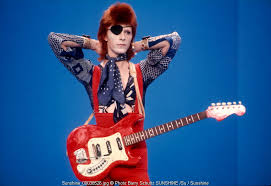
UnknownDavid and Reeves wanted to get piercings. First we grabbed lunch in Japantown (David had pork katsu, and treated everyone. His credit card was in his real name: David Jones.) Then we took them to the Gauntlet, SF’s premier piercing parlor at the time. It was David’s first piercing. He told us that he and his wife-to-be Iman were both getting simple single-ear piercings. It was an old sailor’s tradition, he said: The departing seaman and his love who stayed behind would get matching piercings as a symbol they’d be reunited some day.

David confessed to being a bit scared. As we scaled the stairway to the second floor, he jokingly clutched the bannister as if hauling himself up against the wishes of his legs. Naturally, the guy behind the counter recognized him within milliseconds. He was too hip to make a fuss, but you could literally see his eyes widen. After the guys got their piercings, the wide-eyed dude explained the maintenance procedure, recommending that David rotate the stud to keep the hole from scabbing over. David initially misunderstood and thought he had to remove the stud from his ear. “No,” Piercing Guy explained. “Leave it in there and just rock it.” He paused for two comically perfect seconds. “You know how to do that.”

We drove up and down the city’s hills, climbing out at viewpoints and talking San Francisco lore. David was easy to chat with. Unlike many of the super-famous, he’d actually listen to what you’d say and would usually respond with something fascinating. At the same time, it was exhausting. I felt like 33% of my mind was on the words. Another third was studying his eyes with their famously mismatched pupils. And everything else was OHMYGODI’MTALKINGTODAVIDBOWIE.

Everywhere we went, shy fans would approach David, thanking him or seeking autographs. Without exception, David would pause what he was doing, take a moment to chat, and humbly thank them. It was like a master class on the right way to be a rock star. What a gentleman!

David-BowieBut the gentlemanly feat that most floored me was purely physical. By that point, Elise insisted that David, the out-of-towner, sit up front while she sat on the hump. When we got out to enjoy some view, David helped her out of the rear seat. It wasn’t just extending a hand — it was a deft and complex balletic gesture, as if levitating her out of the car, bowing slightly, and ushering her on her way. I can’t quite describe the impossibly graceful maneuver, and I couldn’t begin to replicate it. It was like something a 17th-century French courtier might do.

Our last stop was a funky hat shop in North Beach. I jokingly urged David to try on an orange plastic pith helmet with a Grateful Dead sticker front and center. Instead, he asked to see a green felt fedora. “How does this look?” he asked, turning and striking a smoky 1940s film star pose. Elise and I swear we felt an electrical shock. We’d almost relaxed by that point, and suddenly David Bowie was standing there! (And yes, he bought the hat.)

Later, back home, we were exhausted. Elise theorized that there’s something vampiric about that sort of charisma. David didn’t just emanate energy — he seemed to soak it up it from those around him. Yeah, woo-woo again. But that’s how it felt.

My second encounter was in 1995, when I flew to NYC to interview Reeves and David separately and together for a Guitar Player cover story. I got to sit in on a rehearsal, where David was calm, kind, and focused with his band. We also went to a Rosie O’Donnell Show taping where the group played live at some decidedly un-rock n’ roll morning hour. Again, David was the very picture of modesty and graciousness.

My solo interview with David was as fascinating as you’d imagine. The focus, of course, was guitar playing. He had compelling things to say about his great accompanists: Mick, Earl, Carlos, Robert, Stevie Ray, Adrian, and, of course, Reeves. But we also spent a lot of time talking about David’s own underrated playing. Did you know he was the sole guitarist on the Diamond Dogs album? And have you listened to that record lately? Those grinding, clanking guitars are like Sonic Youth 15 years ahead of schedule. And that’s David playing the immortal riff from “Rebel Rebel.” He said it came to him in a flash, and when it did, he looked up at the sky and thanked God.

2001-07TotalGuitar-BowiewithEccleshall12-stringAt one point David made an arch comment about a then-huge band he’d shared a flight with — something like, “They were nice enough kids, and I’m told they’re quite popular.” Back in my hotel room after the interview, the phone rang. “Oh, one thing,” said David. “Would you be so kind as to leave that comment out of the story? It wasn’t a nice thing to say, and I wouldn’t want to hurt anyone’s feelings.” I did as asked.

I almost had a third encounter later that year when I was touring with PJ Harvey. David contacted Polly, asking her to duet with him and his band on “The Man Who Stole the World” for some TV or award show. Polly being Polly, she said she’d only do it if she could use her own band, and we even rehearsed a dirge-like version of the tune. (Without David, of course.) In the end David nixed the idea, opting to perform his song with the musicians of his choice.

I could write reams about David’s music from the perspective of a naïve young fan (I’m old enough to have had Hunky Dory on my radar when it was new), as an aspiring music student during his Berlin era, and from the jaded perspective of a middle-aged music journalist. I probably will at some point. But now I’m just feeling grief for our collective loss, and gratitude for my brushes with Bowie — and getting to spend some time with that remarkable gentleman genius.
Categories
Technique

Mastur Class!

Happy 2016! I hope everyone’s holidays were epic, and that you got lots of good stuff.

There’s no better way to ring in the new year than to highlight the … um … peculiar culture that somehow got attached to our instrument. You can’t make this shit up.

Screenshot 2016-01-05 18.14.07

Hard to believe, but this mastur class is totally real — at least in the mind of its creator. From the master:

Only a master guitarist and master guitar teacher understand both mastery of these concepts and how to break down complex and advanced ideas into easy-to-understand lessons that you can begin to learn and use right away in your own guitar playing.

I’ve been asked to teach on this topic by students again and again over the years. So I decided to create a 4-part master class video series. In fact, people travelled from all over the world, with great anticipation, to be part of this master class while it was being filmed.

Does it really work? It sure does! 🙂 When I filmed the master class, I called up several volunteers (all students of mine) to come forward and try the concepts I shared with everyone. And, as you will see for yourself on these videos, whenever any of these students implemented these specialized concepts, every woman in the room was not only paying complete attention, but all were smiling constantly. We could all see the effect it was having directly on them!

But don’t worry, this is not a bunch of childish obscene gimmicks or noises that you make with your guitar. This is about REAL guitar playing mastery! In other words, you won’t get slapped in the face when you play this way for women… but they’ll definitely feel what you are expressing in a good way!

This, apparently, is the sort of music that does the trick.

Categories
Gigs Music Pickups Recording

Guitar Mag Gossip: Personal and Practical

Screenshot 2015-11-02 12.42.23

I’d like to call out several items of interest in the November issue or Premier Guitar. The first one is personal: As head honcho Shawn Hammond mentions in his monthly editor’s letter, I’m changing roles at the magazine. After two years as a part-time senior editor, I’m going part-part-time as a contributing editor.

It was a tough call for me — it was a fun gig working with awesome people on subjects I love. But I’ve felt an increasing need to dedicate more time to my own projects: playing, recording, writing, developing gear, and trying to make my tonefiend.com blog and YouTube channel seem a bit livelier than something you’d encounter at Urban Ghosts. (It’s one of my favorite websites, but not the attitude I’m aiming for here.)

If you’ve enjoyed the articles I’ve contributed to PG, well, first of all, thanks! And second, note that I’ll actually be contributing more columns and reviews than before. That may sound contrary to the laws of physics, but it’s possible because I will no longer be editing material by other writers. (I’d been processing an average of 35 stories per month in addition to my bylined pieces.) Picking up the slack will be new hire Ted Drozdowski, a fine writer and player, a lovely guy, and one of the music journalists I looked up to when I got into the guitar mag racket decades ago. (Ted was part of the now-legendary Musician magazine of the ’80s and ’90s.) Meanwhile, I’ll be contributing my Recording Guitarist column and at least three major gear reviews per issue.

Also in the issue are several tech-oriented pieces that I found particularly interesting. My old pal Frank Falbo — a leading pickup designer and master luthier — contributed a great piece on pot and capacitor substitutions. More than anything I’ve read, Frank’s article nails down exactly what changes to expect when swapping out part values, documented via audio files.

For me, the most fascinating part is how varying tone-pot values change your guitar’s tone, even when the tone knob is wide-open. Yeah, a lot of us would expect some change, because pots of varying resistances exert different loads on your pickups. But as far as I know, no one has ever nailed down the exact differences the way Frank has.

Others generalize. Frank Falbo nails it down.

Spoiler alert: The differences are massive — it’s a far bigger deal than I’d always assumed. Check out Frank’s first set of sound clips and prepare to be impressed.

It’s not a new idea that you can shift the overall tone of a guitar “bright-ward” or “dark-ward” by swapping pots, but Frank makes explicit how dramatic such changes can be, and what to expect from the likeliest substitutions.

I also learned much from two articles I wrote. The first is a shootout between five sets of ultra-vintage-style Strat replacement pickups, featuring models by Amalfitano, Fender, Klein, Manlius, and Mojotone. (Spoiler alert #2: They all sound pretty great, though the Kleins and Mojotones were my personal faves.)

I only realized after evaluating tones that the two sets I loved most don’t deploy a hotter pickup in the bridge position, while the other three do. (I don’t mean some blazing-hot bridge pickup, but one just a tasteful tad louder than the others, an approach many Strat players seem to love.) In the Klein and Mojotone sets, the middle pickup is loudest. Food for thought.

There are good reasons why few guitar mags run serious pickups reviews, and almost never compare models directly: It’s labor-intensive, and it’s damned hard to establish a level playing field. Here, I tried to remove as many variables as possible, installing all the pickups in the same test guitar, scrupulously measuring everything from pickup height to mic position, and laboring mightily to create identical demo performances for each set. My favorite part appears on the final page of the article, where you can directly compare each pickup from each manufacturer side-by-side.

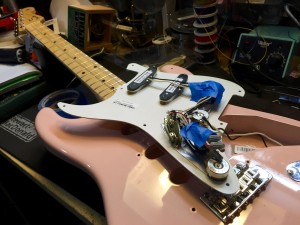
This poor pink Strat got one hell of a workout.

Finally, you might find interesting the audio clips in my latest Recording Guitarist column. It’s about is direct recording, a topic I’ve been covering since this blog began. I got cool sounds using a JHS Colour Box (a dumbed-down Neve channel in stompbox form) and especially with the Neve preamp simulations in the latest Universal Audio software. I’m hardly the first to point this out, but wow! Some recent plug-ins are so stupefyingly realistic that they can mimic analog gear pushed to extremes — a longstanding weak link in faux-analog plug-ins. I found it easy to create cool and compelling sounds without amps or amp simulators. Let me know what you think.

Okay, now I’m nodding off from jet lag. I just returned from a two-week trip to Italy, which generated some interesting musical thoughts and discoveries that I’ll share here soon. 🙂

Categories
Pickups

What’s Your Favorite Note?

No, I don’t mean like, “What’s better: B-flat or F-sharp?” Rather, is there a single note from a great recording or performance that haunts your dreams?

Here’s what go me on the topic: One of my Premier Guitar colleagues, Gary Ciocci, recently turned me on to El Twanguero (aka Diego Garcia), a brilliant Spanish-born, Argentina-based electric guitarist who’s created a head-spinning fusion of classic Latin jazz and rockabilly guitar. The only thing I don’t worship about the great Afro-Caribbean music of the 1950s and ’60s is the fact that it rarely includes guitar. But in Garcia’s retro fantasia, it’s as if the great Cuban and Puerto Rican mambo kings had migrated to Memphis instead of settling in NYC.

¡Bien tocado, señor!
Diego “El Twanguero” Garcia: ¡Bien tocado, señor!

When I explored Garcia’s YouTube channel, I immediately clicked on his version of “Cherry Pink and Apple Blossom White,” a Perez Prado classic that topped the charts in 1955. (You probably know the tune even if you don’t recognize the title — it’s been in a zillion movie soundtracks.) I was eager to hear how Garcia would interpret the famous trumpet slur — perhaps the booziest single note ever recorded. (Yes, theory sticklers — I’m using the word “note” to mean a single articulated note, even when it spans multiple pitches over its duration.)

The tipsy note appears right at the top — it’s the fourth pitch in the trumpet melody. But it gets boozier and woozier with each repetition, and by its dead-drunk appearance at 2’27”, it’s amazing anyone’s still standing up.

Okay, try to convince me that it isn’t the sleaziest note ever! (Just for fun, here’s a live performance, where you can see what Prado looks like when emitting his signature grunt.)

How the hell would you render that on guitar without period-inappropriate distortion and locking tremolo? Take it away, Sr. Garcia!

Love it! ¡Bien tocado, Señor!

That got me thinking about other favorite notes. My #1 choice was easy — it comes at the end of this post. But two others also sprang to mind.

George Harrison’s “It’s All Too Much” used to be considered one of the Beatles’ least important tracks, though it seems to have been critically rehabilitated over of the course of the last few psychedelic revivals. It was cut in 1967 between the recording and release of Sgt. Pepper, just when the Beatles were discovering LSD. (It shows). But it wasn’t issued until 1969, when it appeared as a throwaway on the Yellow Submarine soundtrack — the first album I ever purchased with my own money. (And I’ve never recovered from the horror of discovering that side B features no Beatles material — just George Martin’s twee orchestral soundtrack.) But that blast of sustained feedback carved its way into my consciousness.

The experts say George played it, though I doubt anyone present was coherent enough to recall. I’m not saying it ain’t George, though I can’t help noting that whenever you investigate a particularly ferocious bit of Beatles guitar work, the perpetrator always seems to be Paul. (Examples: “Helter Skelter” and the solos on “Taxman” and “Good Morning.”) I dunno — maybe acid unleashed Harrison’s inner beast.

Another note that’s possessed me for decades is from Miles Davis’s heartbreaking take on Rogers and Hart’s “It Never Entered My Mind.” (From Workin’ — the first jazz album I bought with my own cash, at age 14.) Man, you could write a dissertation on the first eight bars of Miles’ solo, and someone probably has. Even though the notes are few and far between, I dare you to try playing along, matching the trumpet phrasing. But the highlight for me is the sublimely out-of-tune note in the fifth bar of the trumpet head. (It first appears at 0’33” in this clip.)

The performance is in A-flat, and the special note is a very flat E-flat — about halfway to D-natural. Man, how does something so wrong feel so … not just right, but transcendent?

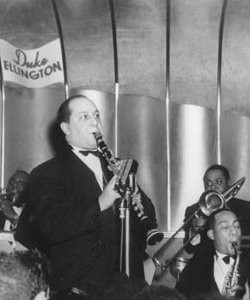
That was my favorite note for many years, until I became a born-again Ellingtonian. Friend/genius Stephen Yerkey turned me on to Ellington’s 1938 remake of his own “Black and Tan Fantasy,” whose original 1927 version is universally regarded as one of the most important early jazz discs. But the 1938 remake is equally brilliant. Duke’s band was at or near the height of its powers. The orchestration is sublime. The piano work is radical. Each solo is a jewel. And then there’s THE NOTE.

Now, there’s nothing I find more musically distasteful than a cheesy, star-searchin’ vocalist wowing the crowd with a long sustained note. I hate it just as much when operatic singers do it (as did many of the great opera composers). And using the national anthem at ball games as a pretext is just plain nauseating.

Did Barney Bigard play the greatest note ever?

Yes, THE NOTE is impossibly long and difficult. But there’s more here than sheer virtuosity. The painfully slow glissando literally makes you dizzy, as if the world were tilting off-axis. (It’s more psychoactive than the Beatles on acid!) It exerts exquisite tension against the backing harmonies, and it lets Duke display his most Debussy-like side in his watery, chromatic piano accompaniment. And the dismount is astonishing: Another wind player would be gasping on the floor, but incomparable clarinetist Barney Bigard (also featured on the 1927 original) concludes with a soft, casual phrase, as if he had all the time and breath in the world. For me, this is the ultimate musical embodiment of “cool” in its most profound African diaspora sense.

Play it, Mr. Bigard! The miracle commences right after 1’15” (but please, treat yourself to the entire performance).

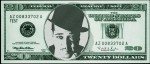
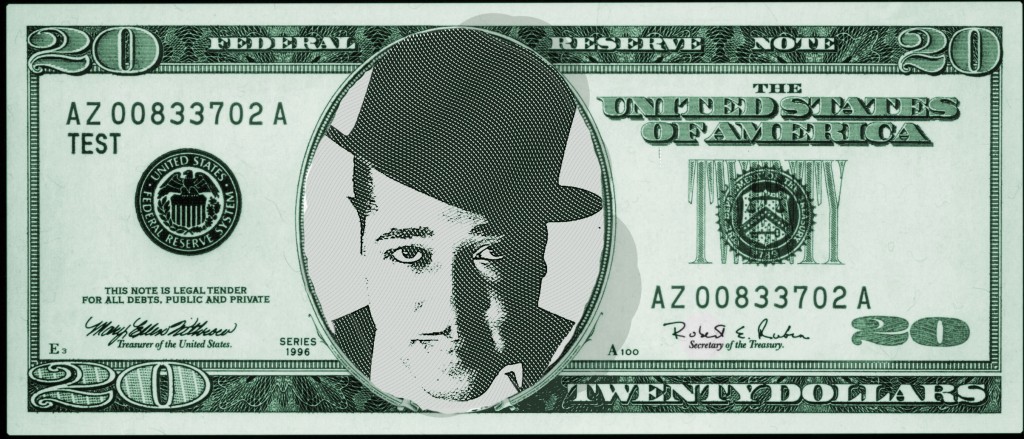
(I know I’ve said this about 50 times on this blog, but I repeat it whenever possible: In much of the civilized world — Europe in particular — the arts are considered precious, and musicians routinely appear on currency. If Americans gave a crap about culture, our greatest composer would grace the $20 bill, not genocidal Jackson. Though admittedly, there’s a strong case for Harriet Tubman.)

duke_dollars

Okay, enough of my yakkin’! What’s your favorite note?

Categories
Digital guitar Music Technique

Less-Boring Looping (“Pumped-Up Kicks” Cover)

For a while I’ve been playing this loop-based cover of Foster the People’s “Pumped-Up Kicks” at solo gigs and with my duo band, Mental 99. At risk of sounding like a pompous dick, I’ve annotated the performance, highlighting techniques I’ve found useful for making loop-based performances livelier and less predictable.

I’ve covered some of this ground before, particularly in this Premier Guitar looping-technique article. But here I call out the techniques mid-performance, and I’ve included a few new ones. I hope you find some of them useful.

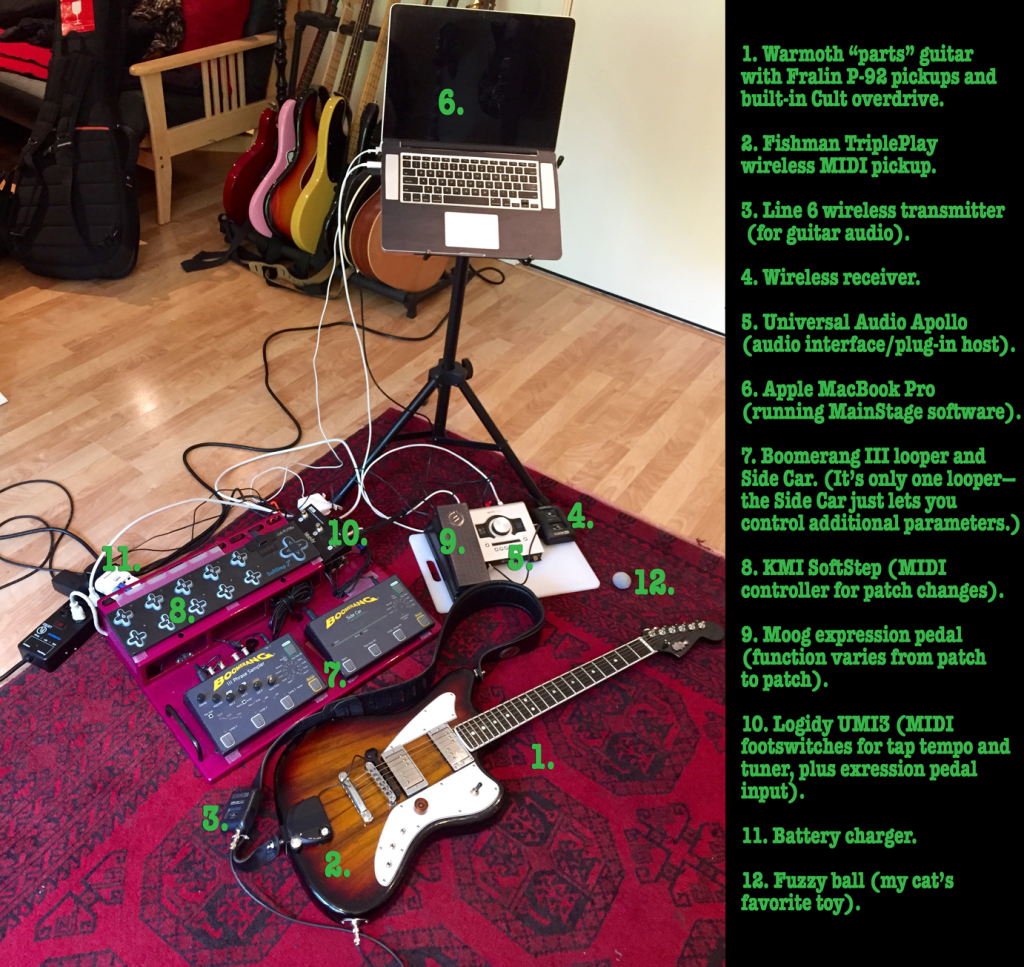
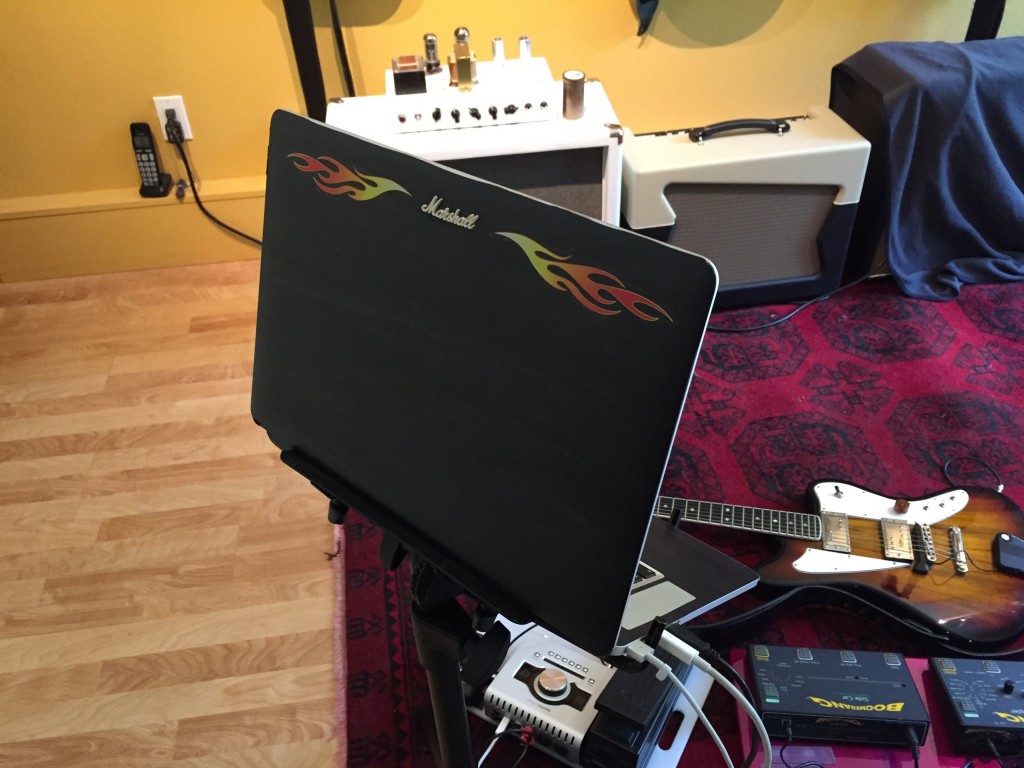
Likewise, I’ve already written about my live looping rig, but it’s changed a bit since then, and I’ve recently integrated a Universal Audio Apollo Twin interface (plus the stellar plug-ins it allows me to run). An updated overview:

Pedalboard-Diagram

The arrangement perform nicely, and I dig the individual components. But I dislike the system’s Rube Goldberg complexity—it’s a royal pain to set up and schlep. I’m always looking for ways to simply. (Other than, you know, just plugging the guitar into a frickin’ amp.) I’m open to suggestions for streamlining!

Black Mac
I love Apple products, but I hate having Macs onstage (mainly ’cause they’re so much better looking than me). Covering it in black wrap makes it less obtrusive. The Marshall logo is from one of those “toy” stacks (which, of course, can be far more than toys in the studio).
Categories
guitar

Those $24 Acoustic Strings

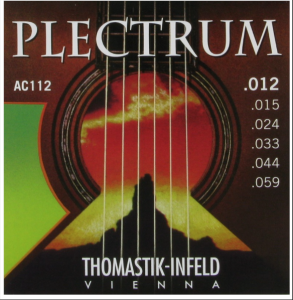
As if I weren’t already blowing enough money on arcane strings, I’ve got a new obsession: Thomastik-Infeld Plectrum series acoustic strings (which sell for $24 in the U.S.).

If you hang out here much, you’ve heard me bitch incessantly about acoustic strings. I hate the way most modern strings are all hyped treble zing and blaring volume, at the expense of deep, decisive fundamentals. With due respect to my vegetarian friends, too many strings are all sizzle and no steak.

Screenshot 2015-06-03 14.55.56

Yeah, bright strings can seem energizing in a cocaine-binge sort of way. But all that glassy presence gets fatiguing. Meanwhile, darker bass strings leave sonic space for the treble strings to shine. Even on my teensy-tiny Martin 0-17, these low strings sing in a warm baritone voice, not like some squeaky, poorly Auto-Tuned teen idol.

This pricy Austrian set features brass-coated steel 1st and 2nd strings, while the bass strings are bronze, but with both silk inlays and flexible steel cores. The flatwound 3rd, 4th, and 5th strings nix finger noise and minimize tone contrasts between wound and unwound strings. The polished roundwound 6th string adds a touch of focus to the lowest register, yet introduces no awkward contrasts on melodies played across multiple strings.

The set is low in both tension and volume relative to most U.S.-made strings. Even though the low E is a chunky .059, it has a soft, relaxed feel that makes me want to linger over notes, shaping them. The harmonic range is fantastic, the dynamic range even more so. They’re long-lasting too — this video was recorded three weeks and many playing hours after installing the set.

I’m hooked. Damn it.

(Hey, Mr. Tambourine Man — I don’t want you getting your nasty treble overtones all over my acoustic strings, no matter how frickin’ jingle-jangle the morning happens to be. Just back off, pendejo.)