Categories
Acoustic guitar

A High-Tech Plastic Guitar —
from Half a Century Ago

Plastic guitars are not a new idea!

In comments to a recent post on 3D-printed guitars, we were discussing the pros, cons, and general aesthetics of instruments molded from plastic. But this isn’t exactly a new idea.

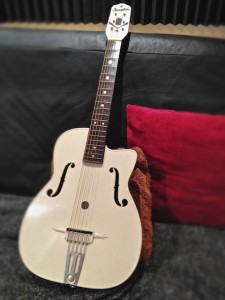
Back in the 1950s, luthier Mario Maccaferri conceived a line of plastic guitars and ukuleles. (This was many years after Maccaferri designed the D-hole Selmer guitars that will forever be associated with the Gypsy jazz of Django Reinhardt.) These plastic guitars were never very popular, and they’re not particularly valuable today.

I bought the one pictured here a few years ago at one of the music shops in London’s Denmark Street (I forget which one). I paid a couple of hundred bucks, and felt like a chump.

But I’ve grown attached to this guitar. It’s lovely to look at, and it plays great. The neck is substantial yet comfy, and it intonates well throughout its range. The tone isn’t warm, complex, or rich. But the Maccaferri has a cool, lo-fi character this sits well in a mix. I also like using it to double conventional acoustic guitars — the sharp, percussive tone adds a rough, aggressive edge.

Have a listen:

Categories
Acoustic guitar Technique

Welcome to Fingerstyle Boot Camp!

I’m 200 years old, but I can still kick your ass, punk!

UPDATE: I’m proud to announce that my fingerstyle video lesson based on the 200-year-old etudes of Mauro Giuliani has been selected to appear in the debut issue of Pure Guitar, a new digital guitar mag whose editorial staff includes my two music journo mentors : Tom Wheeler and Jas Obrecht. Also on board: jazz ace Wayne Goins, session superhero Tim Pierce, Nashville’s leading guitar tech, Joe Glaser, and other preeminent axe experts.

You’ll find my article here — but frankly, I recommend starting at the homepage of issue #1 and reading all the way through!

Congrats, guys, on the new mag. I’m psyched to be part of it. :beer:

Categories
Acoustic

Acoustic Strings: Bronze vs. Nickel

Like Talos the Giant from Jason & the Argonauts, most modern acoustic strings are made from bronze. Like him, they can be cruel and inflexible.

UPDATE: I’ve updated the audio examples to include 80/20 bronze strings, as detailed in this newer post.

Can I share my steel-string psychodrama?

I’m lucky enough to own many electric guitars, but I’ve played one steel-string acoustic almost exclusively for many years — a small-bodied Lowden with a tone that a very famous manufacturer of acoustic pickups once described as “like a f%^$ing cannon!” Its sizzling-bright treble and modest low-end make it a great recording instrument. (Engineers often boost highs and roll off lows when processing acoustic guitar, but this model is practically “pre-EQ’ed.”)

But it’s not an easy guitar to play. It seems to amplify string noise, flubbed notes, and all other playing imperfections. “This is a ‘tough love’ guitar,” muttered one singer/songwriter friend.

So when I bought a second steel-string recently, I wanted something warmer, softer, and more flattering, and I found it in a pretty old small-bodied Martin. The day I bought it, I restrung it with treble strings to record my recent Nashville high-strung demo, then popped on a set of the phosphor-bronze strings I’ve been using for years on the Lowden.

And I was seriously bummed out by the tone, as I lamented over at the forum.

The problem was, my sweet, soft antique suddenly sounded a hell of a lot like the Lowden, with blistering treble and cruel string noise. And I realized in a flash that a lot of the qualities I’d attributed to the Lowden were, in fact, a result of the modern, coated phosphor bronze string I’d been using. So I ordered some alternatives and made a few test recordings to demonstrate how dramatic the differences are.

Have a listen: