Tag: tone fiend

  • Attenuation Nation:Loud Sounds at Low Volume?

    Attenuation Nation:
    Loud Sounds at Low Volume?

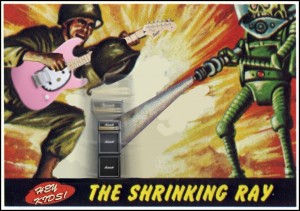
    skrinking-ray

    I just tried an interesting tone comparison, one I’ve never seen attempted. It concerns the search for loud amp sounds at low volumes.

    Have any of you ever experimented with speaker attenuators — the passive load boxes that reside between your amp output and speaker input, which let you crank the amp while maintaining a low level from the speaker?

    I’ve worked with one model before, a borrowed THD Hot Plate, and thought it performed well. I decided to purchase my own attenuator after several Premier Guitar reviews of large amps. As a small amp fan (not to mention an aging player with fragile ears), I wanted to minimize the aural assault of evaluating loud-ass amps.

    But first, I wanted to determine whether it’s legit to evaluate amps at attenuated levels. Does attenuation inevitably alter the tone? And if so, can you compensate for via recording software?

    Online opinions about attenuators range from “works like a charm!” to “totally killed my tone!” So I picked up a Swart Night Light and started recording and measuring. (I didn’t compare rival products. I just went with the Swart for its reasonable price, solid online reviews, and dual outputs for driving two cabs. I didn’t A/B it with a Hot Plate, though the results seem roughly similar.)

    I direct-recorded a brief guitar phrase using my black Les Paul with Bigsby and PAFs, and then ran it through a ReAmp to my early ’60s Tremoverb, a 35-watt Fender with two 6L6 power tubes. I dimed the volume and left the EQ flat. Tt was insanely loud in my small studio. After recording that, I tracked the same clip again using the attenuator at each of its three settings. The lowest attenuation setting reduced the sound from insanely loud to very loud. Medium attenuation reduced to somewhat loud. Strong attenuation produced a sound quiet enough to speak over. I recorded the results through Royer R-121 ribbon mic. I added a touch of plate reverb, but no compression or EQ. (Though I did normalize the files so they played back at similar levels.) In other words, you hear the same clip four times through a head whose settings never vary.

    So did the tone change? Have a listen:

    Do you hear what I hear?

    IMHO, none of the clips sound particularly great. (Most amps, including this one, don’t sound their best at 10.) But the unattenuated loud sound has some qualities the others examples lack. The attenuated clips have a little less low-mid impact, and the higher-register single notes that sound a bit thin and prickly even on the original sound even thinner and pricklier post-attenuation.

    Why, since the amp settings don’t change, and the performance are identical? Mics can respond differently at different sound pressure levels, and the relatively restrained speaker movement alters the result as well. Conclusion: the timbres of the attenuated signals are fairly faithful to the original, but there are slight spectral differences and a bit less body/fatness, especially on single notes.

    Then I introduced some additional wrinkles: (more…)
  • It’s Raining Germanium!

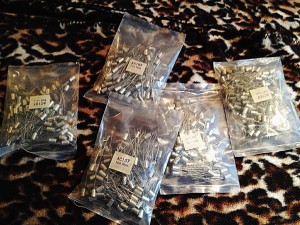
    I just bought 500 germanium transistors. Yes, as a matter of fact, I am insane. Why do you ask?
    I just bought 500 germanium transistors.
    (Yes, as a matter of fact, I am insane. Why do you ask?)

    UPDATE: My Dunlop Fuzz Face Mini review is live at Premier Guitar. Audio clips included!

    How and when did it get so frickin’ easy to procure great-sounding germanium transistors?

    I’ve been building stompboxes for four years or so. I used to consume article after article detailing the sheer horror of dealing with germanium. Sure, those old-school transistors sound great, I’d read, and they’re necessary for vintage distortion circuits. But they’re unstable. They’re expensive. They’re hard to find. You have to sort through dozens to find the few good ones. And once you do, you must spend countless hours matching and biasing them for optimal sound.

    I believed everything I read — until I finally admitted to myself that I seldom encountered any of those problems.

    (If you don’t know much about germanium transistors and why they’re cool, here’s my manifesto.)

    I used to buy germanium transistors from Small Bear and other parts sites, and was always happy with the results, even though I had to pay eight or ten bucks per transistor. (Small Bear even does the matching for you, offering sets of transistors suitable for various vintage fuzz circuits.) However, it was a little tough finding NPN (negative-ground) germanium transistors. In fact, Small Bear once rejected my order of a dozen or so NPNs because they were so scarce. (To his credit, Small Bear’s Steve Daniels explained that he restricted sales so that everyone who wanted to build a couple of great DIY fuzzes would have the opportunity.)

    The workaround is to build pesky positive-ground pedals, or jigger with the schematic in order to use PNP (positive-ground) transistors in negative-ground circuits. (This site’s Fiendmaster project is an example of the latter workaround.)

    Then some odd things happened: (more…)

  • The Jon Herington Interview

    Soloist, Sideman & Steely Dan’s Guitarist of Choice

    One unexpected pleasure of my recent Marianne Faithful mini-tour was getting to hear guitarist Jon Herington at the Kate Wolf Music Festival.

    Jon Herington with his Gibson ES-336. [Photo: Tony Kukulich.]
    Jon Herington with his Gibson ES-336. [Photo: Tony Kukulich.]

    Since 1999, Herington has been best known to audiences as Steely Dan’s touring and recording guitarist. He also performs with The Dukes of September Rhythm Review, an all-star band featuring Donald Fagen, Michael McDonald, and Boz Scaggs. And when he’s home in New York, he sings and plays with his trio, the Jon Herington Band, whose material blend bluesy raunch with sly, jazz-informed harmonies in a way that Steely Dan fans are likely to love. (Their latest release is Time on My Hands.) He’s also worked with many other jazz and pop luminaries (partial discography here).

    Angel-voiced Madeleine Peyroux was onstage when out van pulled up at the festival. She was performing a set of intimate chamber jazz, complete with strings and a whisper-quiet rhythm section. We couldn’t see the band, but man, could we hear them! When the guitarist took flight with a ravishingly lyrical slide solo — in standard tuning, no less — my bandmate Rob Burger and I turned to each other. “Who is that?” I mouthed. More lovely guitar work wafted from the stage: a fluent bop solo. Sublimely understated rhythm guitar work straight out of a 1940s session. “Seriously,” I muttered. “Who is that?”

    It was Jon, of course. As he left the stage, I plied him with as many questions as the quick set change permitted. How did he get those tones? How did he wring such a great slide sound from that Gibson ES-336 using conventional tuning and a standard setup? I was also curious about the demands of the Steely Dan gig, and not merely the challenge of performing a vast catalog of complex guitar parts for the notoriously demanding duo of Walter Becker and Donald Fagen. How, I wondered, would a player approach those oh-so-varied riffs and solos? How would a guitarist honor those beloved solos without making them sound canned?

    I didn’t have time to ask half those questions. But Jon, a charming, articulate fellow, agreed to an email interrogation upon his return home, even though he’s busy with Steely Dan rehearsals in advance of the band’s summer tour. (more…)

  • My Flatwound Addiction

    flatwound
    So smooth. So sexy.
    So frickin’ expensive!

    Hi. I’m Joe, and I’m a flatwound addict.

    It took me a long time admit it. “What wrong with a little recrational flatwound use?” I used to ask. “I can quit anytime I want.”

    Sure, I’d sometimes put flatwound strings on my Guild archtop. And sometimes on a bass. And yeah, I did that post about how flatwounds are the key to nailing that ’60s electric 12-string sound. And that other post on how flatwounds brought my reissue Fender Bass VI to life. And yeah, I may have happened to blurt out that I like using flatwounds on a MIDI guitar.

    But I wouldn’t use them on, you know, one of my normal guitars.

    But then I recorded that Bartók piece, using the above-mentioned Guid and Bass VI alongside two standard-tuned guitars with roundwounds. The piece has a lot of counterpoint — all these motifs bouncing between the instruments. And the more I listened, the more I realized that I liked the tone of the two flatwound guitars far more than that of the two roundwound guitars.

    And then I bottomed out. I put flats on four more guitars. It wasn’t just musically risky — it was economically catastrophic! And that’s what brought me here tonight.

    Funny thing about flatwounds: Everytime I pick up a guitar with flats, I react negatively to the dullness of the wound strings. Where’s the shimmer? Where’s the zing?

    But the more I listen, the more I get sucked in. Parts layer over each other more readily. Chords speak more clearly. Fuzz and distortion yield sweeter overtones. It’s easier to get a consistent sound from melodies spanning wound and unwound strings. And the feel? Smooth, sleek and sensual.

    Sigh. Maybe I’ll try and kick the habit again tomorrow.

  • NAMM 2013: The Analog Edition

    NAMM

    UPDATE: My apologies if this page failed to load properly before. After a much screaming and crying some careful troubleshooting, it seems to be working correctly now.

    I put together a little slideshow of some of the interesting things I saw last week at the 2013 NAMM show in Anaheim.

    I covered some of the coolest new digital gear in this post. This time, the focus is analog guitars, amps, and effects. Plus: an ultra-rare sighting of a true California celebrity!

  • The Best Music Notation Software for Guitarists?

    Since New Year resolutions expire at midnight, January 7th, I’m racing to realize my goal of finally becoming fluent with music notation software before the sands run out.

    A new way to feign productivity in cafes!

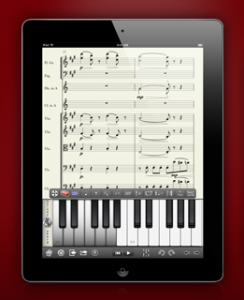
    I’d like to share some initial impressions about Notion. This isn’t a full-fledged product review — just a few thoughts about a half-dozen features I dig. (Most also apply to Notion’s sister app, Progression, which compiles all of Notion’s fretted-instrument tools, but omits the orchestral stuff. If you only plan to notate for guitar, the lower-priced Progression is probably all you need.)

    1. Appropriate complexity. Two programs, Sibelius and Finale, dominate the music notation field. Both are powerful, deep programs. Most notation pros use them because they’re packed with features essential to “music engraving” (the archaic and pretentious term for the process of preparing music for publication). (more…)

  • A Tale of Two Pedalboards

    A Tale of Two Pedalboards

    Is it just me, or do many guitarists these days find themselves alternating between separate analog and digital setups?

    I’m posting some pics of my current pedalboards (bearing in mind that, for reasons I’ll get into in a sec, my pedalboards only tend to stay “current” for a few days at a time). Both were assembled using store-bought housings, though I’ll talk a bit about total DIY boards as well.

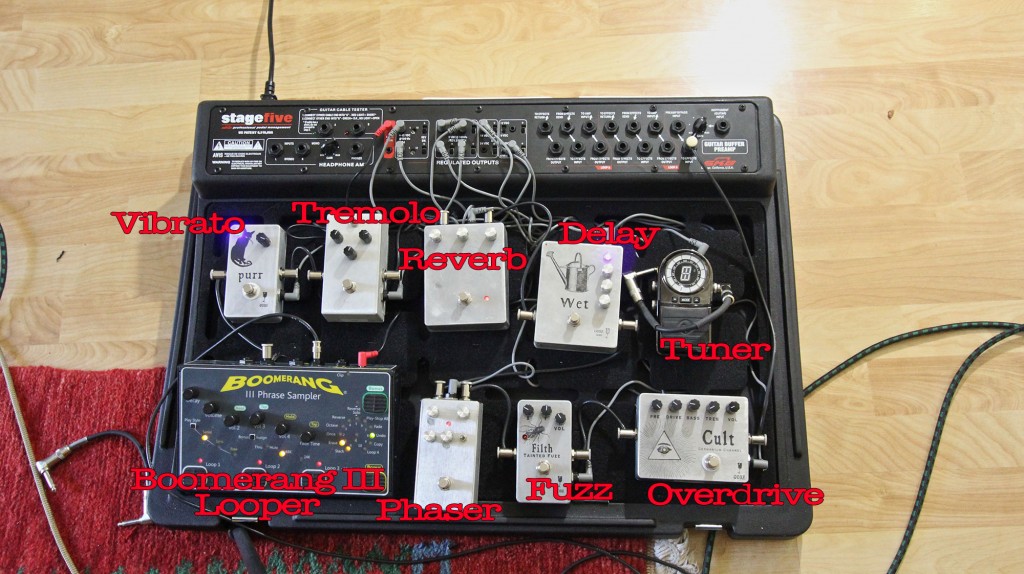
    First, the mostly analog setup (the exception, of course, is the digital Boomerang III looper).

    Joe Gore’s mostly analog pedalboard.

    The case is a newly purchased SKB Stage Five, a full-featured unit in a relatively rugged molded plastic case. These retail for a whopping $540, but you can find them heavily discounted. (I forget the exact price I paid for mine, but it was under $300.) It’s loaded with cool features, like dual effect loops, a built-in buffered preamp, and support for 9- through 24-volt DC power, plus 9V AC for those digital pedals like Line 6 modelers and many loopers. There are even trim pots on a few power jacks to simulate dying batteries. I’m less impressed by some of the fittings (like the cheapo plastic jacks), though I suppose they keep the weight down. And make no mistake: This thing is heavy!

    Verdict: Too early to tell, since I haven’t subjected it to road abuse, but I trust it enough to at least give it a go. I think I’d be a bit disappointed had I paid full pop, but it strikes me as a fair deal if you can find it at a 40+% discount.  (more…)

  • Hello Kitty Strat: Not for Pussies!

    Hello Kitty Strat: Not for Pussies!

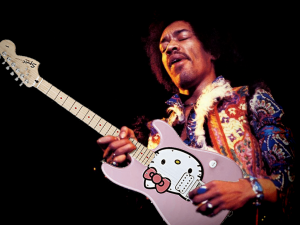
    Would this be anything less than awesome? I think not.

    As I gloated last week, Jane Wiedlin gave me her Hello Kitty Stratocaster  — the most bitchin’ $99 guitar ever conceived! I finally had a chance to destroy/customize it yesterday, in what will no doubt be the first of many desecrations/enhancements.

    I’d ordered one of those Synyster Gates Duncan Invaders with the pretty white pole pieces for the guitar, but just couldn’t wait to experiment, so I browsed through the ol’ pickup collection, and found a nice Duncan Phat Cat I’d used in a Les Paul experiment some months ago.

    I don’t generally recommend choosing pickups because of their names, but come on! Kitty + Cat? How could I resist?

    Turns out it was a lucky choice. I hadn’t planned to install a pickup that was actually lower in output than the stock humbucker, but it lets me get nicer clean sounds, and coughs up more than enough crunch when goosed with distortion. Speaking of which: the other custom feature is a built-in-distortion circuit activated via push-pull pot (I took lots of pics of the process for a DIY built-in-effects tutorial I’ll be posting very soon.)

    View the carnage in this little video. Thanks, Jane Weidlin! Sorry, Stevie Nicks!

    (more…)

  • The Pagey Project: Postscript

    The Pagey Project: Postscript

    Does this guitar LOOK like it has over a hundred settings?

    Just a quick follow-up on the Pagey project, which first recreated the original Jimmy Page wiring scheme, and then explored an even  more extreme version using Seymour Duncan Triple Shot Mounting Rings.

    Once I’d finished the project, I had to decide whether to keep the guitar heavily modded, or revert to something simpler. It probably won’t surprise you to hear I decided to keep the extreme Phase 2 wiring, with its added germanium overdrive.

    But as cool as the Duncan ’59 model pickups sounded, I wanted to revisit the Duncan Seth Lover pickups I’d previously had in the guitar. They’re bright — twangy, even — compared to the ’59s, and I like the midrange honk they add by virtue of being unpotted. (I’ve written about the pros and cons of potting here.)

    I’ve recorded an example of how the guitar sounds with the Seth Lovers. (You can’t make exact comparisons with the previous Pagey videos, since I used an amp for those, while the new examples were recorded through an amp simulator, though the “Seth” character still shines through.) I’ve included the clip in the post after/above this one, because it’s my first audio example using SoundCloud, and I wanted to say a few words about that.

    "There's GOLD in that thar pickup!"

    And call me shallow, but…I really dig the way my guitar looks with the Seth Lovers installed. Between the teensy switches on the mounting rings and the push/pull pots, you really have to look hard to tell the guitar is not merely non-stock — it’s a morbidly overdeveloped tweak machine.

    Funny — I’ve always found gold hardware a little bit tacky. But now I’m so enthusiastic about the look of gold that I feel like this guy at the right.

  • The Pagey Project, Phase 2:An INSANELY Versatile Les Paul

    The Pagey Project, Phase 2:
    An INSANELY Versatile Les Paul

    Just how many colors can you coax from one guitar?

    This post is about a guitar wiring scheme that only geeks and tweakers could love.

    I think you’ll dig it. :satansmoking:

    In Phase 1 of this project, I recreated the original Page wiring scheme using an ’82 Paul, a pair of Duncan ’59 model pickups, and four push-pull pots. The result was a great-sounding, almost absurdly versatile guitar, though the sheer number of options was downright bewildering.

    So naturally, the only way forward was to make the instrument even more bewildering by adding additional sonic options. This version offers all the sound of the Phase 1 model, and a buttload more. Several buttloads, actually — and I’m not talking about those skimpy metric buttloads!

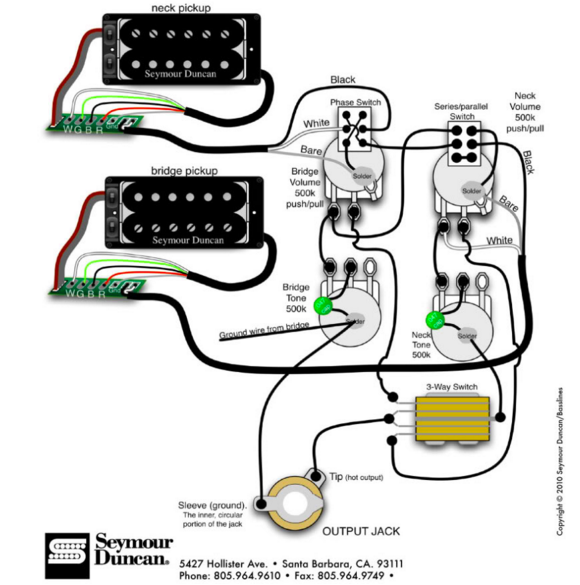
    I gutted all the Phase 1 electronics. (Man, that hurt!) Next, using the same pickups, I added a pair of Duncan Triple Shot Mounting Rings. These provide four settings per pickup: humbucker, inner coil split, outer coil split, and both coils in parallel. (The Phase 1 plan offers only one split-coil setting per pickups. While you can configure the two pickups in parallel, you can’t do so with the individual coils in each pickup like you can here in Phase 2.) Here’s the wiring diagram I worked from, which for some reason is no longer posted on the Duncan site.

    Since the Triple Shots add four new switches, the Phase 2 wiring requires only two push/pull pots. I wan’t about to let that real estate go unused! I installed a homemade germanium overdrive circuit (similar to the one we made in DIY Club) inside the guitar. My third push/pull pot activates it, and the fourth selects between two input caps, so I get a choice between a fat, Sabbath-style drive and a brighter, thinner Bluesbreakers-type tone.

    Check out the demo video:
    (more…)