Categories
Bass DIY Effects guitar Pickups Tonefiend DIY Club

Tonefiend DIY Club:
Join and or Die!

I hereby call to order the first meeting of the Tonefiend DIY Club!

Our mission: To attain tonal mastery over our guitars, amps, and effects with the least possible damage to our gear, bodies, homes, and pets. When the smoke has cleared (and all the smoke alarms have been reset) you’ll be able to install pickups, customize your guitar’s electronics, mod and build stompboxes, repair cables, and brag about your technical prowess while waiting in line to file your insurance claims.
Take it from one of the laziest and clumsiest people ever to brandish a soldering iron: Anyone can learn these skills. They’re fun and creative, and they’re one of the best ways to “own you tone,” if I may borrow the Seymour Duncan motto.

As promised, this material will be suitable for absolute beginners. (Though I hope more experienced guitar hackers join in, because we’ll really need your help!)

Read on for lists of what you’ll need to build our first three projects, plus recommended reading while waiting for your stuff to arrive.


Categories
DIY Effects

A Question for YOU, Dear Readers . . .


UPDATE, Friday, September 23th: Attend the first Tonefiend DIY Club meeting here.

____________

Can if  I make like a zombie and eat pick your collective brain?

One of my key goals for this blog is to promote do-it-yourself experimentation. It’s a topic I approach with the passion of a recent convert, largely due to the influence of the Maker Faire,  the unspeakably cool DIY event that has sparked a worldwide movement. (Witness this video I shot at a 2011 Maker Faire, in which hundreds of little kids learn to solder.)

My question: Would anyone be interested in joining a guitar electronics “makers club” suitable for absolute beginners? I’m sure that many of you already have more workbench skills than I will acquire in several lifetimes, but I have a hunch there are at least as many who are curious about making and modding, but just haven’t taken the leap of faith. Am I right?

Categories
Bass DIY Pickups

In Search of Primitive Bass

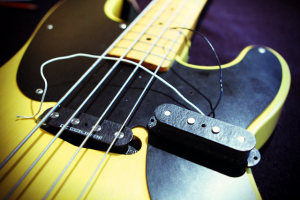
Compare the honkin' magnets on the installed Quarter Pound to those of the factory pickup.

The original P-Bass is a fascinating instrument. It’s wasn’t the first electric bass guitar—inventor and owner Paul Tutmarc claimed that title with the instruments he created and sold through his Seattle, Washington, music shop in the 1930s and ’40s. But the P-Bass, released in 1951, was the first electric bass that really mattered—the one that made the instrument a fixture of our musical landscape.

The P-Bass has evolved much over the course of its 60 years. In fact, its creators instigated the first big makeover back in 1957, when Fender abandoned the original Telecaster-inspired styling and single-coil pickup in favor of a sleeker, Strat-type look and a split-coil pickup wired in humbucking mode. (The earlier P-Bass style resurfaced in the late ’60s as the Telecaster Bass, and in Fender’s  ’51 P-Bass reissues.)

Categories
DIY guitar Pickups

Can You Love a Guitar You Hate? [Part 2]


The story so far: In Part 1 of this post, I snatched a pair of Seth Lover pickups in an attempt to improve my unlovable ’81 Les Paul. Will they transform the guitar from a pig to a prince? Or am I just casting pearls before swine?

I’m sharing some comparative recordings I made so you can judge for yourself. I distort, you decide!

Categories
DIY Effects

The Uglyface: World’s Nastiest Stompbox?

Makes you sound pretty as a picture!

When it comes to seriously messed-up guitar effects, few can rival the Uglyface. And, as they say on infomercials, “It’s not available in any stores!” In fact, as of this writing, the only way to unleash this particular brand of brutality is to build the box for yourself.

It’s based on one of dozens of great circuits created by Tim Escobedo, a stompbox genius who has shared his innovations with the world for free. His library of schematics has been dormant for years, but it’s archived here. Almost all these great-sounding designs display true originality, a rare commodity in pedaldom.

Categories
DIY guitar Pickups

Can You Love a Guitar You Hate? [Part 1]

Some guitars are hard to love . . .

Did you ever come across one of those magical guitars? The kind that just seems to cast everything you play in the best possible light? A guitar you never want to stop playing because it sounds so darn good?

Well, this story isn’t about that kind of guitar.

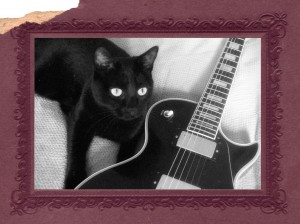
It’s about a singularly uninspiring 1981 Les Paul Custom I picked up a few years ago. Sonically and physically, the guitar delivered everything you think of when you think of your basic, post-vintage Paul, only less. So I call it the Less Paul.

Categories
DIY guitar

Cool Guitar Tool

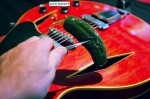
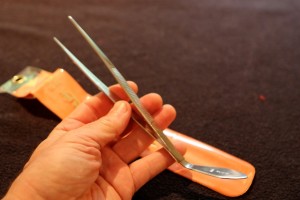
Long bonsai tweezers for all those hard-to-reach places.

I found it in my local Goth gardening emporium, tucked between the carnivorous plants and taxidermy mice: a long pair of tweezers with a spatula on one end, designed for manicuring bonsai plants. Voilá—the perfect tool for fiddling around inside a hollowbody guitar. You can use it wrangle pickup wires and grounding cables, coax the cables for an internal acoustic guitar mic through the end pin hole, or just collect any stray debris that may have accumulated inside your guitar. (I don’t know about you, but I’m always finding weird stuff in there . . . )

Categories
DIY guitar

Change Your Caps, Change the World!
(or at least your tone pot response)

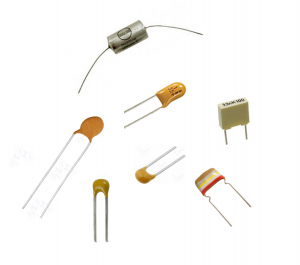
The capacitor value matters. But for guitar tone controls, the type of capacitor does not.

Many players know you can change the voicing of your tone pot by substituting capacitors of different values. I’ve seen many explanations online, though I’ve never come across side-by-side audio comparisons. This post is designed to fill the gap.

I’ll skip the “what’s a capacitor?” spiel. If you’re curious, check out this easy-to-understand article from Beavis Audio Research, one of the best (and funniest!) DIY sites.

For our immediate purposes, here’s all you really need to know: